Game of Thrones – Cersei Lannister

Cersei Lannister BLOGFINE ART PRINTS AVAILABLE HERE
– – –
MORE ILLUSTRATIONS ON DISPLAY HERE

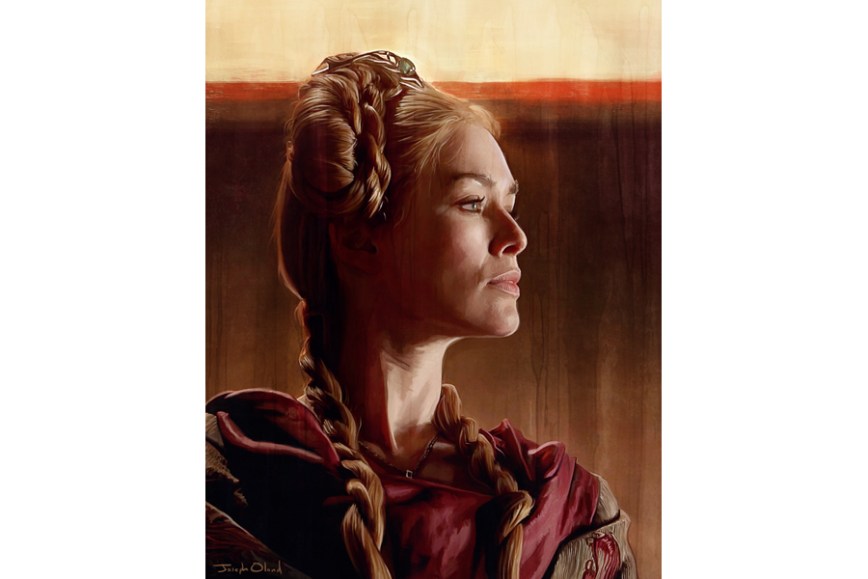
Volumes could be written in the analysis of Cersei Lannister, one of the most interesting and complex characters in Game of Thrones. From a haunting childhood prophecy to the conclusion of season six, we have seen her character travel into ever-colder and devious territory. With her three children deceased, the prophecy has proven itself to be accurate; as the series moves toward its conclusion, we will have to remind ourselves that the final part of the prophecy includes her being killed – strangled, in fact – by her younger brother.

The real question is whether Tyrion will be the one to end her life, or if it will be Jaime?

Cersei has won the throne after the destruction of the Sept of Baelor and the suicide of her last living son, King Tommen, but she has few allies in King’s Landing, and fewer still in the rest of Westeros. Not even The Mountain can protect her from the forces that will be descending upon King’s Landing as the narrative moves forward.

FINE ART PRINTS AVAILABLE HERE
– – –
SIGN UP FOR THE LENSEBENDER NEWSLETTER

Game of Thrones – Brienne of Tarth

Brienne01BLOGFINE ART PRINTS AVAILABLE HERE
– – –
MORE ILLUSTRATIONS ON DISPLAY HERE

“Brienne’s ugly, and pig-head stubborn. But she lacks the wits to be a liar, and she is loyal past the point of sense.”
~Jaime Lannister

The distinctly un-feminine Brienne of Tarth makes her first appearance in the second season of Game of Thrones, besting Loris Tyrell in a tourney and winning a seat in the kingsguard in the service of Renly Baratheon. Because of her stature (standing at six-foot three-inches), Brienne is considered extremely unattractive by Westerosi standards, and she is often mockingly referred to as “Brienne the Beauty.” But the tall, muscular woman with straw-colored hair is one of the most honorific characters in the entire series.

Like Eddard Stark, her sense of honor and duty often works against her interests.

Her character, much like Samwell Tarly’s, is a sympathetic one. As a child, she was met with mockery when attempting to dress and act like a proper lady. Once she turned to a career more suited to her talents as a warrior, she likewise received contempt and resentment because of her gender, despite her obvious and considerable skill. Having spent most of her life as an object of scorn and rejection, Brienne yearns for respect and acceptance, and she easily gives her love and loyalty to those few who treat her with courtesy.

Renly Baratheon, Catelyn Stark, and Jaime Lannister are the primary objects of Brienne’s friendship, love, and service.

FINE ART PRINTS AVAILABLE HERE
– – –
SIGN UP FOR THE LENSEBENDER NEWSLETTER

Game of Thrones – Samwell Tarly

Samwell blogFINE ART PRINTS AVAILABLE HERE
– – –
MORE ILLUSTRATIONS ON DISPLAY HERE

In a television series where no character is safe, the innocent and noble characters naturally become more valuable to us. When the threat of death is ubiquitous, the audience is more likely to become more emotionally invested. In years past, principle characters suffered from a certain invulnerability in television; no amount of danger they confront is insurmountable. When the audience knows, almost to a certainty, that no lasting harm with visit them, the drama isn’t as pronounced or effective as it could be. When we expect a happy ending, and when that expectation isn’t ever violated, storytelling becomes predictable – it becomes boring.

A number of television shows have begun to address this, but none with such success as Game of Thrones. Certainly, Dexter Morgan’s girlfriend was slain by the Trinity Killer in season four of that woefully mismanaged series. And years before that, Curtis “Lemonhead” Lemansky was killed off near the end of FX’s flagship program The Shield. So, from The Sopranos to The Shield and Game of Thrones to The Walking Dead, the killing of important or beloved characters isn’t entirely a brand new phenomenon. It began in earnest about fifteen years ago with cable television; network dramas and serialized storytelling doesn’t allow for the kind of jolt killing a main character provides. And I’m confident that there is a whole legal and contractual end to this discussion that I know absolutely nothing about (other than, of course, when a character is killed, the actor no long has a role to play and is, in one way or another, removed from payroll). Game of Thrones, unlike its predecessors, has managed to take things to the next level, obliterating audience expectations with a spectacle of violence and the elimination of beloved characters unlike anything else in television.

Unlike Dexter or The Shield – or any other of the modern television dramas with the story-telling courage to kill main characters – Game of Thrones has developed a reputation for mass slayings. The Red Wedding, The Battle of Blackwater, the wildfire incident at the Sept of Baelor, and the Battle of the Bastards – these didn’t see a single linchpin character die abruptly and needlessly. No, no – Instead we witnessed entire factions, whole families, entire congregations meeting their violent end.

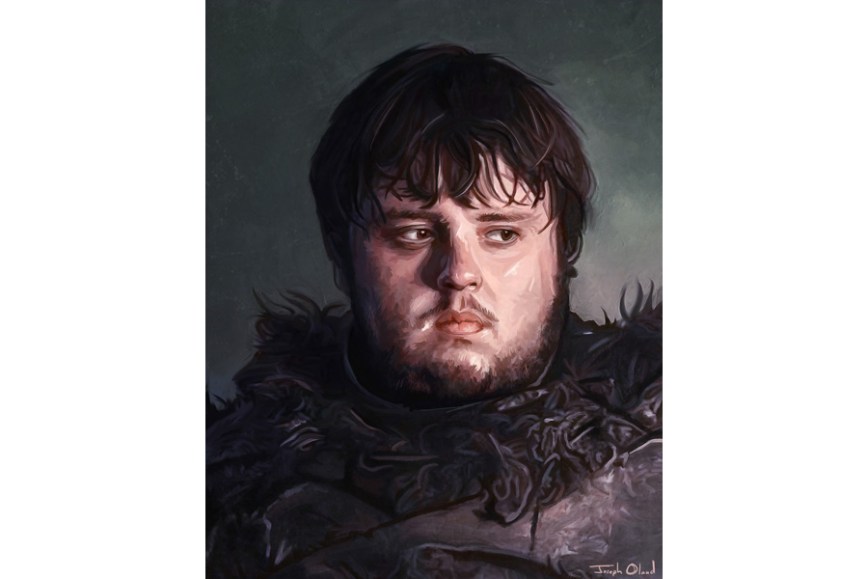
With the possibility for such narrative mayhem, audiences gravitate toward the honorable characters and worry about their fates. Jon Snow is certainly a fan favorite, but he still wields the sword, struggles with his conscience, and is conflicted about his upbringing and lineage. In later episodes, we even find sympathy for previously reviled characters like the incestuous Jaime Lannister, and even more sympathy for his dwarf brother Tyrion. Out of the entire ensemble, in my humblest of opinions, the most innocent character – perhaps aside from Hodor, whose mental incapacities automatically make him more sympathetic – is Samwell. A coward, he finds bravery when defending the innocent. He is not headstrong and he speaks true, never using his words or his sword to harm his brothers.

As I launch a new series of illustrated portraits – all of the characters in Game of Thrones – I decided to begin with the most likable and honorable of characters. So today, available at my online storefront, are prints of this illustration of Samwell Tarly of the Nights Watch, the most likable of the crows and the lover of books. I hope you enjoy these portraits as they become available.

FINE ART PRINTS AVAILABLE HERE
– – –
SIGN UP FOR THE LENSEBENDER NEWSLETTER


Cardinal (illustration)

Cardinal postFINE ART PRINTS AVAILABLE HERE

– – –

Life sometimes gets in the way, and I haven’t had the opportunity to really pour myself into a project recently. My uncle, who has fallen ill, has been on my mind. Family is in from out of town, and everybody is coming together to see this whole things through.

One of the things that has completely stuck with me, though, is my uncle telling me that one of his favorite things to do is sit outside in his backyard. He enjoys spending time listening to the birds. At first, I think people gave him grief about it; it’s odd to sit on a porch and stare up at the sky for hours at a time. But then, if your time on this earth might just be running out, I would also imagine that the sound of a gentle breeze coursing through the trees might sound that much more soothing. The sound of birds chirping might sound that much sweeter.

Everything changes when you realize you’re living on borrowed time. When you realize how little you may have left.

So, thinking about these things, I sat down yesterday and worked on this illustration. It’s based on a photograph I took last year. I’ve always had a tough time getting decent photographs of birds, and one afternoon this cardinal managed to just hang out, for a good long while, on the tree outside our living room window. I’m sure my girlfriend thought I was crazy, walking back and forth, to both ends of the house, out the front door, through to the back door, moving like a slow lumbering, stalking maniac with a gigantic camera lens clutched in his fists.

But every moment truly is a gift. Even when we obsessively try to snap a picture of a bird and curse under our breath when we can’t get our camera to focus properly. Every moment is a gift, because we only ever get to enjoy each moment once. Enjoy your day. Find an excuse to smile. It’s important.

FINE ART PRINTS AVAILABLE HERE
– – –
SIGN UP FOR THE LENSEBENDER NEWSLETTER

Glitch Art – It’s A Thing

Glitched August postFINE ART PRINTS AVAILABLE HERE

– – –

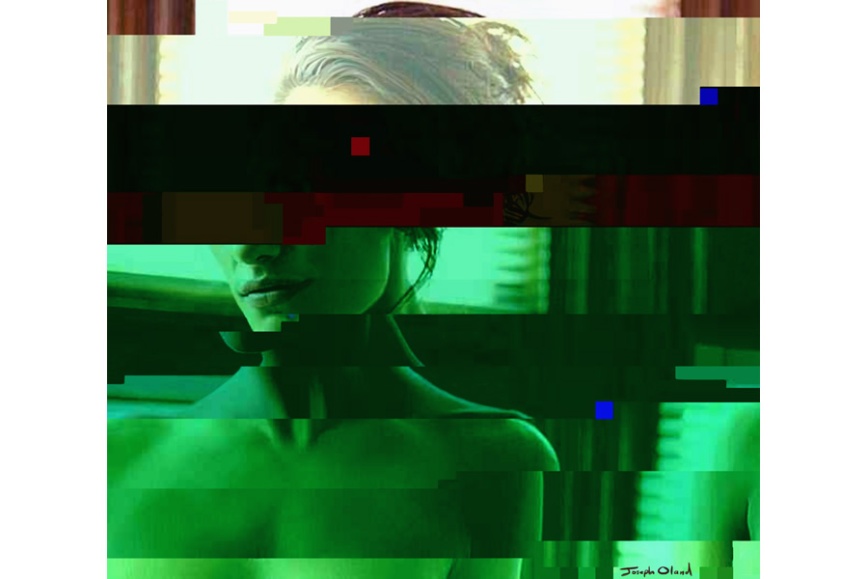
Glitch art. It baffles me that this isn’t something that managed to capture my attention sooner. In a lot of ways, it has, but I didn’t recognize it at the time. The album art from Nine Inch Nails, a decade ago, with the release of the album “With Teeth” represents this artform, I think. But then, in the age of the internet, there’s so much that slips through our fingers. I was recently listening to an interview with Whitney Moore – an obscure media personality and the star of such ‘high-end’ cinema as “Birdemic” (an incredibly low-budget slosh, self-aware and celebratory for it’s obscene garishness) that added fuel. When asked what her favorite art is, Miss Moore answered (reactively, and without a moments hesitation) with a simple, two word remark: Glitch Art.

And Whitney’s no loser. She’s a smart commentator on creative media. She is an insightful voice with a pretty face, and likely not taken seriously because of that pretty face (and her proclivity for making YouTube videos while less-than-sober). Nevertheless, I hadn’t heart the term. And ‘glitch-art’ and ‘data-moshing’ are not the most recognizable terms, at least not in the circles I travel. Naturally, I started sifting through the terminology. Isn’t Google a remarkable resource?

In a technical sense, a glitch is the unexpected result of a malfunction. The term was first recorded in 1962 during the American space program by a gentleman named John Glenn when he described problems they were having. He explained, “Literally, a glitch is a spike or change in voltage in an electric current.”

Data-moshing, which I would suppose is the current way of saying “intentional glitching,” is a relatively new term. We have examples of “circuit bending” in audio recording, and I think that “data-moshing” is the commensurate term (in light of audio-engineers) to image-manipulation. What’s appealing about the practice is that the effects are unpredictable and randomized. The artist is present, but his (or her) intentions are violated by the practice itself. Accidents are acceptable, invited, and celebrated.

There are a variety of ways to “break” encoded visual data. Artists have taken scripted data – text documents of encoded pictures – and fed them into audio engineering programs in order to “listen” to their photographs. The reverse has been done, too. And one of the more popular experiments, it seems, is writing visual data – be they cell-phone pictures, digital photos, Microsoft Paint drawings – into the BitMap file format, opening the file in a text editor, and manipulating or deleting entire lines of code, just to see how these manipulations register when the data is opened back up with an imaging editor (like Photoshop) after being altered in a text-editor (like notebook or Wordpad).

Not all of these experiments yield anything worth looking at. Digitally breaking a document is a grab-bag, mixed-blessing practice. But sometimes something interesting happens. And it’s that unpredictable, random, unimagined result that artists like me crave. Being forced into reinterpreting a perfectly normal, easily understood image – it forces an entire aesthetic re-imagining. Most artists pre-visualize – which is to say that they have an idea of what they want, and then create it. But sometimes, I find, it’s valuable to have one’s vision completely savaged. The concept, tone, and nature of a piece can be altered entirely.

Sometimes for the better.

I imagine I will be pouring over code and tinkering with these scripts, over and over, hoping for a new and expressive result. Like I said, it’s a grab-bag. It’s random. But soft, banal imagery is given a second life when they’re broken. And I could spend hours, days, weeks, tinkering with the code to see what happens. Script-sculpting is my new favorite past-time. Won’t you join me?

FINE ART PRINTS AVAILABLE HERE
– – –
SIGN UP FOR THE LENSEBENDER NEWSLETTER
The Dream Figure

Dream Figure postFINE ART PRINTS AVAILABLE HERE

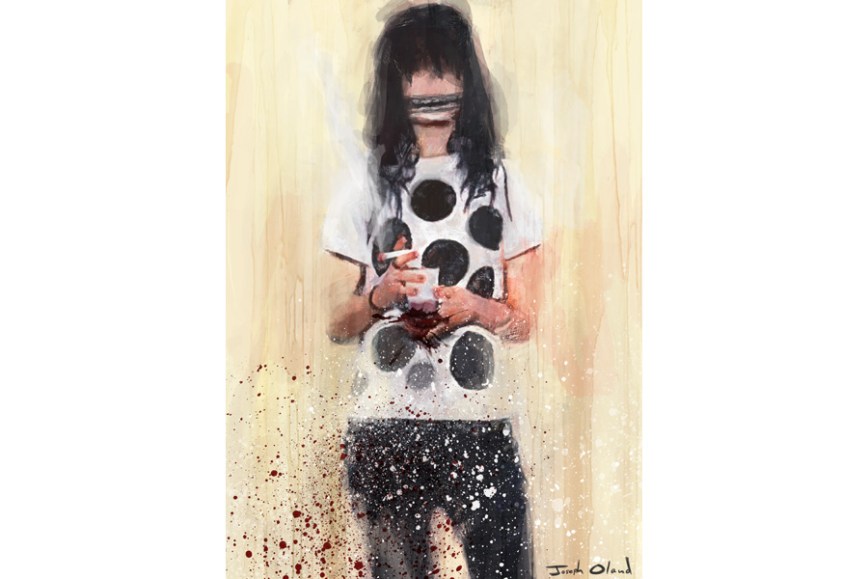
Irrationally peculiar dream figures – my loose, ‘armchair’ understanding of things is that most people don’t have recurring dreams, or even recurring themes or personalities in their dreams. It’s a popular trope in story-telling, which makes perfect sense – haunting dreams are a wonderful expression of foreshadowing, a device to inject a sense of inevitability, foreboding, or fate. The reality, of course, is far more banal. Those of us who encounter recurring dream figures ought not take too much from them; the general consensus in the psychological community is that they are completely happenstance, and may represent nothing more than a single event in one’s history – not even a particularly important event – that managed to get stored in our memory in such a way as to appear and reappear, like a skipping record.

This particular dream figure has been visiting me for the better part of a decade. I’m assuming she’s some remnant of my college days, which I spent at the University of Arizona. She reminds me of art school girls at house parties, smoking cigarettes in used clothes bought at Buffalo Exchange, a haven for hipster women looking to spend twice as much on a pair of pre-worn jeans than the original price-tag when they were brand new and not covered in holes.

This apparition – and she really feels like an apparition, an uninvited ghost that only I can see – is never aggressive, she never threatens me, never harms me. But I always recall feeling an extreme unease when she walks into the room. She usually walks around a corner, and it’s usually when I’m trying to leave and get outside. In most of my dreams, I turn around and nurse a drink, taking little sips, and make small-talk to the gaggle of faceless others around me, glancing occasionally to see if she’s still there.

She’s always blocking my path. And I spend my time hoping for a chance to scoot by and get outside.

Nothing bad ever happens. No gore. No evil. Just a faceless, toothed, unsettling creature.

I’ll let the psychoanalysts in the inter-webs analyze this. In the quiet of night, unable to sleep, I decided to scribble-out a picture from my dreams.

FINE ART PRINTS AVAILABLE HERE
– – –
SIGN UP FOR THE LENSEBENDER NEWSLETTER

Geometric Art, Color, and Heavy Metal

Mandala WP PostFINE ART PRINTS AVAILABLE HERE

Growing up I listened to a lot of Tool, a progressive metal band that some of you may be familiar with and some of you may not be familiar with. I still listen to my old albums. The percussionist, Danny Carey, heralded from a local community here in Kansas, giving us mid-western backwater hicks some prestige. I’ve spent my entire career as an artist trying to explain to people that the “fly-over” states are filled with creative artists and political malcontents, too.

Midway through their career, Tool began incorporating works form artist Alex Gray – anatomical cross-sections, repeating patterns, and other evocative images intended to illustrate the connection between body and spirit – into their albums. The images rely heavily on the symbolism of the third eye and chakra charts, but they also weave this content into renderings reminiscent of anatomy textbooks, esoteric symbols, and studies of celestial bodies. It’s really cool stuff.

At one point or another, after looking at all of that great art (and probably after watching Martin Scorsese’s film Kundun, and after attending a talk with the Dali Lama at the Tucson convention center), I really wanted to make a mandala. There are countless designs out there, but I’d never made one of my own and, frankly, I didn’t know the first thing about making a design like that. I’m pretty confident that I still, for the most part, still don’t. Nevertheless, I nabbed my metal ruler and protractor and took to making some of the most god-awful radial line-drawings the world has ever seen (except, of course, that the world never saw them – I threw ’em all away because, well, they were terrible).

I have, of late, taken the practice up again. It’s a great meditative practice. It’s complicated and simple at the same time, mathematical and symmetrical, but layered with compositional complexity. Today’s image is my first shot out of the gate – I know I can make more interesting images, but I’m very pleased to be back in the saddle and experimenting with these designs. I’m already working on others, which I will share once they’re done.

I’m “getting my zen on,” as an old friend from the San Rafael Valley would say. The repetition, the tedious nature of making pictures like this, open doorways in the mind. These compositions require a certain kind of concentration to make, but they’re also ordered, logical, straight-forward. The perfect kind of exercise for any creative personality who isn’t feeling any other specific drive; it’s a way of exercising the brain and being creative when one is feeling stifled, uninspired, or otherwise “blocked.”

The trick is to keep the pen moving. This is how I keep moving. I hope you like it.

FINE ART PRINTS AVAILABLE HERE
– – –
SIGN UP FOR THE LENSEBENDER NEWSLETTER

Breaking Bad – Say My Name

Say My Name postFINE ART PRINTS AVAILABLE HERE
– – –
MORE POSTS FROM THE GILLIGAN-VERSE

Many folks herald Breaking Bad as the greatest television show in the history of television. I wouldn’t go so far. It was successful in developing a narrative that rewarded its audience and grew along with its popularity. But if we’re going to be honest with ourselves, it’s a show that began slow. It certainly managed to enhance its narrative velocity throughout its five-season run, but there was an undeniable lull during the earliest episodes. Its biggest success rested in the show-runners – and creator Vince Gilligan – outlining how they wanted the story to end. The network had no opportunity to milk the show – keep it on life support while the numbers were good – until it fell into relative obscurity (think Dexter or True Blood).

Sure, we would all have gleefully sat through an additional three seasons of Walter White and Jesse Pinkman dodging bullets and escaping the guillotine, but a poorly-resolved narrative condemns a story to the realm of ‘the forgettable.’ We remember Breaking Bad because the story respected its audience. It was designed to be a complete story, not a money-maker – and that’s why it’s such a profoundly successful money-maker. The competition between ‘art’ and ‘commerce’ destroys most shows, most books, and a lot of popular art. Focus groups and ratings have a direct influence on the direction many of our stories go – seeking to please audiences rather than impact them.

Focus groups are as effective as the SAT’s in measuring success – which is to say, they don’t measure success. In many cases, they destroy it. Breaking Bad is one of the greatest examples of long-form story-telling specifically because it didn’t allow itself to be influenced by outside, disaffected parties. It took risks. It reminded audiences that creativity and ingenuity can allow a television show to achieve as much – if not more – than feature-length films. Breaking Bad inaugurated the wave of cinema-quality television we’re now experiencing.

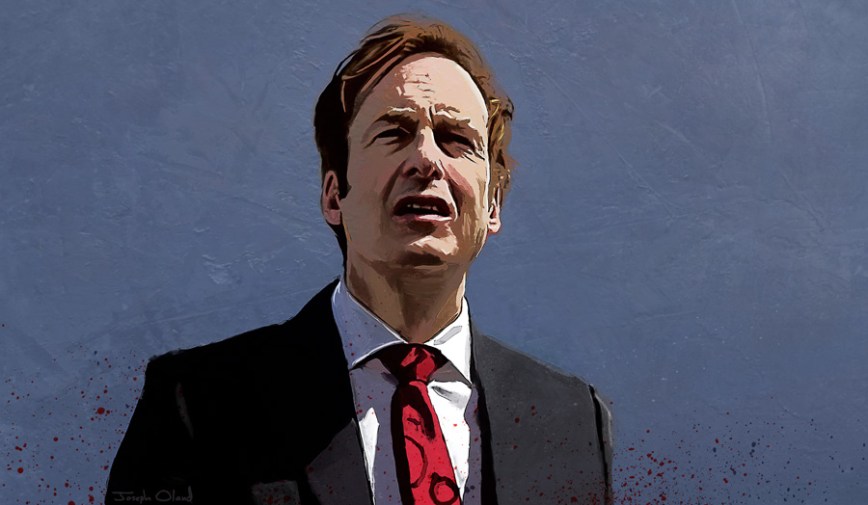
And hindsight is 20/20. If we can be genuinely objective, Better Call Saul is better at the job of character development and story-telling than Breaking Bad ever was. Artists – and the writers in their ranks – evolve. In Saul, nothing is taken for granted in it’s production. Breaking Bad, the early years, has the tainted film of “this might not be picked up for another season” written all over it. Better Call Saul is infinitely more confident in it’s story-telling – in a way that audiences have never seen. Sure, it could be canceled at any time, but it’s obvious that the writers know precisely where they’re going with their characters. They have to be, because half of these characters already exist in the Breaking Bad series.

With the ultimate fate of the principle characters an already-known quantity, the writers of Better Call Saul have been working on – and achieving – a heightened level of story-telling, the likes of which we have never, in the history of books, movies, or television, ever seen. It’s pretty damn cool.

Keep your eyes open. Look at the quality. And please: Say. My. Name.

FINE ART PRINTS AVAILABLE HERE
– – –
SIGN UP FOR THE LENSEBENDER NEWSLETTER

Another ‘Suicide Squad’ Trailer

Harley-Cakes postFINE ART PRINTS AVAILABLE HERE
– – –
OTHER POSTS ABOUT SUICIDE SQUAD

For all of the wailing about Batman V Superman, that movie is still a freight train that is on it’s way to hitting the one billion dollar mark. Sure, it was an expensive production and it has proved to be less profitable than Warner Brothers had hoped, but the movie’s still a success. The most vehement critics point to a longer-than-necessary run-time (clocking in at two and a half hours) and a darker-than-necessary tone. These are legitimate criticisms – Superman is supposed to be fun, and this film seemed overly-focused on dragging the Man Of Steel into ‘brooding Batman’ territory, and it simply didn’t work. The film is largely humorless, lacking the kind of heart that audiences had obviously hoped for.

The DC Cinematic Universe is not as well-oiled as Marvel, but the studio still has plenty of opportunity to course correct. The only concern is the very real possibility that they over-correct. For instance, a well-sourced rumor has begun to circulate the Warner is now re-shooting certain scenes from the upcoming Suicide Squad feature to make it more ‘light’ and ‘funny.’ These kinds of last-minutes changes do not augur well for the franchise. They aren’t ‘inspired’ changes. They’re ‘fearful’ changes. Hopefully this won’t spell disaster for what looks to be a pretty exciting ride.

The newest trailer dropped yesterday, and it’s fun as hell. Check it out HERE.

FINE ART PRINTS AVAILABLE HERE
– – –
SIGN UP FOR THE LENSEBENDER NEWSLETTER

Better Call Saul 2.09 – Nailed

Jimmy-Boy postFINE ART PRINTS AVAILABLE HERE
– – –
READ PREVIOUS SAUL POSTS HERE

“Nailed” is about right. The screws are tightening and Better Call Saul has breached the barrier between ‘procedural’ into ‘true drama.’ This is the episode that fans have been waiting for, after a laborious – and often frustratingly tedious and long-winded – build-up. Consider the final two episodes as one long story; we’ve only seen the first act. And the gun from the Regalo Helado opening from last week? Well, we all know what happens when you introduce a gun in the first act.

The ‘Cain and Abel’ story between Jimmy and Chuck is reaching it’s apex. The connection between Mike and the Salamanca cartel is cemented, but not resolved. The spindle is turning and the yarn isn’t complete. For today, I’ll be reserving a more in-depth review until the season climax next Monday.

Any predictions?

FINE ART PRINTS AVAILABLE HERE
– – –
SIGN UP FOR THE LENSEBENDER NEWSLETTER