The Walking Dead – Who Is Michonne?

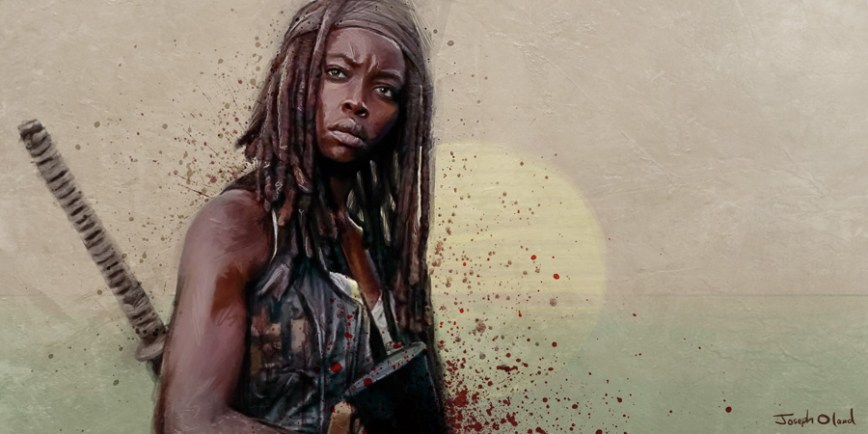
Michonne POST

Something’s always going to happen when resources are tight and survival is the game. With our stalwart knife-slinger, neo-samurai Michonne holds her cards close to the vest, which is part of her appeal. “The Walking Dead” has let her tragic back-story leak in, in slow deliberate drops. She is the ultimate stoic – even by Rick Grimes standards – laying in the prison doing crunches while discussing the group’s next move. She is the unsmiling guard above the gates to Alexandria. She is unattached, emotionless, and lethal.

Until recently.

She has had her moments, crying alone, caring for the wounded, considering the odds and calculating her risks. We appear to have entered into a new chapter, a new age of domestic bliss with Rick and Carl. But it isn’t going to last. Nothing ever does in “The Walking Dead.” Negan is out there, and the communities on the hill will add muscle to Alexandria, but Ezekiel’s tiger – spoilers – and bigger numbers won’t necessarily be enough.

The ‘next world’ is nascent. Michonne won’t be hanging up her sword anytime soon.
That’s a promise.

– – –

“”Everyone has a job and that job never stops. You work until you feel like your back is going to break and then you collapse and sleep like you’ve never slept before. And that’s only if things are going well, which almost never happens. We had some shit go down…it’s hard. There’s no time to think about what happened to you, or what you did. You just work.”

– – –

FINE ART PRINTS AVAILABLE HERE
– – –
SIGN UP FOR THE LENSEBENDER NEWSLETTER
 

February 25 – San Xavier

02-25 San Xavier post“Apply yourself both now and in the next life. Without effort, you cannot be prosperous. Though the land be good, You cannot have an abundant crop without cultivation.”

~Plato

– – –

FINE ART PRINTS AVAILABLE HERE

SIGN UP FOR THE LENSEBENDER NEWSLETTER

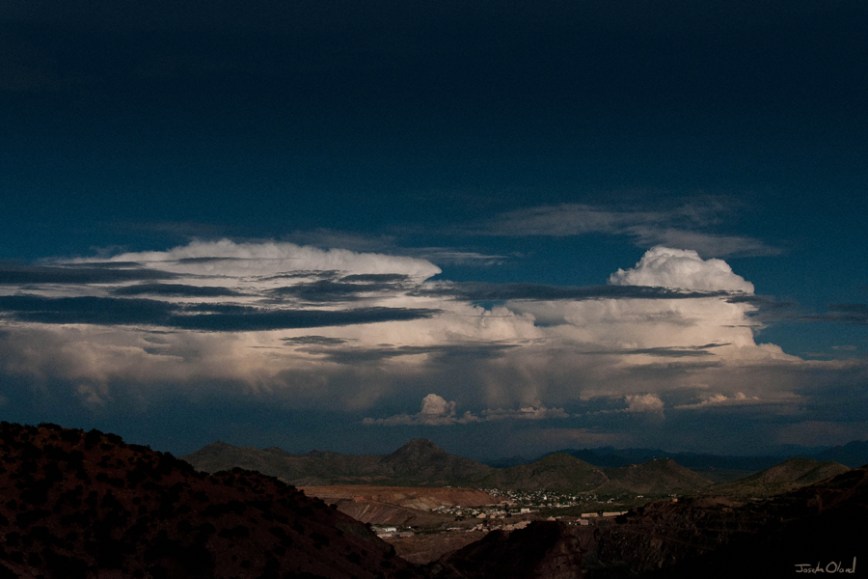
February 24 – The Mule Mountains

02-24 Bisbee post“Nature holds the key to our aesthetic, intellectual, cognitive and even spiritual satisfaction. As a single footstep will not make a path on the earth, so a single thought will not make a pathway in the mind. To make a deep physical path, we walk again and again. To make a deep mental path, we must think over and over the kind of thoughts we wish to dominate our lives.”

~Henry David Thoreau

– – –

FINE ART PRINTS AVAILABLE HERE
SIGN UP FOR THE LENSEBENDER NEWSLETTER
The Walking Dead – “The Next World”

Jesus Saves postJesus saves. Or does he?

After spending a painful amount of time on the lives of the Alexandrians – the first half of season six takes place over only a couple of days – we break with the comic book narrative and jump ahead two months. The comic spends time watching the community develop while Carl is bedridden, but we begin here with Carl upright and able-bodied, albeit with a certain lack of depth perception.

“The Walking Dead” hasn’t ever taken such a positive turn. We see domestic quibbles over who used the last of the toothpaste. We see clean-shaven faces and signs that the community has tethered it’s resources and established a new sense of unity. There’s a confidence in this new-found domesticity and cooperation. It’s something that viewers haven’t seen since Hershel’s farm. And even back then, there were serious problems.

It feels alien to have the show’s trademark ‘horror film’ violin music fade-in for the opening credits when nothing bad has actually happened. Quite the contrary, we’re actually left chuckling at Rick’s ultimate redneck honkytonk music as he and Daryl drive off in a plume of dust on a scavenging run.

Given how the story of “The Walking Dead” has unfolded, it’s unlikely that this newfound repose will last. The real question is, what terrible thing is going to happen to disrupt the peace?

Is Jesus going to be a savior? Doubtful. Fans of the comic book will be delighted that this mysterious new character has been introduced, and it’s the opinion of this writer that the nature of Jesus need not be prematurely revealed here.

One of the wonderful things about “The Walking Dead” is that the writers have gone to great lengths to change key plot points. This is likely an effort to keep the story relevant and prevent fans of the graphic novel from spoiling the television show. In the end, both formats have strengths and weaknesses, and the adaptation to the screen exploits every opportunity to remain it’s own distinct experience.

In the comic book, for instance, there isn’t even a Daryl Dixon character – he was written for the early episodes and was never intended to survive. He become such a beloved character so quickly, the decision was made to keep him in. Similarly, it’s Michonne who first encounters Jesus, at the gates of Alexandria, and not Rick and Daryl out on the road. And no, Michonne doesn’t share an intimate moment with Rick at all in the books. Chances are, the producers felt inclined to bend to the will of the fans, who have been more than vocal about their desire to see the two hard-core survivor-leaders, the two characters with the thickest skin, fall into bed together. It’s pleasantly disarming to see these two, hardened warriors both, actually smiling – a lot. In a world so broken, with characters who have endured as much tragedy as these two, it was something akin to relief to see them come together in one peaceful moment.

Will it last? Who is Jesus, and does he have anything to do with Negan and his band of highwaymen? It is true that he wasn’t carrying a weapon, and he didn’t attack Rick and Daryl. He might have stolen from them, but he didn’t hurt them. Hell, he even managed to save Daryl from a walker. Is he going to play a larger role in “the next world” he makes mention of? Are there really other communities out there that can be trusted? Only time will tell. The one thing we do know is that the show leaves us with more questions than answers, and it definitely keeps things interesting.

FINE ART PRINTS AVAILABLE HERE
SIGN UP FOR THE LENSEBENDER NEWSLETTER

– – –

Bonus factoids.

  1. Rick is no longer wearing his wedding ring.
  2. The comic book we see Carl reading in the woods is “Invincible,” another comic series penned by “Walking Dead” creator Robert Kirkman.
  3. You can see Glenn’s name scratched off the casualties list at the beginning of this episode.
  4. In the comics Jesus’ real name is Paul Monroe. It’s changed to Paul Rovia to avoid confusion with him being a member of Alexandria’s Monroe family.
  5. Rick shares a passionate kiss with Andrea, not Michonne, in the opening to ‘Volume 16: A Larger World’

February 23 – All

02-23 All post“Pictures, abstract symbols, materials, and colors are among the ingredients with which a designer or engineer works. To design is to discover relationships and to make arrangements and rearrangements among these ingredients.”

~Paul Rand

– – –

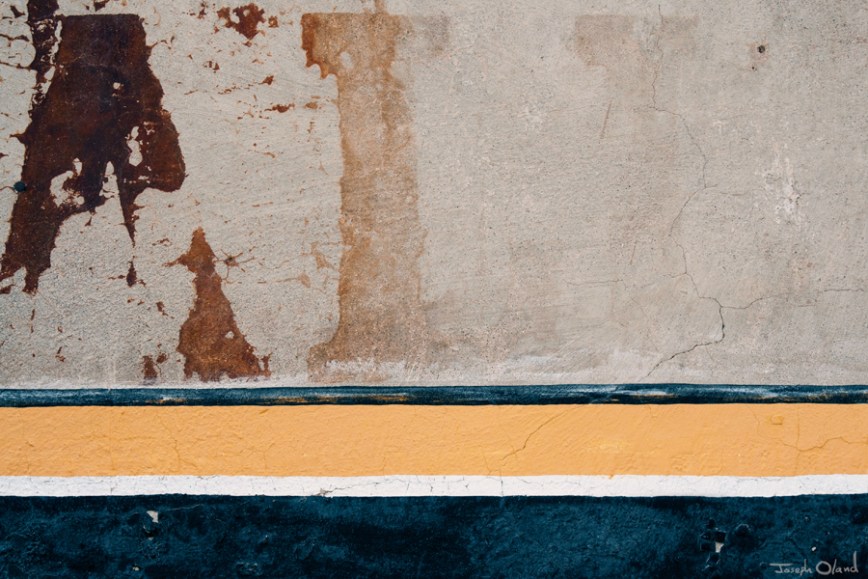
No flowery words today. Film February marches on with this very basic composition, taken with my first real camera, the Nikon N80 that my parents got me. Up until that point, I was using an old Canon with a broken manual rewind lever – it would take about five minutes to wind the film after finishing a roll.

This picture was made using my favorite film stock, a color-reversal stock from Fujifilm called Velvia. It was pretty expensive film, so I never used it much, but it produced these rich colors that always seemed to take the most basic, common, mundane, and forgettable subject matter leap up at you.

A faded practice, film photography, for the faded paint lettering on an old building.
Seems appropriate enough.

FINE ART PRINTS AVAILABLE HERE
SIGN UP FOR THE LENSEBENDER NEWSLETTER
February 22 – The Nebula

02-22 Nebula postExperimentation sometimes leads to the break-through. It certainly leads to some failure. Sometimes you hit an in-between result; this one lives somewhere in the middle. Today’s image wasn’t made with film, nor was it made with a camera. It was made with black-and-white photo paper, an incandescent light, some old print developer (Kodak Dektol multigrade), and a bottle of india ink.

An entire box of my photo paper was accidentally exposed to light; the material isn’t cheap, and I wasn’t amused by the loss. For those of you who don’t know what film and photo paper is, it’s a light-sensative material that’s coated in silver halide (a crystallized salt form of the metal). When light hits this material, the areas that were exposed to the greatest amount of light turn correspondingly dark. With the assistance of corrosive chemicals, you can accelerate the process of darkening the tones and then you can use another set of chemicals to fix the image permanently.

When a box of photo paper is accidentally exposed, it becomes useless for traditional printing – all prints will be slightly flat-toned or “fogged” when you go to draw a print in the darkroom. Rather than snap my fingers in defeat and pitch the useless pages into the trash, I decided to try and have some fun. The paper was already ruined, so what could I lose?

I started taking these pieces of partially-exposed paper out. I threw them into the developing bath and sprayed india ink over the prints before snapping on the overhead light. Since some of the paper was protected from the light by the dark, floating plumes of ink, strange patters begin to emerge on the paper. I’d then lift the prints before they turned completely black and put them in the fixing chemicals. The result is what you see above – atmospheric swirls and bubbles that, to my eye, are reminiscent of astral photography. I’d stumbled on a new, slightly messier form photogram, and I spent the entire afternoon experimenting, saving the best results to be toned, hand-colored, or scanned into digital files later.

Sometimes it pays just to goof off for a bit and forget that there are any rules.

FINE ART PRINTS AVAILABLE HERE
SIGN UP FOR THE LENSEBENDER NEWSLETTER

Better Call Saul 2.02 – Cobbler

Saul Is Born post“I guess I shouldn’t be surprised I have to tell you this. But it’s probably a bad idea that you willingly talk to the police, being a criminal and all. ”

Jimmy McGill (Bob Odenkirk) doesn’t disappoint as season two inches forward. Last week, he explained his perspective clearly enough, explaining to Kim (Rhea Seehorn) that the reason he liked being a lawyer was because he likes to sell people, persuade them into believing him. He also put it bluntly, after pulling a con on a loathsome businessman at a hotel bar, that “I don’t have to be a lawyer to do that.”

But he still takes the job offer in Santa Fe, eventually. We’re left with the impression that he’s more curious than passionate about the position, but it’ll serve his interests for the time being. Company car, salary, and his own office – including an almost too ‘on-the-nose’ painting of a man slipping on ice.

This week, we see one of our first concrete glimpses into the Saul Goodman we known from “Breaking Bad.” Jimmy spins an intricately detailed fiction and sells it to the police to disrupt an investigation into his client’s extra-curricular drug dealing. How does he do it? Easy as pie – or cobbler. He invents a tale that plays into the jaded worldview police detectives: people are stupid and sick and anything, no matter how ridiculous or depraved, is possible.

Jimmy reserves the right to break all the rules, and his lies have migrated from hotel bar and into his profession. This is the first crack in the facade, and temptation is no doubt going to continue chiseling away at his already-flimsy sense of morality.

FINE ART PRINTS AVAILABLE HERE
SIGN UP FOR THE LENSEBENDER NEWSLETTER

February 21 – Manhole Cover

02-21 Manhole Cover post“The longer you look at an object, the more abstract it becomes, and, ironically, the more real.”

~Lucian Freud

– – –

Film February continues with yet another recurring theme in the pantheon of old subject matter. Some people miss out on what’s going on around them because they stare at their shoes rather than look around. There’s nothing wrong with staring at the ground, if you ask me – there’s a lot going on there.

As I’ve mentioned in previous entries to this project, street photographer Aaron Siskind played a major role in inspiring a younger version of myself. Seeking out interesting compositions in mundane places became something of a game. While interning at The Center For Creative Photography in Tucson, I also became deeply fascinated by a photographer named Minor White, who also had a tendency to isolate seemingly normal, everyday objects and somehow manage to make them alien, interesting, unique.

There is definitely something magical about working in black-and-white film.

FINE ART PRINTS AVAILABLE HERE
SIGN UP FOR THE LENSEBENDER NEWSLETTER

February 20 – The Serpent (and semiotics)

02-20 The Serpent postToday’s photograph for the continuation of ‘Film February’ corresponds to a time when I was first exposed to a different, more literary side of photography. After reading “Subculture: The Meaning of Style” by Dick Hebdige, the door to semiotics was opened. It was nauseatingly confusing to me, this new philosophy of graphic language, but it was also intriguing. I fell down the rabbit hole and found myself thinking about my photographs in a completely different way. I’m reminded of one of photography’s seminal publications, “Camera Lucida: Reflections on Photography,” and a particular passage by author Roland Barthes which summarizes my feelings perfectly:

“For me the noise of Time is not sad: I love bells, clocks, watches — and I recall that at first photographic implements were related to techniques of cabinetmaking and the machinery of precision: cameras, in short, were clocks for seeing, and perhaps in me someone very old still hears in the photographic mechanism the living sound of the wood.”

From the moment I began these new studies I started looking through the viewfinder differently. This is when I became interested in macro photography, and it’s when I became much more deliberate with my compositions. When I take the time to really investigate, I discover that there are interesting things all around, that there is always something interesting to investigate with my photographers’ tools. With camera in hand, I’m a kid looking under rocks and discovering whole worlds that I never knew were there before.

FINE ART PRINTS AVAILABLE HERE
SIGN UP FOR THE LENSEBENDER NEWSLETTER
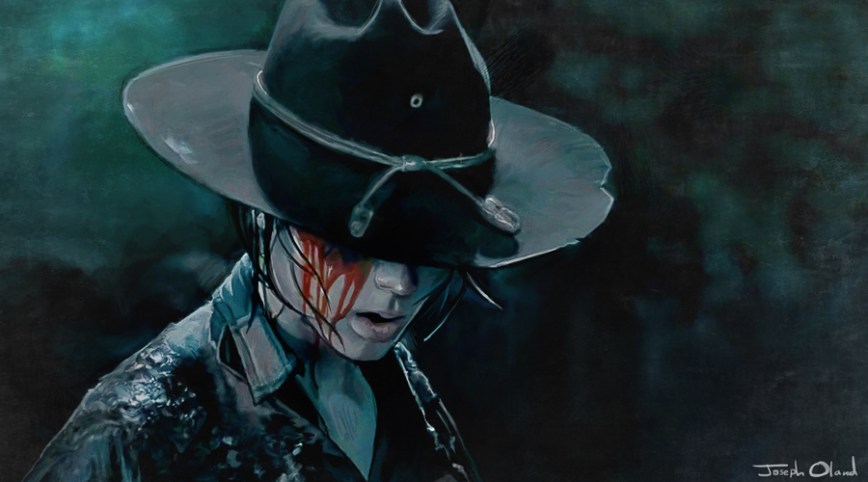
The Walking Dead – “No Way Out”

Carl's Eye postFINE ART PRINTS AVAILABLE HERE

“The Walking Dead” returned on Sunday from the mid-season break and, in the show’s well-established style, nobody is safe. Alexandria’s wall has been breached and we watched while various citizens were predictably devoured by the walking dead. This might actually be what’s most problematic about the series; despite interesting turns and high-tension moments, the show’s rhythms and repetitions are overwhelmingly obvious. Previous seasons have routinely established a pattern in which the core characters appear to find long-term safety, only to be pushed out by larger and larger herds of walkers or competing survivor groups. The countryside of Atlanta, Hershel’s Farm, the State Penitentiary, Terminus, and Alexandria have all fallen in a predictable series of missteps and misfortune. Corrupt and despotic leaders have also become a common element, from The Governor to the cannibals of Terminus to the still-mysterious (but soon-to-be-revealed) Negan.

If “The Walking Dead” has common themes of corruption, perennially unsafe shelters, and the promise of “unkillable” characters being killed, then the shocking moments become less shocking. We still care, but we see the writing on the wall. We oscillate between moments of sadness and moments of relief, but with less and less impact. In an attempt to ratchet-up the stress, the show has begun playing unfairly to our emotions. The incident with Glenn and the dumpster is our best example. It was a relief to see the show’s most loved character pull through, but it was an unnecessarily manipulative cheap shot. The story should be able to achieve these levels of emotional impact by itself, not through slights of hand.

The show still has tremendous momentum and consistently delivers strong performances, but that doesn’t mean we don’t need something to change in order to disrupt these increasingly played-out patterns. This may have already begun to happen, of course, as we consider how the early episodes of season six began to fragment the timeline. The architecture of the narrative has changed dramatically as the story has been compressed, telescoped, and as the moments of decisive action have begun to occur with greater frequency. Where in the beginning a season would take place over several weeks or months, the whole of season six has (at least thus far) taken place over only a couple of days. We also have one unique 90 minute episode that looks backwards in time, showing us how Morgan transformed after a chance encounter with a kind loner. It is truly a magnificent episode that could just as easily have been a stand-alone film.

The best “zombie” features actually focus little on the zombies themselves. Rather, the best zombie stories are preoccupied with exploring humanity. “The Walking Dead” is no different. Most of the story is about a group of people struggling to reason and fight their way through an extraordinary situation. This is a survival story, in which disparate personalities collide, pecking orders are established, and drama unfolds. Everybody in the zombie apocalypse wants the same thing: to live to see another day. But everybody has their own idea how to accomplish that goal. Others have the opportunity to seize control, become leaders, ascend the dictator’s throne, or become sacrificial and selfless. That’s what is so darn good about “The Walking Dead.” We all watch these characters, study their struggle, and we all have an idea of what it is we would do if placed in that situation.

George A. Romero’s original zombie masterpiece, “Night of the Living Dead,” set the stage. It’s a brilliant thought experiment as we watch a half dozen strangers, marooned in a  farmhouse, arguing about the best course of action. Zombies occupy less than five minutes of screen time and most of the violence is implied. The script was written like a brilliant one-act play, and the moral questions are so compelling that we barely realize there’s hardly any action driving the plot forward, just words.

“The Walking Dead” could be a compelling television show even after the last walker collapses in dry-rot and melts back into the earth; the world is still a wasteland, filled with roving bands of survivors, scavengers, and highwaymen. Civilization still has to be rebuilt, infrastructure established, townships reclaimed. If the show can find a way to break out of it’s rinse-repeat cycle, it could be around for a long time to come.

FINE ART PRINTS AVAILABLE HERE
SIGN UP FOR THE LENSEBENDER NEWSLETTER