Illustration – Nude Study

FINE ART PRINTS AVAILABLE HERE

There is no genre of art older than the nude study, the bare human form. It commands our attention and often makes some of us turn away, either in modesty or – more sadly – in shame. The question of its endurance as an art-form throughout the ages is an interesting one. To my mind, the nude is deeply symbolic philosophically, and elegant in its accidental eroticism. The nude is both attractive – and to many, uncomfortably attractive – because it symbolizes true vulnerability; exposed flesh presents a form with nothing left to reveal.

The nude subject is in its most confident and vulnerable state, achieving these at the same time. This cannot be found anywhere else, and that is why nude studies are so captivating, so mesmerizing, so subtly profound. We objectify and sympathize, simultaneously, and this duality forces certain truths to snake their way into our consciousness, about how we view our own bodies and how we use them.

I am proud to be both painter and subject in this genre, to continue this great tradition. In a media landscape that barely bats an eye at extreme violence but suppresses the most natural of sexual desires, I regret only that my artwork isn’t more filled with genitalia.

FINE ART PRINTS AVAILABLE HERE
– – –
SIGN UP FOR THE LENSEBENDER NEWSLETTER

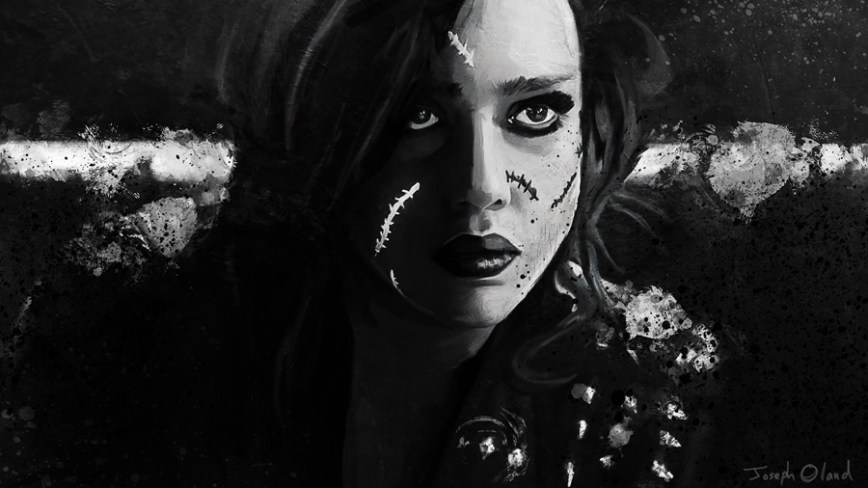
Sin City – Nancy Callahan

SinCity Nancy postFINE ART PRINTS AVAILABLE HERE

I sat down today and watched both of the Sin City films. I’ve been a fan of the comic series ever since I bought a used paperback at ‘Bookman’s Buy-Sell-Trade’ superstore in Tucson when I was a freshmen in college. At the time, the rack was overstuffed with copies, and I nabbed mine for a measly ninety-nine cents. It was cheap enough that I didn’t find it sacrilege at all when I chopped it up and pasted individual frames into my sketchbook.

I was a comic collector since childhood – mostly X-Men titles – and had no idea what Sin City was about. I didn’t even read the book. I just sifted through the pages and appreciated the art. When it was adapted into a feature film, I started paying attention. It had the noir elements, the over-clocked one-liners, trench coats, and fedoras. It was black and white, self-referencing, darkly comedic, and playful. It was a perfect film specifically because it didn’t take itself too seriously – it was engineered to be pulp entertainment. It was designed to be fun.

Sin City was also a throw-away film. It appealed to a niche demographic, not turning too many heads. This is a disappointing revelation because the production was insanely innovative, inventing new film-making techniques that allowed the comic book to come to life. Of all the comic book movies that exist today, I can’t think of a project more true to the source material than Sin City. Most of the film was shot on green-screen, with the background environments inserted in post-production. The violence is stylized, and the black-and-white palette is used with intuitive brilliance.

The sequel, A Dame To Kill For, didn’t perform well at the box office. But it’s a fantastic voyage into the back alleys of Frank Miller’s fictitious city of crime and corruption. Think Gotham, only more fucked up. The vignetted stories are fun, dark, grimly humorous, and worth a look.

FINE ART PRINTS AVAILABLE HERE
– – –SIGN UP FOR THE LENSEBENDER NEWSLETTER

Better Call Saul – Expert Camera Work

Regalo Helado postFINE ART PRINTS AVAILABLE HERE
– – –
READ OTHER ‘CALL SAUL’ POSTS HERE

One of the better things I’ve heard somebody say recently was that “storytelling is telepathy.” I was listening to this interview with a young screenwriter and he summoned those [likely not too famous] words from author Stephen King. I enjoy the odd logic of the statement, though – somebody writes the words down, and then we absorb them when we read them and create the story in our minds. We don’t just absorb them; we become a part of the story. The inert symbols on the page, black ink on white paper, become images in our imaginations. We assign voices and details, interpretations and emotions, to the tune of elegant simplicity – black ink on white paper.

We’ve been doing it since the birth of civilization.

Cinema, a decidedly modern method of storytelling, is a little different. It’s all more specific. The images, the look of the characters and the sound of their voices – these things have all been chosen for us, by a director. In many ways, we can describe reading as more of a ‘participatory’ form of storytelling – we have to use our imaginations and help co-author the story being told – and watching film & television as more of a ‘passive’ form of storytelling. This is why we associate books with intellect and television with laziness.

This is a false dichotomy.

Good storytelling, either in print or telecast, motivates the reader (or audience member) to make decisions. Good storytelling on the screen is the kind of storytelling that rewards the audience for paying attention – to color palettes, symbolism, narrative structure, foreshadowing, and character development/evolution. Most of us recognize these things, even if we aren’t looking for them or actively thinking about them. Television shows in the last several years, it should also be noted, have achieved a level of quality and substance that rivals most mainstream feature films.

In many ways, the television series allows storytellers to exercise their talents in a way that feature film could never allow. Can a ninety minute film accomplish as much as a sixteen episode season (or an entire series)? Of course not. A television series has more time to introduce an ensemble of characters, establish their unique and individual qualities – their challenges, their strengths, their shortcomings – and bring the circumstance of their lives into clear and cutting focus.

Better Call Saul is a wonderful example of long-form story-telling. It’s one of the reasons that it’s so beloved (and simultaneously so under-appreciated, because of it’s painful rarity) in the television world. It is incredibly ‘literate’ in its approach, each episode a small little piece of a morality play, each episode a small little piece of a bigger puzzle. The most recent episode, to my mind, is one of the greatest examples of cinema-quality film-making applied to a television series, specifically because of how the opening scene is shot, choreographed, and cut.

The entire first sequence follows a refrigerated truck – presumably smuggling narcotics – across the US-Mexico port of entry. Using one camera operator, three different vehicles, and a steady-cam, the establishing shot is achieved in one single, sustained, three-plus minute shot. A ballet of vehicles and extras – law enforcement, truck drivers, perpetrators, and K-9 units – swirl around the scene. The camera glides through and captures this scene without a single cut. The trick of trying to cram non-narrative story into a long, sustained, uncut shot is as old as film itself, but rarely is it accomplished with such extraordinary finesse. The longer the camera can reveal an unfolding narrative, the less the audience is motivated – whether consciously or unconsciously – to question its authenticity. That’s because real life – our true, moment-to-moment lives – aren’t cut from angle-to-angle, perspective-to-perspective, over one shoulder and then <whack> over another shoulder. The longer the scene can go without an edit, the more we are seduced, as audience members, to believe it.

If you haven’t hopped aboard the Better Call Saul bandwagon, I suggest you give it a day in court – pun intended. Following the ‘cartel mule-truck through the port’ scene – an extraordinary achievement in television film-making – I can’t wait to see what other cards the show-runners are hiding up their sleeve.

– – –

Other films with remarkable tracking shots (nope, can’t think of any other television shows):

  1. Boogie Nights – The opening scene starts outside the night club, tracks into the club, snakes through the seating area and onto the dance floor, and winds back out. Every single major character in the film has at least one spoken line of dialogue and the scene lasts roughly ten minutes (a so-called ‘full-film-magazine’). It is insane when you consider how hard it must have been to choreograph this.
  2. Irreversible – This is the film that can’t be un-seen. It’s one of the most grotesque and challenging-to-watch films ever made, with Gaspar Noe at the helm. The film is replete with slight-of-hand cuts (paving the way for Birdman, but taking it’s inspiration from Alfred Hitchcock’s Rope) that give the illusion of long cuts, including the devastating brawl at the gay sex club in the first scene. But it’s the sexual assault scene in the middle of the film, in a dark roadway underpass, that is truly shocking. The camera sits like a fly on the wall. The graphic content of the scene makes it all-the-more uncomfortable for the audience, that the camera never blinks, never looks away, never cuts to something less awful than the brutal violation right in front of it. It’s easy to forget that this is just a movie, watching this scene. It’s hard to remember that it’s not real, that this isn’t in fact a true-to-life snuff film. This is one of the most amazing films ever made, but it comes with an asterisk – not for the weak of heart.
  3. Children Of Men – I’m not even a fan of this film. The premise is outlandish, with little or no real time spent on trying to explain how or why the characters live in a world where women simply can’t get pregnant. The idea itself is compelling, but the details are glossed-over and we’re expected to just accept that, yeah, this is the world of this film. Women ain’t gettin’ pregnant. World’s gonna end. Bummer, dude.
    Nevertheless, there is a moment in an embattled urban area, tanks creaking into the streets, in which the protagonist walks through mortar fire and military vehicles, through throngs of people, to bear witness among a huddled gathering of resistance fighters, to an infant child. The camera follows him through the streets, around tanks, amid explosions and hordes of civilians battling military personnel. The camera never cuts, and the scene is undeniably, tear-inspiringly beautiful. It’s a shame that it’s embedded in what, to me, is a muddled mess of a film. But it’s one brilliant piece of film-making nonetheless.

Can you think of any long-cuts that should be added to the pantheon? Let me know in the comments.

FINE ART PRINTS AVAILABLE HERE
– – –
SIGN UP FOR THE LENSEBENDER NEWSLETTER

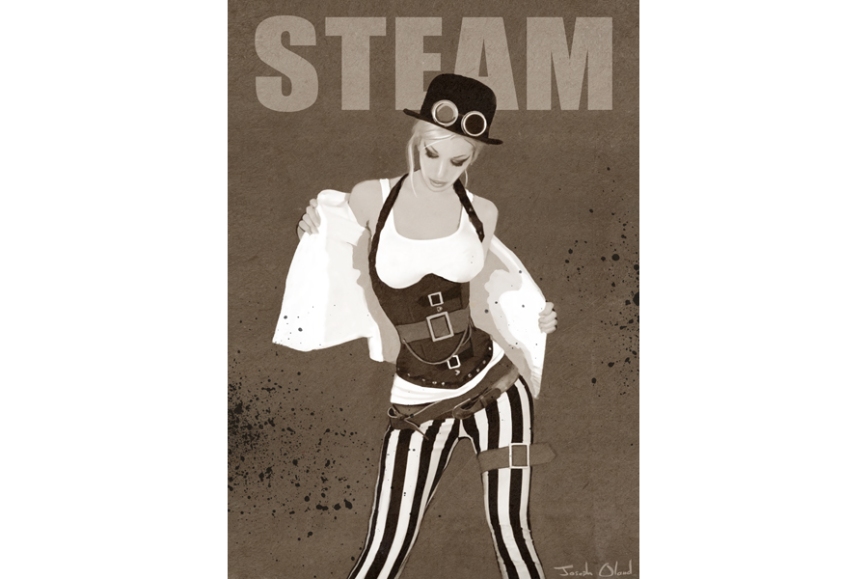
Illustration – Steam Punk Poster

Paris Steam postFINE ART PRINTS AVAILABLE HERE

Right up front, I have to admit that this poster-style illustration is based on a photograph. I made a lot of choices while constructing this graphic but, I don’t know, I think it’s always important to be honest when sourcing other material. In cases where I’m doing fan art, it’s obvious that I’m sourcing from various popular culture properties, but it isn’t obvious when it comes to pieces like this.

I’ve never been into cosplay or SCA (society for creative anachronism), but I brush shoulders with countless creatives who participate in these activities. I’ve only been to a couple of comic book conferences, and I spend more time in front of the computer than I ever could spend trying to problem-solve my way through an elaborate fan costume. Rather than create a costume, I derive a lot of inspiration and develop ideas by knowing these people, listening to their ideas, and witnessing their marvelous creations.

That being said, the steam punk aesthetic has been popular for maybe about ten years now, but it wasn’t until the past few years that it has become recognized in a more mainstream way. Steam punk has been around for decades, tracing it’s origin back to the science fiction sub-genre ‘cyberpunk,’ usually attributed to the stories penned by William Gibson; Neuromancer should be required reading for anybody who feigns interest in cyberpunk and steam punk.

Aesthetically, steam punk designs are generally influenced by the style of the 19th-century scientific romances of Jules Verne, H.G. Wells, and Mary Shelley. It incorporates the technology and designs of 19th-century industrial steam powered machinery (hence the name), often implementing clocks, gears, modified 19th century dresses, suits, and hats, and other such paraphernalia.

I had a lot of fun tinkering with this illustration, and I certainly hope you enjoy it.

FINE ART PRINTS AVAILABLE HERE
– – –
SIGN UP FOR THE LENSEBENDER NEWSLETTER

The Walking Dead – “East”

Rick and Morgan postFINE ART PRINTS AVAILABLE HERE
– – –
LAST WEEK’S EPISODE REVIEW HERE

Carol and Daryl, taking things into their own hands, are the catalyst for a host of poor decision-making among the Alexandrians in this week’s episode of “The Walking Dead.” Carol, broken and weary, leaves a note behind announcing her departure, insisting that nobody come looking for her. Daryl, on the other hand, heads off in another direction, recklessly in pursuit of Dwight to avenge the needless slaughter of Doctor Denise. Rick and Morgan head out to find Carol while Rosita, Michonne, and Sasha head out to stop Daryl.

At this point in the story, “The Walking Dead” isn’t really a horror-genre narrative – it’s a study on survival on recovery. That being said, there are certainly horror tropes that persist, lest we forget that dead cannibalistic corpses continue to roam the countryside. Every character in the show that we have come to know as capable, dependable, and intelligent does the one thing you never do in a horror film: they split up, leaving Alexandria vulnerable. None of this is really in-character, but one might surmise that the storytellers are trying to cement the notion that the Alexandrians are prepared, have united as a community, can face any problem together, et al. But it falls flat. When all is said and done, the audience recognizes that this is an excuse to fragment the group, push forward with the character drama, and leave the principle characters in an exposed position for the [likely] explosive season finale.

The heart of this episode’s themes exist in the interaction between Morgan and Rick. We are reminded of the flimsy morality in the new world as the two characters explain why they have chosen their own particular path toward survival. Morgan refuses to kill the living and Rick sees killing as an inevitability; one message seems sage-like, the other authoritarian. As Morgan expresses how he sees everything as cyclical, explaining to Rick how he saved the Wolf who, in turn, saved Denise, it’s difficult not to view Morgan as the more sympathetic, morally upright person.

“We didn’t finish it like we thought we did, with The Saviors,” Rick says midway through the episode.
“No,” Morgan says. “You started something.”

And we know that Morgan is absolutely correct.

Watching these two talk reminds us that they represent far opposite ends of a moral spectrum. As members of the audience, we know that both of them are right in their thinking, and that it’s the circumstance that lets us know which course of action is the correct one. That’s what the jail cell Morgan built is all about: creating an option other than falling on routine and regular summary execution. The set designers didn’t build that room just for one small scene in last week’s episode – that jail cell is going to get some use. At least, that’s my prediction.

We’re also reminded that, even though Rick and Morgan view the world from radically different lenses, they are on the same side. There are several paths that can lead to the same destination. Thankfully, the end their conversation on peaceful terms instead of thrown punches; they know that they can learn something from one another, temper their philosophies, and survive together, even if this conclusion is explicitly presented.

– – –

Is Daryl Dixon dead? Don’t count on it. That spray of blood was pretty spectacular, but super-fans have Zaprudered it, as have I, and there are a few things to keep in mind. First, the advertisement for the season finale clearly shows Daryl in a scene, so he at the very least isn’t dead yet. More importantly, he is a fan favorite with plenty of qualities rife for further exploration in this increasingly character-driven narrative. I have long predicted that Daryl would eventually be killed because he is one of the few characters who only exists in the television series (not the source material of the graphic novel), but I have actually reversed my position on this. As the show veers further and further away form the source material, characters like Daryl and Carol and Morgan are actually more essential than ever, allowing the show-runners and the writer’s room to keep the story distinct enough from the graphic novel as to keep the show unique.

Who was the man in the barn that Rick and Morgan happen across? He had a spear that was clearly forged by the blacksmith at The Hilltop, and Rick concludes that he must be one of The Saviors. But what about the peculiar armor he’s wearing? It’s my guess that this is the first hint at yet another community wrapped-up in the trade agreement with The Hilltop and The Saviors. It’s my hope that the seed is planted in the season finale – and the brief glimpse of an armored man on horseback in the season finale preview metes this out – and we start to learn more about The Kingdom. There’s no need to spoil anything here, because I could just as easily be wrong, but it’s certainly one of my hopes.

See you next time, after Negan crushes a few skulls with his barb-wired wrapped baseball bat, Lucille.
I’m guessing she’s pretty thirsty…

FINE ART PRINTS AVAILABLE HERE
– – –
SIGN UP FOR THE LENSEBENDER NEWSLETTER

Nude Woman With Flower

Woman With Flower post

FINE ART PRINTS AVAILABLE HERE

Art for art’s sake. Isn’t that the expression? We just like to look at pretty shit and say “hey, jeez, that’s some pretty shit.” Everything is beautiful, nothing is off-script in the production-house of life. We wipe the crust from our eyes every morning, slap the alarm clock, brew our coffee, and go about our lives. And everything involved in that process is pretty nifty when you get right down to it. I mean, there’s tragedy and frustration as well, but these things can also feed into a creative, evocative, and transcendent output.

All of that is to say this: when in down, artist friends, make pictures of naked women. It’s as old as cave paintings. I found myself sifting through old source material, looking for an excuse to make a painting, and the image above is where I landed, for lack of anything else to do. I hope you like it.

FINE ART PRINTS AVAILABLE HERE
– – –
SIGN UP FOR THE LENSEBENDER NEWSLETTER HERE

The Matrix, The Wachowskis, And Transgender Issues

Switch postFINE ART PRINTS AVAILABLE HERE

Most of us remember the 1999 groundbreaking film “The Matrix,” and most of us enjoyed it enough to forgive Warner Brothers for the cash-grab follow-ups, which will not be discussed here. It introduced a revolutionary new visual style and participated in the invention and popularization of bullet-time photography, which has been adapted, modified, and used in movies and television ever since.

We might also remember that the film was directed by The Wachowski Brothers.

As it turns out, Larry Wachowski (now Lana) is transgender. Rumors began to circulate in the early 2000s that Lana was transgender, but the siblings kept this information private until after Lana’s transition in 2008. The earliest publication to mention Lana by her new moniker, and to refer to the siblings simply as ‘The Wachowskis,’ occurred in 2010. She has been very active in the transgender community ever since, eventually receiving The Human Rights Campaign’s ‘Visibility’ Award.

In March of 2016, Andy Wachowski also came out as transgender and has adopted the name Lilly.

Lana has expressed in several speeches and interviews that she had considered committing suicide in her youth because of her feelings of confusion about her gender identity. In retrospect, it’s interesting to note that themes of identity are ubiquitous in films made by the Wichowskis. One of the earliest examples is “The Matrix.” The main character struggles with accepting the possibility that he may be a messiah figure. But there’s also an interesting tertiary character, Switch, who is a clear expression of the Wachowskis’ struggle with their gender identity. One of Morpheus’s cohort, the character was intentionally designed to be androgynous, and the script even reveals that Switch was supposed to be female in the ‘real’ world and male while in ‘the matrix.’ This was narratively designed to illustrate the concept of “residual self image” explained by Morpheus as a projection, while in the matrix, of one’s most concise and accurate image of Self. While biologically female, Switch views himself as being male.

Casting the character proved to be challenging; finding a male actor and female actor that could be made to resemble each other closely proved nearly impossible. Time and budget constraints eventually motivated the Wachowskis to abandon this concept, and the androgynous character of Switch that we see in the film was developed, with a pretty ‘on-the-nose’ name. The fact that the character of Switch was written in the manner it was, however, clearly points to the very real possibility that The Wachowskis were working – whether consciously or unconsciously – through their own gender identity circumstances, and reflects how meticulously the first Matrix film was assembled (and why that first film continues to be a contemporary classic).

FINE ART PRINTS AVAILABLE HERE
– – –
SIGN UP FOR THE LENSEBENDER NEWSLETTER

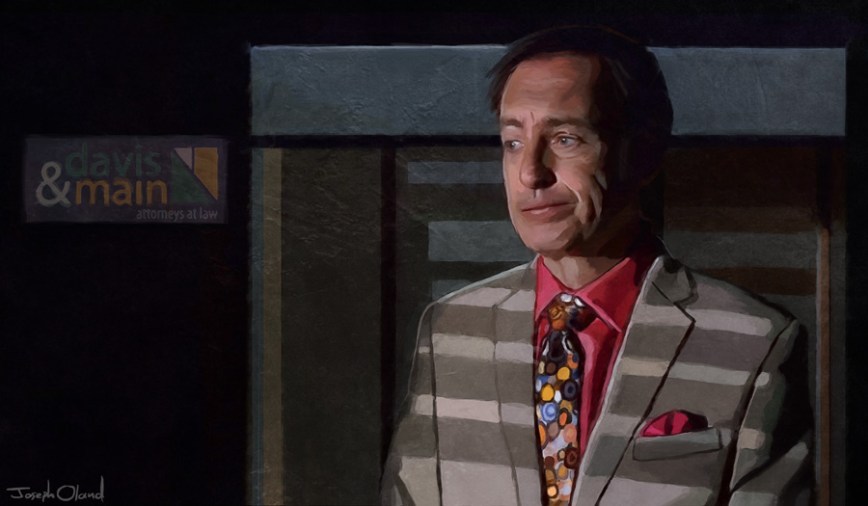
Better Call Saul 2.07 – Inflatable

Jimmy's Fired postFINE ART PRINTS AVAILABLE HERE
– – –
READ LAST WEEK’S REVIEW

This week’s episode of Better Call Saul opens in the summer of 1973, with an establishing shot of a magazine rack reminding us of the downfall of Richard Nixon. On the cover of the magazine, with Nixon’s stern portrait, the headline reads: “Can Trust Be Restored?” As the scene unfolds, we see a young Jimmy McGill, who eventually takes a hard (and wrong-headed) lesson from a grifter.

“Listen, kid. In this world there are sheep, and there are wolves.” Any Breaking Bad fan will remember that this exact line is spoken by a fully-grown Saul Goodman to Walter White and Jesse Pinkman midway through the series.

This opening scene clearly establishes young Jimmy as a preternaturally wizened student of the human carnival. He sees right through the grifter’s con, even trying to warn his father – a message that falls on deaf ears – before taking the con-man’s advice and yanking a few bucks from the till when dad isn’t looking. It’s an oddly moving scene, witnessing a twelve-year-old boy decoding the vulnerability of his father, the man who is supposed to have all the answers.

“And so we see Jimmy steal from the till, out of resolute bitterness. With a rejection of his father’s soft-hearted gullibility, and through extension the whole sucker-generation of sheep-idealists that let themselves be cheated by the wolves of violence and corruption.”

Clearly, the theme of this episode is occupied with corruption.

As an adult, we know that Jimmy McGill is incredibly good at spotting the long-con; that’s how he landed the lucrative Sandpiper class-action case and parlay that into a company car, corporate apartment, and cushy salary. He knows how criminals work because he is, in no uncertain terms, just like them. Rather than conning convenience store clerks, he has evolved into a legal animal hoping to justify his cons by going after other con artists – for the most part.

This episode sees Jimmy admitting to certain truths about himself openly. He comes clean and admits that his atrocious behavior at Davis & Main was a ploy to escape his contract (but not the signing bonus). He admits that he’s a “square peg” that needs to do his own thing. He drops the British secretary charade when he nestles back into his nail salon back-office. Kim, having absorbed Chuck’s story about Jimmy’s youthful thievery, also confronts Jimmy in more concrete terms. She cannot allow herself to partner with Jimmy and expose herself professionally to any of his shenanigans. Jimmy can sense her distrust even if he isn’t privvy to Chuck’s meddling.

Will Jimmy accept Kim’s proposal? The episode doesn’t seem to want to reveal this until next week, but my guess is that he eventually will.

FINE ART PRINTS AVAILABLE HERE
– – –
SIGN UP FOR THE LENSEBENDER NEWSLETTER

Wonder Woman – Rebooted To Perfection?

Wonder Woman postFINE ART PRINTS AVAILABLE HERE
– – –
READ THE BATMAN V SUPERMAN REVIEW

As mixed reviews funnel through the infinite avenues of internet film criticism, there does appear to be some consensus on one particular issue: in the new “Batman V Superman” feature, the depiction of Wonder Woman is exceptional. The movie is something of an effects-driven, superficial peek into the DC Cinematic Universe, trying incredibly hard – and failing on a number of tiers – just to try and catch up to the success of Marvel. For comic book enthusiasts and movie freaks, this isn’t news; we already knew, months before the movie was released.

The movie is, in so many ways, a bloated mess.

We see yet another retelling of the Batman origin story, an exercise as silly as approaching a stranger and asking if they know about Christ’s crucifixion. It’s a vacuous sequence that adds nothing to the movie. Anybody interested in doling out twelve bucks for a ticket, let’s face it, already knows the story. It’s the perfect example of a “by committee” decision, made by executives who, unlike fans, have no real emotional connection to the source material. It’s forgivable enough, I suppose, and maybe even a little expected – so be it. It was done well, the slow-motion sequence resembling comic book panels more beautifully and effectively than any other depiction of the origin story. So there’s that.

We also see a newer Batman, older and cynical, more violent and erratic, impotent and resentful in the shadow of the god-like alien from Krypton. We see a subversion of the morality we expect from the Caped Crusader, a war-weary vigilante who views criminals as weeds, perennial inconveniences that always reappear, no matter how many times you try to pluck them from your garden. We see a digital dossier of the “meta-humans” – other superheros in the DC canon – in a ham-fisted set-up presumably for future movies.

The movie has lots of issues, both narratively and tonally.
It happens.

The best part of the movie is a toss-up between Ben Affleck as Batman and Gal Gadot as Wonder Woman. Both portrayals are phenomenal. Affleck captures the charismatic swagger of the moneyed executive and steps into the cape & cowl with finesse. His relationship with Alfred (played by Jeremy Irons) is tenuous, complex, and believable, rivaling the jibber-jabber we saw in the Christopher Nolan films with Michael Cain in the Alfred role. The twenty minutes, give or take, that we get to watch Wonder Woman are arguably the most enjoyable twenty minutes of the entire film. With the tongue-and-cheek television portrayals of yore, the primary colors and glossy idealism, I don’t think anybody had any real expectation that Gadot’s portrayal of the character would bring anything interesting to the film. During the production, there was a lot of “thin-shaming,” with comic book fans insisting that their Wonder Woman is a towering, strong, meaty beast of a woman – that there’s no way that the slim, slinky Miss Israel could ever convincingly present the power and presence necessary to breathe life into the heroine.

Wrong.
Wrong, wrong, wrong.

The lasso isn’t silly, the strength of body and character are crystal clear. I enjoyed the film, despite its flaws, but I’m actually looking forward to a Wonder Woman solo picture more than ever – something I never would have expected.

FINE ART PRINTS AVAILABLE HERE
– – –
SIGN UP FOR THE LENSEBENDER NEWSLETTER

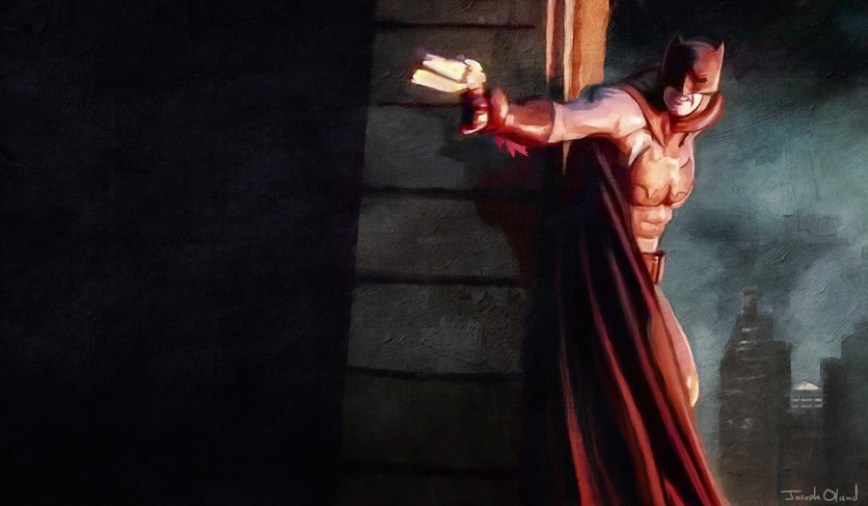
Batman V Superman – Spoiler Free

Wall Climber postFINE ART PRINTS AVAILABLE HERE

When watching a spectacle film like “Batman V Superman: Dawn Of Justice,” it can be difficult to distinguish between the experience of watching the film and the actual quality of the film. Even more interesting, I find it both important and interesting that I have to mention that this is a spoiler-free review. Judging from the content-dense film trailers, it didn’t appear that there would be any surprises to spoil, a woeful trend in modern movie marketing (see video below). The trailers already reveal the action sets, the super-villains (Doomsday and Lex Luthor), both the fight and reconciliation between the film’s two protagonists, and even what would have been a spectacular surprise introduction of Wonder Woman. Regardless, there are three plot-critical events that are likely to catch most moviegoers completely off-guard, and it was satisfying to see that this latest entry into the burgeoning DC Cinematic Universe actually managed to surprise me.

Those three events will not be mentioned here. Neither will a synopsis, for that matter, because in that regard the trailers really are enough.

Critic reviews have been mixed at best, but many filmmakers are more finely tuned to the desires of their audience than the sometimes over-stuffed attitudes of their critics. The modern era of superhero movies makes reviewing them a different kind of activity; the fan-base is already built in and the source materials for most of these properties have been around for decades. Many film reviewers aren’t able to lose themselves in these narratives as easily as ‘true believers,’ which is why I think a lot of reviews are murky. With regards to criticism of “Batman V Superman,” there are some salient observations out there, pointing to obvious flaws and questionable decisions made by director Zack Snyder. Despite some of the movie’s shortcomings, no one thing leeches too much joy from the overall experience. This movie is well-worth the price of admission.

The biggest complaint out there is that the movie is bloated with needless or distracting content, taking longer than it needs trying to achieve, what some might argue, is far too much in the first place. In many regards, three separate (and good) movies could be made from what this one feature aspires to do all by itself. The main attempt, as most of us are already aware, is to hit the reset button on the DC properties and setting up an expanded cinematic universe. Disney has had a seat at the table for years, beginning with the first “Iron Man” film, and Warner Brothers has been struggling for years to crack the code. This year, we have two major titles in the DC Universe, “Batman V Superman” and “Suicide Squad.” Beyond that, there are nine separate films currently in the works, all to be released within the next five years. All nine of thee will share a point of origin with this year’s two films. This is arguably the biggest problem with the production: it takes too much time trying to set up other movies and not focusing enough on resolving its own central story.

Are we going to see Cyborg, Flash, Aquaman, and Wonder Woman in future titles? It looks like a certainty, but that all may hinge on the success of “Batman V Superman.” Sadly, the movie is too distracted setting up these other projects, shoe-horning most of them in pretty clumsily, disrupting the pace of the film. The only other issue I have may be a personal one, but I swear if I have to watch yet another depiction of Bruce Wayne’s parents being gunning down, in slow motion, in front of a movie theater, with pearls scattering and falling to the gutter, I may pledge to never see a Batman movie ever again. Scenes like this are part of the bloat, and do little to serve to actual story of the film.

– – –

The conflicting ideologies of the two main characters in “Batman V Superman” – the brooding, gritty street-justice approach of Batman paired with the idealistic, heartland-of-America spirit of Superman – gives the film an interesting texture. This is a story of day and night, good versus evil, but it points to how even good can get muddled, that justice is not a black and white issue. Watching the two characters explore their moral philosophies and confront inconvenient realities about their morality is one of the more satisfying elements of the film.

Ben Affleck turns in a stupendous performance as an aging and increasingly cruel and bitter vigilante, inspired by “The Dark Night Returns” comic series and the decidedly darker tone established by comic artist & writer Frank Miller. Some fans may not like this new Batman and his obvious descent into moral ambiguity. He still fights crime, but his ethics are looser in this depiction than at any other time. This is a Batman that kills, which is something we’ve never seen on the silver screen before, and the jury is still out on how audiences feel about that. Nevertheless, this makes the comparison with Superman and his squeaky-clean demeanor all-the-more fascinating, adding layers of complexity to their conflict.

By far my favorite part of the film was the introduction of Wonder Woman (played by Israeli actress Gal Gadot), a character I have never really liked, never found interesting, and never thought could be made to be as fun, relatable, and believably hard-hitting; this Wonder Woman is a force of nature, and her springing into action in the third act is, by far, my favorite moment in the film. The art direction and casting for the entire feature is admirable, the action set-pieces exciting and fun to watch, and the characters are all truly three-dimensional – they are all uniquely conflicted, navigating their lives and predicaments with agency.

Box office numbers will be high. My prediction is that this will easily be a billion-dollar movie. This might finally be the shot of adrenaline to the heart of Warner Brothers and DC. They may never catch up with Marvel, but I think the competition just got a little stiffer.

FINE ART PRINTS AVAILABLE HERE
– – –
SIGN UP FOR THE LENSEBENDER NEWSLETTER

WTF Trailers