The Yashica-D

Yashica-DThis camera is closely associated with what press photographers carried during the 1950s and 1960s, although I must admit that the Yashica is a bit of a knock-off; the Rolleiflex is the original sensation. The reason these were considered more professional had a lot to do with the lens specifications and the selective-focus feature, allowing for more artful and aesthetically pleasing compositions.
This is a medium format camera – accepting 120mm medium format film – and makes 6×6 centimer square images.
Most of the latter models were equipped with a three-element 80mm lens capable of opening up to f/2.8 – this is considerably “faster” glass than many contemporaneous camera models, allowing for faster exposures, effectively giving the photographer the power to ‘freeze’ moving objects on the film plane. Earlier camera models had darker glass and slower shutter speeds, so moving objects would render as a blurry jumbled mess.

– – –

With the discovery of Vivian Maier‘s work and the release of her books, the often ignored TLR style camera has seen renewed interest. Prices for the Rolleiflex have risen significantly, leaping from as low as $150 to figures closer to $1,000. The Yashica (and the Rollei) are relatively easy to find, and because they aren’t as user friendly as your smart phone, I’m confident this fad will die down. When the fad dies down, so will the price.

If you’re a camera freak like me, I suggest you keep your eyes peeled – get one of these as soon as possible. They’re cumbersome to work with compared to modern DSLRs, but they are reliable, sharp, and produce stunning negatives. Like any tool, a well-built camera is a joy to work with.

And if you haven’t heard the name Vivian Maier, go and see  John Maloof & Charlie Siskel’s documentary “Finding Vivian Maier” immediately. It’s blasphemous if you haven’t at least heard the name.

SIGN UP FOR THE LENSEBENDER NEWSLETTER HERE

Vivian YouTube

February 09 – Industry, Steel, And Aaron Siskind

02-09 Industry post“Stone, steel, dominions pass,
Faith too, no wonder.
So leave alone the grass
That I am under.”

~A.E. Housman

– – –

I’m not sure who said it first, but it always stuck with me: there is nothing as unnatural as a perfectly straight line.

There’s actually some truth to this. Straight lines don’t really just occur in nature. Every natural process with the potential to create a straight line is subject to other processes that disrupt it. Theoretically, trees would grow straight up were they not subjected to wind, rain, gravity, uneven soil. If the distribution of air, sunlight, nutrients, gravity, and other factors were perfectly even, we would have straight-edge trees. These elements aren’t even, have never been even, cannot be even, and so they produce randomly mutated fractal patterns.

Interestingly, we humans now we live in environments wholly based on the straight edge; I-beams and milled lumber, the foundations of our homes, our streetlamps, television screens, windowpanes. There is no greater example that I can think of that represents the unbroken human endeavor to conquer nature.

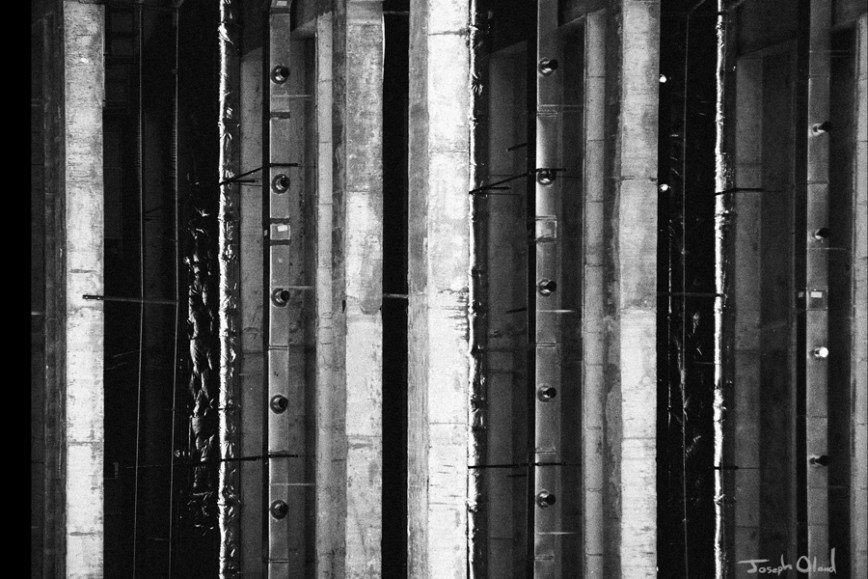
Today’s photograph is how I present the tension between humankind and the natural world – steel beams, the skeletal structure of a half-complete hotel in Albuquerque. I made this image when I was in my “Aaron Siskind” period. It was my second or third year of college, and I refused to photograph anything other than sub-par replicas of his patented abstract style. For those of you unfamiliar with Siskind, he was a prolific American photographer considered to be closely involved with the Abstract Expressionist movement, whose works focused primarily on the details of nature and architecture. At his height in the 1950s, his works were often described as blurring the line between painting and photography – something I’m personally interested in as an artist.

I was working as a research assistant at The Center for Creative photography on starvation-level wages under the Federal Work-Study Program. At the time it didn’t bother me; access to so many wonderful, historically significant photographic prints and photographer archives was plenty enough for me. Hell, I considered it an honor (and still do).

Then, recently, I found a faded, crinkled pay stub in an old suitcase. Boy was I being robbed.
But that’s a story for another day.

They say that emulation is the greatest form of flattery. I hope Mr. Siskind was looking down on my  from high with his notoriously crooked smile. I learned a lot trying to copy the masters, and I believe this is how many artists begin their journey. Not from square-one, but on the shoulders of giants, borrowing their voice while we struggle to find our own.

FINE ART PRINTS AVAILABLE HERE
SIGN UP FOR THE LENSEBENDER NEWSLETTER


February 05 – Craters In The Earth

02-05 Meteor Crater postThe year was 2001 and I was a cocky asshole of a man. My girlfriend and I somehow conned her parents into lending their minivan to the enterprise and we lit-out for the western territories. I’d received an acceptance letter from the University of Arizona and I was ready to get the hell out of Kansas. Little did I know that attending the UofA would mean just about nothing, other than a pile of debt with a degree worth less than the scrap of parchment it was printed on.

But that’s a whole other story.

An 18-year-old version of me screamed down the highway in a soccer-mom van with a young slab of beautiful woman-flesh – and that’s all that mattered. We camped along the high desert, free spirits, and I will never forget the experience. Trading sex in a two-door coup for sex in a bulky 1970s-style canvas tent is probably one of the more sublime experiences this young man could have ever hoped for at the time.

We drove through Tucson and struck camp at Mount Lemon and surveyed the landscapes along the painted desert of Northern Arizona. It was the first time in my life I felt truly unfettered, rising in the morning to the sound of rushing creek water and a lovely ivory face beside me, cloaked in locks of streaming brown hair, lips upturned in a sly satisfied smile.

No drug can ever replace the experience of being eighteen years old and in love. Today’s photograph is a reminder of that innocent time; my woman by my side, unaware of the struggles ahead, I dialed the numbers in and pushed a button along the rim of the great meteor crater. This picture represents everything I held important from those lofty teenage years.

It was a good time, in tall grass and open sky. And I will take that pleasure with me into the earth.
When the time comes.

FINE ART PRINTS AVAILABLE HERE
SING UP FOR THE LENSEBENDER NEWSLETTER

February 03 – Drive Thru Liquor

02-03 DriveThru Liquor post

“Film February” continues with this little gem, taken using another one of my handy-dandy vintage film cameras.

Folding cameras were a mid-century fad, dominating the post-war market. You had the style of accordion bellows, but in a handheld package for ease of use. These were imprecise cameras, to sum them up succinctly, but black and white film stocks had a lot of latitude. A poorly exposed negative could still yield a pretty decent print.

Learn more about the Sears & Roebuck Tower Series of cameras here.

Today’s photo of the day comes from Stone Avenue in downtown Tucson, across the street from the police station. I have no hard confirmation, but the rumor goes that Texas is responsible for the grand innovation known as the drive-through liquor store. The source of so many an absurd idea, Texas seems as good a candidate as any; I’m inclined to believe it. In any event, they’re scattered across the southwest like jacks.

This was the maiden voyage of my Tower ’52. I’m pretty sure that this is the very first exposure I made with the camera, which I’d purchased at an estate sale on Tucson’s east side (along with about two dozen other camera bodies). The compression plate is bent, so the film focus falls off on the left and right edges, but it’s this kind of imprecision that makes old cameras fun to work with. Unpredictable things happen, and you never know what the film is going to look like until you develop it.

FINE ART PRINTS AVAILABLE HERE
SIGN UP FOR THE LENSEBENDER NEWSLETTER

The Sears And Roebuck Tower ’52

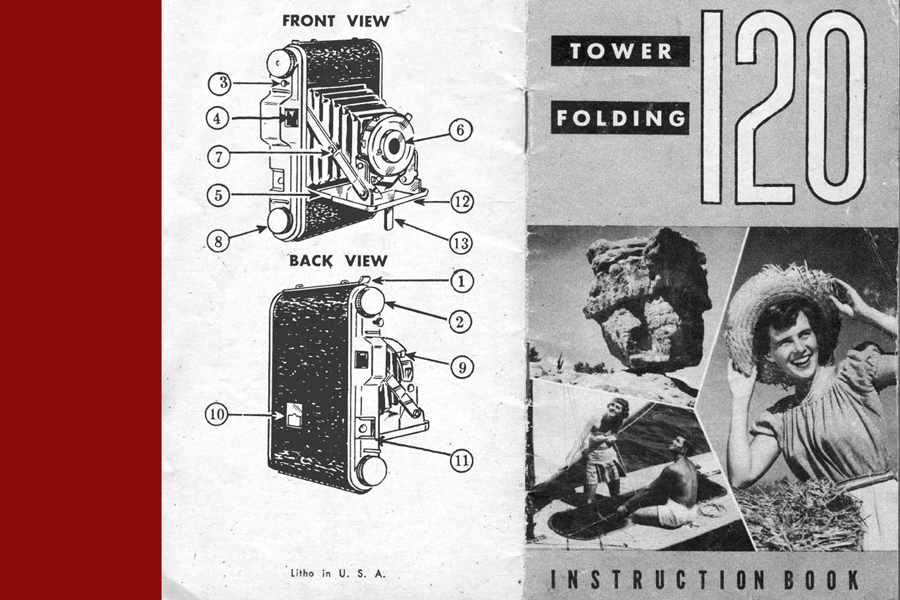
tower folding postThe 1950s saw continued expansion in casual consumer photography. Film costs were prohibitive, but newer models with ease-of-use features attracted new buyers. Bulkier, double-lens cameras (the twin-lens reflex model) were still considered the gold-standard for press photographers, but folding cameras had quickly begun to replace box cameras. Kodak’s turn-of-the-century innovations – the ‘Brownie’ and ‘Brownie No.2’ – fell out of fashion as cameras such as the 1950s Tower series arrived, manufactured and distributed by Sears, Roebuck & Company.

A folding camera is precisely that – a camera with bellows that can be folded down so that it occupies less space when not in use. The self-erecting bed camera has a fixed viewfinder, a simple pre-set lens aperture, and a synchronized shutter. Without having to adjust the aperture, shutter speed, or focal length of the lens, the user literally only has to “point and shoot.” Using medium format 120 film – the most common film size before the transition to 35mm – the Sears & Roebuck Tower produces negatives measuring 6×8 centimeters.

Most folding cameras I come into contact with are metal-construction models, although I’ve read that Bakelite models were also used. Metal models are durable and almost always function (so long as they haven’t rusted). Bakelite models, on the other hand, are infinitely less common (most likely because Bakelite plastics become brittle with age). Folding cameras in circulation today usually require some rudimentary maintenance if they’re to be used – torn bellows will leak light into the camera and fog your film. This is easily remedied with a bellows repair kit, or even black gaffers tape or shoe-repair liquid rubber.

The beauty of old cameras – of old technology in general – is that they can pretty much be held  together with rubber cement & tape and still produce interesting images.

Images produced using my personal 1952 model are quite good, especially when you consider how rudimentary this series of cameras is. Images made with these cameras weren’t intended to be enlarged, but rather contact-printed, yielding prints the exact same size as the negative. Because of the fixed lens and lack of adjustable focus, enlarged prints will reveal a lack of sharp focus. The only other downside is the frame-count – you can only get eight exposures from a standard roll of 120 film. Large negatives make for fewer exposures, and there’s just no way around it.

In my experience, a limited frame-count usually means that the photographer has an incentive to make every picture count. In the age of digital cameras and smart phones, where we can just delete whatever doesn’t turn out, we wind up making a lot of junk that we have to sift through later on. If nothing else is to be celebrated about the era of film, it forced the camera operator to actually think before they pressed the button.

TAKE A LOOK AT THE FILM-ONLY SECTION
SIGN UP FOR THE LENSEBENDER NEWSLETTER

February 02 – Tucson Streetside

02-02 DoubleFrame post

Monday saw the start of Film February – only film photographs for this month during the 2016 ‘Photo A Day’ project. I began with an image taken using one of my favorite vintage cameras from the 1960’s. I realized that my explanation about how the Fujica Half works might not be entirely coherent to those of you who aren’t as absurdly gear-headed as I am.

For more detailed specs, read about the Fujica Half here.

Today’s image is intended to illustrate a little more clearly what the Fujica Half accomplishes. Instead of one horizontal picture, like what you would get using a regular old 35mm film camera, the Fujica half makes a series of small vertical exposures – two exposures fit in the same space that one standard 35mm picture would go. It takes some getting used to; when you look through the viewfinder, the image plane is vertical. I can’t think of any other camera out there that operates like this.

These two images were taken a few years ago. I used to carry the Fujica Half everywhere I went because it was such a compact camera. In my free time, I would go on bike rides all over Tucson, looking for interesting things to photograph. If memory serves correctly, the palm tree is from the center median along Swan Road, just north of the Rillito River wash. The statue on the right is from Evergreen Cemetery, located near Oracle Road & Miracle Mile.

FINE ART PRINTS AVAILABLE HERE
SIGN UP FOR THE LENSEBENDER NEWSLETTER

February 01 – San Pedro Chapel

02-01 San Pedro post

Film is not dead! It’s only kinda, sorta, half-way, a little bit, almost dead.

February over here at LenseBender Design is going to be the month of film. Every single day I’ll be contributing a new film-based photograph made exclusively with one of my vintage film cameras. I have an extensive collection of old cameras – and even some vintage film stock – so this should be a pretty fun ride.

The first photograph of the month was made using a little-known camera known as the Fujica Half. For more information on this nifty little hand-held miracle machine, you can read about it here.

The San Pedro Chapel (pictured above) is located in the historic Fort Lowell neighborhood near the Rillito River north of Tucson. The neighborhood is named after the military outpost that once stood nearby. Fort Lowell was an Army outpost active from 1873 to 1891 and was intentionally placed on the outskirts of Tucson at the confluence of the Tanque Verde and Pantano Creeks. Year-round water at the mouth of the Rillito River made this area prime real-estate for a camp.

Once the fort was decommissioned, the Department of the Interior put the fort’s lumber, windows, doors, and other salvageable items up for sale; the fort was quickly dismantled and hauled off. The old adobe structures were already disintegrating back into the desert by the turn of the Twentieth Century, when immigrant families from Sonora, Mexico began to settle into the territory.

The migrants occupied the remaining fort structures and replaced the missing windows, roofs, and doors. The enclave eventually became known as El Fuerte. The community mainly raised livestock and sold lumber to residents in the town of Tucson.

The community developed strong roots. They built new houses in the Sonora Ranch style, dug wells (finding water at less than thirty feet), built a school house, and established a cemetery and built a church. The first church on this site was just large enough for the Carmelite Fathers to stand in while serving mass; the congregation would gather under the mesquite trees outside.

A more permanent structure was built in either 1915 or 1917 (the records are not clear on this), but was destroyed by a tornado in 1929. The San Pedro Chapel that survives today was built directly over the ruins of the previous chapel in the Mission Revival Style and dedicated in 1932.

In the 1940s, as Tucson was growing, the Church and general store of the El Fuerte community made this area a de facto town center. Mexicans living in the east of the territory would travel to El Fuerte to attend mass & school as well as  enjoy family parties, baptisms, and other social events. The Chapel is still in use today, as it was then, for baptisms and weddings. At its height, the community was only about three-hundred people, and this building is one of the few reminders of what once existed here.

And I just happened to stumble across San Pedro Chapel on a bike ride.
Pretty darn neat.

FINE ART PRINTS AVAILABLE HERE
SIGN UP FOR THE NEWSLETTER HERE

One More Word About My Friend

COVER


Aching legs, kicking the parking lot curb in Deming, New Mexico – if not out of exhaustion & boredom, then to loose the day’s dirt from our cracked boots. Cow shit, mud, wind-burned faces and angry lungs – we carried what might well have been bags of flour on the surface of our jeans and on our feet all afternoon, leaving behind an impressive pile of dust.

We headed out to the fair grounds from our Luna County motor-lodge every day for a solid week back in September 2010, specifically to see what the rodeo was like outside of the professional circuit. And outside of the circuit, out in the badlands – out where people hold the guttering torch of an agrarian lifestyle – things proved to be contrary to any expectation we could’ve had.

Out here, ranchers exchange stories about the season’s rain, and drought is on their minds. A rash of hardship – of broken men and busted operations, sick livestock and parched crops, lost land, failure, sadness, and suicide – permeates their conversation. There’s also the non-sanctioned events of the working-rancher’s rodeo, cowboys (and girls) telling stories to one another and laughing, exchanging advice and promising prayers and support, good luck and good will. The rodeo performance itself is unflinchingly quiet, even anti-climactic to most of the rodeo crowds we know. The livestock here belong to the ranchers themselves, not a stock agency. Nobody is risking harm to self or harm to their animals – they simply can’t afford it – and that kind of risk just isn’t what we see in pro-rodeo.

At PRCA (Professional Rodeo Cowboys Association) events, many competitors certainly do herald from the ranch-lands. No question about that. But there are endorsement deals – Jack Daniels, Coors, Boot Barn, and Stetson, to name only a few. Those are professional athletes competing for professional money, and it’s a spectator sport. Risks are higher, so is the money, and sometimes people get hurt. In the photo pit and up in the crow’s nest are photographers, print journalists, and videographers, all waiting for that perfect ride. And let’s be honest: many of them are waiting for blood, too. The crowd itself is in for excitement, shaking the grandstand with stomping feet.

With working ranchers, events are skill-based with diminished risk, with little chance of personal injury or damage to livestock. It’s a meeting-ground for regional farmers & ranchers interested in land-management, stock-prices, water resources, and futures markets.

It’s a different game entirely.

Unlike pro-rodeo, women are allowed to compete in events other than barrel racing, and some of them can throw a rope with remarkable skill, rivaling the most celebrated male competitors. Ropers and muggers aren’t as daring, and there’s no Jack Daniel’s tent pouring free samples for onlookers.

These aren’t professional athletes. They’re businessmen.

This is a social gathering for ranchers, whose fates are tied together by market price and rain-water, seasonal planning and farm size. These men and women raise livestock and grow produce. They represent an increasingly rare incarnation of the American laborer. The national average of US ranchers and farmers are approaching sixty years of age, with less than two percent of the US population currently dedicated to producing food. It’s no surprise that events like this are becoming increasingly rare. In fact, when I returned to Luna County in 2011, the rodeo event was canceled due to lack of participation. With few competitors, the prize-pot was far too small to justify the expense of attending.

No gold buckles are awarded here. There are no endorsement deals. No radio station promos or truck dealerships. These men and women pay to play, with the possibility of making business contacts and winning some cash. Eliminate half of the incentive, and the rodeo grounds remain woefully empty.

– – –

Gray skyscapes and scattered clouds boiling off into the east and a peach mist of dirt in high winds, dissolving as the sun crawls down. We stomp our boots and smoke our cigarettes, leaning against the car, kicking tires and uncapping a bottle of cheap off-brand whiskey in the motel parking lot. The room is dirty but I’m not paying, so there’s no reason to complain. Moldy carpet and four channels, a shitty water-heater that takes twenty minutes just to warm up, and an infuriatingly faulty ice machine – this couldn’t be mistaken for paradise.

But hell – not half bad.

With a case of Mexican beer and a bottle of local wine from local St. Claire, the ‘take’ of the day arrives in wry comments, inside jokes, and several hundred near-useless photographs, choked-out as thoroughly as we were by the dust.

– – –

This is my best memory of Will Seberger – photojournalist, political junky, decent human being. Unafraid to curse in mixed company, he was superhuman in his ability to inject benign conversation with pointed and incendiary commentary – and usually some laughter – and all without coming off as elitist or disrespectful. He passed away unexpectedly in the wee-hours of August 17th, leaving in his wake a constellation of family, friends, fellow journalists, and a wife.

It was this trip to Deming that stands out to me, as both a photographer and a friend. Recently unemployed and living on a buddy’s couch in Tucson, this trip was a gift to me. Will called me up, lord knows why, and asked me along. I didn’t have anything better to do and I felt honored for the invite. This was an opportunity to escape my depression, to get out of the house, to be challenged as a photographer, and to spend time with my friend. I told him I was ‘in’ without skipping a beat.

I’m saddened by how few photographs I actually took of him in the twelve years I knew him. Most of the images presented here, Will was standing right beside me. At the hotel each night, reviewing our work, he didn’t pull punches when critiquing my work. I always appreciated that. It takes a good friend to look you in the eye and say “that’s shit” while loving you at the same time.

– – –
We spent a lot of time outside on the splintered concrete in front of the room, sifting through photos on Will’s laptop, a glowing screen perched on the hood of his JEEP. We smoked a lot of cigarettes outside our non-smoking room, enjoying the autumn weather. Absent a corkscrew, I remember Will cracking the head off a bottle of wine with his survival-knife. He may have ruined that knife, but we enjoyed drink, dag-nabbit.

“Drink up. It’s only ‘day one,’ and we’re only gettin’ dirtier.”

We filled the bathroom sink with ice each afternoon for beer. Twelve hours under the sun each day, rings of mud on the damp bandannas we wrapped over our mouths, local food and cheap Mexican beer were our only comfort outside of conversation. But we talked a lot. And that was nice.

We never complained. This was fun for us.

As the week wore on, the titled presented itself: Apocalypse Cow. We’d wandered into foreign land and buried ourselves in the job. After heat-stroke, booze, and a gaggle of interesting characters – a drunken beast insisting that he was black ops and handed us a copy of his self-authored bio-pic screenplay, a wild-eyed fifty-something donning kilt and ‘zombie apocalypse’ baseball cap telling stories of chemical baths, government medical experiments, anthrax, and cancer – the title seemed appropriate.

“Apocalypse Cow” became the name of the trip. We decided it’d be the name of the gallery show if we ever had one. Sadly, such a show never materialized. We did gather a lot of pictures, though, and we met a lot of great people. I’m confident some of Will’s images wound up in the portfolio, and I know there are a small handful of images that I’m proud of, too. We took notes, collected phone numbers, made plans to return. I just wish we’d found the time to get back out there.

– – –
Our political climate – of vitriol and anger, polarized constituencies and ineffectual representatives – doesn’t have much place out where Will and I ventured. In a saloon, two photographers from the Midwest found each other and struck up a friendship. Our paths were circuitous, but Will and I possessed a healthy blend of old-world values and new-world education. Neither of us were particularly seduced by partisanship. When we worked together, we’d often arrive at the media tent side-by-side. He’s bang on the door and announce: “the liberal media has arrived!”

Always a joke, and always laughter from the other side of the door.

I can’t recall Will ever scoffing at someone’s vote – even if it was against his own horse. He was a man of moral and social integrity, and always fought for what he thought was right. He understood that there are few Truths, and he burned few bridges. He was deeply principled and unforgivably opinionated, but never without a sense of humor to blunt the angst.

Time spent in the borderlands, Will appreciated that some old-world values still exist. He believed that working people matter. Beyond politics and exit polls, network & cable news, party affiliations, gender, or personal bias, he believed in our collective ability to push forward. He found common ground with each and every person he befriended, each and every person he photographed, each an every person he reported on (for the most part). He believed in the possibility of disparate players, approaching the table.

Will was my friend. And I write with a heavy heart that I can’t imagine life being as valuable without him. May he be at peace, and may he and I meet again, against all odds, in the great beyond.

It was a good ride, Will.

If I live to be twice as old and achieve half as much, I’ll be happy.

Thank you. For everything.

-joe