January 05, 2017 – The Cardinal

201701-05-blogFINE ART PRINTS AVAILABLE HERE
– – –
OTHER ‘IMAGE OF THE DAY’ PRINTS AVAILABLE HERE

Bird photography is incredibly challenging, but it’s also very addicting. I’m certainly no expert, but there are times when I will grab my telephoto lens, go for a walk or a hike, and hunt around for birds to try and capture.

I’m not the only one who loves cardinals. They’re bright, vibrant creatures with a very distinctive song. I seem to have better luck photographing these guys than just about any other species of bird, too.

I looked up the symbolism behind cardinals recently. Evidently, they make pretty wonderful animal totems – if you’re into that kind of thing. From what I can gather, the cardinal is supposed to remind us to hold ourselves with pride – not ego pride, mind you, but rather to stand tall, be more regal, and step into our natural confidence.

I can dig that.

SIGN UP FOR THE LENSEBENDER NEWSLETTER


January 04, 2017 – Snowstorm In Arizona

201701-04-blog

FINE ART PRINTS AND MERCHANDISE AVAILABLE HERE
– – –
FOLLOW LENSEBENDER ON INSTAGRAM!

After a glorious New Years celebration in Sedona, Arizona, we decided to take the long way back to Tucson. Although it was sixty miles out of our way, Flagstaff was too close not to pass through. As we approached the mountaintop city, whiteout conditions descended from the hills, a big black mass of winter fury.

Naturally, once we passed through the maelstrom, it was necessary to stop and get our boots wet. Virgin snow is beautiful, but even more-so to the desert-rat. It’s a rare sight for Arizonans – and even though I’m from Kansas, I have to admit an affinity for a landscape draped in fresh snow.

SIGN UP FOR THE LENSEBENDER NEWSLETTER!


Save

Save

January 03, 2017 – Muddy Stream

201701-03-blog

FINE ART PRINTS AND MERCHANDISE AVAILABLE HERE
– – –
FOLLOW LENSEBENDER ON INSTAGRAM

Textures – a long obsession of mine.
Without spending too much time being overwhelmingly boring, I will say that I have spent weeks – probably months – of my life with a macro lens in my hands and earbuds piping music into my brain, photographing cracks in pavement, tree bark, broken patches of clay-rich earth, rusty garbage containers, and just about anything you can find on a rusting old car or in a back alley, in order to expand my collection of texture images.

My library is extensive.

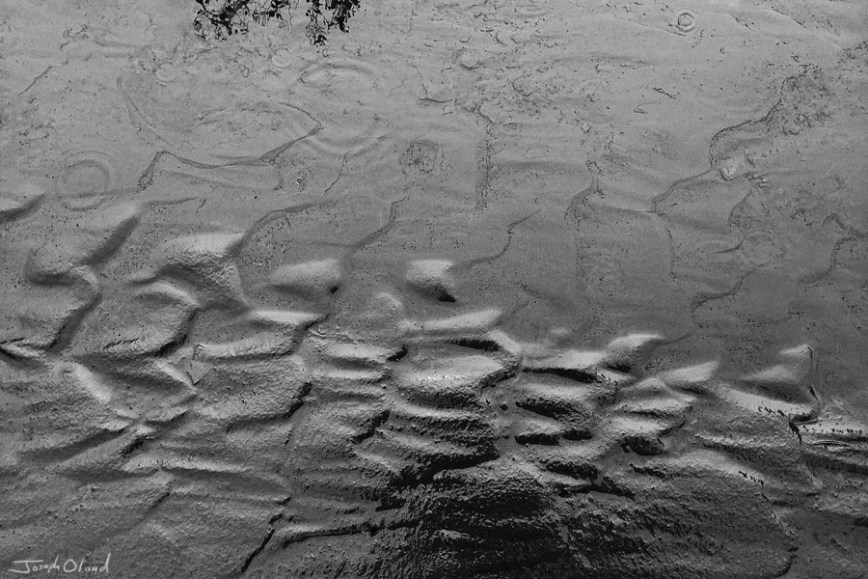
Some of these images are used to add grit and texture to other photographs I’ve taken (as overlays and double exposures). Some of them reveal themselves to be stand-alone pieces. The image above just so happens to be one of those stand alone pieces. While hiking through the rain-drenched red mud of Sedona, Arizona, there was a moment when I realized I had been paying too much attention to the mountains towering over me – that’s what always captures people’s attention – and I needed to take a moment and start looking around.

So I trained my lens on the ground, rather than the high peaks. To the streams and the insects, the animal tracks and the budding cacti, rather than the red rock spires that dominate the landscape. And this is what I got – a portrait of the tiny little stream, the stream that traveled a long distance from a large rock formation, from a mist of rain, to soak into my boots and ensure that my feet would be wet and itchy all day long.

Small price to pay to be reminded how beautiful the world is.

The details, the small little things? They really are beautiful. And they really do matter.

“The past becomes a texture, an ambience to our present.”
~Paul Scott

SIGN UP FOR THE LENSEBENDER NEWSLETTER

January 01, 2017 – New Landscapes

201701-01-blogFINE ART PRINTS AVAILABLE HERE
– – –
FOLLOW ME ON INSTAGRAM

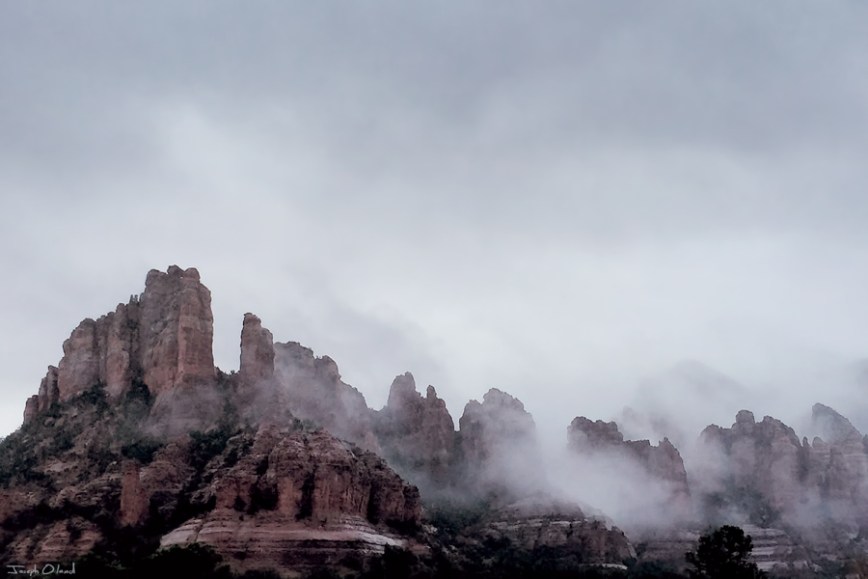
I started this project last year and I didn’t even make it to the three month mark. Well, we just said goodbye to the year 2016, and I’m going to give this another solid run. One photograph a day – or painting, or drawing, or whatever – for the full 365. I’m beginning this series with a photograph taken with my phone, New Years Day, after waking up hangover-free to a rainy Sedona, Arizona landscape.

It was a good hike, with good, loving company. The best possibly way I think I have ever welcomed the beginning of a new year.

I hope you’ll send me some support and positive thoughts, and I will try my best to keep this project on its feet.
Happy New Year!

“Amateurs sit and wait for inspiration, the rest of us just get up and go to work.”
~Stephen King

SIGN UP FOR THE LENSEBENDER NEWSLETTER


Save

Illustration – Nude Study

FINE ART PRINTS AVAILABLE HERE

There is no genre of art older than the nude study, the bare human form. It commands our attention and often makes some of us turn away, either in modesty or – more sadly – in shame. The question of its endurance as an art-form throughout the ages is an interesting one. To my mind, the nude is deeply symbolic philosophically, and elegant in its accidental eroticism. The nude is both attractive – and to many, uncomfortably attractive – because it symbolizes true vulnerability; exposed flesh presents a form with nothing left to reveal.

The nude subject is in its most confident and vulnerable state, achieving these at the same time. This cannot be found anywhere else, and that is why nude studies are so captivating, so mesmerizing, so subtly profound. We objectify and sympathize, simultaneously, and this duality forces certain truths to snake their way into our consciousness, about how we view our own bodies and how we use them.

I am proud to be both painter and subject in this genre, to continue this great tradition. In a media landscape that barely bats an eye at extreme violence but suppresses the most natural of sexual desires, I regret only that my artwork isn’t more filled with genitalia.

FINE ART PRINTS AVAILABLE HERE
– – –
SIGN UP FOR THE LENSEBENDER NEWSLETTER

Better Call Saul – Expert Camera Work

Regalo Helado postFINE ART PRINTS AVAILABLE HERE
– – –
READ OTHER ‘CALL SAUL’ POSTS HERE

One of the better things I’ve heard somebody say recently was that “storytelling is telepathy.” I was listening to this interview with a young screenwriter and he summoned those [likely not too famous] words from author Stephen King. I enjoy the odd logic of the statement, though – somebody writes the words down, and then we absorb them when we read them and create the story in our minds. We don’t just absorb them; we become a part of the story. The inert symbols on the page, black ink on white paper, become images in our imaginations. We assign voices and details, interpretations and emotions, to the tune of elegant simplicity – black ink on white paper.

We’ve been doing it since the birth of civilization.

Cinema, a decidedly modern method of storytelling, is a little different. It’s all more specific. The images, the look of the characters and the sound of their voices – these things have all been chosen for us, by a director. In many ways, we can describe reading as more of a ‘participatory’ form of storytelling – we have to use our imaginations and help co-author the story being told – and watching film & television as more of a ‘passive’ form of storytelling. This is why we associate books with intellect and television with laziness.

This is a false dichotomy.

Good storytelling, either in print or telecast, motivates the reader (or audience member) to make decisions. Good storytelling on the screen is the kind of storytelling that rewards the audience for paying attention – to color palettes, symbolism, narrative structure, foreshadowing, and character development/evolution. Most of us recognize these things, even if we aren’t looking for them or actively thinking about them. Television shows in the last several years, it should also be noted, have achieved a level of quality and substance that rivals most mainstream feature films.

In many ways, the television series allows storytellers to exercise their talents in a way that feature film could never allow. Can a ninety minute film accomplish as much as a sixteen episode season (or an entire series)? Of course not. A television series has more time to introduce an ensemble of characters, establish their unique and individual qualities – their challenges, their strengths, their shortcomings – and bring the circumstance of their lives into clear and cutting focus.

Better Call Saul is a wonderful example of long-form story-telling. It’s one of the reasons that it’s so beloved (and simultaneously so under-appreciated, because of it’s painful rarity) in the television world. It is incredibly ‘literate’ in its approach, each episode a small little piece of a morality play, each episode a small little piece of a bigger puzzle. The most recent episode, to my mind, is one of the greatest examples of cinema-quality film-making applied to a television series, specifically because of how the opening scene is shot, choreographed, and cut.

The entire first sequence follows a refrigerated truck – presumably smuggling narcotics – across the US-Mexico port of entry. Using one camera operator, three different vehicles, and a steady-cam, the establishing shot is achieved in one single, sustained, three-plus minute shot. A ballet of vehicles and extras – law enforcement, truck drivers, perpetrators, and K-9 units – swirl around the scene. The camera glides through and captures this scene without a single cut. The trick of trying to cram non-narrative story into a long, sustained, uncut shot is as old as film itself, but rarely is it accomplished with such extraordinary finesse. The longer the camera can reveal an unfolding narrative, the less the audience is motivated – whether consciously or unconsciously – to question its authenticity. That’s because real life – our true, moment-to-moment lives – aren’t cut from angle-to-angle, perspective-to-perspective, over one shoulder and then <whack> over another shoulder. The longer the scene can go without an edit, the more we are seduced, as audience members, to believe it.

If you haven’t hopped aboard the Better Call Saul bandwagon, I suggest you give it a day in court – pun intended. Following the ‘cartel mule-truck through the port’ scene – an extraordinary achievement in television film-making – I can’t wait to see what other cards the show-runners are hiding up their sleeve.

– – –

Other films with remarkable tracking shots (nope, can’t think of any other television shows):

  1. Boogie Nights – The opening scene starts outside the night club, tracks into the club, snakes through the seating area and onto the dance floor, and winds back out. Every single major character in the film has at least one spoken line of dialogue and the scene lasts roughly ten minutes (a so-called ‘full-film-magazine’). It is insane when you consider how hard it must have been to choreograph this.
  2. Irreversible – This is the film that can’t be un-seen. It’s one of the most grotesque and challenging-to-watch films ever made, with Gaspar Noe at the helm. The film is replete with slight-of-hand cuts (paving the way for Birdman, but taking it’s inspiration from Alfred Hitchcock’s Rope) that give the illusion of long cuts, including the devastating brawl at the gay sex club in the first scene. But it’s the sexual assault scene in the middle of the film, in a dark roadway underpass, that is truly shocking. The camera sits like a fly on the wall. The graphic content of the scene makes it all-the-more uncomfortable for the audience, that the camera never blinks, never looks away, never cuts to something less awful than the brutal violation right in front of it. It’s easy to forget that this is just a movie, watching this scene. It’s hard to remember that it’s not real, that this isn’t in fact a true-to-life snuff film. This is one of the most amazing films ever made, but it comes with an asterisk – not for the weak of heart.
  3. Children Of Men – I’m not even a fan of this film. The premise is outlandish, with little or no real time spent on trying to explain how or why the characters live in a world where women simply can’t get pregnant. The idea itself is compelling, but the details are glossed-over and we’re expected to just accept that, yeah, this is the world of this film. Women ain’t gettin’ pregnant. World’s gonna end. Bummer, dude.
    Nevertheless, there is a moment in an embattled urban area, tanks creaking into the streets, in which the protagonist walks through mortar fire and military vehicles, through throngs of people, to bear witness among a huddled gathering of resistance fighters, to an infant child. The camera follows him through the streets, around tanks, amid explosions and hordes of civilians battling military personnel. The camera never cuts, and the scene is undeniably, tear-inspiringly beautiful. It’s a shame that it’s embedded in what, to me, is a muddled mess of a film. But it’s one brilliant piece of film-making nonetheless.

Can you think of any long-cuts that should be added to the pantheon? Let me know in the comments.

FINE ART PRINTS AVAILABLE HERE
– – –
SIGN UP FOR THE LENSEBENDER NEWSLETTER

Nude Woman With Flower

Woman With Flower post

FINE ART PRINTS AVAILABLE HERE

Art for art’s sake. Isn’t that the expression? We just like to look at pretty shit and say “hey, jeez, that’s some pretty shit.” Everything is beautiful, nothing is off-script in the production-house of life. We wipe the crust from our eyes every morning, slap the alarm clock, brew our coffee, and go about our lives. And everything involved in that process is pretty nifty when you get right down to it. I mean, there’s tragedy and frustration as well, but these things can also feed into a creative, evocative, and transcendent output.

All of that is to say this: when in down, artist friends, make pictures of naked women. It’s as old as cave paintings. I found myself sifting through old source material, looking for an excuse to make a painting, and the image above is where I landed, for lack of anything else to do. I hope you like it.

FINE ART PRINTS AVAILABLE HERE
– – –
SIGN UP FOR THE LENSEBENDER NEWSLETTER HERE

February 29 – Reflections

02-29 Reflections postToday I present the final image for Film February, a landscape made with my favorite old film stock, Fujifilm Velvia.

FINE ART PRINTS AVAILABLE HERE
– – –
SIGN UP FOR THE LENSEBENDER NEWSLETTER

February 28 – Checkerboard Café

02-28 Checkerboard post

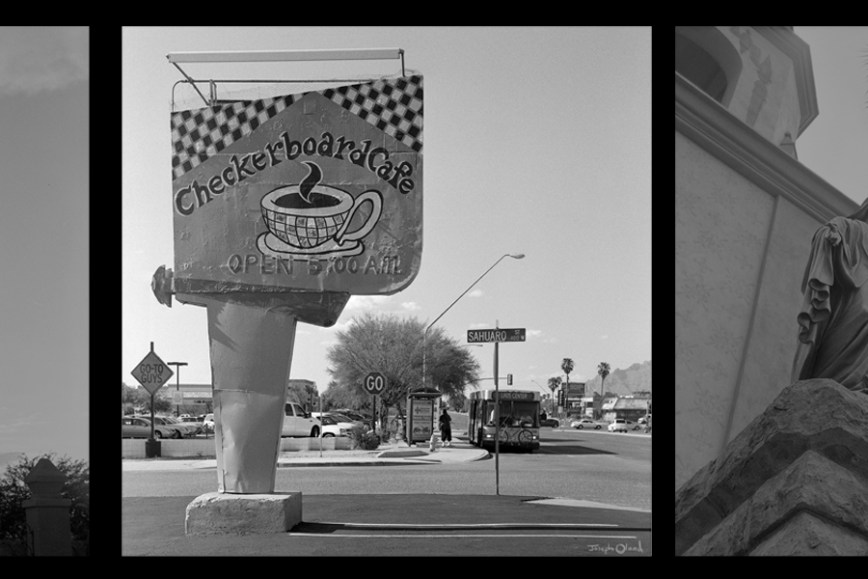
I’ve never dined at The Checkerboard Café, but I always liked the sign. Billed on its website as “Tucson’s Friendliest Diner,” I suppose I will make this my first destination upon my return. Of course, the home page possesses a few typos, including listing at as “Located a Grand and Oracle Road,” when I’m pretty sure they meant Grant Avenue, I supposed I’ll give ’em a pass. Seeing as how the website also lists its copyright as 2012, I suppose I’d have to dig a little deeper just to confirm that it’s even still there.

FINE ART PRINTS AVAILABLE HERE

SIGN UP FOR THE LENSEBENDER NEWSLETTER

February 27 – Bridge Over The Wash

02-27 River Wash postThe Rillito River no longer runs twelve months a year, although it is credited with Tucson’s early growth. During a brief period of time, I lived along the wash and rode my bike along the hiking path whenever I could. During the monsoon season, the stretch of the river wash near my apartment would erupt with the sound of chirping frogs, and sometimes at night I would hear packs of coyotes howling.

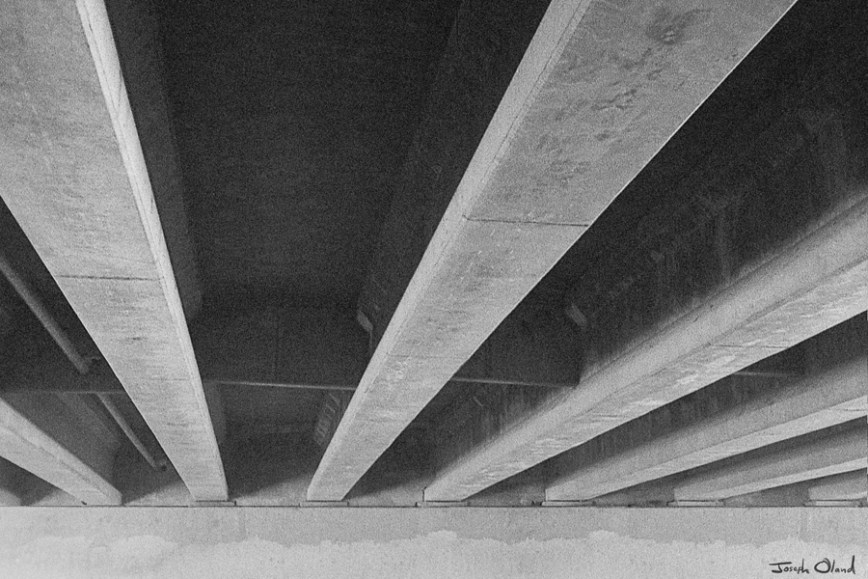
Beneath the Swan Road bridge, I made several studies of the steel beams. It’s a simplistic composition, but I always thought it looked interesting through the viewfinder of my Fujica Half vintage camera. This is one of the many pictures I made during that time.

FINE ART PRINTS AVAILABLE HERE
– – –
SIGN UP FOR THE LENSEBENDER NEWSLETTER