January 04, 2017 – Snowstorm In Arizona

201701-04-blog

FINE ART PRINTS AND MERCHANDISE AVAILABLE HERE
– – –
FOLLOW LENSEBENDER ON INSTAGRAM!

After a glorious New Years celebration in Sedona, Arizona, we decided to take the long way back to Tucson. Although it was sixty miles out of our way, Flagstaff was too close not to pass through. As we approached the mountaintop city, whiteout conditions descended from the hills, a big black mass of winter fury.

Naturally, once we passed through the maelstrom, it was necessary to stop and get our boots wet. Virgin snow is beautiful, but even more-so to the desert-rat. It’s a rare sight for Arizonans – and even though I’m from Kansas, I have to admit an affinity for a landscape draped in fresh snow.

SIGN UP FOR THE LENSEBENDER NEWSLETTER!


Save

Save

January 03, 2017 – Muddy Stream

201701-03-blog

FINE ART PRINTS AND MERCHANDISE AVAILABLE HERE
– – –
FOLLOW LENSEBENDER ON INSTAGRAM

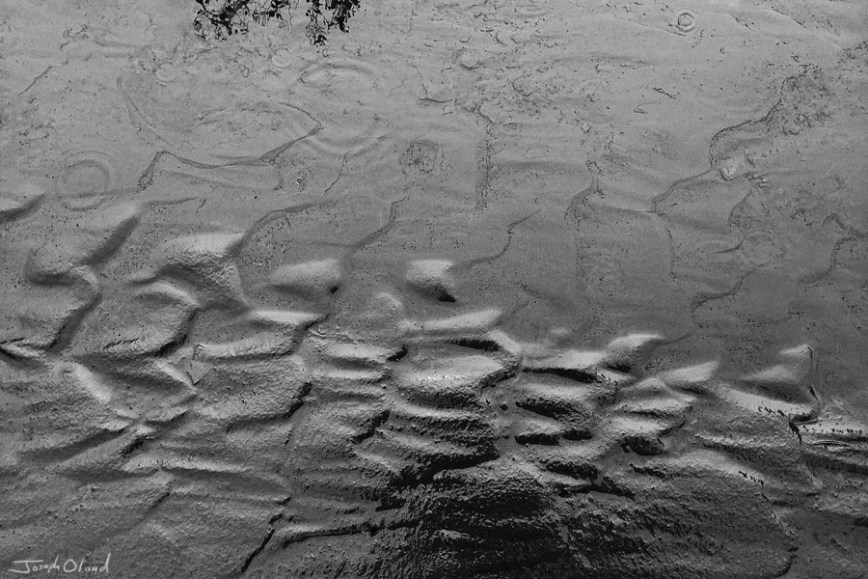
Textures – a long obsession of mine.
Without spending too much time being overwhelmingly boring, I will say that I have spent weeks – probably months – of my life with a macro lens in my hands and earbuds piping music into my brain, photographing cracks in pavement, tree bark, broken patches of clay-rich earth, rusty garbage containers, and just about anything you can find on a rusting old car or in a back alley, in order to expand my collection of texture images.

My library is extensive.

Some of these images are used to add grit and texture to other photographs I’ve taken (as overlays and double exposures). Some of them reveal themselves to be stand-alone pieces. The image above just so happens to be one of those stand alone pieces. While hiking through the rain-drenched red mud of Sedona, Arizona, there was a moment when I realized I had been paying too much attention to the mountains towering over me – that’s what always captures people’s attention – and I needed to take a moment and start looking around.

So I trained my lens on the ground, rather than the high peaks. To the streams and the insects, the animal tracks and the budding cacti, rather than the red rock spires that dominate the landscape. And this is what I got – a portrait of the tiny little stream, the stream that traveled a long distance from a large rock formation, from a mist of rain, to soak into my boots and ensure that my feet would be wet and itchy all day long.

Small price to pay to be reminded how beautiful the world is.

The details, the small little things? They really are beautiful. And they really do matter.

“The past becomes a texture, an ambience to our present.”
~Paul Scott

SIGN UP FOR THE LENSEBENDER NEWSLETTER

Sin City – Nancy Callahan

SinCity Nancy postFINE ART PRINTS AVAILABLE HERE

I sat down today and watched both of the Sin City films. I’ve been a fan of the comic series ever since I bought a used paperback at ‘Bookman’s Buy-Sell-Trade’ superstore in Tucson when I was a freshmen in college. At the time, the rack was overstuffed with copies, and I nabbed mine for a measly ninety-nine cents. It was cheap enough that I didn’t find it sacrilege at all when I chopped it up and pasted individual frames into my sketchbook.

I was a comic collector since childhood – mostly X-Men titles – and had no idea what Sin City was about. I didn’t even read the book. I just sifted through the pages and appreciated the art. When it was adapted into a feature film, I started paying attention. It had the noir elements, the over-clocked one-liners, trench coats, and fedoras. It was black and white, self-referencing, darkly comedic, and playful. It was a perfect film specifically because it didn’t take itself too seriously – it was engineered to be pulp entertainment. It was designed to be fun.

Sin City was also a throw-away film. It appealed to a niche demographic, not turning too many heads. This is a disappointing revelation because the production was insanely innovative, inventing new film-making techniques that allowed the comic book to come to life. Of all the comic book movies that exist today, I can’t think of a project more true to the source material than Sin City. Most of the film was shot on green-screen, with the background environments inserted in post-production. The violence is stylized, and the black-and-white palette is used with intuitive brilliance.

The sequel, A Dame To Kill For, didn’t perform well at the box office. But it’s a fantastic voyage into the back alleys of Frank Miller’s fictitious city of crime and corruption. Think Gotham, only more fucked up. The vignetted stories are fun, dark, grimly humorous, and worth a look.

FINE ART PRINTS AVAILABLE HERE
– – –SIGN UP FOR THE LENSEBENDER NEWSLETTER

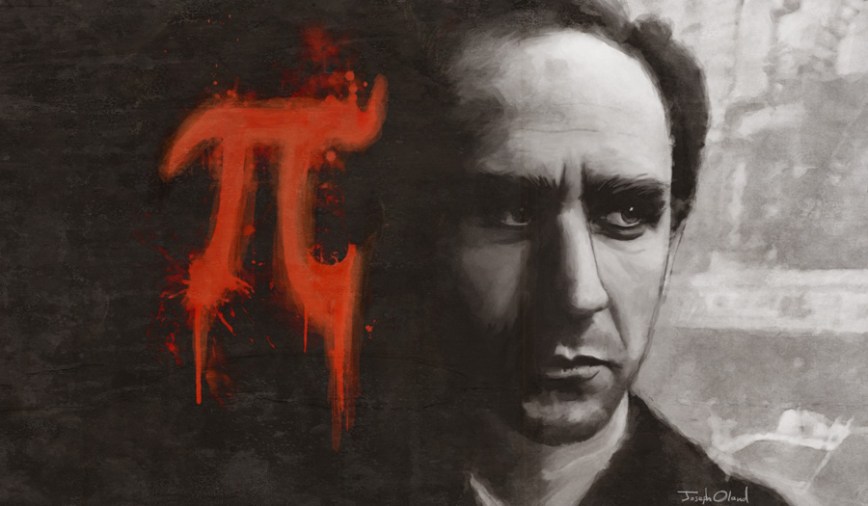
Happy Pi Day!

Pi Day postFINE ART PRINTS AVAILABLE HERE

Forget the smattering of delicious home-baked goodies swarming social media. “Pi Day” will always remind me of the pseudo-noir psychological thriller from esteemed director Darren Aronofski. It’s a difficult plot to summarize, but suffice it to say that it has the feeling of an experimental film, shot in cheap black-and-white film-stock with golf ball sized film grain that serves to hugely influence the dark tone of the film. The main character is a supremely brilliant mathematician that becomes obsessed with the number Pi, an obsession that leads him down a severely dark path. If you haven’t seen it, I highly, highly, recommend  it.

In honor of the day, I sat down and hammered out this illustration, which is now for sale at my online storefront.
Cheers!

FINE ART PRINTS AVAILABLE HERE
– – –
SIGN UP FOR THE LENSEBENDER NEWSLETTER

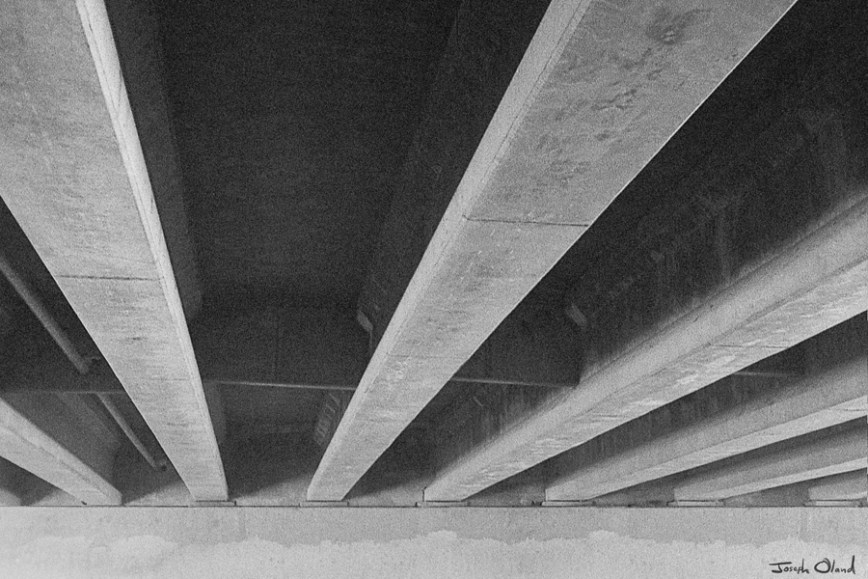
February 27 – Bridge Over The Wash

02-27 River Wash postThe Rillito River no longer runs twelve months a year, although it is credited with Tucson’s early growth. During a brief period of time, I lived along the wash and rode my bike along the hiking path whenever I could. During the monsoon season, the stretch of the river wash near my apartment would erupt with the sound of chirping frogs, and sometimes at night I would hear packs of coyotes howling.

Beneath the Swan Road bridge, I made several studies of the steel beams. It’s a simplistic composition, but I always thought it looked interesting through the viewfinder of my Fujica Half vintage camera. This is one of the many pictures I made during that time.

FINE ART PRINTS AVAILABLE HERE
– – –
SIGN UP FOR THE LENSEBENDER NEWSLETTER

February 21 – Manhole Cover

02-21 Manhole Cover post“The longer you look at an object, the more abstract it becomes, and, ironically, the more real.”

~Lucian Freud

– – –

Film February continues with yet another recurring theme in the pantheon of old subject matter. Some people miss out on what’s going on around them because they stare at their shoes rather than look around. There’s nothing wrong with staring at the ground, if you ask me – there’s a lot going on there.

As I’ve mentioned in previous entries to this project, street photographer Aaron Siskind played a major role in inspiring a younger version of myself. Seeking out interesting compositions in mundane places became something of a game. While interning at The Center For Creative Photography in Tucson, I also became deeply fascinated by a photographer named Minor White, who also had a tendency to isolate seemingly normal, everyday objects and somehow manage to make them alien, interesting, unique.

There is definitely something magical about working in black-and-white film.

FINE ART PRINTS AVAILABLE HERE
SIGN UP FOR THE LENSEBENDER NEWSLETTER

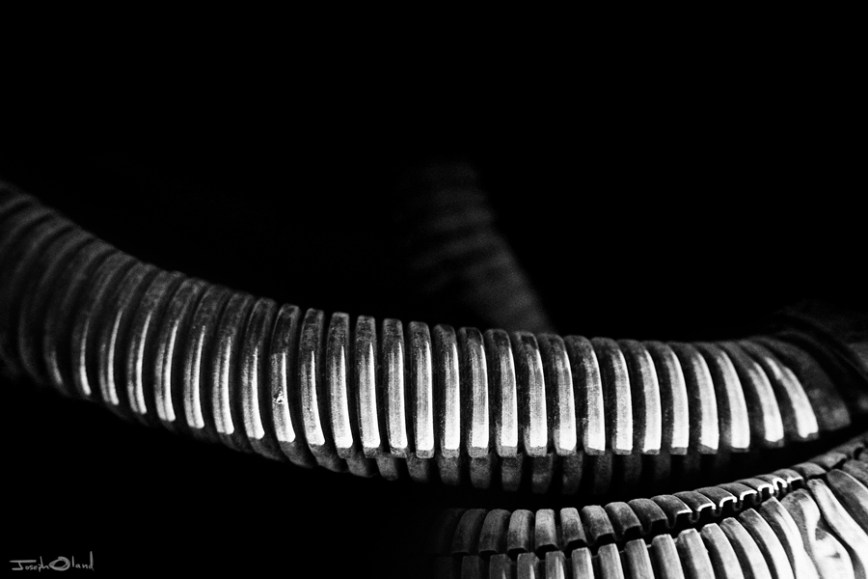
February 20 – The Serpent (and semiotics)

02-20 The Serpent postToday’s photograph for the continuation of ‘Film February’ corresponds to a time when I was first exposed to a different, more literary side of photography. After reading “Subculture: The Meaning of Style” by Dick Hebdige, the door to semiotics was opened. It was nauseatingly confusing to me, this new philosophy of graphic language, but it was also intriguing. I fell down the rabbit hole and found myself thinking about my photographs in a completely different way. I’m reminded of one of photography’s seminal publications, “Camera Lucida: Reflections on Photography,” and a particular passage by author Roland Barthes which summarizes my feelings perfectly:

“For me the noise of Time is not sad: I love bells, clocks, watches — and I recall that at first photographic implements were related to techniques of cabinetmaking and the machinery of precision: cameras, in short, were clocks for seeing, and perhaps in me someone very old still hears in the photographic mechanism the living sound of the wood.”

From the moment I began these new studies I started looking through the viewfinder differently. This is when I became interested in macro photography, and it’s when I became much more deliberate with my compositions. When I take the time to really investigate, I discover that there are interesting things all around, that there is always something interesting to investigate with my photographers’ tools. With camera in hand, I’m a kid looking under rocks and discovering whole worlds that I never knew were there before.

FINE ART PRINTS AVAILABLE HERE
SIGN UP FOR THE LENSEBENDER NEWSLETTER

February 18 – The High Plains (cyanotype)

cyanotreeRather than discuss a vintage camera, today’s Film February photograph highlights an antiquated printing process that, unlike the abnormally frail Daguerreotype or the albumen paper negative print, is still in somewhat frequent use today.

The “cyanotype” is a printing process that produces a blue-tinted print – cyan colored, even – so it’s an unironic name. Using basic ferric (iron) salts, this is one of the most affordable printing processes ever invented. This is why engineers used the process, with frequency, well into the 20th century; you would recognize them as “blueprints.”

The process uses two chemicals: ammonium iron(III) citrate and potassium ferricyanide.

During the latter half of the 19th century, photographers used horses and donkeys to carry their mobile darkrooms, consisting of photo chemicals, containers, camera equipment (view cameras were quite cumbersome) and a tent that served as dark room. Organic compounds commonly referred to as ‘ethers’ were used to dissolve collodion silver for wet-plate photography – never mind what wet-plate photography is, just know that it was the dominant method. The instances of field photographers being overcome by ether fumes and dying were not rare. In fact, the chemical nature of print photography has represented significant risk to all photographers prior to the digital revolution.

The pyrogallol (“pyro”) film developing process functions to tan and harden film images in a low sulfite environment. In the era prior to darkroom tongs, latex gloves, and ventilators, this chemical caused serious nerve damage to a generation of photographers. It’s most famously linked to Edward Weston, America’s founding father of photography. If you don’t know who Edward Weston is, don’t worry – you know his most famous pupil. Weston taught a young Ansel Adams. He had previously been though to have died of Parkinson’s disease. The symptoms of Parkinson’s are identical to prolonged exposure to pyrogallol, and he worked with this chemical for most of his life.

Selenium toners are used to make silver gelatin prints more archival. The selenium metal is less prone to aging, fading, or degrading than the silver halide crystals that it replaces. It also gives prints additional tonal density and a slight brown color tone that many photographers find appealing in their black-and-white work. Selenium toner poses cancer risks and respiratory damage if inhaled or absorbed through the skin.

Cyanotype printing is widely believed to be a harmless process, but potassium ferricyanide can be incredibly dangerous if improperly handled. Reactions can occur with other darkroom chemicals, producing a noxious gas that can be fatal.

Why do I say all of this? Well, I suppose because I find it all very interesting. Photography is both a science and an art, and I think that we forget that sometimes, especially with how easy photography has become with our smartphones. Prior to the digital revolution, photographers weren’t just ‘witnesses with cameras.’ They didn’t simply “Point. shoot. Viola! Here’s your print.”We were visual composers, yes, but we were also reasonably experienced chemists, often coming up with our own chemical mixtures – our own recipes – to produce desired film grain, image density, contrast, print aesthetic, and color tone. We don’t often think about the photographer in his darkroom (nor, contemporaneously, hunched over a computer screen). We prefer to think of the photographer in the field, riding in the back of a muddied Jeep, sitting on the 50-yard-line, credentialed and in the front row at the press conference. Photography is spent half out in the world, gathering images, and half in the dark, fine-tuning the images we’ve gathered.

Photographers have always had a history of risking health and personal injury in order to execute their craft, and I’m proud to consider myself among that cohort. I haven’t covered war, traveled to a third-world nation, been kidnapped. I’m no hero, but I like to think that I’ve had the opportunity to bear witness to extraordinary events, and I was there with my camera. I have participated, in my own small way, to that rich history.

The lessons I learned in the darkroom are lessons of patience, an appreciation for chemistry, and the rewards of diligence. Pulling prints from a negative is an involved process, and no amount of Photoshop can replace the sheer joy of walking into the light with fresh, wet print. To walk out of the red light in the darkroom and see what your print actually looks like, to have been working for hours and hours, and finally see that you’ve dialed it in, that you have the perfect print.

You stink. You’re tired. It’s three o’clock in the morning. And damn is it exhilarating. That’s why I still shoot film when I can.

FINE ART PRINTS AVAILABLE HERE
SIGN UP FOR THE LENSEBENDER NEWSLETTER


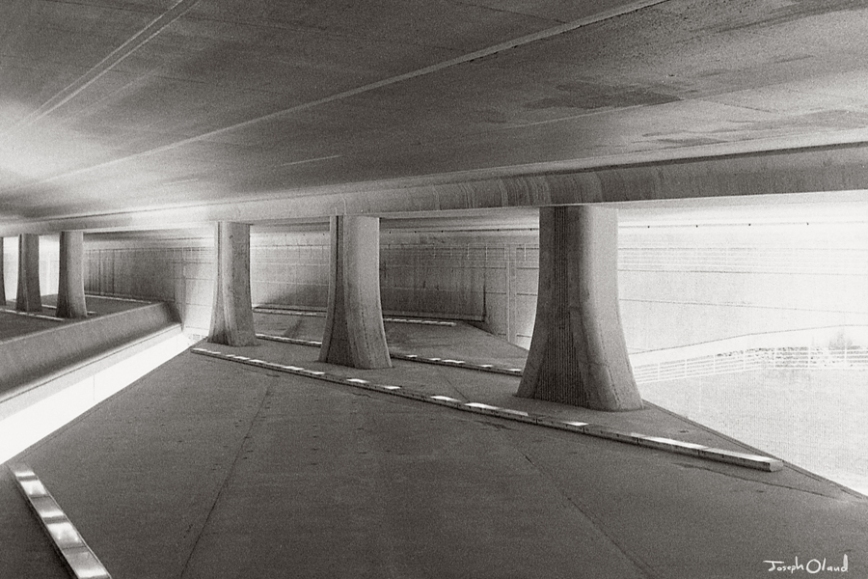
February 07 – Changes In Perspective

02-07 Tucson Underpass postThis Sunday’s photograph of the day is one of the older classics I’ve always loved and nobody else ever seemed interested in. That’s just one of the painful little things you have to get over when you’re an artist; almost every single painting or photograph that I love are the very paintings and photographs nobody seems to like. And those pieces that I’m not so sure about? The ones I even consider throwing away or deleting? Well, people tend to love those the most.

It’s just one of the ironies.

Nevertheless, I remember looking at the negatives, still dripping wet after being developed in my friend’s kitchen. These are Fujica Half images, so there were tons of exposures to look through. The composition of these really intrigued me. I had a small pile of proof prints eventually made, and that’s when I realized how I wanted to display these images. Thumbing through the proofs, I saw this image upside down, and it really intrigued me. It looked like an alien city or a futuristic concept.

I was reminded of the scene from Steven Soderbergh’s “Ocean’s Eleven” where the fidgety tech character is in the labyrinthine hallways to seek out the server room and tap into the security camera output for the hotel. The room itself is flooded with blue neon light and looks incredibly alien – it turns out that the film’s location scout had looked at a photograph of a server room upside-down and though it looked neat. So the set was built, complete with neon lights coming from the floor, rather than from the ceiling.

Happy little accidents. It’s the simple things we don’t think of that can really influence our work. That’s why critique is important, and why artists like to bounce ideas off each other. Some small little detail may make all the difference.

FINE ART PRINTS AVAILABLE HERE
SIGN UP FOR THE LENSEBENDER NEWSLETTER
February 05 – Craters In The Earth

02-05 Meteor Crater postThe year was 2001 and I was a cocky asshole of a man. My girlfriend and I somehow conned her parents into lending their minivan to the enterprise and we lit-out for the western territories. I’d received an acceptance letter from the University of Arizona and I was ready to get the hell out of Kansas. Little did I know that attending the UofA would mean just about nothing, other than a pile of debt with a degree worth less than the scrap of parchment it was printed on.

But that’s a whole other story.

An 18-year-old version of me screamed down the highway in a soccer-mom van with a young slab of beautiful woman-flesh – and that’s all that mattered. We camped along the high desert, free spirits, and I will never forget the experience. Trading sex in a two-door coup for sex in a bulky 1970s-style canvas tent is probably one of the more sublime experiences this young man could have ever hoped for at the time.

We drove through Tucson and struck camp at Mount Lemon and surveyed the landscapes along the painted desert of Northern Arizona. It was the first time in my life I felt truly unfettered, rising in the morning to the sound of rushing creek water and a lovely ivory face beside me, cloaked in locks of streaming brown hair, lips upturned in a sly satisfied smile.

No drug can ever replace the experience of being eighteen years old and in love. Today’s photograph is a reminder of that innocent time; my woman by my side, unaware of the struggles ahead, I dialed the numbers in and pushed a button along the rim of the great meteor crater. This picture represents everything I held important from those lofty teenage years.

It was a good time, in tall grass and open sky. And I will take that pleasure with me into the earth.
When the time comes.

FINE ART PRINTS AVAILABLE HERE
SING UP FOR THE LENSEBENDER NEWSLETTER