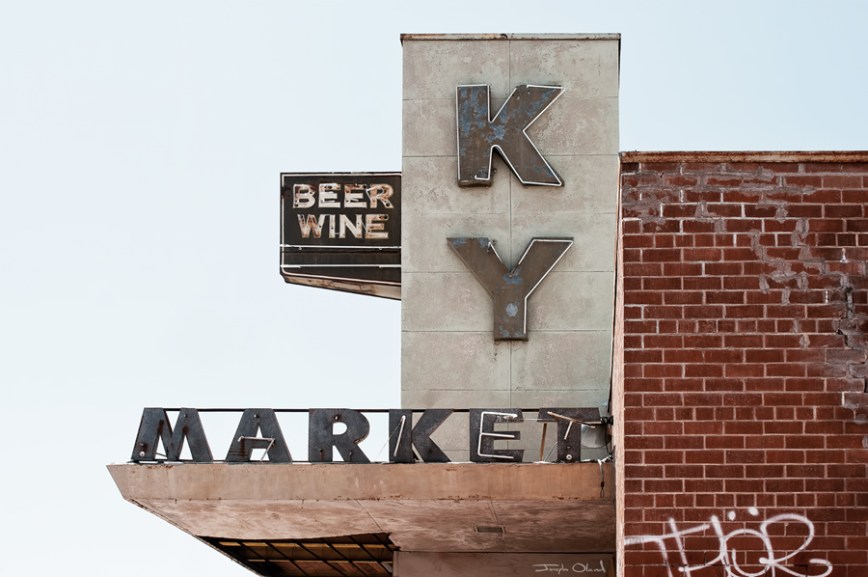
May 01, 2017 – Vintage Tucson

FINE ART PRINTS AVAILABLE HERE
– – –
OTHER ‘IMAGE OF THE DAY’ PRINTS AVAILABLE HERE

We’re beginning the new month with a theme of ‘interesting places,’ but this will be a loosely interpreted theme. I don’t always uphold the rules of the month entirely, but there certainly isn’t a a dearth of interesting, weathered, creative, or otherwise unique little corners of the world.

There are a lot of interesting old buildings in Tucson, as the desert city rose into greater prominence in the middle of the 20th Century. State highways were lined with service stations and motels, and American ‘car culture’ was alive and well. In some ways, Tucson was something of a stopover as people made their way to California, and that’s precisely where many of the old motor lodge neon signs come from along the Old Benson Highway.

This image, just south of Downtown Tucson, has recently been rehabilitated and the neon sign has been repaired and re-lit. I’m happy that the structure is being preserved, but I also have this strong affinity for these old, rusty, rickety buildings. I guess there’s something to appreciate on both sides of that coin, and there’s definitely something to appreciate when an old relic of a building is once again inhabited, rather than vacant and in danger of demolition.

SEE YESTERDAY’S IMAGE OF THE DAY
– – –
SIGN UP FOR THE LENSEBENDER NEWSLETTER
April 08, 2017 – Message Board

FINE ART PRINTS AVAILABLE HERE
– – –
OTHER ‘IMAGE OF THE DAY’ PRINTS AVAILABLE HERE

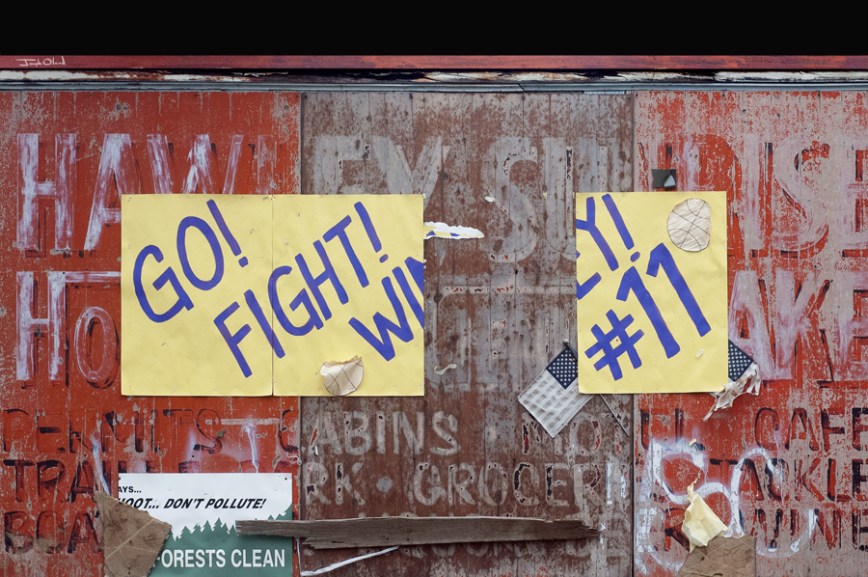
McNary, Arizona, is only about ten minutes down the road from Pinetop-Lakeside. Unlike the Pinetop community – with curio shops, antique malls, and a well-established network of cabins, resorts, hotels, and restaurants – McNary is a forgotten, depressed community with collapsing buildings, open dumping grounds in the middle of residential neighborhoods, and shuttered shop windows. The population is around five hundred people, eight-six percent of which live below the poverty line.

Here’s one of the old shop signs, covered with graffiti, bulletins, and the faded original paint.

SEE YESTERDAY’S IMAGE OF THE DAY
– – –
SIGN UP FOR THE LENSEBENDER NEWSLETTER

February 22, 2017 – Old Car

FINE ART PRINTS AVAILABLE HERE
– – –
OTHER ‘IMAGE OF THE DAY’ PRINTS AVAILABLE HERE

Today’s image comes from Opera Drive, a winding road on one side of the canyon known to local Bisbee, Arizona residents as Brewery Gulch. There’s new money in the old mining town, and some old money – but mostly there’s no money. Anybody who walks far enough up Brewery Gulch will see the junk houses and the yards filled with splintered lumber, old tires, bathtubs, and rusted cars. The paved road terminates, giving way to a gravel pathway with sharp rocks and small remnant shacks from the old mining days, when Bisbee produced more copper than any other mine in the United States.

Up on Opera, looking down on the gulch, are houses perched on the hillside – some little more than remnant shacks, others renovated by the nouveau riche. Regardless of income or social standing, the views are just the same, and always fantastic. I made this picture of an old car parked on the roadside while I was hiking up to the end of the gulch, where the road splits into a couple of hiking trails that wind around into the surrounding hills in the high desert.

“The goal of abstract art is to communicate the intangible, that which eludes the photograph and normal seeing.”
~Curtis Verdun

SIGN UP FOR THE LENSEBENDER NEWSLETTER

February 08, 2017 – An Antique Land

east-helen-post

FINE ART PRINTS AVAILABLE HERE
– – –
OTHER ‘IMAGE OF THE DAY’ PRINTS AVAILABLE HERE

The difficulty with making anything that could even closely be mistaken for art is that art is entirely subjective. We live in a highly interconnected world, and there are volumes of online videos, written articles, marketing books, and web pages dedicated to “hacking” yourself into financial success. That’s fine, except it reduces art to a craft – identify your niche in the market, and then do nothing but the same thing, over and over and over again until it’s time to retire.

There’s a lot of beautiful work made by incredibly talented people who adopt this model of marketing, but I can’t quite seem to hop aboard. I don’t want to sit down, do some social media research, and then spend the rest of my life making different versions of the same picture. I suppose this is why I haven’t ever struck it rich as a creative professional – but I’m definitely satisfied when I finish a piece.

This is the newest image in a series that I started about a decade ago, called ‘An Antique Land,’ a line borrowed from Percy Shelley’s poem. To me, this series of architectural ‘portraits’ taps into the impermanence of our communities. But I prefer not to comment much beyond that; I don’t like to tell people what to think about this kind of work. My interpretation, or my intent, doesn’t imbue this images with significance. I like the idea of people looking at this kind of work and bringing their own ideas to the table.

Until next time, folks. I’ll be seeing you soon.

“A photograph is a secret about a secret. The more it tells you the less you know.”
Diane Arbus

SIGN UP FOR THE LENSEBENDER NEWSLETTER

January 15, 2017 – Rusted Car

rusted-carpostFINE ART PRINTS AVAILABLE HERE
– – –
OTHER ‘IMAGE OF THE DAY’ PRINTS AVAILABLE HERE

Today’s image – like most of them – is pretty self-explanatory. I mean, it’s photography, right?

Usually – but hey, not necessarily always – it’s almost always obvious what a photographic image is actually of. Even a brickwork of primary-colored Mondrian tiles is imbued with subtext and pregnant with meaning. So why not a portrait of a rusted heap, rotting in the desert like a disposed of beer can baking under the sun?

But it isn’t my job to tell anybody how they’re supposed to feel about an image like this. Much of my work, I’ve been told, carries with it, or conveys, a certain ambivalence. This isn’t even halfway close to true. I compose my images carefully, but I’m not concerned, at least not at all times, with being explicit with personal meanings. Ambiguity allows for different experiences, and I think that ambiguity can be a very powerful tool when creating artwork – especially photographic artwork, which is often disregarded as an easy, unimportant happenstance that occurs between the photographer and whatever happens to fall before his or her camera lens.

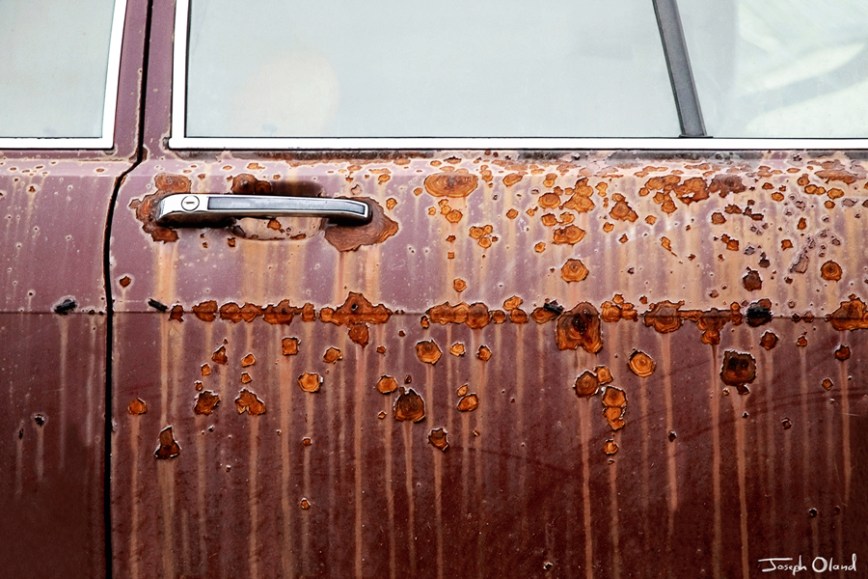
I am drawn to textures, contrasts, and colors. And I love the camera’s ability to take everyday objects and completely re-frame them. We all know what a car is – wheels and a seat, a hood and door-handles. But when we encounter cars in our day-to-day lives, we’re always taking in the whole thing. It’s a familiar object and, because of its familiarity, it’s easy to disregard. But when you look at the details, the scratches, the design of the body, the wear on the upholstery, the scuffs on the tires, something else emerges. I wouldn’t want to give that ‘something’ a name, really, but the camera has given me, if nobody else that looks at my photographs, the ability to recognize absolutely insane beauty in the unutterably mundane.

In a world filled with cars – to an almost sickening degree – I was walking down the road and saw the age and rust on this particular vehicle, and I was drawn to it. So…I dunno. Do with that anecdote what you will.

SIGN UP FOR THE LENSEBENDER NEWSLETTER

Save

Save

The Yashica-D

Yashica-DThis camera is closely associated with what press photographers carried during the 1950s and 1960s, although I must admit that the Yashica is a bit of a knock-off; the Rolleiflex is the original sensation. The reason these were considered more professional had a lot to do with the lens specifications and the selective-focus feature, allowing for more artful and aesthetically pleasing compositions.

This is a medium format camera – accepting 120mm medium format film – and makes 6×6 centimer square images.
Most of the latter models were equipped with a three-element 80mm lens capable of opening up to f/2.8 – this is considerably “faster” glass than many contemporaneous camera models, allowing for faster exposures, effectively giving the photographer the power to ‘freeze’ moving objects on the film plane. Earlier camera models had darker glass and slower shutter speeds, so moving objects would render as a blurry jumbled mess.

– – –

With the discovery of Vivian Maier‘s work and the release of her books, the often ignored TLR style camera has seen renewed interest. Prices for the Rolleiflex have risen significantly, leaping from as low as $150 to figures closer to $1,000. The Yashica (and the Rollei) are relatively easy to find, and because they aren’t as user friendly as your smart phone, I’m confident this fad will die down. When the fad dies down, so will the price.

If you’re a camera freak like me, I suggest you keep your eyes peeled – get one of these as soon as possible. They’re cumbersome to work with compared to modern DSLRs, but they are reliable, sharp, and produce stunning negatives. Like any tool, a well-built camera is a joy to work with.

And if you haven’t heard the name Vivian Maier, go and see  John Maloof & Charlie Siskel’s documentary “Finding Vivian Maier” immediately. It’s blasphemous if you haven’t at least heard the name.

SIGN UP FOR THE LENSEBENDER NEWSLETTER HERE

Vivian YouTube

The Fujica Half

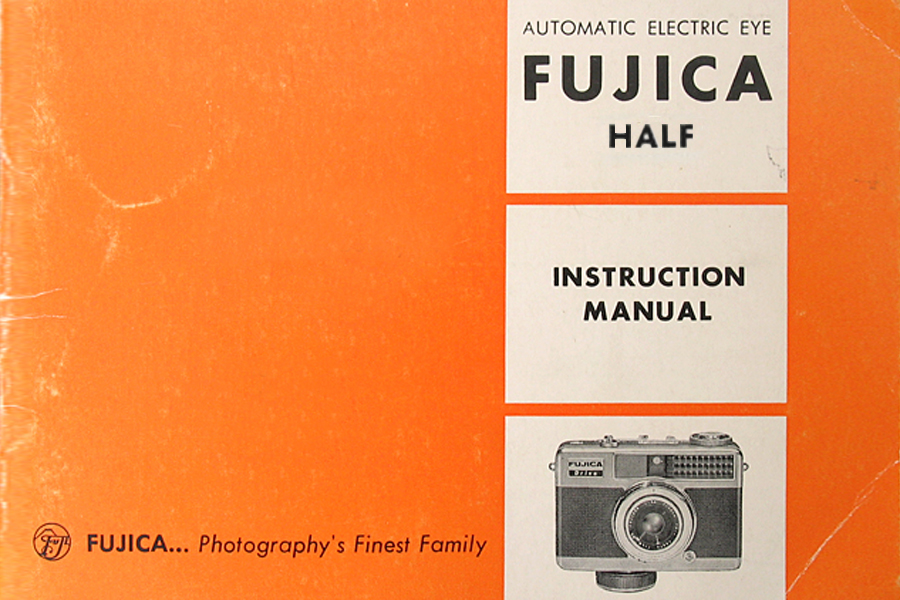
fujicaOriginally marketed as a “true candid camera,” the Fujica half was a wonderful new addition to the world of casual “economy photography” in 1963. Using standard 35mm film, this camera split the 35mm frame size in half, allowing for two vertical exposures for every single frame – hence the name “half.” Seventy-two exposures were now possible from a thirty-six exposure roll of film. Pretty snazzy.

The Fujica Half was likely developed to compete with the Olympus PEN half-frame camera, which had experienced a great deal of success. Boasting crisp pictures from a wide-angle (28mm) five-element lens, the Fujica Half could also open up to a 2.8 f/stop, making it unusually versatile. Wide angle, low-light friendly, sharp fixed-focus, extended frame count, and all in a compact design small enough to fit in your pocket.

Designed for a point-and-shoot audience, the built-in selenium light meter and compact design made the Fujica an ideal machine. It was one of the most accessible, user-friendly camera models designed until this time, delivering the practice of photography into the hands of an unprecedented number of consumers.

It was the iPhone camera of the 1960’s. Period.

As film prices dropped throughout the latter 60’s, “whole-frame” cameras supplanted the half-frame models. By the end of the decade, major manufacturers abandoned the half-frame model altogether. It was a short-lived fad, but these metal-constructed beauties were built to last. For any camera enthusiast, it’s easy to find a functioning model for a cheap price. They’re a lot of fun to shoot with.

SIGN UP FOR THE LENSEBENDER NEWSLETTER

January 24 – Downtown Tucson

01-24 Rio Nuevo post

I was a freshman at The University of Arizona back in 2001. The whole of downtown Tucson has completely changed in the years since then. University Boulevard was a third-world country; the old brick buildings at the intersection of Park & University were a shelled-out scene reminiscent of 1980s East St. Louis. The only missing set-piece would be an arrangement of chopped cars on cinder-blocks. The old drug store was razed that year, piles of bricks and construction equipment lined the streets, and the sound of jackhammers provided the background music audible from my eighth story dorm room in Coronado Hall.

Downtown wasn’t entirely different. Congress Street, the main thoroughfare, had it’s own share of problems. The Screening Room still had events every weekend, Hotel Congress was a hub for live music & adult beverage, and The Grill – open twenty-four hours – always had coffee, beer, and tater tots for the restless insomniac artist. The scene was markedly different in the light of day, though; many of the storefronts on Congress were shuttered and vacant, rents were low, and a series of businesses seemed to play musical chairs with commercial space.

A lot has changed since then.

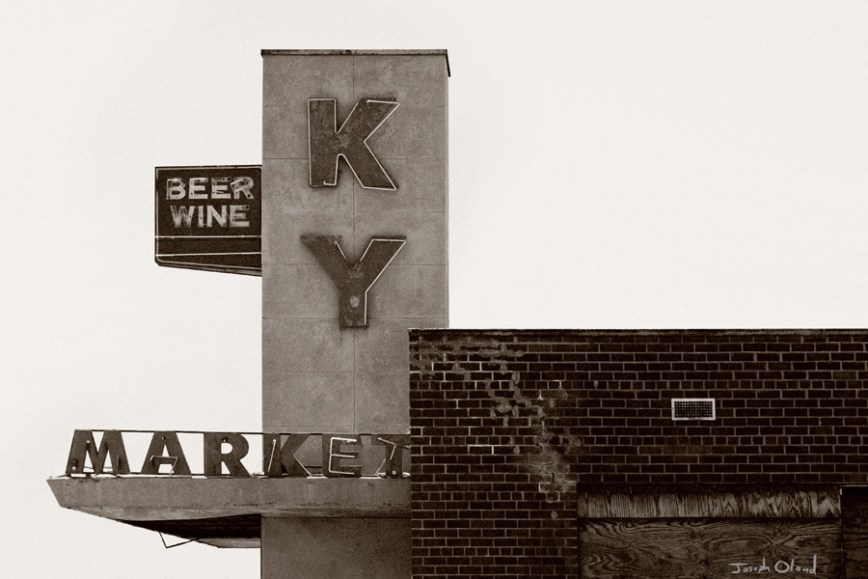
Today’s ‘photograph of the day’ is an old market just south of Tucson’s downtown area on 6th Avenue. I don’t have a lot of information about the old business, but I’m guessing it was one of the many bodegas near Barrio Viejo that eventually fell into irrelevancy. The structure appeared to sit vacant during the entirety of my tenure in Tucson, the ten years stretching from 2001 to 2011.

Revitalization hasn’t just hit Congress and 4th Avenue – the old KY Market has been purchased by a gentleman named Danny Vinik and converted into a multimedia space for his company, Brink Media. I worked for the company, briefly, but I don’t think I possessed quite the skill-set, and the project I was working on didn’t seem to be too tremendously focused. The people that work there, however, are some of the most brilliant web developers, graphic designers, and videographers I’ve ever met. I was happy to be a part of the operation, short-lived and fruitless as it may have ultimately proved to be.

I have a lot of pre-restoration photographs of downtown Tucson, and this is one that has a little bit of meaning for me. Progress happens, and I’m happy knowing that the building is finally being put to use; one of the greatest friends I’ve ever had works there today. But I also selfishly enjoy the rustic aesthetic of abandonment. Maybe I just have sour grapes that the whole time I lived in Tucson, the whole of downtown was like a pile of rusting beer cans in the desert, and now it all seems to have sprung to life – you know, now that I’m not there to enjoy it.

So it goes.

PRINTS AVAILABLE HERE
SIGN UP FOR THE NEWSLETTER HERE

January 20 – Here’s Your Sign

01-20 Your Sign post

Our life is what our thoughts make it.
~Marcus Aurelius

– – –

I’m not the only photographer that has a weird fascination with signs. It seems like a habit a lot of us have fallen into. I don’t think it’s the signs themselves that attract us, but the era they evoke. Designs from the golden age of commercial neon signage, starting roughly in the 1950s, have long ago gone out of style. Vintage neon tubes are getting harder to find, especially in their original context. Buildings are torn down and the signs are often demolished, too. A few survive in their original context, usually on registered historic buildings, and others survive in personal collections.

Old buildings, ghost towns, unique architecture, and vintage signs present something of a game to image collectors; objects like these are like checklist items in a photography scavenger hunt. The image above is actually a bit of a “non-sign,” I’d venture to say. It’s likely the entrance sign for an old two-pump gas station on this street corner. There’s a shuttered repair shop, aluminum doors locked, and the gas pumps have been removed. This sign frame is a rusting heap keeping vigil over a shack and a loosely organized pile of whitewashed cinder blocks that vaguely resemble a low-rent apartment complex.

Hell, since the original picture was made five years ago – never previously published – the area may be completely different today.

The street corner is on South 4th Avenue along the Old Benson Highway on Tucson’s south side, across from the Lazy 8, Tucson’s “cleanest budget motel.” A lot of you Tucson folks have probably driven that stretch of highway but never stopped to look at the scenery; mostly cheap hotels, run-down apartments, abandoned commercial structures, rent-a-fences, and dumpsters. You’ve probably clapped eyes on the Lazy 8 sign on your way to the airport, but never had a reason to pull over and check it out.

That’s what I like about this photography gig. Boring things become interesting. You stop and look around when you normally wouldn’t have any reason to hit the brakes. Sure, the suspicion that there might not be anything of interest often proves to be true, but it’s still a different kind of experience. There’s a slow-down that happens when you look at the world through the lens. I became addicted to that sensation when I first started making pictures, and I’ve never gotten over it.

I encourage everyone to take the time, even just once, to walk around with a camera and start looking at the world through that funny little box with a lens. It can be pretty eye-opening.

PRINTS AVAILABLE HERE
SIGN UP FOR THE NEWSLETTER HERE

January 19 – The Old Aztec Theater

01-19 Art & Athletics post

“Unless we tell stories about ourselves, which is all that theater is, we’re in deep trouble.”
~Alan Rickman

– – –

Winter-time in Kansas City is like summer-time in Tucson – the streets looks deserted most of the day, as if everybody packed in the middle of the night and fled without notice. Instead of tumbleweeds, the crisp air carries dead leaves and newspapers.

I went on a walk in downtown Shawnee, through the nearby cemetery and up towards city hall. The temperature has been hovering in the teens and twenties; needless to say, I didn’t see any other pedestrians, save for the poor pitiful fool dressed as the statue of liberty, promoting a tax prep service on the corner. There ought to be a law against that kind of cruelty.

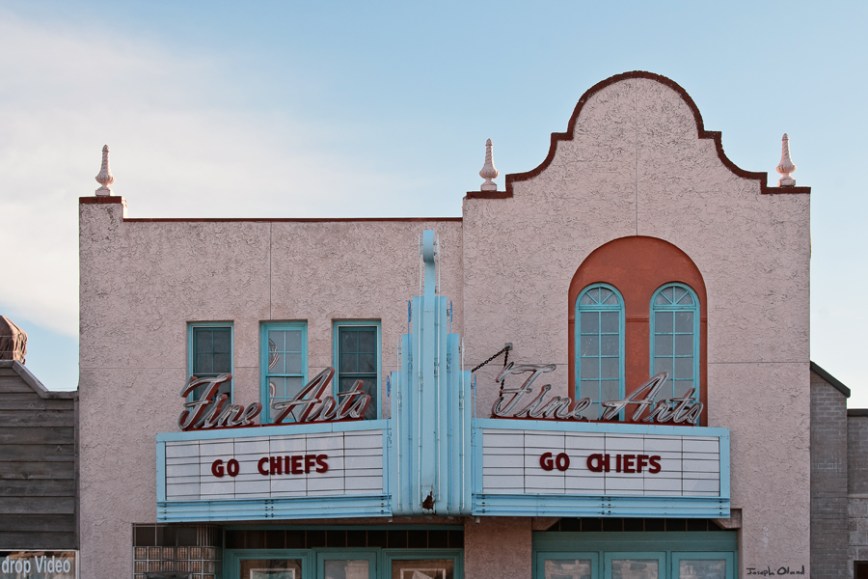
Pictured here is the Old Aztec movie theater.

The Old Aztec was designed by the Boller Brothers architectural firm of downtown Kansas City, Missouri. Their designs ranged widely in size and style, from minor vaudeville houses to grand movie palaces. To date, about twenty surviving Boller Brothers theaters are listed on the National Register of Historic Places. The Old Aztec is clearly among the smaller houses, commissioned by Shawnee’s third mayor, Mr. Marion Summeror, and opened on Labor Day in 1927.

It was named Aztec in the 1940s after it was acquired by Dickinson Theaters. The current signage was installed in 1972 after the theater was purchased by the Pflumm family. Closed for renovations in the summer of 1975, the theater never reopened. There was a time in 2005 when the building changed hands again. Renovations began again, too. The outside has been finished, but the project stalled and the status of the theater is not known.

I like the way old towns feel, although that sense of Main Street life has largely melted away. This little intersection in Shawnee is surrounded by an ocean of strip malls and shopping centers, traffic congestion and highways. But for one block, you can dig your hands into your pockets, bury your head between your shoulders, and walk down the sidewalk against the wind. You can look up at the old marquis and consider a time, almost a hundred years ago, when people walked the same streets, through the threshold and into theater, to watch a silent film dance across the canvas screen of a true American movie house.

PRINTS AVAILABLE HERE
SIGN UP FOR THE NEWSLETTER HERE