February 07 – Changes In Perspective

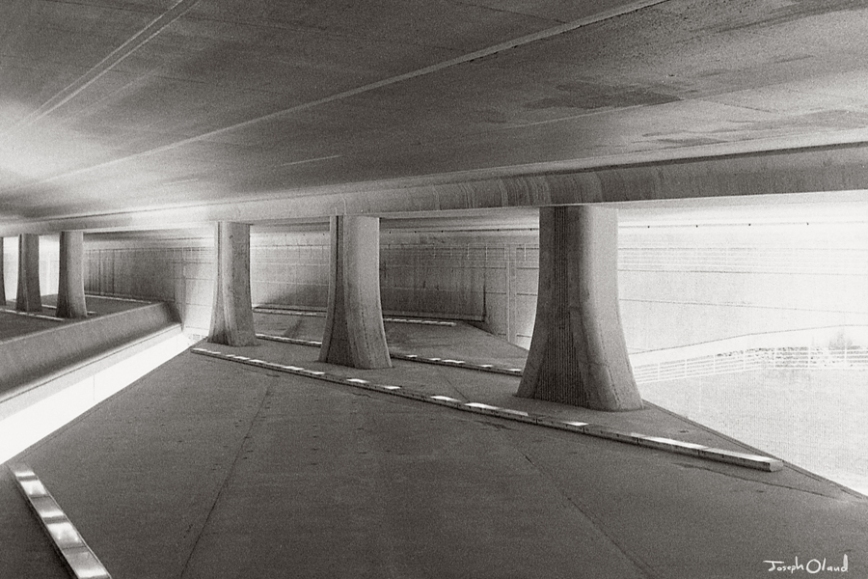
02-07 Tucson Underpass postThis Sunday’s photograph of the day is one of the older classics I’ve always loved and nobody else ever seemed interested in. That’s just one of the painful little things you have to get over when you’re an artist; almost every single painting or photograph that I love are the very paintings and photographs nobody seems to like. And those pieces that I’m not so sure about? The ones I even consider throwing away or deleting? Well, people tend to love those the most.

It’s just one of the ironies.

Nevertheless, I remember looking at the negatives, still dripping wet after being developed in my friend’s kitchen. These are Fujica Half images, so there were tons of exposures to look through. The composition of these really intrigued me. I had a small pile of proof prints eventually made, and that’s when I realized how I wanted to display these images. Thumbing through the proofs, I saw this image upside down, and it really intrigued me. It looked like an alien city or a futuristic concept.

I was reminded of the scene from Steven Soderbergh’s “Ocean’s Eleven” where the fidgety tech character is in the labyrinthine hallways to seek out the server room and tap into the security camera output for the hotel. The room itself is flooded with blue neon light and looks incredibly alien – it turns out that the film’s location scout had looked at a photograph of a server room upside-down and though it looked neat. So the set was built, complete with neon lights coming from the floor, rather than from the ceiling.

Happy little accidents. It’s the simple things we don’t think of that can really influence our work. That’s why critique is important, and why artists like to bounce ideas off each other. Some small little detail may make all the difference.

FINE ART PRINTS AVAILABLE HERE
SIGN UP FOR THE LENSEBENDER NEWSLETTER

February 06 – Mission San Xavier del Bac

02-06 San Xavier postOn the Tohono O’odham Indian Reservation, about ten miles south of downtown Tucson, rests “the pearl of the Sonoran desert.” San Xavier del Bac is a Spanish Catholic mission, erected between 1783-1797 near a natural water spring fed by the Santa Cruz River. It’s the oldest European structure in Arizona, considered by many to be one of the greatest specimens of Spanish Colonial architecture. The natural spring no longer exists, and this stretch of the Santa Cruz only runs for part of the year.

This is one of my favorite places in the world. There’s no way I could every take an original photograph of it – it has been photographed countless times by tourists, photo enthusiasts, and professionals. Most famously, Ansel Adams turned his lens to the beautiful structure; the images reside at The Center for Creative photography on the University of Arizona campus.

This particular image was made in the Spring of 2001. This is one of the earliest visit I’d made to San Xavier, although I would make the drive out on a regular basis during my tenure at the University of Arziona. Up on the hilltop, in the background, is where I would often sit and listen to the wind. It’s the most peaceful, magical place. A wonderful site to clear one’s head.

FINE ART PRINTS AVAILABLE HERE
SIGN UP FOR THE LENSEBENDER NEWSLETTER

February 05 – Craters In The Earth

02-05 Meteor Crater postThe year was 2001 and I was a cocky asshole of a man. My girlfriend and I somehow conned her parents into lending their minivan to the enterprise and we lit-out for the western territories. I’d received an acceptance letter from the University of Arizona and I was ready to get the hell out of Kansas. Little did I know that attending the UofA would mean just about nothing, other than a pile of debt with a degree worth less than the scrap of parchment it was printed on.

But that’s a whole other story.

An 18-year-old version of me screamed down the highway in a soccer-mom van with a young slab of beautiful woman-flesh – and that’s all that mattered. We camped along the high desert, free spirits, and I will never forget the experience. Trading sex in a two-door coup for sex in a bulky 1970s-style canvas tent is probably one of the more sublime experiences this young man could have ever hoped for at the time.

We drove through Tucson and struck camp at Mount Lemon and surveyed the landscapes along the painted desert of Northern Arizona. It was the first time in my life I felt truly unfettered, rising in the morning to the sound of rushing creek water and a lovely ivory face beside me, cloaked in locks of streaming brown hair, lips upturned in a sly satisfied smile.

No drug can ever replace the experience of being eighteen years old and in love. Today’s photograph is a reminder of that innocent time; my woman by my side, unaware of the struggles ahead, I dialed the numbers in and pushed a button along the rim of the great meteor crater. This picture represents everything I held important from those lofty teenage years.

It was a good time, in tall grass and open sky. And I will take that pleasure with me into the earth.
When the time comes.

FINE ART PRINTS AVAILABLE HERE
SING UP FOR THE LENSEBENDER NEWSLETTER

February 04 – The Rialto Theater

02-04 Rialto post

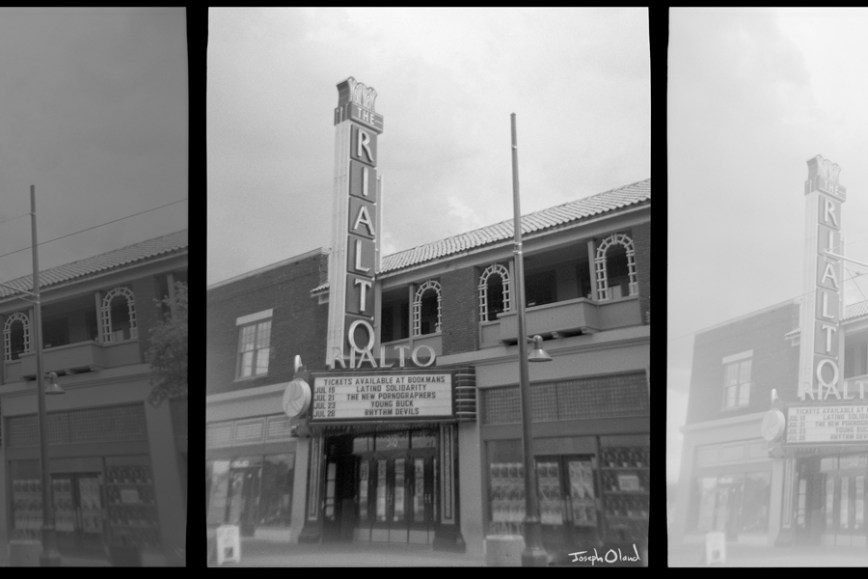
The Rialto Theater is one of the most recognizable buildings on Tucson’s most recognizable street. Situated on Congress Street across from the famous Hotel Congress, The Rialto opened its doors in 1922 with silent films and vaudeville performances.

I moved to Tucson in 2001. At the time, the University of Arizona was a construction zone, as was a great deal of University Boulevard. Congress Street felt like a ghost town during the daytime, but a handful of businesses kept the heart of downtown pumping – especially The Grill, which only recently closed its doors.

Paying the university a premium for the privilege to listen to jackhammers and to perpetually circumnavigate rent-a-fenced holes in the ground are but two of many disappointing experiences. The 24 hour availability of tater tots at The Grill and the wonderful performers that The Rialto attracted would be the other side of the coin; the downtown scene was among the greatest things I remember from those early college days.

Today’s ‘photograph of the day’ wasn’t made with a vintage camera like the others. It was made with what we’d consider a toy camera. Weighing in at only twelve ounces – the most forgiving weight of any camera – my first plastic “Holga” model camera cost about twenty bucks brand new. The unpredictable exposures, light leaks, and low-tech aesthetic these cameras produce have seen them grow in popularity over the past twenty years. When I last checked, the same model camera I’ve been shooting with costs somewhere in the neighborhood of fifty dollars.

Film isn’t dead. Neither are Daguerreotypes, for that matter. Historians, enthusiasts, and hobbyists will always keep these old methods alive. Thanks to Hollywood directors who prefer to shoot on film, popular low-tech products like the Holga (which attracts photo nerds like myself), and the infinite resource that is the internet, film will always be out there – even if it’s lost its relevance.

FINE ART PRINTS AVAILABLE HERE
SIGN UP FOR THE LENSEBENDER NEWSLETTER
February 03 – Drive Thru Liquor

02-03 DriveThru Liquor post

“Film February” continues with this little gem, taken using another one of my handy-dandy vintage film cameras.

Folding cameras were a mid-century fad, dominating the post-war market. You had the style of accordion bellows, but in a handheld package for ease of use. These were imprecise cameras, to sum them up succinctly, but black and white film stocks had a lot of latitude. A poorly exposed negative could still yield a pretty decent print.

Learn more about the Sears & Roebuck Tower Series of cameras here.

Today’s photo of the day comes from Stone Avenue in downtown Tucson, across the street from the police station. I have no hard confirmation, but the rumor goes that Texas is responsible for the grand innovation known as the drive-through liquor store. The source of so many an absurd idea, Texas seems as good a candidate as any; I’m inclined to believe it. In any event, they’re scattered across the southwest like jacks.

This was the maiden voyage of my Tower ’52. I’m pretty sure that this is the very first exposure I made with the camera, which I’d purchased at an estate sale on Tucson’s east side (along with about two dozen other camera bodies). The compression plate is bent, so the film focus falls off on the left and right edges, but it’s this kind of imprecision that makes old cameras fun to work with. Unpredictable things happen, and you never know what the film is going to look like until you develop it.

FINE ART PRINTS AVAILABLE HERE
SIGN UP FOR THE LENSEBENDER NEWSLETTER

February 02 – Tucson Streetside

02-02 DoubleFrame post

Monday saw the start of Film February – only film photographs for this month during the 2016 ‘Photo A Day’ project. I began with an image taken using one of my favorite vintage cameras from the 1960’s. I realized that my explanation about how the Fujica Half works might not be entirely coherent to those of you who aren’t as absurdly gear-headed as I am.

For more detailed specs, read about the Fujica Half here.

Today’s image is intended to illustrate a little more clearly what the Fujica Half accomplishes. Instead of one horizontal picture, like what you would get using a regular old 35mm film camera, the Fujica half makes a series of small vertical exposures – two exposures fit in the same space that one standard 35mm picture would go. It takes some getting used to; when you look through the viewfinder, the image plane is vertical. I can’t think of any other camera out there that operates like this.

These two images were taken a few years ago. I used to carry the Fujica Half everywhere I went because it was such a compact camera. In my free time, I would go on bike rides all over Tucson, looking for interesting things to photograph. If memory serves correctly, the palm tree is from the center median along Swan Road, just north of the Rillito River wash. The statue on the right is from Evergreen Cemetery, located near Oracle Road & Miracle Mile.

FINE ART PRINTS AVAILABLE HERE
SIGN UP FOR THE LENSEBENDER NEWSLETTER

February 01 – San Pedro Chapel

02-01 San Pedro post

Film is not dead! It’s only kinda, sorta, half-way, a little bit, almost dead.

February over here at LenseBender Design is going to be the month of film. Every single day I’ll be contributing a new film-based photograph made exclusively with one of my vintage film cameras. I have an extensive collection of old cameras – and even some vintage film stock – so this should be a pretty fun ride.

The first photograph of the month was made using a little-known camera known as the Fujica Half. For more information on this nifty little hand-held miracle machine, you can read about it here.

The San Pedro Chapel (pictured above) is located in the historic Fort Lowell neighborhood near the Rillito River north of Tucson. The neighborhood is named after the military outpost that once stood nearby. Fort Lowell was an Army outpost active from 1873 to 1891 and was intentionally placed on the outskirts of Tucson at the confluence of the Tanque Verde and Pantano Creeks. Year-round water at the mouth of the Rillito River made this area prime real-estate for a camp.

Once the fort was decommissioned, the Department of the Interior put the fort’s lumber, windows, doors, and other salvageable items up for sale; the fort was quickly dismantled and hauled off. The old adobe structures were already disintegrating back into the desert by the turn of the Twentieth Century, when immigrant families from Sonora, Mexico began to settle into the territory.

The migrants occupied the remaining fort structures and replaced the missing windows, roofs, and doors. The enclave eventually became known as El Fuerte. The community mainly raised livestock and sold lumber to residents in the town of Tucson.

The community developed strong roots. They built new houses in the Sonora Ranch style, dug wells (finding water at less than thirty feet), built a school house, and established a cemetery and built a church. The first church on this site was just large enough for the Carmelite Fathers to stand in while serving mass; the congregation would gather under the mesquite trees outside.

A more permanent structure was built in either 1915 or 1917 (the records are not clear on this), but was destroyed by a tornado in 1929. The San Pedro Chapel that survives today was built directly over the ruins of the previous chapel in the Mission Revival Style and dedicated in 1932.

In the 1940s, as Tucson was growing, the Church and general store of the El Fuerte community made this area a de facto town center. Mexicans living in the east of the territory would travel to El Fuerte to attend mass & school as well as  enjoy family parties, baptisms, and other social events. The Chapel is still in use today, as it was then, for baptisms and weddings. At its height, the community was only about three-hundred people, and this building is one of the few reminders of what once existed here.

And I just happened to stumble across San Pedro Chapel on a bike ride.
Pretty darn neat.

FINE ART PRINTS AVAILABLE HERE
SIGN UP FOR THE NEWSLETTER HERE

January 31 – Farm Country

01-31 Kansas Barn post“You must live in the present, launch yourself on every wave, find your eternity in each moment.”

~Henry David Thoreau

– – –

One of my occupations, of late, has involved walking around the city. During these urban hikes I keep a sharp eye out and I try to keep in mind my own individual, physical perspective. As a challenge to myself, I’ve been re-imagining the familiar neighborhoods, shopping centers, roadways, and walking paths. The city – the concrete and steel, the timber boxes of row houses and the carved-out subdivisions – has so thoroughly consumed all of the wild, untouched areas I grew up around, so I’ve been looking for spaces untouched by development.

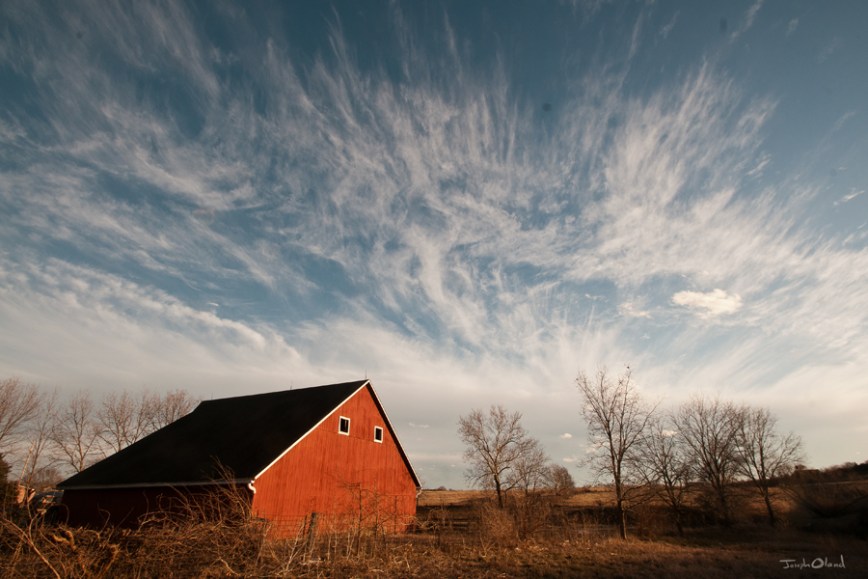
This barn sits on the intersection of Interstate-435 and 87th Street Parkway. It is in the eye of the storm. To the right of this red barn, just off-camera, is the off-ramp and a line of cars waiting to merge onto 87th Street. Behind the barn is a field, probably two miles deep, before a thicket of housing, strip malls, and office buildings. Across the street from this barn is a McDonald’s, a Taco Bell, and a supermarket.

I don’t know the story behind this tract of land, but I’m guessing there’s a stubborn landowner who has refused generous offers on his property. I applaud such action, if only because I enjoy the basic concept of a person saying no to cold hard cash – it forces each of us to consider the possibility that there are indeed things more important than money.

I this small slice of untouched land. A little reminder of what the whole surrounding territory probably looked like a generation ago, before all of this “progress.”

FINE ART PRINTS OF TODAY’S PICTURE ARE AVAILABLE HERE
SIGN UP FOR THE NEWSLETTER HERE

January 30 – The Connecticut River

01-30 Connectitcut River post

In New England the character is strong and unshakable.”

~Norman Rockwell

– – –

Yesterday was an amazing day – like all good days, it was too short. I found myself being guided along by my uncle Rick, who has lived in this territory for the past twenty years. There’s no such thing as a transition between the southwest and the east coast – they are different worlds altogether. We didn’t cover a tremendous amount of territory, but New England is so dense with architecture & history, I imagine I could spend ten weeks in a ten mile radius and not ever – not for a single moment – feel bored.

Along the Connecticut River are a number of beautiful places to make pictures. This is just one of them, a position adjacent to the historic Goodspeed Opera House in East Haddam, Connecticut.

FINE ART PRINTS HERE
SIGN UP FOR THE NEWSLETTER HERE

January 29 – Grandma

01-29 Grandma Goodmans post

“True terror is to wake up one morning and discover that your high school class is running the country.”

~Kurt Vonnegut

– – –

I’ll be spending the better part of today in airports, threading my way through Chicago and onto Hartford where my aunt and uncle live. Connecticut is one of the most beautiful states that I have absolutely no knowledge of; sadly, this will not be the voyage that finds me discovering much. My grandmother needs assistance traveling back home to Kansas City, and I will be the steady arm for her to hold onto.

These posts may not arrive until after I return; since I will be traveling far to see my grandmother for the first time in several months, and because I know our time is limited, I will be focusing on enjoying the trip and spending time with dear relatives that I woefully do not often get to see.

I’ll be gathering pictures and stories throughout.

I leave this short post pointing to the image above. For any soul who has traveled the roads south of Tucson, along the San Pedro river, you may have driven through the peculiar and verdant valley town of Saint David. The store’s full name is “Grandma Goodman’s” and I cannot recall a time that it was ever open for business. I like to imagine that it was a small general store, and I like to imagine that it was as quaint as its name suggests.

FINE ART PRINTS AVAILABLE HERE
SIGN UP FOR THE NEWSLETTER HERE