 FINE ART PRINTS AVAILABLE HERE
– – –
ALL ‘SAUL’ & ‘BREAKING BAD’ MERCHANDISE HERE
“Nice to fix something for once.”
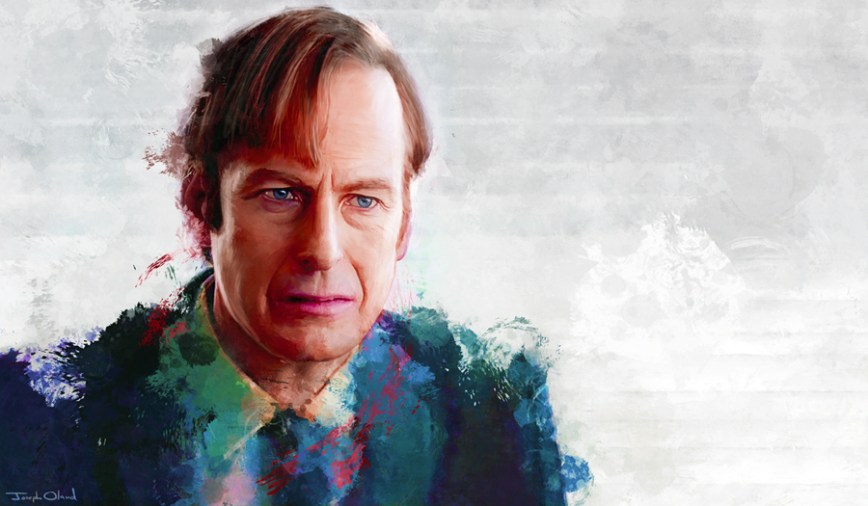
Most of the entire run of Better Call Saul has split up its time between the story arc of Jimmy McGill (Bob Odenkirk) and the story arc of Mike Ehrmantraut (Jonathan Banks), the two primary protagonists. Their stories run parallel, too, as each character is confronted with certain opportunities and temptations. These characters are abundantly aware of the difference between right and wrong, and they both find ways to justify a bending and breaking of the rules.
The overarching plot of the series, at least in the early seasons, is designed to illustrate how these two characters are different and how they’re alike. Jimmy is painted as a reformed confidence-man attempting to leave his criminal ways behind. Mike is painted as a once-corrupt cop who, after the death of his son, is motivated to live a clean life and care for his son’s widow and granddaughter.
Jimmy craves success and Mike craves redemption.
Jimmy has raw ambition and Mike has a planet of regret resting on his shoulders.
Jimmy is frenetic and Mike is calm and collected.
The differences are glaring when we compare these characters side-by-side, which makes their similarities all-the-more compelling. In their own way, both characters break rules, break laws, lie, steal, and cheat in order to achieve their goals. They’re both lost souls. Better Call Saul seems to be interested in fleshing-out these characters individually before showing how they ultimately collide.
– – –
This week’s episode, “Sabrosito,” begins in Mexico, with another little vignette with the yellow color-pallet established in Breaking Bad – yellow means Mexico, and it’s an effective visual storytelling element. The scene elucidates precisely how and why Hector Salemanca (Mark Margolis) has come to find a rival in the meticulous and successful Gus Fring (Giancarlo Esposito) – a question never completely answered in Breaking Bad. Like siblings at war with one another, the competition between Fring and Salemanca mirrors the tension between Jimmy and his older brother Charles (Michael McKean); anger, frustration, and sabotage.
This is one of the weakest episodes of the series. While all of the characters and stories in the Gilligan-verse are stylized, there’s a certain sense of believability that makes the characters sympathetic and the situations believable. Unfortunately, the idea of Hector Salemanca waltzing into the Los Pollos Hermanos fast-food chain and intimidating the patrons – and then holding the employees captive – rings as painfully unbelievable, as false, as genuinely sloppy from a story-telling perspective. The notion that not one single patron took it upon themselves to call the police after escaping an obviously dangerous situation is asking way too much from the audience. The speech that Fring delivers to his employees the following day – the “this is America!” speech – would also, never, not in a million years, be enough to satisfy a base-wage fast-food employee, let alone a whole crew of them. Regardless, Fring speaks the words and the employees cheer and rally, and the whole dangerous, gang-related, terrifying incident they had all endured magically disappears.
That is asking too much.
The Jimmy story-line is more reserved, illustrating the ‘Cain and Abel’ nature of Jimmy’s relationship with his brother. It’s collected and procedural, as Jimmy plants Mike into Chuck’s house in the guise of a repairman in order to collect evidence; the question as to ‘why’ will likely be addressed in next week’s episode, and attempts at prognostication will be relatively useless. One could guess that Mike has been planted in order to gather evidence of Chuck’s lifestyle in order to support a claim, in court, that Chuck is mentally unstable. Time will tell on that one.
Some plot-holes and inconsistencies are, as always, forgivable in a fictitious universe – inevitable, even. This episode broke some walls and provides some reasons for concern, but this may just be a hiccup as the writers find their way from the point ‘a’ to the point ‘b’ of the story. We see a developing relationship between Mike and Gus, and we see a continuation of Jimmy’s conflict with his brother. Gus offers Mike a position that “will depend on the work,” and Jimmy appears to be setting a trap for Chuck in order to discredit him.
Next week, I predict, will offer some answers to our lingering questions.
READ LAST WEEK’S REVIEW
– – –
SIGN UP FOR THE LENSEBENDER NEWSLETTER
 FINE ART PRINTS AVAILABLE HERE
 FINE ART PRINTS AVAILABLE HERE
 FINE ART PRINTS AVAILABLE HERE
 LenseBender