What’s So Special About “Fury Road” Anyway?

Blue Ange postFINE ART PRINTS AVAILABLE HERE

This is a question that’s been plaguing a lot of moviegoers this Oscar season. After news broke that the George Miller’s fourth “Mad Max” film had fetched ten – that’s right, ten – Oscar nominations, many heads flew atilt with confusion. A film with such clichés as maidens in distress, revving motorcycle engines, and great big dumb explosions can’t possibly make the cut – or can it? That’d be like giving “Lethal Weapon” an Oscar nod, and that just doesn’t happen!

Even with the disappointment with “Birdman” winning best picture last year (just go see “Boyhood,” then think long and hard about it), at least audiences could sit back and remind themselves of that movie’s half-sensical whimsy. We actually kind of get it when an “artsy fartsy” film is trying to be clever and avant-garde. We actually kind of get it when a film is intentionally bizarre and eventually fetches a lot of awards; it’s happened a thousand times before, even if it isn’t quite to our liking. But that still doesn’t explain why an action beat-em-up like “Fury Road” is getting so much attention. So what’s the deal?

The deal is this. We’re currently entrenched in an era of film-making that largely produces only two kinds of mainstream feature: special-effects-driven action films and dialogue-heavy or otherwise “literary” films. The former represents, as an example, just about any comic-book movie out there. The latter represents your so-called “art” films, those “Oscar bait” features like “The Hateful Eight” or “The Revenant.” I advocate for all category of film, to be sure, and I enjoyed “The Force Awakens” as much as anybody else. That being said, I think we all knew going into the theater, 3-D glasses in hand, that the new “Star Wars” flick wasn’t going to win a ton of awards (save, of course, for visual effects, sound engineering, and the like). It’s just the way that particular cookie crumbles.

So where does “Mad Max: Fury Road” fit into this bifurcated cinematic equation? It doesn’t – simple as that.

I will concede that, on the surface, it certainly does have the appearance of a brainless visual effects parade. Upon closer investigation, the film reveals itself to be infinitely more creative than that. Rather than confuse plot complexity with artistic brilliance, director George Miller reversed course, using a basic and straightforward narrative as a foundation from which to explore a relatively dormant style of visual storytelling.

The first thirty minutes of “Fury Road” present a deeply sophisticated visual rhythm that explains everything the moviegoer needs to know without relying on standard Hollywood action tropes. In almost every regard, the setup for “Fury Road” is a sublime sequence of pictures that approach a “silent film” quality unlike any other movie in the action genre, or any other 2015 title of any genre. I challenge any reader to re-watch the beginning of the film with no sound (or with any old song of your choosing – I’m quite convinced this would play remarkably well with a Chopin nocturne) and consider how marvelously rich and detailed the mythology of this “Mad Max” story is – and all without the aid of narration or expositional dialogue.

That is the brilliance of “Fury Road.” It is deceptively simple, but speaks in a universal, wholly accessible visual language that doesn’t rely overmuch on historical allusion and the tropes of “avant-garde” or “high” art cinema. It is a primal story that presents itself in primal, pictographic language. It’s honest with itself, it’s honest with it’s audience, and it accomplishes what very few films today accomplish. It’s visually remarkable but behaves as though its practical and digital effects aren’t important; that’s a rare quality in the action and adventure genre, and I’m pleased to see that the Academy has taken note.

FINE ART PRINTS OF THE ABOVE IMAGE AVAILABLE HERE
SIGN UP FOR THE LENSEBENDER NEWSLETTER HERE


A Look Back At “Dumb And Dumber”

Seabass postI loved “Dumb & Dumber.” Absolutely loved it. I saw it at the perfect time in my life to truly appreciate its magnificent stupidity while also getting a hint that there was a thoughtful craft behind the crude humor, a quiet genius necessary for this kind of movie to work. That’s right, the perfect time in my life: adolescence.

Two years ago, after finishing the first season of “The Newsroom,” I was pleased to see a picture of Jeff Daniels dressed as his “Dumb & Dumber” character, Harry Dunne, on my newsfeed. Talk about timing, right? As it turns out, the actor went immediately from wrapping the most recent season of his amazingly well-performed – and somewhat serious – HBO drama to once again act the fool with compatriot James Carrey. Twenty years later.

I could have guessed, even before the teaser trailer was released, that this was going to be a throw-away nostalgia grab-bag, a “hey, let’s cash a check” kind of movie. Comedy sequels have this awful habit of ham-fistedly repackaging the same jokes from their franchise, recycling winning punch-lines and tropes. It is a stupid trick that rarely, if ever, works. This usually doesn’t prevent one or two sequels from dribbling out of successful film properties. Quite frankly, after twenty years of lying dormant, I’m surprised this one even got made.

I enjoyed seeing the characters again, and I dusted off my old VHS copy of the original “Dumb & Dumber,” a hunk of plastic I bought previously viewed from a supermarket in Kansas. If you put a gun to my head, I wouldn’t be able to tell you a single thing about “Dumb and Dumber To.” It was just that forgettable. I laughed a few times, I think, but nothing really stands out. One might suppose that being forgettably bland is a notch above being memorably awful. And hey, I had an excuse to watch the original one more time, and that was enough to put a smile on my face.

Please consider supporting independent artists like myself.

FINE ART PRINTS OF THE ABOVE ILLUSTRATION ARE HERE
SING UP FOR THE LENSEBENDER NEWSLETTER HERE
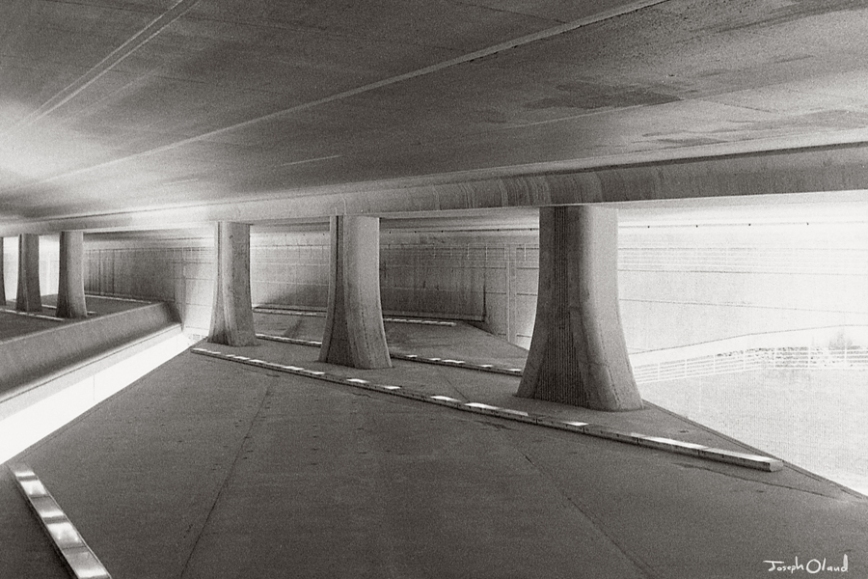
February 07 – Changes In Perspective

02-07 Tucson Underpass postThis Sunday’s photograph of the day is one of the older classics I’ve always loved and nobody else ever seemed interested in. That’s just one of the painful little things you have to get over when you’re an artist; almost every single painting or photograph that I love are the very paintings and photographs nobody seems to like. And those pieces that I’m not so sure about? The ones I even consider throwing away or deleting? Well, people tend to love those the most.

It’s just one of the ironies.

Nevertheless, I remember looking at the negatives, still dripping wet after being developed in my friend’s kitchen. These are Fujica Half images, so there were tons of exposures to look through. The composition of these really intrigued me. I had a small pile of proof prints eventually made, and that’s when I realized how I wanted to display these images. Thumbing through the proofs, I saw this image upside down, and it really intrigued me. It looked like an alien city or a futuristic concept.

I was reminded of the scene from Steven Soderbergh’s “Ocean’s Eleven” where the fidgety tech character is in the labyrinthine hallways to seek out the server room and tap into the security camera output for the hotel. The room itself is flooded with blue neon light and looks incredibly alien – it turns out that the film’s location scout had looked at a photograph of a server room upside-down and though it looked neat. So the set was built, complete with neon lights coming from the floor, rather than from the ceiling.

Happy little accidents. It’s the simple things we don’t think of that can really influence our work. That’s why critique is important, and why artists like to bounce ideas off each other. Some small little detail may make all the difference.

FINE ART PRINTS AVAILABLE HERE
SIGN UP FOR THE LENSEBENDER NEWSLETTER

Self Portrait As A Dissociative Patriot

Dissociative Self Portrait post“Everything that irritates us about others can lead us to an understanding of ourselves.”

~Carl Jung

– – –

I am an artist. That pretty much means I’m one rung up the ladder from a beggar. Or, more appropriately, I’m a clever beggar, intent on marketing my own neuroses. On a good day, artists are great observers, presenting novel ideas to the world. On a bad day, we’re self-destructive narcissists that only think our ideas are novel.

I avoid self-portraiture. Throughout my career, I’ve met a lot of talented and creative people, but I’ve also met a lot of hacks. College proved to be a breeding ground for self-indulgent creativity, and the “self portrait obsessed” always struck me as inauthentic and cruel.

That being said, here’s a self-portrait. My kind of self-portrait.

An associate of mine and I used to frequent several bars in Tucson. Several. We always brought our sketch books, and we were always armed with markers, pencils, and charcoal. We’d pluck our pocket watches from our vests and come up with drawing challenges. Thirty-five seconds to draw a portrait of the cute girl in the corner. Two minutes to draw one another – we’d sit across from one another and furiously claw at our sketch books. The idea was to override our own insecurities by making it flat-out impossible to make anything of value. You don’t have time to second-guess your decisions when you only have thirty seconds. Nothing terribly good usually comes from a sixty second sketch.

An aesthetic grew out of these hapless challenges, which quickly filled our portfolios. We eventually began to refer to these images as “chaos portraits.” This is a chaos portrait I did of myself. It was a one-minute drawing, made in the dim light of Danny’s Lounge, a bar out on Fort Lowell & Country Club, after a pitcher of cheep beer and a game of pool. I like to think it expresses the constant hateful insecurity of the irrelevant middle-class artist.

It also reminds me that I need to wear ties more often.

FINE ART PRINTS AVAILABLE HERE
SIGN UP FOR THE LENSEBENDER NEWSLETTER

February 06 – Mission San Xavier del Bac

02-06 San Xavier postOn the Tohono O’odham Indian Reservation, about ten miles south of downtown Tucson, rests “the pearl of the Sonoran desert.” San Xavier del Bac is a Spanish Catholic mission, erected between 1783-1797 near a natural water spring fed by the Santa Cruz River. It’s the oldest European structure in Arizona, considered by many to be one of the greatest specimens of Spanish Colonial architecture. The natural spring no longer exists, and this stretch of the Santa Cruz only runs for part of the year.

This is one of my favorite places in the world. There’s no way I could every take an original photograph of it – it has been photographed countless times by tourists, photo enthusiasts, and professionals. Most famously, Ansel Adams turned his lens to the beautiful structure; the images reside at The Center for Creative photography on the University of Arizona campus.

This particular image was made in the Spring of 2001. This is one of the earliest visit I’d made to San Xavier, although I would make the drive out on a regular basis during my tenure at the University of Arziona. Up on the hilltop, in the background, is where I would often sit and listen to the wind. It’s the most peaceful, magical place. A wonderful site to clear one’s head.

FINE ART PRINTS AVAILABLE HERE
SIGN UP FOR THE LENSEBENDER NEWSLETTER

February 05 – Craters In The Earth

02-05 Meteor Crater postThe year was 2001 and I was a cocky asshole of a man. My girlfriend and I somehow conned her parents into lending their minivan to the enterprise and we lit-out for the western territories. I’d received an acceptance letter from the University of Arizona and I was ready to get the hell out of Kansas. Little did I know that attending the UofA would mean just about nothing, other than a pile of debt with a degree worth less than the scrap of parchment it was printed on.

But that’s a whole other story.

An 18-year-old version of me screamed down the highway in a soccer-mom van with a young slab of beautiful woman-flesh – and that’s all that mattered. We camped along the high desert, free spirits, and I will never forget the experience. Trading sex in a two-door coup for sex in a bulky 1970s-style canvas tent is probably one of the more sublime experiences this young man could have ever hoped for at the time.

We drove through Tucson and struck camp at Mount Lemon and surveyed the landscapes along the painted desert of Northern Arizona. It was the first time in my life I felt truly unfettered, rising in the morning to the sound of rushing creek water and a lovely ivory face beside me, cloaked in locks of streaming brown hair, lips upturned in a sly satisfied smile.

No drug can ever replace the experience of being eighteen years old and in love. Today’s photograph is a reminder of that innocent time; my woman by my side, unaware of the struggles ahead, I dialed the numbers in and pushed a button along the rim of the great meteor crater. This picture represents everything I held important from those lofty teenage years.

It was a good time, in tall grass and open sky. And I will take that pleasure with me into the earth.
When the time comes.

FINE ART PRINTS AVAILABLE HERE
SING UP FOR THE LENSEBENDER NEWSLETTER

The Dead Flower

Dead Flower post“Autumn is a second spring when every leaf is a flower.”
~Albert Camus

– – –

I was reminded of this painting, based on a photograph, by an unlikely figure: Facebook.

We all have a profile and engage in it’s meticulous, brilliant distraction. Over the past several weeks, I’ve plucked the crust from my eyes each morning and reached over to quell the grating sounds of my alarm clock – which would also be my phone. Usually there’s a recommendation from our social media overlord to reminisce and share an old memory – I’m guessing they’ve been pulling at your nostalgia-strings too. The catch, at lease for me, is that the past twelve months of my life have been, mildly put, troubled.

Facebook’s algorithms have yet to filter out the job losses, financial woes, marital strife, and death. It’s hard to fault an equation for hoisting my life’s misery back upon me, even as I scramble to escape the sense of demoralizing defeat, but there it is, like a mirror, holding your failures as a civilized man right up to your face.

Today, thankfully, brought a different narrative. Rather than a friend-turned-enemy or a recently-deceased compatriot, I was reminded of a painting I’d made and quickly forgot about. I made a simple picture of a crisp, lifeless twig; I was satisfied. The canvas of the earth shifts during the winter time; colors turn from vibrant to monochrome. A very good and close friend, deeply religious, often speaks of God’s divine design, proclaiming that “the colors of His palette never clash.”

I certainly couldn’t be described as a religious or faithful human being, but my friend is right. The colors of the natural world do not compete for glory – they sit side-by-side in exquisite harmony, promoting a sensory experience that is indeed “miraculous,” and can easily be described as “heavenly.”

And now I spread my gospel to you.

FINE ART PRINT AVAILABLE HERE
SIGN UP FOR THE LENSEBENDER NEWSLETTER


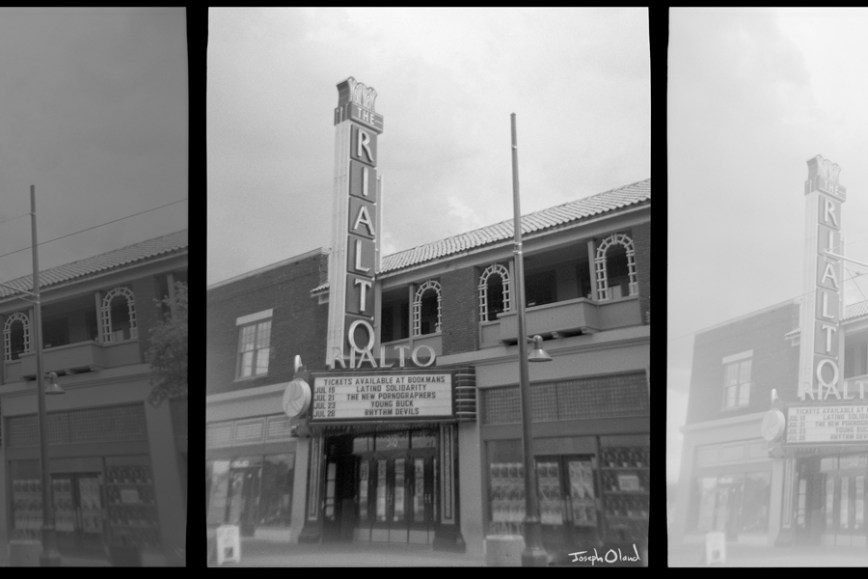
February 04 – The Rialto Theater

02-04 Rialto post

The Rialto Theater is one of the most recognizable buildings on Tucson’s most recognizable street. Situated on Congress Street across from the famous Hotel Congress, The Rialto opened its doors in 1922 with silent films and vaudeville performances.

I moved to Tucson in 2001. At the time, the University of Arizona was a construction zone, as was a great deal of University Boulevard. Congress Street felt like a ghost town during the daytime, but a handful of businesses kept the heart of downtown pumping – especially The Grill, which only recently closed its doors.

Paying the university a premium for the privilege to listen to jackhammers and to perpetually circumnavigate rent-a-fenced holes in the ground are but two of many disappointing experiences. The 24 hour availability of tater tots at The Grill and the wonderful performers that The Rialto attracted would be the other side of the coin; the downtown scene was among the greatest things I remember from those early college days.

Today’s ‘photograph of the day’ wasn’t made with a vintage camera like the others. It was made with what we’d consider a toy camera. Weighing in at only twelve ounces – the most forgiving weight of any camera – my first plastic “Holga” model camera cost about twenty bucks brand new. The unpredictable exposures, light leaks, and low-tech aesthetic these cameras produce have seen them grow in popularity over the past twenty years. When I last checked, the same model camera I’ve been shooting with costs somewhere in the neighborhood of fifty dollars.

Film isn’t dead. Neither are Daguerreotypes, for that matter. Historians, enthusiasts, and hobbyists will always keep these old methods alive. Thanks to Hollywood directors who prefer to shoot on film, popular low-tech products like the Holga (which attracts photo nerds like myself), and the infinite resource that is the internet, film will always be out there – even if it’s lost its relevance.

FINE ART PRINTS AVAILABLE HERE
SIGN UP FOR THE LENSEBENDER NEWSLETTER

Why We Need To Eliminate Marriage

Equality post“When I am instructed by the all-knowing Jehovah to profess an ostensibly ‘equal’ brotherly love within the same pages where I am instructed to murder my fellow man for engaging in a love act, I can’t help but look elsewhere for guidance.”

– – –

Among people of all ages, ethnicities, and religions, a growing acceptance of same-sex marriage has been growing. This acceleration of tolerance culminated on 26 June 2015 with the Supreme Court decision in the case of Obergefell v. Hodges, declaring that states cannot prohibit the issuing of marriage licenses to same-sex couples, or deny recognition of lawfully performed out-of-state marriage licenses to same-sex couples.

In the 5-4 decision, the highest court of the land invalidated gay marriage bans in the United States of America. This was no longer a state’s rights issue. A push for equality and a celebration of our inalienable rights had occurred.

Many consider this a progressive forward movement, failing to recognize the near fifty-fifty split in the court’s decision, a figure which loosely reflects the national attitude toward same-sex marriage. Some citizens of faith – certainly not all – viewed the move as an attack of their religion, and the bellicose rhetoric of conservative radio began once again to sound the trumpets about the “War On Christianity.”

The decision to overturn gay marriage bans has been viewed by some as the first stumble on the slippery slope. Some groups genuinely believe that the government has become a bloated, liberal bureaucracy that intends to dismantle their church, manipulate their faith, and legislate morality. Regardless of how foolish such an attitude may outwardly appear, the court’s decision served not to end the argument, but to reinvigorate opposition to marriage equality.

There has been unanimity among the GOP presidential candidates to have the decision overturned. The only difference in their rhetoric would be the degree to which they would fight. Ted Cruz, who won the Iowa Caucus on February 1st, has spared no opportunity to express his fervent opposition to same-sex marriage – an ironic stance for any patriot, especially a student of constitutional law.

In an 1802 letter to the Danbury Baptist Association, Thomas Jefferson made reference to the First Amendment to the United States Constitution. He wrote, “Believing with you that religion is a matter which lies solely between Man and his God, that he owes account to none other for his faith or his worship, that the legitimate powers of the government reach actions only, and not opinions, I contemplate with sovereign reverence that act of the whole American people which declared that their legislature should ‘make no law respecting an establishment of religion, or prohibiting the free exercise thereof,’ thus building a wall of separation between Church and State.”

If we are to examine the topic, perhaps we could recognize that the issue of marriage equality truly does hinge on the definition of marriage; we have a semantic legal problem, not a religious or moral one. The term itself, marriage, has both secular and religious connotations. In a land where there is a supposed “wall of separation” between church and state, it is the word itself that has led to such persistent conflict. The only sensible argument – an argument that has yet to be made by any politician on the hill – is the argument to eliminate marriage from our legal doctrine altogether.

It sounds extreme, but it’s actually quite sensible. If we view marriage as a tradition largely steeped in religious values, then we all ought to acquiesce and consider the term a religious one. If there is indeed a separation of church and state in these United States, then no statehouse should recognize any marriage of any kind. If we can view marriage as the joining of individuals in a religious ceremony, then it is appropriate for the ceremony to be privately held, between those individuals being married and their faith community. The government ought have nothing to do with it.

In order to honor the Equal Protection clause of the 14th Amendment to the Constitution, it is necessary to strip marriage of its legal status. Heretofore, the legal benefits of marriage have been distributed by a discriminatory legal apparatus that would not grant those same benefits to same-sex partnerships. This is wholly in violation of the 14th Amendment which mandates that individuals in similar situations be treated equally under the law. This is precisely why the Supreme Court eventually ruled as they did.

All partnerships, homosexual or heterosexual, should be required to apply for a domestic partnership – not a marriage license – should they seek legal status and the benefits bestowed upon legal partnerships. Fears of government intruding on hallowed faith traditions will be quelled. Citizens will enjoy greater equality under the law. People can continue to define marriage however they please, and there will be no legal consequence to those who disagree.

Supporting strong domestic unity will have a net-positive impact on our society. Such unity will serve only to create more satisfied, socially invested patriots, regardless of the form their love happens to take.

It would be a challenge to identify a distinction between denying same-sex lovers equal rights under the law and refusing to let a black person drink from the same water fountain as a white person. This is the 21st Century, and we cannot accept any argument that would diminish a person’s inalienable rights.

Spread the word.

Consider supporting this independent artist by sharing this article or purchasing a print.
FINE ART PRINTS AVAILABLE HERE
SIGN UP FOR THE LENSEBENDER NEWSLETTER HERE

February 03 – Drive Thru Liquor

02-03 DriveThru Liquor post

“Film February” continues with this little gem, taken using another one of my handy-dandy vintage film cameras.

Folding cameras were a mid-century fad, dominating the post-war market. You had the style of accordion bellows, but in a handheld package for ease of use. These were imprecise cameras, to sum them up succinctly, but black and white film stocks had a lot of latitude. A poorly exposed negative could still yield a pretty decent print.

Learn more about the Sears & Roebuck Tower Series of cameras here.

Today’s photo of the day comes from Stone Avenue in downtown Tucson, across the street from the police station. I have no hard confirmation, but the rumor goes that Texas is responsible for the grand innovation known as the drive-through liquor store. The source of so many an absurd idea, Texas seems as good a candidate as any; I’m inclined to believe it. In any event, they’re scattered across the southwest like jacks.

This was the maiden voyage of my Tower ’52. I’m pretty sure that this is the very first exposure I made with the camera, which I’d purchased at an estate sale on Tucson’s east side (along with about two dozen other camera bodies). The compression plate is bent, so the film focus falls off on the left and right edges, but it’s this kind of imprecision that makes old cameras fun to work with. Unpredictable things happen, and you never know what the film is going to look like until you develop it.

FINE ART PRINTS AVAILABLE HERE
SIGN UP FOR THE LENSEBENDER NEWSLETTER