February 19 – Liberty

02-19 Liberty postOne of the little tricks film photographers sometimes employ is known as “cross processing,” in which slide film is developed using chemicals designed to for regular color film. The results vary, but are characterized by a dramatic color shift, with punched-out contrast and deep tonal saturation. These effects can be applied to digital images with relative ease using editing software like Photoshop; the film photographer, however, is forced to accept the final result rather than having the opportunity to endlessly tweak the effect in post production.

Basically, cross processing is controlled chaos. It’s a method of embracing “happy accidents.”

This photograph was made in Jerome, Arizona, a small mining town outside of Prescott Valley in the Black Hills of Yavapai County. The copper mining operation saw a huge boom in the 1920s, pushing the population to around ten thousand. Today there are only about five hundred people, but it gets a lot of traffic from Phoenix – it’s a wonderful weekend getaway. I’ve always enjoyed walking around and looking at the old buildings, the narrow alleys, and the wrecks of brick rotting on the hillsides. It is a quiet place with a rich history. If you’re lucky, you might even bump into Tool and Puscifer front-man Maynard James Keenan, who moved to Jerome to start a winery in the early 2000s.

FINE ART PRINTS AVAILABLE HERE
SIGN UP FOR THE LENSEBENDER NEWSLETTER

February 18 – The High Plains (cyanotype)

cyanotreeRather than discuss a vintage camera, today’s Film February photograph highlights an antiquated printing process that, unlike the abnormally frail Daguerreotype or the albumen paper negative print, is still in somewhat frequent use today.

The “cyanotype” is a printing process that produces a blue-tinted print – cyan colored, even – so it’s an unironic name. Using basic ferric (iron) salts, this is one of the most affordable printing processes ever invented. This is why engineers used the process, with frequency, well into the 20th century; you would recognize them as “blueprints.”

The process uses two chemicals: ammonium iron(III) citrate and potassium ferricyanide.

During the latter half of the 19th century, photographers used horses and donkeys to carry their mobile darkrooms, consisting of photo chemicals, containers, camera equipment (view cameras were quite cumbersome) and a tent that served as dark room. Organic compounds commonly referred to as ‘ethers’ were used to dissolve collodion silver for wet-plate photography – never mind what wet-plate photography is, just know that it was the dominant method. The instances of field photographers being overcome by ether fumes and dying were not rare. In fact, the chemical nature of print photography has represented significant risk to all photographers prior to the digital revolution.

The pyrogallol (“pyro”) film developing process functions to tan and harden film images in a low sulfite environment. In the era prior to darkroom tongs, latex gloves, and ventilators, this chemical caused serious nerve damage to a generation of photographers. It’s most famously linked to Edward Weston, America’s founding father of photography. If you don’t know who Edward Weston is, don’t worry – you know his most famous pupil. Weston taught a young Ansel Adams. He had previously been though to have died of Parkinson’s disease. The symptoms of Parkinson’s are identical to prolonged exposure to pyrogallol, and he worked with this chemical for most of his life.

Selenium toners are used to make silver gelatin prints more archival. The selenium metal is less prone to aging, fading, or degrading than the silver halide crystals that it replaces. It also gives prints additional tonal density and a slight brown color tone that many photographers find appealing in their black-and-white work. Selenium toner poses cancer risks and respiratory damage if inhaled or absorbed through the skin.

Cyanotype printing is widely believed to be a harmless process, but potassium ferricyanide can be incredibly dangerous if improperly handled. Reactions can occur with other darkroom chemicals, producing a noxious gas that can be fatal.

Why do I say all of this? Well, I suppose because I find it all very interesting. Photography is both a science and an art, and I think that we forget that sometimes, especially with how easy photography has become with our smartphones. Prior to the digital revolution, photographers weren’t just ‘witnesses with cameras.’ They didn’t simply “Point. shoot. Viola! Here’s your print.”We were visual composers, yes, but we were also reasonably experienced chemists, often coming up with our own chemical mixtures – our own recipes – to produce desired film grain, image density, contrast, print aesthetic, and color tone. We don’t often think about the photographer in his darkroom (nor, contemporaneously, hunched over a computer screen). We prefer to think of the photographer in the field, riding in the back of a muddied Jeep, sitting on the 50-yard-line, credentialed and in the front row at the press conference. Photography is spent half out in the world, gathering images, and half in the dark, fine-tuning the images we’ve gathered.

Photographers have always had a history of risking health and personal injury in order to execute their craft, and I’m proud to consider myself among that cohort. I haven’t covered war, traveled to a third-world nation, been kidnapped. I’m no hero, but I like to think that I’ve had the opportunity to bear witness to extraordinary events, and I was there with my camera. I have participated, in my own small way, to that rich history.

The lessons I learned in the darkroom are lessons of patience, an appreciation for chemistry, and the rewards of diligence. Pulling prints from a negative is an involved process, and no amount of Photoshop can replace the sheer joy of walking into the light with fresh, wet print. To walk out of the red light in the darkroom and see what your print actually looks like, to have been working for hours and hours, and finally see that you’ve dialed it in, that you have the perfect print.

You stink. You’re tired. It’s three o’clock in the morning. And damn is it exhilarating. That’s why I still shoot film when I can.

FINE ART PRINTS AVAILABLE HERE
SIGN UP FOR THE LENSEBENDER NEWSLETTER


Nebraska Life

Fallen Saul postThe return of “Better Call Saul” on Monday has seen me reacquainting myself with the show’s first season. Anybody who has been a fan of “Breaking Bad” and “Saul” will understand that most episodes warrant multiple viewings; the narratives are layered, the characters complex, and the writers go to great lengths to embed interesting symbols – easter eggs, if you will – into each episode.

It is always fun watching genre-bound comics break through with powerful dramatic performances. With a great script, rubber-faced slapstick goof-ball comedians often turn in remarkable performances. One may never have believed Jim Carrey could play a dramatic role, but “Eternal Sunshine of the Spotless Mind” turned a lot of heads. Bill Burr, albeit a secondary character, was given an interesting opportunity as one of Saul’s fixers in “Breaking Bad.” Bob Odenkirk, who plays the titular character in “Better Call Saul” has himself spun some incredible magic bringing his character’s internal struggle and moral complexity to life.

There’s little doubt that “Saul” is a strong show, replete with powerful performances, but season one ended with a whimper. The writers have taken great care to make Jimmy McGill relatable, sympathetic, and three-dimensional. This is necessary if we’re to care at all as we watch his gradual descent into corruption and moral ambiguity. Nevertheless, the phenomenal performances and fascinating back-stories haven’t led to any concrete gasp-worthy moments, which is what we have been preparing for. I think this has a lot to do with the rhythms set up by “Breaking Bad,” but “Better Call Saul” has proven to be a different kind of program. The ten-episode set-up of season one didn’t lead to a satisfying catharsis, car chase, murder, or any other kind of earth-shaking revelation.

Season one of “Saul” is a sentence without punctuation. It’s a beautiful sentence, yes, but we are left without knowing quite how to feel. We know the ultimate fate of Mike Ehrmantraut. We know that Saul Goodman flees Albuquerque under an assumed identity, relegated to the life a low-rent fast food manager, always looking over his shoulder. What we don’t know is where he came from, not entirely. We’ve been provided with some interesting details, but the picture is still undeniably incomplete. What we’re still waiting for is a solid explanation: when, exactly, did Jimmy McGill ditch his birth name and become Saul Goodman? When did he lose his soul? How did he lose it? And why?

Hopefully, season two will satisfy some of these questions.

FINE ART PRINTS AVAILABLE HERE
SIGN UP FOR THE LENSEBENDER NEWSLETTER

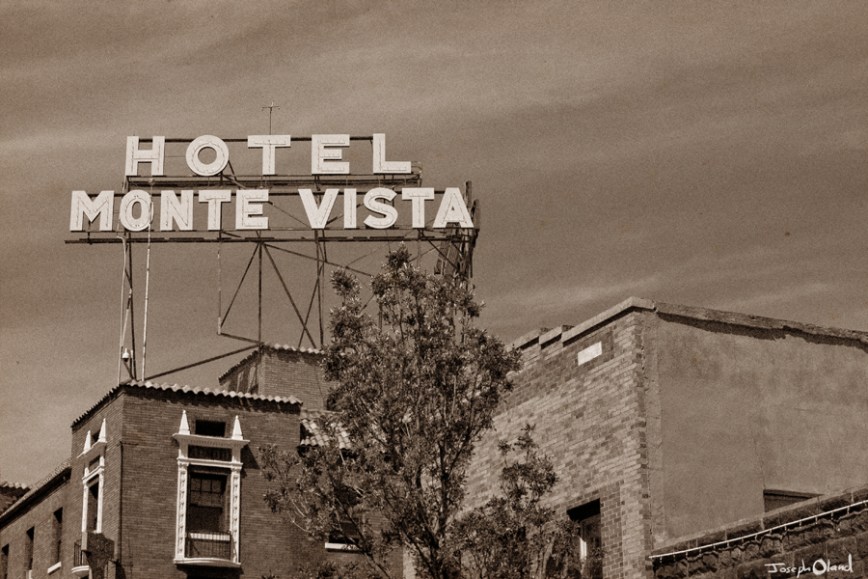
February 17 – Hotel Monte Vista

02-17 Monte Vista postAutomobile culture reached Arizona in the early 1900s and brought major roadway projects (see yesterday’s post about Miracle Mile Road) and an increase in tourism, which delivered new money to Flagstaff in the 1920s. Fundraising began in 1926 by local community leaders to establish first-class accommodation to replace some of the outmoded and run-down hotels.

Ground broke for the 73 room Community Hotel (named in honor of the prominent citizens who funded its construction) on June 8 of that year. It was finished in six months, opening its doors on New Years Day, 1927.

My first visit was back in 2005 or 2006, when I had the chance to tag along with a friend of mine. We worked together at a local Tucson photo lab and he happened to be a drummer in a band called “The Deludes.” I was able to hop aboard for a show they’d booked at the hotel’s “Cocktail Lounge.” It was a prohibition-era bootlegging operation, but the secret wasn’t kept long – local officers disrupted the illegal business in 1931. Ironically, the speakeasy reopened only two years later when prohibition was lifted.

It is one of the oldest operating hotels in Flagstaff and is a registered historic landmark, and its sign is one of the most recognizable landmarks in Flagstaff.

FINE ART PRINTS AVAILABLE HERE
SIGN UP FOR THE LENSEBENDER NEWSLETTER

February 16 – Sunland Motel

02-16 SunLand Motel postAs car culture began to take root in Arizona, the Old Spanish Trail Highway was established in 1916. This route represents a massive construction project intended to thread from Southern California to Florida. Motels and gas stations sprung up from the route, and some of the old remnants just so happen to survive today.

The Old Spanish Trail merged with other routes on the north side of Tucson, creating a network throughout the city. In the 1920s, the road became US Highway 80, which snaked down through Benson, Bisbee, and onto Douglas. Another vein sprung up, US Highway 89, stretching down through Tubac, Tumacacori, and on toward to the port of entry in Nogales along the Mexican border. Highway 84, known as the Casa Grande Highway, is now called Miracle Mile – it led north to Casa Grande and Phoenix.

Miracle Mile is today a somewhat notorious stretch of road, with low-rent rooms, weekly rates, a strip club, and a bowling alley. But that isn’t news. The area began to decline in the late 1960s, and Miracle Mile became synonymous with drugs, prostitution, and other illicit activity.

Only recently has the area has begun to shed it’s negative reputation, and it may be a while yet before the old stories fade away. Reinvestment has seen renovation, but many of the motels still seem relatively neglected, and the low rates still have the appearance of attracting a particular type of clientele. I guess time will tell what’s in store for old Miracle Mile road.

FINE ART PRINTS AVAILABLE HERE
SIGN UP FOR THE LENSEBENDER NEWSLETTER

February 15 – The Flamingo

02-16 Flamingo post1The Flamingo was originally built in 1948, providing comfort and shelter for the likes of Bing Crosby, Gene Autrey, Rudy Valley, and other members of the Hollywood and show-business elite. Before it’s doors were closed in the 1980s, it had fallen into miserable disrepair. The rooms were poorly lit, the pool was dry and cracked. The old-world gloss had given way to broken concrete and mold.

When the doors were locked and the windows boarded up, shrink-wrapped soaps still sat in their dishes, dusty towels still hung on the racks, the beds still tightly made. It only sat vacant for seven years before the padlocks were snapped open and the hotel was resurrected with new furniture, carpets, air conditioning, and placards on the doors to designate which Tinseltown stars had stayed there.

I had the pleasure of staying in Burt Reynold’s room. Above the bed was a framed poster of a 1973 Reynolds feature I had never even heard of before: The Man Who Loved Cat Dancing. I still haven’t seen it, but I think I might have to check it out and add a movie review.

The Flamingo was the first Tucson hotel I stayed at – it’s salmon colored paint drawing me in – back in the Spring of 2001. I’d taken a road trip out to Tucson with my girlfriend to check out the city, seeing as how I had just received my acceptance letter from the U of A. Thankfully the new owner respected the building’s history – rather than tear down the classic sign, it was resurfaced and adorned with new neon tubes.

Hopefully, even as the city around it modernizes, The Flamingo will hold onto its charm. The neighborhood isn’t the prime real estate it once was, but affordable rooms in a college town will always find occupants. It isn’t fancy by today’s standards, but I’ll never forget how good that hot shower felt after camping on Mount Lemon for several days.

Today’s photograph is a continuation of “Film February,” made using the Fujica Half. I think the aged aesthetic of film works quite well with a classic mid-century building.

FINE ART PRINTS AVAILABLE HERE
SIGN UP FOR THE LENSEBENDER NEWSLETTER

Lover’s Embrace

Embrace postFINE ART PRINTS AVAILABLE HERE

“Love is that condition in the human spirit so profound that it empowers us to develop courage; to trust that courage and build bridges with it; to trust those bridges and cross over them so we can attempt to reach each other.”

~Maya Angelou

– – –

Love is difficult to quantify, impossible to explain. I don’t possess the skill to describe the feelings of love that I have experienced in this short life. There have been moments of incredible intensity and tremendous pain, giddy uncertainty and unrelenting ecstasy. I’m certain that anybody reading these words will agree that passionate love is a glorious thing, that each of our experiences are unique and, somehow, surprisingly similar.

On this Valentine’s Day, I decided to forego with the condemnation I typically feel inspired to express. We have, all of us, already heard the arguments against the expense, the crowded restaurants, the expectations and the pressure. Rather than hammer-out a screed about the pitfalls of the holiday, I decided instead to nestle into the corner of a coffee shop and come up with a image of love that suits me.

This is the result, and I hope you enjoy it.
Happy Valentine’s Day.

FINE ART PRINTS AVAILABLE HERE
SING UP FOR THE LENSEBENDER BLOG

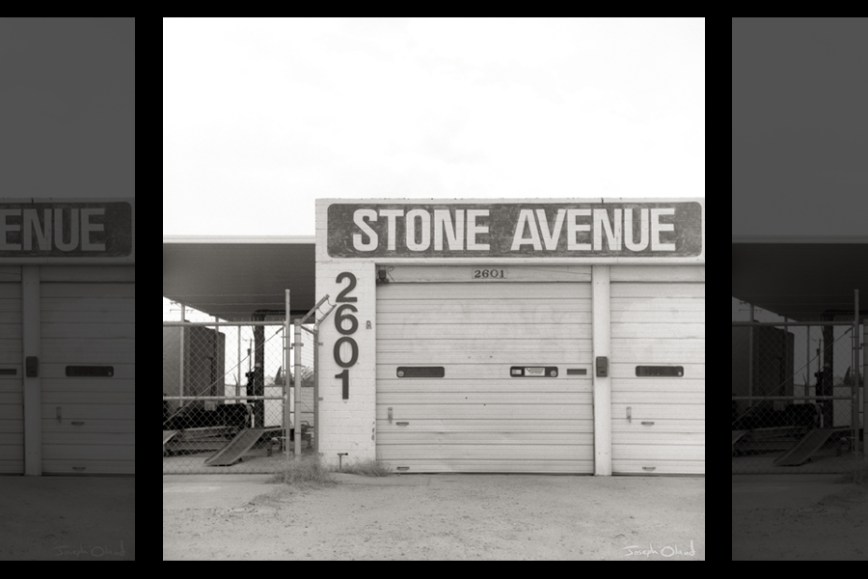
February 14 – Stone Avenue Garage

02-14 Stone Ave Garage postOne of the things I enjoy most about photographing using traditional film methods is the aesthetic. The ease of digital photography has ushered in a new era of thoughtlessness; we are free to machine-gun the shutter and then pick-and-choose which images we like after the fact. There’s nothing inherently wrong with this, but it’s a time-consuming approach. I genuinely believe that the time, limited frame-count, and money involved with film photography naturally motivates the photographer to be more thoughtful regarding what to photograph and how to photograph it.

I made today’s photograph of the day using my twin-lens Yashica-D vintage view camera.

There is also a built-in aesthetic that comes along with black and white photography. Removing the color element, the photograph is more focused on the architecture and balance of composition. These photographs appear more “classic” or “timeless” because of the reticulation of the film grain and the lack of vibrant color. I’m reminded of a lecture delivered by one of the best professors I ever had, Mr. Keith McElroy.

I’ll paraphrase:
“If any of you are interested in your photographs being important, remembered, recirculated, studied in text books, there’s one sure-fire way to help your chances. Go to the grocery store, the shopping mall, the warehouse markets. Go up and down the isles and photograph a catalog of all the merchandise on the shelves. In fifty years, the global marketplace is going to be different. Many of those products will have changed, will not exist, will be antiquated. People will be interested in seeing what they were like.”

It doesn’t sound like a glamorous project, but there’s so much truth to this. Photographs of turn-of-the-century Main Street, of general stores with apron-clad mustachioed men with monocles, New York street scenes with horse-drawn carriages, or street scenes with early model Ford cars and horses both navigating the thoroughfare – these are interesting photographs, even if the skill used to execute them is pedestrian. It’s the document that’s important and, in conjunction with the happenstance “aesthetic of age,” these photographs become unique (and sometimes important) historical specimens.

We never know what’s going to be considered important or interesting to future eyes. For all we know, a snapshot of t-shirt wearing shoppers at your local Wal-Mart will be republished in a History of Photography anthology at the dawn of the next century.

With the proliferation of photography, I expect to be reminded that such a snapshot would be but one of millions floating around. But computers crash and hard-drives fail. Not nearly as many photographs are printed as we might imagine. Digital file formats change, and can be corrupted; they disappear. Physical prints that survive the ages will be somewhat more significant.

Take a close look, too. Your one-hour photo prints are usually printed improperly, with exhausted film chemistry  by unskilled technicians. You may notice your old family photo albums are filled with fading coloring prints. And do-it-yourself printing is even worse. Inkjet prints fade faster and are highly susceptible to water damage. But then look at great-grandpa’s album. Those black and white albumen prints probably still look pretty darn good.

If I were you, I would scan and re-print all of your cherished prints before they fade entirely.

FINE ART PRINTS AVAILABLE HERE
SIGN UP FOR THE LENSEBENDER NEWSLETTER


Better Call Saul 2.01 – Switch

Saul On Knees postBetter Call Saul has a tricky, if not wholly problematic, premise. We, the audience, already know what’s at the end of the line for James McGill (a.k.a. Saul Goodman, played by Bob Odenkirk). The series begins by showing us exactly where he winds up after escaping New Mexico at the end of Breaking Bad. He is trapped and miserable in Omaha, Nebraska, paranoid, afraid for his life, working under an assumed identity at a local shopping mall. And when you already know how the story ends, great care has to be taken with the narrative in order to keep the story interesting and the characters dynamic.

Season one sets up the chess pieces, the key players, and the motivations. The themes are ultimately borrowed from Faust, the noble doctor tempted by the devil into abandoning his morals for wealth and accolades. Who the devil is in Better Call Saul, we’re not sure. There doesn’t appear to be a Mephistopheles here; the titular character is at war with himself.

Season one explains why con-artist-turned-lawyer Jimmy McGill transitions from a reformed con-artist to slithery lawyer. The first episode of season two, appropriately titled “Switch,” pushes forward. If we have already begun to understand why he abandons the idea of leading an altruistic life, the show is now beginning to show us how he does it.

– – –

Season two picks up right where we left off, moments after Jimmy decides that he no longer needs to satisfy the wishes of his mentally ill older brother Chuck (Michael McKean). Frustrated by failed attempts at establishing a legitimate law practice, he resigns himself to living a morally ambiguous life – a life he seems much more adept at living. The episode steers into territory we’ve only experienced in small vignettes during season one. Above all else, “Switch” explores Jimmy’s relationship with Kim Wexler (Rhea Seehorn), illuminating the nature and details of their intimacy.

The two characters live their lives in seemingly assumed roles, playing characters that aren’t true to who they really are. Jimmy is preoccupied trying to live up to his brother’s standards, and Kim is preoccupied with her professional ambitions. Beneath it all, the two characters experience a sense of freedom together that their personal and professional lives don’t allow. They become giddy, playful, and optimistic when they’re together; apart, their jobs and responsibilities bleed the enthusiasm out of them. Kim occasionally drifts out of her role to spend time with Jimmy, but always returns to the workaday world. Jimmy turns his back on the best opportunity to become a lawyer that he’s ever had – although he does, eventually, take it, and we know it won’t last.

“Switch” is a great title. It’s yet another in a parade of Vince Gilligan tropes. In this case, it refers metaphorically to the transformation of Jimmy McGill. It also refers, quite literally, to the light switch in his new office. A sign is taped over the light switch, with printed instructions to “never ever turn off.” Oppositionally defiant, Jimmy can’t help himself. He peels the tape back and flips the switch into the ‘off’ position. He looks around. Nothing has happened.

It’s a wonderful metaphor for the character. He cannot – absolute can not – abide by the rules, so he breaks them. In this instance, at the close of the episode, he flips the switch. He broke a rule and there is absolutely no consequence. If that isn’t telling, I don’t know what is.

FINE ART PRINTS AVAILABLE HERE
SIGN UP FOR THE LENSEBENDER NEWSLETTER

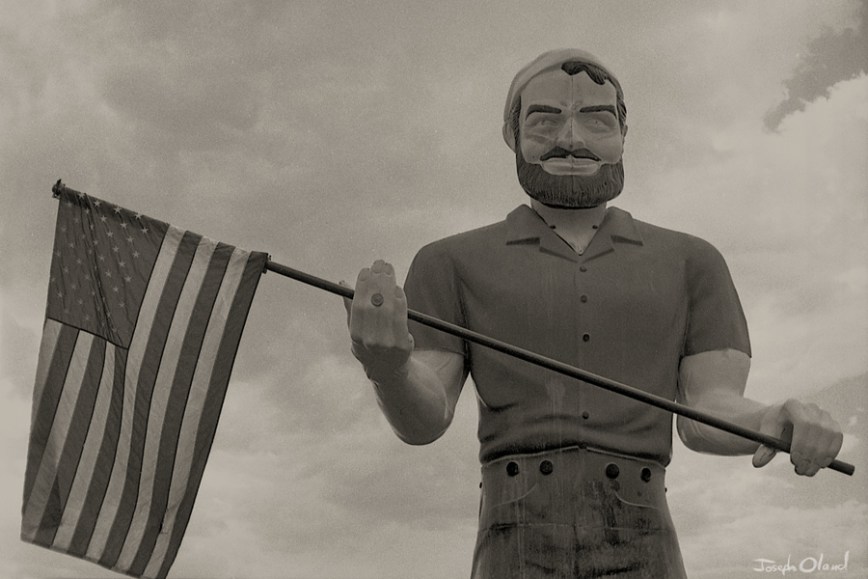
February 13 – Paul Bunyan

02-13 Paul Bunyon postIt was entertaining to learn that this statue of Paul Bunyan has a Yelp! review, which is about as nonsensical as the statue itself. I never looked into why or how this fifteen foot fiberglass statue arrived at the intersection of Glenn & Stone, but I definitely had to photograph it – this time with my Fujica Half vintage camera, on vintage film stock from the 1960s, on vintage photo paper from the 1960s. The film and photo paper was fogged from age, but I rather enjoyed the distressed look of the final print. Not a lot of trees for a lumberjack in Tucson, but he’s definitely become a landmark.

FINE ART PRINTS AVAILABLE HERE
SIGN UP FOR THE LENSEBENDER NEWSLETTER