February 17, 2017 – Vintage Photos

vintage-cheerleaders-post

FINE ART PRINTS AVAILABLE HERE
– – –
OTHER ‘IMAGE OF THE DAY’ PRINTS AVAILABLE HERE

What I love about photography is that it captures a moment never to be reproduced. Photographs are the mosquito in amber of human memory, imprinted with our own projected thoughts and emotions. Snapshots, if they survive long enough, become aesthetic curios. A casual photograph of a street scene in Manhattan taken in 1915 becomes more than a snapshot, but a historical document that captures, with accuracy, what life looked like in that particular place at that particular time.

One of my history professors once told me that the best way to have my work remembered would be to regularly go to the supermarket and photograph the merchandise on the shelves. Print, save, and catalogue them, and wait for time to do the rest. His thinking is that future generations will be thirsty for ideas about how we lived in the past, that the photographer of the present has only a vague concept of how radically a society can change in the short span of a generation or two.

My great grandfather was able to tell me the story of seeing his first automobile as a child and how dazzling it was. He could tell me how, years later as a young man, that the hand-crank engine starters were frustrating as he. He and his wife – my great-grandmother – operated a single-screen silent theater; he ran the projector and she played the piano. I say all of this to point to the last years of his life, with the internet revolutionizing instant electronic mail, cable television that allowed him to watch every Minnesota Vikings football game, and even a wireless headset so he could listen to the game without the noise of the game disrupting everybody else in the house.

Things change faster than they seem. And an old snapshot of a daughter or a girlfriend at cheer-leading practice somehow becomes a nostalgic conversation piece, a document of a by-gone era that makes the viewer think about their experiences in high school, wonder where the people in the photograph are today, or even if they’re still alive. It’s a faded piece of paper that reminds us how little time we have, and how precious these small moments might actually be.

“Today everything exists to end in a photograph.”
Susan Sontag

SIGN UP FOR THE LENSEBENDER NEWSLETTER

February 16, 2017 – No Parking

no-graffiti-post

FINE ART PRINTS AVAILABLE HERE
– – –
OTHER ‘IMAGE OF THE DAY’ PRINTS AVAILABLE HERE

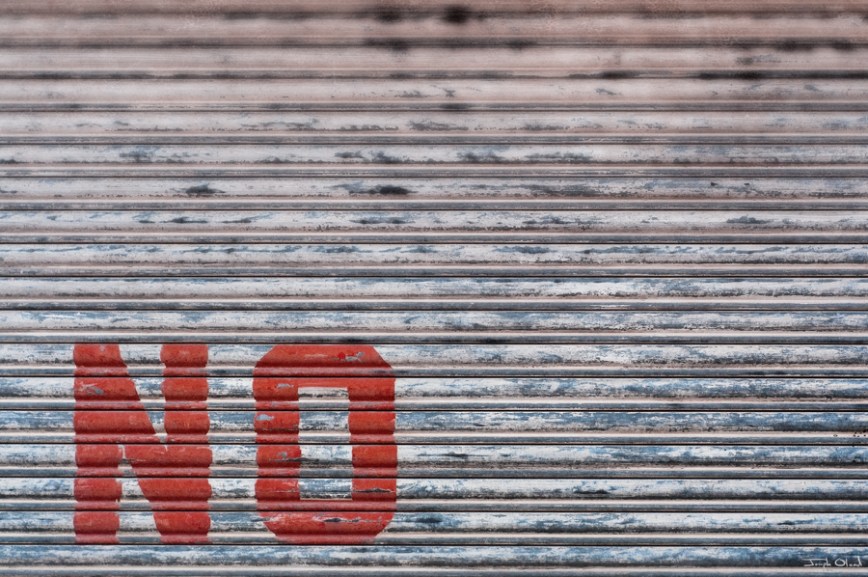
Today’s image of the day is simple and clean, but I was attracted to the faded paint and texture. I’m often criticized for making pictures that don’t have meaning, but I think there’s meaning embedded in just about any picture that anybody takes – not just professional photographers or self-proclaimed artists.

So much of the time, I really simply enjoy taking a small detail from the world and printing it big.

“I really believe there are things nobody would see if I didn’t photograph them.”
Diane Arbus

SIGN UP FOR THE LENSEBENDER NEWSLETTER

February 09, 2017 – The Barrio

the-barrio-post

FINE ART PRINTS AVAILABLE HERE
– – –
OTHER ‘IMAGE OF THE DAY’ PRINTS AVAILABLE HERE

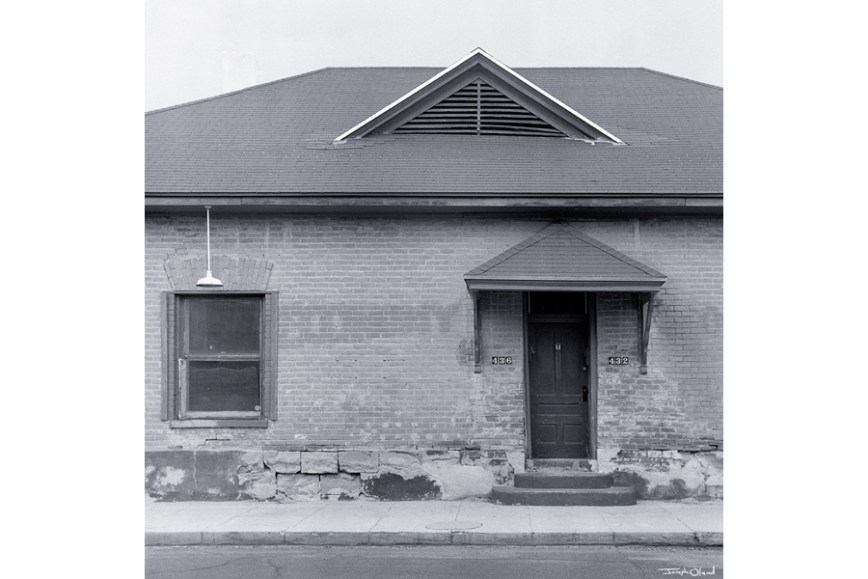
Downtown Tucson is divided into the Presidio District, Barrio Viejo, and the Congress Street Arts and Entertainment District. You could throw a rock from one end and hit the other. But the old barrio is filled with old adobe mud-brick buildings and other rustic reminders of Tucson’s past. In the shadow of some of downtown’s taller office buildings and hotels, the neighborhood is strangely quiet, despite the fact that one could walk three blocks north or east and find themselves smack in the middle of the Rio Nuevo bar and restaurant scene.

This is a unique place, one I like to visit often, and home to a number of supremely talented artists, musicians, and other eclectic Tucson personalities.

This photograph was made using a vintage Yashica-D Twin Lens Reflex, a 1960’s-era medium format film camera. I just loaded some new film into the old beast, after several years, and started making new pictures. I look forward to sharing them with you.

SIGN UP FOR THE LENSEBENDER NEWSLETTER

February 08, 2017 – An Antique Land

east-helen-post

FINE ART PRINTS AVAILABLE HERE
– – –
OTHER ‘IMAGE OF THE DAY’ PRINTS AVAILABLE HERE

The difficulty with making anything that could even closely be mistaken for art is that art is entirely subjective. We live in a highly interconnected world, and there are volumes of online videos, written articles, marketing books, and web pages dedicated to “hacking” yourself into financial success. That’s fine, except it reduces art to a craft – identify your niche in the market, and then do nothing but the same thing, over and over and over again until it’s time to retire.

There’s a lot of beautiful work made by incredibly talented people who adopt this model of marketing, but I can’t quite seem to hop aboard. I don’t want to sit down, do some social media research, and then spend the rest of my life making different versions of the same picture. I suppose this is why I haven’t ever struck it rich as a creative professional – but I’m definitely satisfied when I finish a piece.

This is the newest image in a series that I started about a decade ago, called ‘An Antique Land,’ a line borrowed from Percy Shelley’s poem. To me, this series of architectural ‘portraits’ taps into the impermanence of our communities. But I prefer not to comment much beyond that; I don’t like to tell people what to think about this kind of work. My interpretation, or my intent, doesn’t imbue this images with significance. I like the idea of people looking at this kind of work and bringing their own ideas to the table.

Until next time, folks. I’ll be seeing you soon.

“A photograph is a secret about a secret. The more it tells you the less you know.”
Diane Arbus

SIGN UP FOR THE LENSEBENDER NEWSLETTER

January 24, 2017 – Coffee Break

coffeecan-postrFINE ART PRINTS AVAILABLE HERE
– – –
OTHER ‘IMAGE OF THE DAY’ PRINTS AVAILABLE HERE

This is a photograph that I made while hiking around Bisbee, Arizona back in 2011. I was in the company of several friends, all journalists, and we had traveled to Bisbee to take a few days off after covering the horrible shooting incident involving Representative Gabby Giffords. We were working around the clock during that news cycle, attending press briefings and funerals, and submitting our photographs and our reports. It was a much-needed getaway after absorbing the tumult of that incident and its aftermath.

Interestingly, coffee is what brought me to Bisbee the following year. I managed to secure a job roasting coffee for a local Bisbee coffee roaster. It was a good few years, living in the bosom of the Mule Mountains. And I will never think about coffee the same way again, after learning the origins, the history, and the processes involved in harvesting, hulling, and roasting America’s number one beverage.

SIGN UP FOR THE LENSEBENDER NEWSLETTER

Save

February 23 – All

02-23 All post“Pictures, abstract symbols, materials, and colors are among the ingredients with which a designer or engineer works. To design is to discover relationships and to make arrangements and rearrangements among these ingredients.”

~Paul Rand

– – –

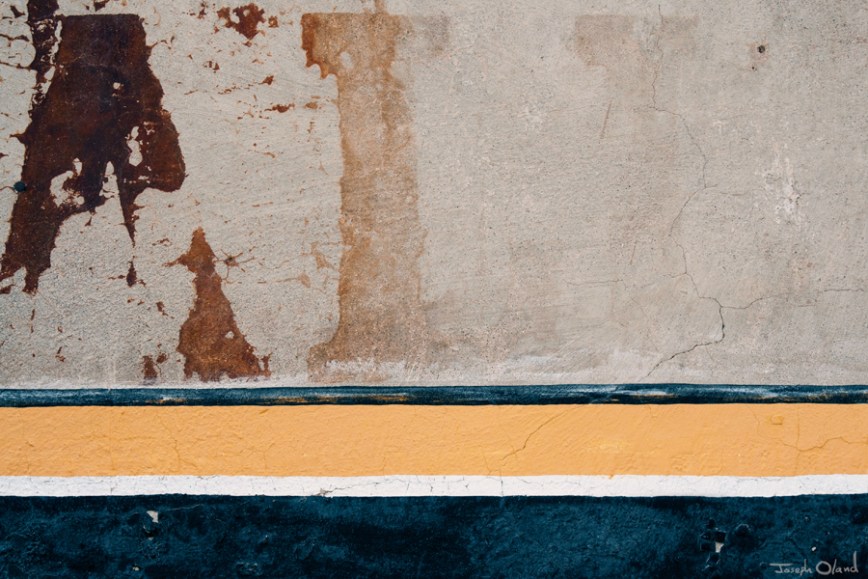
No flowery words today. Film February marches on with this very basic composition, taken with my first real camera, the Nikon N80 that my parents got me. Up until that point, I was using an old Canon with a broken manual rewind lever – it would take about five minutes to wind the film after finishing a roll.

This picture was made using my favorite film stock, a color-reversal stock from Fujifilm called Velvia. It was pretty expensive film, so I never used it much, but it produced these rich colors that always seemed to take the most basic, common, mundane, and forgettable subject matter leap up at you.

A faded practice, film photography, for the faded paint lettering on an old building.
Seems appropriate enough.

FINE ART PRINTS AVAILABLE HERE
SIGN UP FOR THE LENSEBENDER NEWSLETTER

February 22 – The Nebula

02-22 Nebula postExperimentation sometimes leads to the break-through. It certainly leads to some failure. Sometimes you hit an in-between result; this one lives somewhere in the middle. Today’s image wasn’t made with film, nor was it made with a camera. It was made with black-and-white photo paper, an incandescent light, some old print developer (Kodak Dektol multigrade), and a bottle of india ink.

An entire box of my photo paper was accidentally exposed to light; the material isn’t cheap, and I wasn’t amused by the loss. For those of you who don’t know what film and photo paper is, it’s a light-sensative material that’s coated in silver halide (a crystallized salt form of the metal). When light hits this material, the areas that were exposed to the greatest amount of light turn correspondingly dark. With the assistance of corrosive chemicals, you can accelerate the process of darkening the tones and then you can use another set of chemicals to fix the image permanently.

When a box of photo paper is accidentally exposed, it becomes useless for traditional printing – all prints will be slightly flat-toned or “fogged” when you go to draw a print in the darkroom. Rather than snap my fingers in defeat and pitch the useless pages into the trash, I decided to try and have some fun. The paper was already ruined, so what could I lose?

I started taking these pieces of partially-exposed paper out. I threw them into the developing bath and sprayed india ink over the prints before snapping on the overhead light. Since some of the paper was protected from the light by the dark, floating plumes of ink, strange patters begin to emerge on the paper. I’d then lift the prints before they turned completely black and put them in the fixing chemicals. The result is what you see above – atmospheric swirls and bubbles that, to my eye, are reminiscent of astral photography. I’d stumbled on a new, slightly messier form photogram, and I spent the entire afternoon experimenting, saving the best results to be toned, hand-colored, or scanned into digital files later.

Sometimes it pays just to goof off for a bit and forget that there are any rules.

FINE ART PRINTS AVAILABLE HERE
SIGN UP FOR THE LENSEBENDER NEWSLETTER

February 20 – The Serpent (and semiotics)

02-20 The Serpent postToday’s photograph for the continuation of ‘Film February’ corresponds to a time when I was first exposed to a different, more literary side of photography. After reading “Subculture: The Meaning of Style” by Dick Hebdige, the door to semiotics was opened. It was nauseatingly confusing to me, this new philosophy of graphic language, but it was also intriguing. I fell down the rabbit hole and found myself thinking about my photographs in a completely different way. I’m reminded of one of photography’s seminal publications, “Camera Lucida: Reflections on Photography,” and a particular passage by author Roland Barthes which summarizes my feelings perfectly:

“For me the noise of Time is not sad: I love bells, clocks, watches — and I recall that at first photographic implements were related to techniques of cabinetmaking and the machinery of precision: cameras, in short, were clocks for seeing, and perhaps in me someone very old still hears in the photographic mechanism the living sound of the wood.”

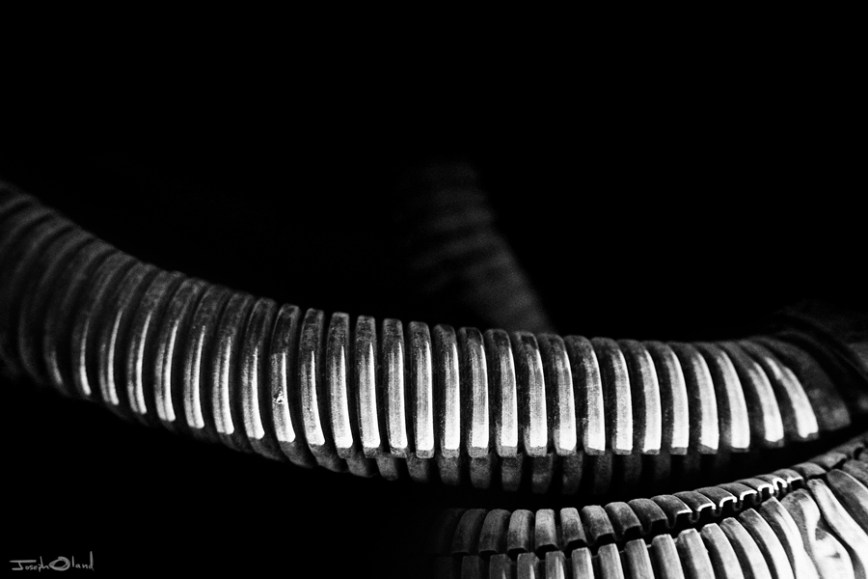
From the moment I began these new studies I started looking through the viewfinder differently. This is when I became interested in macro photography, and it’s when I became much more deliberate with my compositions. When I take the time to really investigate, I discover that there are interesting things all around, that there is always something interesting to investigate with my photographers’ tools. With camera in hand, I’m a kid looking under rocks and discovering whole worlds that I never knew were there before.

FINE ART PRINTS AVAILABLE HERE
SIGN UP FOR THE LENSEBENDER NEWSLETTER

February 16 – Sunland Motel

02-16 SunLand Motel postAs car culture began to take root in Arizona, the Old Spanish Trail Highway was established in 1916. This route represents a massive construction project intended to thread from Southern California to Florida. Motels and gas stations sprung up from the route, and some of the old remnants just so happen to survive today.

The Old Spanish Trail merged with other routes on the north side of Tucson, creating a network throughout the city. In the 1920s, the road became US Highway 80, which snaked down through Benson, Bisbee, and onto Douglas. Another vein sprung up, US Highway 89, stretching down through Tubac, Tumacacori, and on toward to the port of entry in Nogales along the Mexican border. Highway 84, known as the Casa Grande Highway, is now called Miracle Mile – it led north to Casa Grande and Phoenix.

Miracle Mile is today a somewhat notorious stretch of road, with low-rent rooms, weekly rates, a strip club, and a bowling alley. But that isn’t news. The area began to decline in the late 1960s, and Miracle Mile became synonymous with drugs, prostitution, and other illicit activity.

Only recently has the area has begun to shed it’s negative reputation, and it may be a while yet before the old stories fade away. Reinvestment has seen renovation, but many of the motels still seem relatively neglected, and the low rates still have the appearance of attracting a particular type of clientele. I guess time will tell what’s in store for old Miracle Mile road.

FINE ART PRINTS AVAILABLE HERE
SIGN UP FOR THE LENSEBENDER NEWSLETTER

February 13 – Paul Bunyan

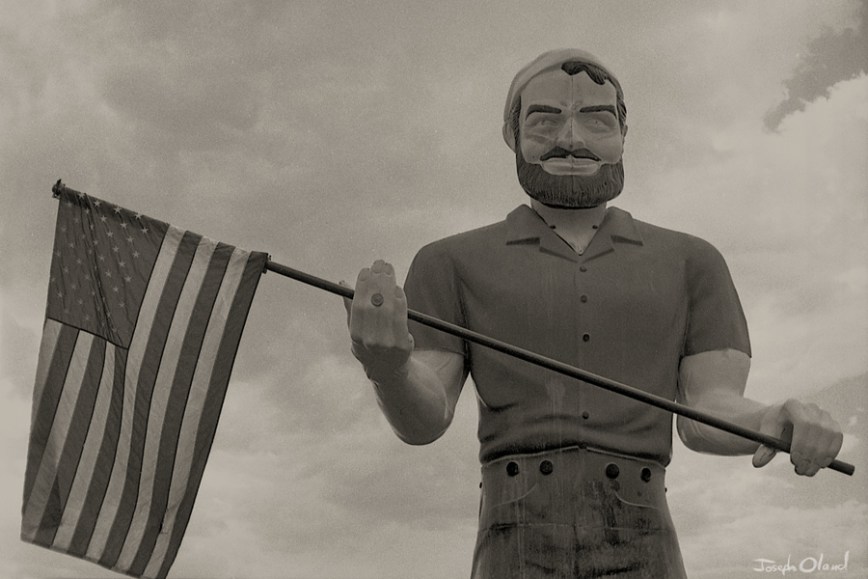
02-13 Paul Bunyon postIt was entertaining to learn that this statue of Paul Bunyan has a Yelp! review, which is about as nonsensical as the statue itself. I never looked into why or how this fifteen foot fiberglass statue arrived at the intersection of Glenn & Stone, but I definitely had to photograph it – this time with my Fujica Half vintage camera, on vintage film stock from the 1960s, on vintage photo paper from the 1960s. The film and photo paper was fogged from age, but I rather enjoyed the distressed look of the final print. Not a lot of trees for a lumberjack in Tucson, but he’s definitely become a landmark.

FINE ART PRINTS AVAILABLE HERE
SIGN UP FOR THE LENSEBENDER NEWSLETTER