January 24 – Downtown Tucson

01-24 Rio Nuevo post

I was a freshman at The University of Arizona back in 2001. The whole of downtown Tucson has completely changed in the years since then. University Boulevard was a third-world country; the old brick buildings at the intersection of Park & University were a shelled-out scene reminiscent of 1980s East St. Louis. The only missing set-piece would be an arrangement of chopped cars on cinder-blocks. The old drug store was razed that year, piles of bricks and construction equipment lined the streets, and the sound of jackhammers provided the background music audible from my eighth story dorm room in Coronado Hall.

Downtown wasn’t entirely different. Congress Street, the main thoroughfare, had it’s own share of problems. The Screening Room still had events every weekend, Hotel Congress was a hub for live music & adult beverage, and The Grill – open twenty-four hours – always had coffee, beer, and tater tots for the restless insomniac artist. The scene was markedly different in the light of day, though; many of the storefronts on Congress were shuttered and vacant, rents were low, and a series of businesses seemed to play musical chairs with commercial space.

A lot has changed since then.

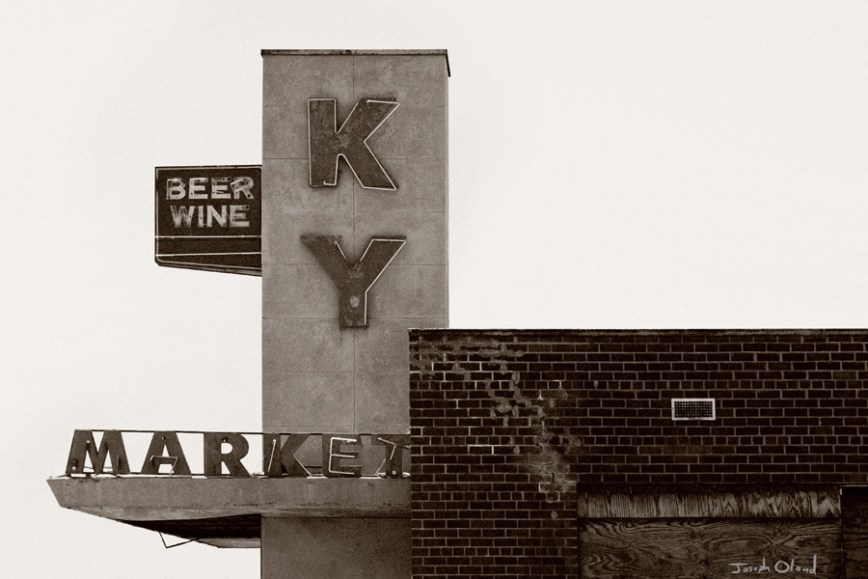
Today’s ‘photograph of the day’ is an old market just south of Tucson’s downtown area on 6th Avenue. I don’t have a lot of information about the old business, but I’m guessing it was one of the many bodegas near Barrio Viejo that eventually fell into irrelevancy. The structure appeared to sit vacant during the entirety of my tenure in Tucson, the ten years stretching from 2001 to 2011.

Revitalization hasn’t just hit Congress and 4th Avenue – the old KY Market has been purchased by a gentleman named Danny Vinik and converted into a multimedia space for his company, Brink Media. I worked for the company, briefly, but I don’t think I possessed quite the skill-set, and the project I was working on didn’t seem to be too tremendously focused. The people that work there, however, are some of the most brilliant web developers, graphic designers, and videographers I’ve ever met. I was happy to be a part of the operation, short-lived and fruitless as it may have ultimately proved to be.

I have a lot of pre-restoration photographs of downtown Tucson, and this is one that has a little bit of meaning for me. Progress happens, and I’m happy knowing that the building is finally being put to use; one of the greatest friends I’ve ever had works there today. But I also selfishly enjoy the rustic aesthetic of abandonment. Maybe I just have sour grapes that the whole time I lived in Tucson, the whole of downtown was like a pile of rusting beer cans in the desert, and now it all seems to have sprung to life – you know, now that I’m not there to enjoy it.

So it goes.

PRINTS AVAILABLE HERE
SIGN UP FOR THE NEWSLETTER HERE

January 20 – Here’s Your Sign

01-20 Your Sign post

Our life is what our thoughts make it.
~Marcus Aurelius

– – –

I’m not the only photographer that has a weird fascination with signs. It seems like a habit a lot of us have fallen into. I don’t think it’s the signs themselves that attract us, but the era they evoke. Designs from the golden age of commercial neon signage, starting roughly in the 1950s, have long ago gone out of style. Vintage neon tubes are getting harder to find, especially in their original context. Buildings are torn down and the signs are often demolished, too. A few survive in their original context, usually on registered historic buildings, and others survive in personal collections.

Old buildings, ghost towns, unique architecture, and vintage signs present something of a game to image collectors; objects like these are like checklist items in a photography scavenger hunt. The image above is actually a bit of a “non-sign,” I’d venture to say. It’s likely the entrance sign for an old two-pump gas station on this street corner. There’s a shuttered repair shop, aluminum doors locked, and the gas pumps have been removed. This sign frame is a rusting heap keeping vigil over a shack and a loosely organized pile of whitewashed cinder blocks that vaguely resemble a low-rent apartment complex.

Hell, since the original picture was made five years ago – never previously published – the area may be completely different today.

The street corner is on South 4th Avenue along the Old Benson Highway on Tucson’s south side, across from the Lazy 8, Tucson’s “cleanest budget motel.” A lot of you Tucson folks have probably driven that stretch of highway but never stopped to look at the scenery; mostly cheap hotels, run-down apartments, abandoned commercial structures, rent-a-fences, and dumpsters. You’ve probably clapped eyes on the Lazy 8 sign on your way to the airport, but never had a reason to pull over and check it out.

That’s what I like about this photography gig. Boring things become interesting. You stop and look around when you normally wouldn’t have any reason to hit the brakes. Sure, the suspicion that there might not be anything of interest often proves to be true, but it’s still a different kind of experience. There’s a slow-down that happens when you look at the world through the lens. I became addicted to that sensation when I first started making pictures, and I’ve never gotten over it.

I encourage everyone to take the time, even just once, to walk around with a camera and start looking at the world through that funny little box with a lens. It can be pretty eye-opening.

PRINTS AVAILABLE HERE
SIGN UP FOR THE NEWSLETTER HERE

January 08 – Tragedy In Tucson

01-08 Tragedy in Tucson post

“We can easily forgive a child who is afraid of the dark; the real tragedy of life is when men are afraid of the light.”

~Plato

– – –

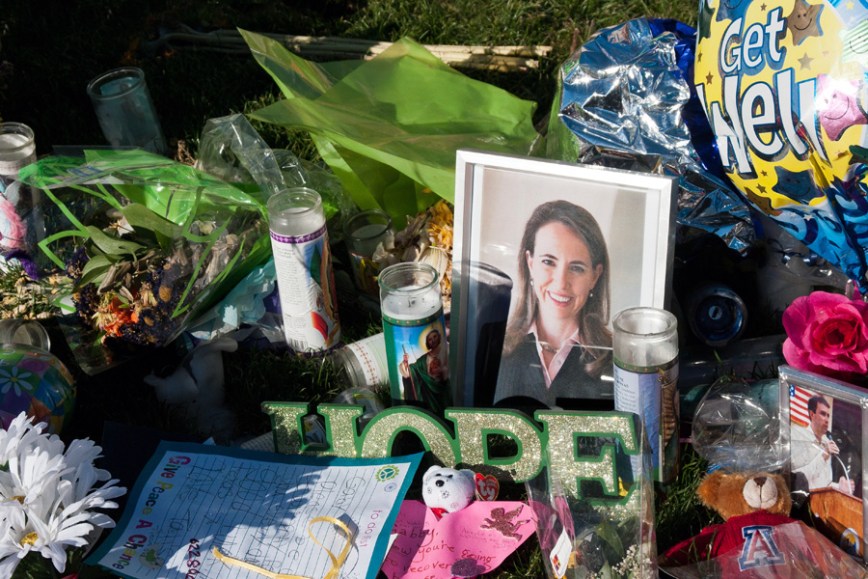
Five years ago violence was visited upon Tucson when a gunman opened fire at a grocery store parking lot. Nineteen individuals were shot, including United States Representative Gabrielle Giffords. Six people lost their lives. I expect that this anniversary will be marked by many in the media, especially after President Obama’s executive order earlier this week. Gun control legislation continues to be a huge point of contention among American voters, but gun violence continues to be an undeniable problem. This isn’t the forum for an individual like myself to hammer out a screed about the issue. All I know is that I was in Tucson that day and I remember how it felt.

I had only just heard the news when my phone rang. A gentleman from SIPA Press introduced himself. He had received my name from a journalist friend of mine, who had explained I’d likely be available to cover the story. This would be the first time I was ever hired to work as a photographic journalist. With shaky hands and shallow breath, I packed up my gear and headed down to the University Medical Center where the wounded, including Representative Giffords, were being treated. I wasn’t sure how I was going to do this job, and I certainly didn’t know what to expect. But I knew I had to go and try my best to do a decent and respectful job.

The next several days were a blur of people in mourning, of funerals and press conferences, of being pressured to go to Jared Loughner’s home and try and get pictures. Any time when I began to feel like a paparazzo, I put my camera down. There were some things I wouldn’t do. Cristina Green – the nine-year-old girl who lost her life in the shooting – was particularly challenging. The media predictably poured in like ghouls for the funeral, sticking microphones into crying faces and asking people “how do you feel, sitting out here” while they choked and sobbed their responses. I was thankful, in that moment, to be a photographer; I was able to do my job from a distance rather than invade people’s space in a moment of sadness.

There is a lot more I could say – about violent political rhetoric, about the second amendment, about the moments years later when I got to sit down with Mark Kelly and Gabby for a brief cup of coffee – but again, I don’t really think this is the place. Gabby has made more of a recovery than any of us could have ever hoped or expected. Jared Loughner, the wild-eyed gunman, is serving seven consecutive life sentences. The world is still here, even if it has been deprived of a not-so-insignificant portion of peace and happiness.

VIEW THE EXTENDED GALLERY HERE


One More Word About My Friend

COVER


Aching legs, kicking the parking lot curb in Deming, New Mexico – if not out of exhaustion & boredom, then to loose the day’s dirt from our cracked boots. Cow shit, mud, wind-burned faces and angry lungs – we carried what might well have been bags of flour on the surface of our jeans and on our feet all afternoon, leaving behind an impressive pile of dust.

We headed out to the fair grounds from our Luna County motor-lodge every day for a solid week back in September 2010, specifically to see what the rodeo was like outside of the professional circuit. And outside of the circuit, out in the badlands – out where people hold the guttering torch of an agrarian lifestyle – things proved to be contrary to any expectation we could’ve had.

Out here, ranchers exchange stories about the season’s rain, and drought is on their minds. A rash of hardship – of broken men and busted operations, sick livestock and parched crops, lost land, failure, sadness, and suicide – permeates their conversation. There’s also the non-sanctioned events of the working-rancher’s rodeo, cowboys (and girls) telling stories to one another and laughing, exchanging advice and promising prayers and support, good luck and good will. The rodeo performance itself is unflinchingly quiet, even anti-climactic to most of the rodeo crowds we know. The livestock here belong to the ranchers themselves, not a stock agency. Nobody is risking harm to self or harm to their animals – they simply can’t afford it – and that kind of risk just isn’t what we see in pro-rodeo.

At PRCA (Professional Rodeo Cowboys Association) events, many competitors certainly do herald from the ranch-lands. No question about that. But there are endorsement deals – Jack Daniels, Coors, Boot Barn, and Stetson, to name only a few. Those are professional athletes competing for professional money, and it’s a spectator sport. Risks are higher, so is the money, and sometimes people get hurt. In the photo pit and up in the crow’s nest are photographers, print journalists, and videographers, all waiting for that perfect ride. And let’s be honest: many of them are waiting for blood, too. The crowd itself is in for excitement, shaking the grandstand with stomping feet.

With working ranchers, events are skill-based with diminished risk, with little chance of personal injury or damage to livestock. It’s a meeting-ground for regional farmers & ranchers interested in land-management, stock-prices, water resources, and futures markets.

It’s a different game entirely.

Unlike pro-rodeo, women are allowed to compete in events other than barrel racing, and some of them can throw a rope with remarkable skill, rivaling the most celebrated male competitors. Ropers and muggers aren’t as daring, and there’s no Jack Daniel’s tent pouring free samples for onlookers.

These aren’t professional athletes. They’re businessmen.

This is a social gathering for ranchers, whose fates are tied together by market price and rain-water, seasonal planning and farm size. These men and women raise livestock and grow produce. They represent an increasingly rare incarnation of the American laborer. The national average of US ranchers and farmers are approaching sixty years of age, with less than two percent of the US population currently dedicated to producing food. It’s no surprise that events like this are becoming increasingly rare. In fact, when I returned to Luna County in 2011, the rodeo event was canceled due to lack of participation. With few competitors, the prize-pot was far too small to justify the expense of attending.

No gold buckles are awarded here. There are no endorsement deals. No radio station promos or truck dealerships. These men and women pay to play, with the possibility of making business contacts and winning some cash. Eliminate half of the incentive, and the rodeo grounds remain woefully empty.

– – –

Gray skyscapes and scattered clouds boiling off into the east and a peach mist of dirt in high winds, dissolving as the sun crawls down. We stomp our boots and smoke our cigarettes, leaning against the car, kicking tires and uncapping a bottle of cheap off-brand whiskey in the motel parking lot. The room is dirty but I’m not paying, so there’s no reason to complain. Moldy carpet and four channels, a shitty water-heater that takes twenty minutes just to warm up, and an infuriatingly faulty ice machine – this couldn’t be mistaken for paradise.

But hell – not half bad.

With a case of Mexican beer and a bottle of local wine from local St. Claire, the ‘take’ of the day arrives in wry comments, inside jokes, and several hundred near-useless photographs, choked-out as thoroughly as we were by the dust.

– – –

This is my best memory of Will Seberger – photojournalist, political junky, decent human being. Unafraid to curse in mixed company, he was superhuman in his ability to inject benign conversation with pointed and incendiary commentary – and usually some laughter – and all without coming off as elitist or disrespectful. He passed away unexpectedly in the wee-hours of August 17th, leaving in his wake a constellation of family, friends, fellow journalists, and a wife.

It was this trip to Deming that stands out to me, as both a photographer and a friend. Recently unemployed and living on a buddy’s couch in Tucson, this trip was a gift to me. Will called me up, lord knows why, and asked me along. I didn’t have anything better to do and I felt honored for the invite. This was an opportunity to escape my depression, to get out of the house, to be challenged as a photographer, and to spend time with my friend. I told him I was ‘in’ without skipping a beat.

I’m saddened by how few photographs I actually took of him in the twelve years I knew him. Most of the images presented here, Will was standing right beside me. At the hotel each night, reviewing our work, he didn’t pull punches when critiquing my work. I always appreciated that. It takes a good friend to look you in the eye and say “that’s shit” while loving you at the same time.

– – –
We spent a lot of time outside on the splintered concrete in front of the room, sifting through photos on Will’s laptop, a glowing screen perched on the hood of his JEEP. We smoked a lot of cigarettes outside our non-smoking room, enjoying the autumn weather. Absent a corkscrew, I remember Will cracking the head off a bottle of wine with his survival-knife. He may have ruined that knife, but we enjoyed drink, dag-nabbit.

“Drink up. It’s only ‘day one,’ and we’re only gettin’ dirtier.”

We filled the bathroom sink with ice each afternoon for beer. Twelve hours under the sun each day, rings of mud on the damp bandannas we wrapped over our mouths, local food and cheap Mexican beer were our only comfort outside of conversation. But we talked a lot. And that was nice.

We never complained. This was fun for us.

As the week wore on, the titled presented itself: Apocalypse Cow. We’d wandered into foreign land and buried ourselves in the job. After heat-stroke, booze, and a gaggle of interesting characters – a drunken beast insisting that he was black ops and handed us a copy of his self-authored bio-pic screenplay, a wild-eyed fifty-something donning kilt and ‘zombie apocalypse’ baseball cap telling stories of chemical baths, government medical experiments, anthrax, and cancer – the title seemed appropriate.

“Apocalypse Cow” became the name of the trip. We decided it’d be the name of the gallery show if we ever had one. Sadly, such a show never materialized. We did gather a lot of pictures, though, and we met a lot of great people. I’m confident some of Will’s images wound up in the portfolio, and I know there are a small handful of images that I’m proud of, too. We took notes, collected phone numbers, made plans to return. I just wish we’d found the time to get back out there.

– – –
Our political climate – of vitriol and anger, polarized constituencies and ineffectual representatives – doesn’t have much place out where Will and I ventured. In a saloon, two photographers from the Midwest found each other and struck up a friendship. Our paths were circuitous, but Will and I possessed a healthy blend of old-world values and new-world education. Neither of us were particularly seduced by partisanship. When we worked together, we’d often arrive at the media tent side-by-side. He’s bang on the door and announce: “the liberal media has arrived!”

Always a joke, and always laughter from the other side of the door.

I can’t recall Will ever scoffing at someone’s vote – even if it was against his own horse. He was a man of moral and social integrity, and always fought for what he thought was right. He understood that there are few Truths, and he burned few bridges. He was deeply principled and unforgivably opinionated, but never without a sense of humor to blunt the angst.

Time spent in the borderlands, Will appreciated that some old-world values still exist. He believed that working people matter. Beyond politics and exit polls, network & cable news, party affiliations, gender, or personal bias, he believed in our collective ability to push forward. He found common ground with each and every person he befriended, each and every person he photographed, each an every person he reported on (for the most part). He believed in the possibility of disparate players, approaching the table.

Will was my friend. And I write with a heavy heart that I can’t imagine life being as valuable without him. May he be at peace, and may he and I meet again, against all odds, in the great beyond.

It was a good ride, Will.

If I live to be twice as old and achieve half as much, I’ll be happy.

Thank you. For everything.

-joe
Back to the Rodeo

87th Fiesta de los Vaqueros

– – –

Today’s blizzard-like conditions don’t augur well for my visit to Tucson for the 88th Annual Fiesta de los Vaqueros. Bisbee was pounded with heavy wind and snow, and I expect all that’s melted on the roadways will be ice by morning. I know Tucson got hit, too and don’t expect a pleasant drive. But what the hell, right? There’s a job to do, and if there’s one thing I can take comfort in, there’ll be plenty of cheap beer and whiskey to take the sting out.

I can picture the grounds, wet with melted snow, settling into a muddy soup. I missed last weekend’s performance – something I lament, but can’t control – but after all the time I’ve spent out there, I can conjure a pretty clear picture: metal railings slathered in mud, pens filled with anxious steers, the aroma of leather and manure. There’s a certain kind of unpredictability before the rodeo; one can sense the adrenaline, anticipate the thud of hooves, the grunting of worked-up rough-stock. It’s a nervous feeling one gets, but it keeps you sharp. Things unfold quickly in the arena and I don’t want to miss a good shot.

– – –

I’ve been photographing the rodeo for years and I’m still pretty dumb-founded at my enjoyment of the sport, considering my earlier years, and the misfit toys that occupy my inner sanctum. I could intellectualize it, I suppose, and there’s definitely a rich history to the sport, but that isn’t really it. At the end of the day, folks could give me a once-over and assume – with some accuracy – that they’re looking at a blue-state sort of guy. So then, what is it about the red-state atmosphere in the rodeo arena that I find so appealing? It isn’t the pop-country rattling the aluminum grandstand, and it isn’t the whiskey; it isn’t about pretending to be anything I’m not, either, donning my hat and walking clandestinely among real cowboys. All I can figure is that my roots are in the Midwest. I took field trips to the Kansas City Royal in elementary school, just like the kids from the Tucson Unified School District spill into the stands up in Tucson. Notions of the Wild West permeate our culture, and I get to participate in this tradition by reporting on it and preserving it.

Everything’s pretty fast-paced out there, and I really dig the challenge.

– – –

There’s a lot of heartland pandering, but that’s nothing new. The idyllic “cowboy” has been used to sell trucks, whiskey, music records, and jeans for as long as I can remember. Salt-of-the-earth imagery is an effective tool to tap into our desire for so-called ‘simpler times.’ The notion of getting one’s hands dirty, being connected to the earth, and having a Calvanistic appreciation for hard work all play a role. Plenty of literature has been devoted to the topic, but this isn’t a screed I’m particularly interested in right now. Rather, I’m interested in the opposite end of the spectrum.

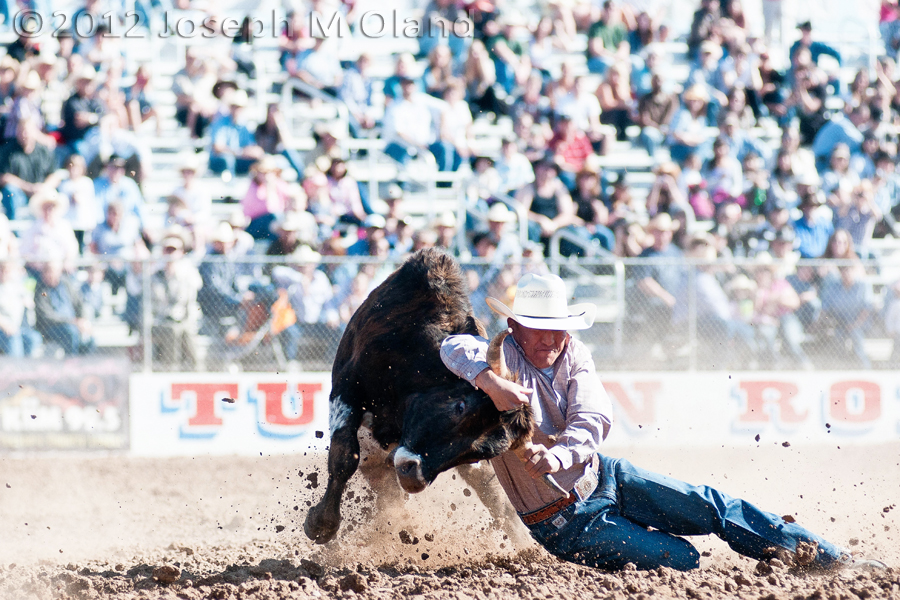
The competitors at these Pro Rodeo events are, in a manner of speaking, the genuine article. These cowboys put their bodies through hell, and have real, quantifiable skill. I’ve seen enough broken-toothed grins and scarred bodies to respect the risk these guys take, and I’m interested in that intense combination of bravery and madness that motivates a 160 pound man to mount an angry beast ten times his weight.

The cold weather’s gonna suck, there’s no doubt about it. But in my experience, the press box and photo pit empty out when the weather doesn’t cooperate. A little bit of discomfort is worth getting the shot that nobody else is around to capture. Wish me luck.