February 16 – Sunland Motel

02-16 SunLand Motel postAs car culture began to take root in Arizona, the Old Spanish Trail Highway was established in 1916. This route represents a massive construction project intended to thread from Southern California to Florida. Motels and gas stations sprung up from the route, and some of the old remnants just so happen to survive today.

The Old Spanish Trail merged with other routes on the north side of Tucson, creating a network throughout the city. In the 1920s, the road became US Highway 80, which snaked down through Benson, Bisbee, and onto Douglas. Another vein sprung up, US Highway 89, stretching down through Tubac, Tumacacori, and on toward to the port of entry in Nogales along the Mexican border. Highway 84, known as the Casa Grande Highway, is now called Miracle Mile – it led north to Casa Grande and Phoenix.

Miracle Mile is today a somewhat notorious stretch of road, with low-rent rooms, weekly rates, a strip club, and a bowling alley. But that isn’t news. The area began to decline in the late 1960s, and Miracle Mile became synonymous with drugs, prostitution, and other illicit activity.

Only recently has the area has begun to shed it’s negative reputation, and it may be a while yet before the old stories fade away. Reinvestment has seen renovation, but many of the motels still seem relatively neglected, and the low rates still have the appearance of attracting a particular type of clientele. I guess time will tell what’s in store for old Miracle Mile road.

FINE ART PRINTS AVAILABLE HERE
SIGN UP FOR THE LENSEBENDER NEWSLETTER

February 13 – Paul Bunyan

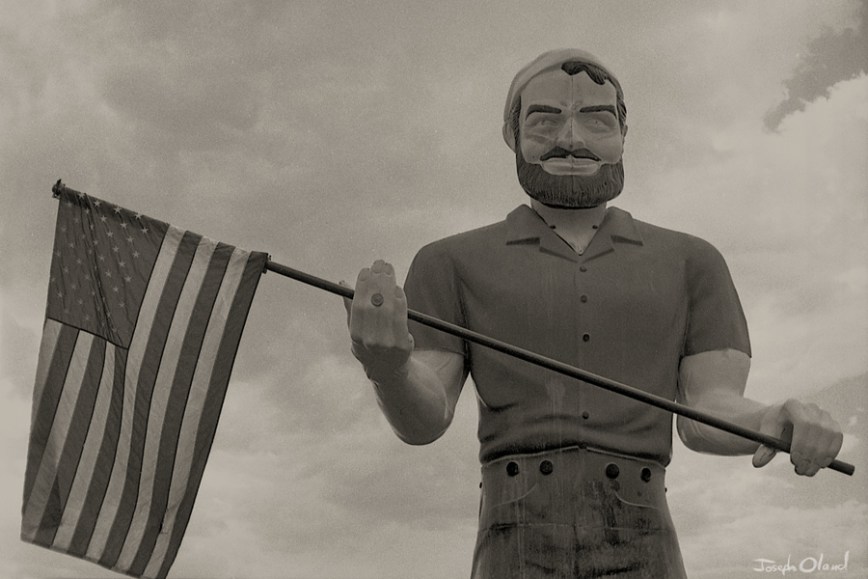
02-13 Paul Bunyon postIt was entertaining to learn that this statue of Paul Bunyan has a Yelp! review, which is about as nonsensical as the statue itself. I never looked into why or how this fifteen foot fiberglass statue arrived at the intersection of Glenn & Stone, but I definitely had to photograph it – this time with my Fujica Half vintage camera, on vintage film stock from the 1960s, on vintage photo paper from the 1960s. The film and photo paper was fogged from age, but I rather enjoyed the distressed look of the final print. Not a lot of trees for a lumberjack in Tucson, but he’s definitely become a landmark.

FINE ART PRINTS AVAILABLE HERE
SIGN UP FOR THE LENSEBENDER NEWSLETTER


February 12 – Suicide Alley

02-12 Suicide Alley post

FINE ART PRINTS AVAILABLE HERE

In October a train hits and kills a pedestrian around 7am. Officials investigate the incident as a suicide.

In November, a man kneels down in front of a train. The conductor tells police the man walked out of the bushes near the tracks and bent down to place something on the tracks. He then knelt down, facing away from the oncoming train. A note is found on the body, along with a single dollar bill. The note says goodbye to a friend and requests that whoever should find the note to please deliver the dollar, a debt, to the mentioned friend.

In December a man steps in front of a train and remains there until he is crushed. Witnesses tell police that the man intentionally stood in front of the train; the engineer sounded his whistle and flashed his lights and was unable to stop before killing the man.

Sixteen years ago, the Tucson Citizen published an article about railroad deaths after a series of tragic incidents, accidents and acts of suicide. Although the number of railroad suicides isn’t known, they’re not uncommon. The article included an interview with Dan Hicks, a veteran railroad conductor who has worked in the Tucson area.

“Hicks, 48, said he’s experienced the trauma of rail accidents several times,” the article reads. “Engine’s he’s operated have hit trucks, cars, and in one horrifying instances, a drunken woman who had been beaten and left on the tracks.”

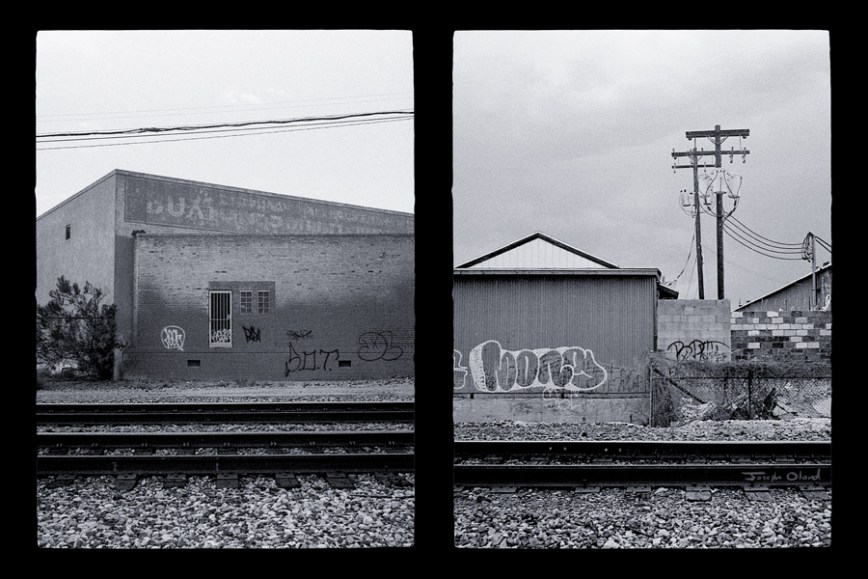
Today’s photograph – two exposures made with my handy-dandy Fujica Half – shows an area south of downtown Tucson. Around the time these two images were made, I met an engineer at Hotel Congress. I was sipping a beer and waiting for some food at the lobby restaurant, The Cup Café. He was dating one of the women who worked there, a woman I’d known for a little while. He told me about the number of accidents he’d witnessed, and the number of suicides. He also talked about a stretch of train tracks nearby that area rail-workers referred to as “suicide alley,” where a cluster of deaths had occurred. He told me how certain determined people would arrange their bodies on the ground, laying their necks directly on the track.

I’d recently been walking around that very stretch of tracks. Taking photographs was actually a challenge while I was studying photography – an irony I can’t even begin to describe – and it was an activity usually undertaken on the weekends. I’d never considered that suicide by train was a problem in this shiny new modern world. I remember thinking I hadn’t heard anybody talking about it. I hadn’t heard anything on the news.

But then – I’d  pretty much been living in the basement of the Theater Arts Building (where the photo lab was), so how would I know? For the past several months that’s the only place anybody could ever find me. I ate there, worked there as an employee and worked there as a student. Hell, I had a sleeping bag and pillow, a hot plate and a wet-bar (rum, coke, tonic water, and whiskey) in my private, closet-sized darkroom in the bowels of that institution. I only ever emerged to meet my girlfriend downtown for food and drink, or to fetch a pack of cigarettes from the 7Eleven across the street.

It shook me to think about what it must feel like, to be that determined to end one’s own life. It shakes me still.
I can’t look at these photos without thinking about it.

FINE ART PRINTS AVAILABLE HERE
SIGN UP FOR THE LENSEBENDER NEWSLETTER

February 11 – Smith Pipe and Steel

02-11 Smith Steel post


In the warehouse district south of Downtown Tucson, beyond the night clubs & restaurants, Armory Park & El Barrio Viejo, one might happen upon this peculiar sight. It appears to be a life-size – perhaps larger than life-size – sculpture of a velociraptor, sitting comfortably on the corner of Euclid & East 25th Street. It keeps constant watch over the parking lot of Smith Pipe & Steel, an industrial warehouse of some kind.

Sometimes a photograph speaks for itself, and I believe this would be one of those times.

Head down to Tucson’s South Park (no joke) neighborhood. According to a GoogleMaps search, this interestingly out-of-place character was still there in 2013. Chances are, it’s still there, like so many rotting beer cans in the desert.

FINE ART PRINTS AVAILABLE HERE
SIGN UP FOR THE LENSEBENDER NEWSLETTER


February 08 – Tap-Dancin’ Granny

02-08 Granny postThe first several years I lived in Tucson, I lived right off of 4th Avenue. Close enough to walk, far enough away to have only had my car vandalized about a dozen times during my tenure,

Some of the grime has been polished off the 4th Avenue I remember from those days, but hey – nothing stays the same forever. Shirtless days on the front porch, cold beer in the summer, an embarrassing amount of hackysack. Brooklyn Pizza’s garlic knots and walks over to The Grill at three o’clock in the morning for some tots. The old underpass, bathed in dim yellow light, always wreaked of urine; most of the young ladies I knew – a generous portion of which who’d smack me across my smug face for referring to ’em as “ladies” – preferred not to walk through by their lonesome.

I magic-markered a piece of copy paper and thumb-tacked that sucker right by the exit to the one-room hovel of a guest house I lived in. “Do you have your camera?” was scrawled in smudged blue ink. That was my healthy little reminder every time I headed for the door. I hardly ever went anywhere without my camera, and only seemed to need it when I’d left it behind. This seems to always been case, even today.

I made it a habit to go down to the 4th Avenue Street Fair every autumn and every spring. It takes a certain kind of con-artist confidence to stick your lens in strangers’ faces, and the various street fairs, county fairs, political protests, and other events proved to be a healthy training ground for inexperienced street photographers like myself. Some people notice you and immediately ruin everything by smiling or posing.

Other people just have to common courtesy to threaten you with as ass kicking.

With enough experience, you learn how to lie your way out of sticky situations, charm your way through others, and – most importantly – make accurate snap judgments about the people around you.

The easiest photographs to make – and often the most fun – are of street performers. They’re used to being looked at, and usually like to dust-off their ‘A’ material when they see a camera watching. Something in my gut tells me that this woman may not be with us any longer. This photograph is somewhere in the neighborhood of ten years old, taken outside of Caruso’s Italian Restaurant on South 4th Avenue. A tap-dancing, smoking granny – how could one not take a photograph?

FINE ART PRINTS AVAILABLE HERE
SIGN UP FOR THE LENSEBENDER NEWSLETTER


February 06 – Mission San Xavier del Bac

02-06 San Xavier postOn the Tohono O’odham Indian Reservation, about ten miles south of downtown Tucson, rests “the pearl of the Sonoran desert.” San Xavier del Bac is a Spanish Catholic mission, erected between 1783-1797 near a natural water spring fed by the Santa Cruz River. It’s the oldest European structure in Arizona, considered by many to be one of the greatest specimens of Spanish Colonial architecture. The natural spring no longer exists, and this stretch of the Santa Cruz only runs for part of the year.

This is one of my favorite places in the world. There’s no way I could every take an original photograph of it – it has been photographed countless times by tourists, photo enthusiasts, and professionals. Most famously, Ansel Adams turned his lens to the beautiful structure; the images reside at The Center for Creative photography on the University of Arizona campus.

This particular image was made in the Spring of 2001. This is one of the earliest visit I’d made to San Xavier, although I would make the drive out on a regular basis during my tenure at the University of Arziona. Up on the hilltop, in the background, is where I would often sit and listen to the wind. It’s the most peaceful, magical place. A wonderful site to clear one’s head.

FINE ART PRINTS AVAILABLE HERE
SIGN UP FOR THE LENSEBENDER NEWSLETTER

February 05 – Craters In The Earth

02-05 Meteor Crater postThe year was 2001 and I was a cocky asshole of a man. My girlfriend and I somehow conned her parents into lending their minivan to the enterprise and we lit-out for the western territories. I’d received an acceptance letter from the University of Arizona and I was ready to get the hell out of Kansas. Little did I know that attending the UofA would mean just about nothing, other than a pile of debt with a degree worth less than the scrap of parchment it was printed on.

But that’s a whole other story.

An 18-year-old version of me screamed down the highway in a soccer-mom van with a young slab of beautiful woman-flesh – and that’s all that mattered. We camped along the high desert, free spirits, and I will never forget the experience. Trading sex in a two-door coup for sex in a bulky 1970s-style canvas tent is probably one of the more sublime experiences this young man could have ever hoped for at the time.

We drove through Tucson and struck camp at Mount Lemon and surveyed the landscapes along the painted desert of Northern Arizona. It was the first time in my life I felt truly unfettered, rising in the morning to the sound of rushing creek water and a lovely ivory face beside me, cloaked in locks of streaming brown hair, lips upturned in a sly satisfied smile.

No drug can ever replace the experience of being eighteen years old and in love. Today’s photograph is a reminder of that innocent time; my woman by my side, unaware of the struggles ahead, I dialed the numbers in and pushed a button along the rim of the great meteor crater. This picture represents everything I held important from those lofty teenage years.

It was a good time, in tall grass and open sky. And I will take that pleasure with me into the earth.
When the time comes.

FINE ART PRINTS AVAILABLE HERE
SING UP FOR THE LENSEBENDER NEWSLETTER

February 03 – Drive Thru Liquor

02-03 DriveThru Liquor post

“Film February” continues with this little gem, taken using another one of my handy-dandy vintage film cameras.

Folding cameras were a mid-century fad, dominating the post-war market. You had the style of accordion bellows, but in a handheld package for ease of use. These were imprecise cameras, to sum them up succinctly, but black and white film stocks had a lot of latitude. A poorly exposed negative could still yield a pretty decent print.

Learn more about the Sears & Roebuck Tower Series of cameras here.

Today’s photo of the day comes from Stone Avenue in downtown Tucson, across the street from the police station. I have no hard confirmation, but the rumor goes that Texas is responsible for the grand innovation known as the drive-through liquor store. The source of so many an absurd idea, Texas seems as good a candidate as any; I’m inclined to believe it. In any event, they’re scattered across the southwest like jacks.

This was the maiden voyage of my Tower ’52. I’m pretty sure that this is the very first exposure I made with the camera, which I’d purchased at an estate sale on Tucson’s east side (along with about two dozen other camera bodies). The compression plate is bent, so the film focus falls off on the left and right edges, but it’s this kind of imprecision that makes old cameras fun to work with. Unpredictable things happen, and you never know what the film is going to look like until you develop it.

FINE ART PRINTS AVAILABLE HERE
SIGN UP FOR THE LENSEBENDER NEWSLETTER

February 01 – San Pedro Chapel

02-01 San Pedro post

Film is not dead! It’s only kinda, sorta, half-way, a little bit, almost dead.

February over here at LenseBender Design is going to be the month of film. Every single day I’ll be contributing a new film-based photograph made exclusively with one of my vintage film cameras. I have an extensive collection of old cameras – and even some vintage film stock – so this should be a pretty fun ride.

The first photograph of the month was made using a little-known camera known as the Fujica Half. For more information on this nifty little hand-held miracle machine, you can read about it here.

The San Pedro Chapel (pictured above) is located in the historic Fort Lowell neighborhood near the Rillito River north of Tucson. The neighborhood is named after the military outpost that once stood nearby. Fort Lowell was an Army outpost active from 1873 to 1891 and was intentionally placed on the outskirts of Tucson at the confluence of the Tanque Verde and Pantano Creeks. Year-round water at the mouth of the Rillito River made this area prime real-estate for a camp.

Once the fort was decommissioned, the Department of the Interior put the fort’s lumber, windows, doors, and other salvageable items up for sale; the fort was quickly dismantled and hauled off. The old adobe structures were already disintegrating back into the desert by the turn of the Twentieth Century, when immigrant families from Sonora, Mexico began to settle into the territory.

The migrants occupied the remaining fort structures and replaced the missing windows, roofs, and doors. The enclave eventually became known as El Fuerte. The community mainly raised livestock and sold lumber to residents in the town of Tucson.

The community developed strong roots. They built new houses in the Sonora Ranch style, dug wells (finding water at less than thirty feet), built a school house, and established a cemetery and built a church. The first church on this site was just large enough for the Carmelite Fathers to stand in while serving mass; the congregation would gather under the mesquite trees outside.

A more permanent structure was built in either 1915 or 1917 (the records are not clear on this), but was destroyed by a tornado in 1929. The San Pedro Chapel that survives today was built directly over the ruins of the previous chapel in the Mission Revival Style and dedicated in 1932.

In the 1940s, as Tucson was growing, the Church and general store of the El Fuerte community made this area a de facto town center. Mexicans living in the east of the territory would travel to El Fuerte to attend mass & school as well as  enjoy family parties, baptisms, and other social events. The Chapel is still in use today, as it was then, for baptisms and weddings. At its height, the community was only about three-hundred people, and this building is one of the few reminders of what once existed here.

And I just happened to stumble across San Pedro Chapel on a bike ride.
Pretty darn neat.

FINE ART PRINTS AVAILABLE HERE
SIGN UP FOR THE NEWSLETTER HERE

January 25 – The Sunflower

01-25 Sunflower State post

It is said that on the darkest days, the sunflower will still stand tall and seek out the light. I rather like that sentiment.

It may just be because I was raised in Kansas – the sunflower state – but I always assume everybody’s seen those time-lapse videos, fields of sunflowers craning their delicate necks from east to west, tracking the movement of the sun. It’s a marvelous thing to consider, that these organisms bend so literally to that glowing orb in the heavens. Everything that we enjoy is because of that mysterious object, and it’s promise to return in the springtime.

Entire populations have bowed in worship of the sun. It is the light that lets us see, the warmth that keeps us alive, the energy that draws life from the soil beneath our feet. Even in an age where the sun itself isn’t deified, it’s rising and setting provide powerful metaphors.

Today’s photograph doesn’t require much explanation. This is ‘pretty for the sake of being pretty,’ or ‘ars gratia artis.’ At the same time, I have a lot of memories anchored to this image.

Two summers ago, I walked by a small patch of sunflowers on my daily walk up Brewery Gulch in Bisbee, Arizona, on my way to Mimosa Market. The tiny brick bodega is another Bisbee landmark, although it’s far enough up the thoroughfare that many tourists never manage to set eyes on it (and those that do are often stymied by the cash-only practice). The proprietor had grown a little patch of sunflowers in the side yard, and I made sure to bring my camera with me one day to photograph the frenzy of bees rolling in the pollen like excited children in a snowbank.

I remember one monsoon season, years before I ever moved to Bisbee, walking up the road past Mimosa Market toward Zacatecas Canyon; the entire road was a river of water from the rains tumbling down the mountain from that morning’s rain-shower. A family was in the middle of the near-vacant road, and a baby in a bloated diaper from the water was sitting in the middle of the stream slapping her hands in the water and giggling. I’ll never forget how excited that fat-cheeked, mostly-toothless face looked.

There’s nothing like an Arizona monsoon. There’s nothing like saying hello to a beautiful flower as you walk by, every single day. There’s nothing like the collection of simple little pleasures that, together, are what make life grand.

PRINTS AVAILABLE HERE
SIGN UP FOR THE NEWSLETTER HERE