February 12 – Suicide Alley

02-12 Suicide Alley post

FINE ART PRINTS AVAILABLE HERE

In October a train hits and kills a pedestrian around 7am. Officials investigate the incident as a suicide.

In November, a man kneels down in front of a train. The conductor tells police the man walked out of the bushes near the tracks and bent down to place something on the tracks. He then knelt down, facing away from the oncoming train. A note is found on the body, along with a single dollar bill. The note says goodbye to a friend and requests that whoever should find the note to please deliver the dollar, a debt, to the mentioned friend.

In December a man steps in front of a train and remains there until he is crushed. Witnesses tell police that the man intentionally stood in front of the train; the engineer sounded his whistle and flashed his lights and was unable to stop before killing the man.

Sixteen years ago, the Tucson Citizen published an article about railroad deaths after a series of tragic incidents, accidents and acts of suicide. Although the number of railroad suicides isn’t known, they’re not uncommon. The article included an interview with Dan Hicks, a veteran railroad conductor who has worked in the Tucson area.

“Hicks, 48, said he’s experienced the trauma of rail accidents several times,” the article reads. “Engine’s he’s operated have hit trucks, cars, and in one horrifying instances, a drunken woman who had been beaten and left on the tracks.”

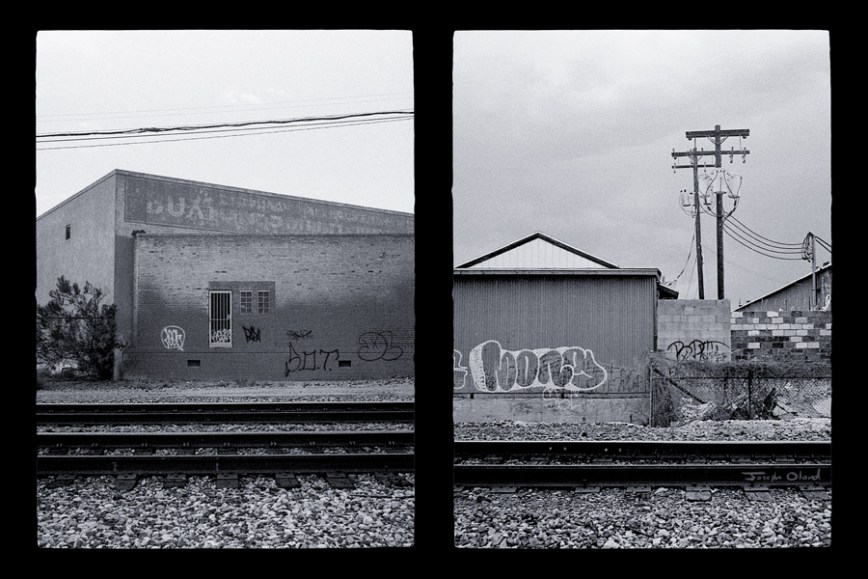
Today’s photograph – two exposures made with my handy-dandy Fujica Half – shows an area south of downtown Tucson. Around the time these two images were made, I met an engineer at Hotel Congress. I was sipping a beer and waiting for some food at the lobby restaurant, The Cup Café. He was dating one of the women who worked there, a woman I’d known for a little while. He told me about the number of accidents he’d witnessed, and the number of suicides. He also talked about a stretch of train tracks nearby that area rail-workers referred to as “suicide alley,” where a cluster of deaths had occurred. He told me how certain determined people would arrange their bodies on the ground, laying their necks directly on the track.

I’d recently been walking around that very stretch of tracks. Taking photographs was actually a challenge while I was studying photography – an irony I can’t even begin to describe – and it was an activity usually undertaken on the weekends. I’d never considered that suicide by train was a problem in this shiny new modern world. I remember thinking I hadn’t heard anybody talking about it. I hadn’t heard anything on the news.

But then – I’d  pretty much been living in the basement of the Theater Arts Building (where the photo lab was), so how would I know? For the past several months that’s the only place anybody could ever find me. I ate there, worked there as an employee and worked there as a student. Hell, I had a sleeping bag and pillow, a hot plate and a wet-bar (rum, coke, tonic water, and whiskey) in my private, closet-sized darkroom in the bowels of that institution. I only ever emerged to meet my girlfriend downtown for food and drink, or to fetch a pack of cigarettes from the 7Eleven across the street.

It shook me to think about what it must feel like, to be that determined to end one’s own life. It shakes me still.
I can’t look at these photos without thinking about it.

FINE ART PRINTS AVAILABLE HERE
SIGN UP FOR THE LENSEBENDER NEWSLETTER

The Yashica-D

Yashica-DThis camera is closely associated with what press photographers carried during the 1950s and 1960s, although I must admit that the Yashica is a bit of a knock-off; the Rolleiflex is the original sensation. The reason these were considered more professional had a lot to do with the lens specifications and the selective-focus feature, allowing for more artful and aesthetically pleasing compositions.

This is a medium format camera – accepting 120mm medium format film – and makes 6×6 centimer square images.
Most of the latter models were equipped with a three-element 80mm lens capable of opening up to f/2.8 – this is considerably “faster” glass than many contemporaneous camera models, allowing for faster exposures, effectively giving the photographer the power to ‘freeze’ moving objects on the film plane. Earlier camera models had darker glass and slower shutter speeds, so moving objects would render as a blurry jumbled mess.

– – –

With the discovery of Vivian Maier‘s work and the release of her books, the often ignored TLR style camera has seen renewed interest. Prices for the Rolleiflex have risen significantly, leaping from as low as $150 to figures closer to $1,000. The Yashica (and the Rollei) are relatively easy to find, and because they aren’t as user friendly as your smart phone, I’m confident this fad will die down. When the fad dies down, so will the price.

If you’re a camera freak like me, I suggest you keep your eyes peeled – get one of these as soon as possible. They’re cumbersome to work with compared to modern DSLRs, but they are reliable, sharp, and produce stunning negatives. Like any tool, a well-built camera is a joy to work with.

And if you haven’t heard the name Vivian Maier, go and see  John Maloof & Charlie Siskel’s documentary “Finding Vivian Maier” immediately. It’s blasphemous if you haven’t at least heard the name.

SIGN UP FOR THE LENSEBENDER NEWSLETTER HERE

Vivian YouTube

February 09 – Industry, Steel, And Aaron Siskind

02-09 Industry post“Stone, steel, dominions pass,
Faith too, no wonder.
So leave alone the grass
That I am under.”

~A.E. Housman

– – –

I’m not sure who said it first, but it always stuck with me: there is nothing as unnatural as a perfectly straight line.

There’s actually some truth to this. Straight lines don’t really just occur in nature. Every natural process with the potential to create a straight line is subject to other processes that disrupt it. Theoretically, trees would grow straight up were they not subjected to wind, rain, gravity, uneven soil. If the distribution of air, sunlight, nutrients, gravity, and other factors were perfectly even, we would have straight-edge trees. These elements aren’t even, have never been even, cannot be even, and so they produce randomly mutated fractal patterns.

Interestingly, we humans now we live in environments wholly based on the straight edge; I-beams and milled lumber, the foundations of our homes, our streetlamps, television screens, windowpanes. There is no greater example that I can think of that represents the unbroken human endeavor to conquer nature.

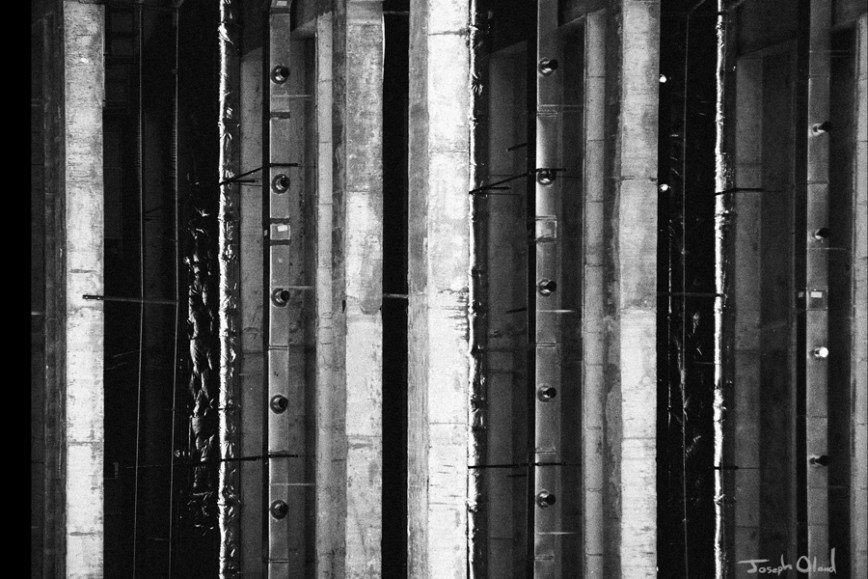
Today’s photograph is how I present the tension between humankind and the natural world – steel beams, the skeletal structure of a half-complete hotel in Albuquerque. I made this image when I was in my “Aaron Siskind” period. It was my second or third year of college, and I refused to photograph anything other than sub-par replicas of his patented abstract style. For those of you unfamiliar with Siskind, he was a prolific American photographer considered to be closely involved with the Abstract Expressionist movement, whose works focused primarily on the details of nature and architecture. At his height in the 1950s, his works were often described as blurring the line between painting and photography – something I’m personally interested in as an artist.

I was working as a research assistant at The Center for Creative photography on starvation-level wages under the Federal Work-Study Program. At the time it didn’t bother me; access to so many wonderful, historically significant photographic prints and photographer archives was plenty enough for me. Hell, I considered it an honor (and still do).

Then, recently, I found a faded, crinkled pay stub in an old suitcase. Boy was I being robbed.
But that’s a story for another day.

They say that emulation is the greatest form of flattery. I hope Mr. Siskind was looking down on my  from high with his notoriously crooked smile. I learned a lot trying to copy the masters, and I believe this is how many artists begin their journey. Not from square-one, but on the shoulders of giants, borrowing their voice while we struggle to find our own.

FINE ART PRINTS AVAILABLE HERE
SIGN UP FOR THE LENSEBENDER NEWSLETTER
 

What’s So Special About “Fury Road” Anyway?

Blue Ange postFINE ART PRINTS AVAILABLE HERE

This is a question that’s been plaguing a lot of moviegoers this Oscar season. After news broke that the George Miller’s fourth “Mad Max” film had fetched ten – that’s right, ten – Oscar nominations, many heads flew atilt with confusion. A film with such clichés as maidens in distress, revving motorcycle engines, and great big dumb explosions can’t possibly make the cut – or can it? That’d be like giving “Lethal Weapon” an Oscar nod, and that just doesn’t happen!

Even with the disappointment with “Birdman” winning best picture last year (just go see “Boyhood,” then think long and hard about it), at least audiences could sit back and remind themselves of that movie’s half-sensical whimsy. We actually kind of get it when an “artsy fartsy” film is trying to be clever and avant-garde. We actually kind of get it when a film is intentionally bizarre and eventually fetches a lot of awards; it’s happened a thousand times before, even if it isn’t quite to our liking. But that still doesn’t explain why an action beat-em-up like “Fury Road” is getting so much attention. So what’s the deal?

The deal is this. We’re currently entrenched in an era of film-making that largely produces only two kinds of mainstream feature: special-effects-driven action films and dialogue-heavy or otherwise “literary” films. The former represents, as an example, just about any comic-book movie out there. The latter represents your so-called “art” films, those “Oscar bait” features like “The Hateful Eight” or “The Revenant.” I advocate for all category of film, to be sure, and I enjoyed “The Force Awakens” as much as anybody else. That being said, I think we all knew going into the theater, 3-D glasses in hand, that the new “Star Wars” flick wasn’t going to win a ton of awards (save, of course, for visual effects, sound engineering, and the like). It’s just the way that particular cookie crumbles.

So where does “Mad Max: Fury Road” fit into this bifurcated cinematic equation? It doesn’t – simple as that.

I will concede that, on the surface, it certainly does have the appearance of a brainless visual effects parade. Upon closer investigation, the film reveals itself to be infinitely more creative than that. Rather than confuse plot complexity with artistic brilliance, director George Miller reversed course, using a basic and straightforward narrative as a foundation from which to explore a relatively dormant style of visual storytelling.

The first thirty minutes of “Fury Road” present a deeply sophisticated visual rhythm that explains everything the moviegoer needs to know without relying on standard Hollywood action tropes. In almost every regard, the setup for “Fury Road” is a sublime sequence of pictures that approach a “silent film” quality unlike any other movie in the action genre, or any other 2015 title of any genre. I challenge any reader to re-watch the beginning of the film with no sound (or with any old song of your choosing – I’m quite convinced this would play remarkably well with a Chopin nocturne) and consider how marvelously rich and detailed the mythology of this “Mad Max” story is – and all without the aid of narration or expositional dialogue.

That is the brilliance of “Fury Road.” It is deceptively simple, but speaks in a universal, wholly accessible visual language that doesn’t rely overmuch on historical allusion and the tropes of “avant-garde” or “high” art cinema. It is a primal story that presents itself in primal, pictographic language. It’s honest with itself, it’s honest with it’s audience, and it accomplishes what very few films today accomplish. It’s visually remarkable but behaves as though its practical and digital effects aren’t important; that’s a rare quality in the action and adventure genre, and I’m pleased to see that the Academy has taken note.

FINE ART PRINTS OF THE ABOVE IMAGE AVAILABLE HERE
SIGN UP FOR THE LENSEBENDER NEWSLETTER HERE


A Look Back At “Dumb And Dumber”

Seabass postI loved “Dumb & Dumber.” Absolutely loved it. I saw it at the perfect time in my life to truly appreciate its magnificent stupidity while also getting a hint that there was a thoughtful craft behind the crude humor, a quiet genius necessary for this kind of movie to work. That’s right, the perfect time in my life: adolescence.

Two years ago, after finishing the first season of “The Newsroom,” I was pleased to see a picture of Jeff Daniels dressed as his “Dumb & Dumber” character, Harry Dunne, on my newsfeed. Talk about timing, right? As it turns out, the actor went immediately from wrapping the most recent season of his amazingly well-performed – and somewhat serious – HBO drama to once again act the fool with compatriot James Carrey. Twenty years later.

I could have guessed, even before the teaser trailer was released, that this was going to be a throw-away nostalgia grab-bag, a “hey, let’s cash a check” kind of movie. Comedy sequels have this awful habit of ham-fistedly repackaging the same jokes from their franchise, recycling winning punch-lines and tropes. It is a stupid trick that rarely, if ever, works. This usually doesn’t prevent one or two sequels from dribbling out of successful film properties. Quite frankly, after twenty years of lying dormant, I’m surprised this one even got made.

I enjoyed seeing the characters again, and I dusted off my old VHS copy of the original “Dumb & Dumber,” a hunk of plastic I bought previously viewed from a supermarket in Kansas. If you put a gun to my head, I wouldn’t be able to tell you a single thing about “Dumb and Dumber To.” It was just that forgettable. I laughed a few times, I think, but nothing really stands out. One might suppose that being forgettably bland is a notch above being memorably awful. And hey, I had an excuse to watch the original one more time, and that was enough to put a smile on my face.

Please consider supporting independent artists like myself.

FINE ART PRINTS OF THE ABOVE ILLUSTRATION ARE HERE
SING UP FOR THE LENSEBENDER NEWSLETTER HERE

February 05 – Craters In The Earth

02-05 Meteor Crater postThe year was 2001 and I was a cocky asshole of a man. My girlfriend and I somehow conned her parents into lending their minivan to the enterprise and we lit-out for the western territories. I’d received an acceptance letter from the University of Arizona and I was ready to get the hell out of Kansas. Little did I know that attending the UofA would mean just about nothing, other than a pile of debt with a degree worth less than the scrap of parchment it was printed on.

But that’s a whole other story.

An 18-year-old version of me screamed down the highway in a soccer-mom van with a young slab of beautiful woman-flesh – and that’s all that mattered. We camped along the high desert, free spirits, and I will never forget the experience. Trading sex in a two-door coup for sex in a bulky 1970s-style canvas tent is probably one of the more sublime experiences this young man could have ever hoped for at the time.

We drove through Tucson and struck camp at Mount Lemon and surveyed the landscapes along the painted desert of Northern Arizona. It was the first time in my life I felt truly unfettered, rising in the morning to the sound of rushing creek water and a lovely ivory face beside me, cloaked in locks of streaming brown hair, lips upturned in a sly satisfied smile.

No drug can ever replace the experience of being eighteen years old and in love. Today’s photograph is a reminder of that innocent time; my woman by my side, unaware of the struggles ahead, I dialed the numbers in and pushed a button along the rim of the great meteor crater. This picture represents everything I held important from those lofty teenage years.

It was a good time, in tall grass and open sky. And I will take that pleasure with me into the earth.
When the time comes.

FINE ART PRINTS AVAILABLE HERE
SING UP FOR THE LENSEBENDER NEWSLETTER

The Sears And Roebuck Tower ’52

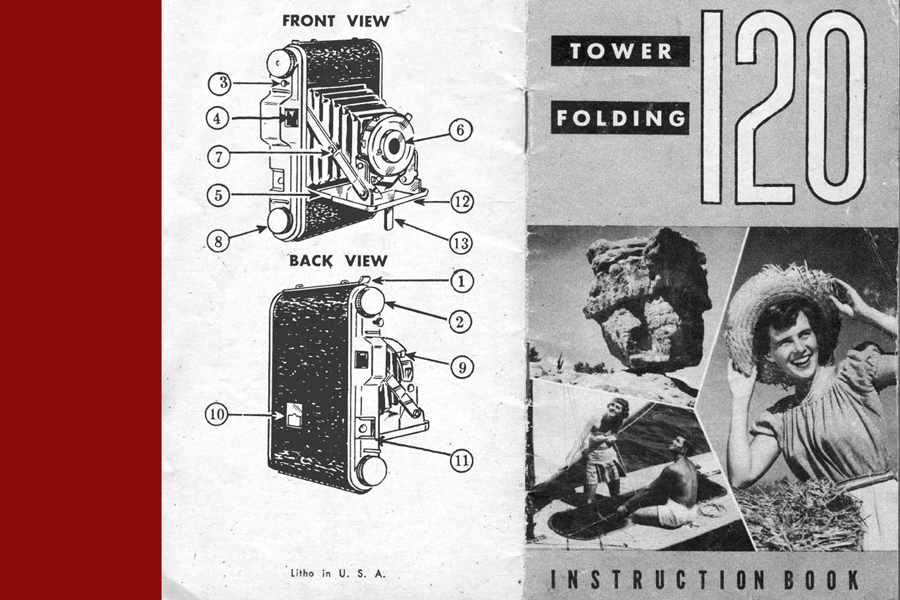
tower folding postThe 1950s saw continued expansion in casual consumer photography. Film costs were prohibitive, but newer models with ease-of-use features attracted new buyers. Bulkier, double-lens cameras (the twin-lens reflex model) were still considered the gold-standard for press photographers, but folding cameras had quickly begun to replace box cameras. Kodak’s turn-of-the-century innovations – the ‘Brownie’ and ‘Brownie No.2’ – fell out of fashion as cameras such as the 1950s Tower series arrived, manufactured and distributed by Sears, Roebuck & Company.

A folding camera is precisely that – a camera with bellows that can be folded down so that it occupies less space when not in use. The self-erecting bed camera has a fixed viewfinder, a simple pre-set lens aperture, and a synchronized shutter. Without having to adjust the aperture, shutter speed, or focal length of the lens, the user literally only has to “point and shoot.” Using medium format 120 film – the most common film size before the transition to 35mm – the Sears & Roebuck Tower produces negatives measuring 6×8 centimeters.

Most folding cameras I come into contact with are metal-construction models, although I’ve read that Bakelite models were also used. Metal models are durable and almost always function (so long as they haven’t rusted). Bakelite models, on the other hand, are infinitely less common (most likely because Bakelite plastics become brittle with age). Folding cameras in circulation today usually require some rudimentary maintenance if they’re to be used – torn bellows will leak light into the camera and fog your film. This is easily remedied with a bellows repair kit, or even black gaffers tape or shoe-repair liquid rubber.

The beauty of old cameras – of old technology in general – is that they can pretty much be held  together with rubber cement & tape and still produce interesting images.

Images produced using my personal 1952 model are quite good, especially when you consider how rudimentary this series of cameras is. Images made with these cameras weren’t intended to be enlarged, but rather contact-printed, yielding prints the exact same size as the negative. Because of the fixed lens and lack of adjustable focus, enlarged prints will reveal a lack of sharp focus. The only other downside is the frame-count – you can only get eight exposures from a standard roll of 120 film. Large negatives make for fewer exposures, and there’s just no way around it.

In my experience, a limited frame-count usually means that the photographer has an incentive to make every picture count. In the age of digital cameras and smart phones, where we can just delete whatever doesn’t turn out, we wind up making a lot of junk that we have to sift through later on. If nothing else is to be celebrated about the era of film, it forced the camera operator to actually think before they pressed the button.

TAKE A LOOK AT THE FILM-ONLY SECTION
SIGN UP FOR THE LENSEBENDER NEWSLETTER

February 02 – Tucson Streetside

02-02 DoubleFrame post

Monday saw the start of Film February – only film photographs for this month during the 2016 ‘Photo A Day’ project. I began with an image taken using one of my favorite vintage cameras from the 1960’s. I realized that my explanation about how the Fujica Half works might not be entirely coherent to those of you who aren’t as absurdly gear-headed as I am.

For more detailed specs, read about the Fujica Half here.

Today’s image is intended to illustrate a little more clearly what the Fujica Half accomplishes. Instead of one horizontal picture, like what you would get using a regular old 35mm film camera, the Fujica half makes a series of small vertical exposures – two exposures fit in the same space that one standard 35mm picture would go. It takes some getting used to; when you look through the viewfinder, the image plane is vertical. I can’t think of any other camera out there that operates like this.

These two images were taken a few years ago. I used to carry the Fujica Half everywhere I went because it was such a compact camera. In my free time, I would go on bike rides all over Tucson, looking for interesting things to photograph. If memory serves correctly, the palm tree is from the center median along Swan Road, just north of the Rillito River wash. The statue on the right is from Evergreen Cemetery, located near Oracle Road & Miracle Mile.

FINE ART PRINTS AVAILABLE HERE
SIGN UP FOR THE LENSEBENDER NEWSLETTER

February 01 – San Pedro Chapel

02-01 San Pedro post

Film is not dead! It’s only kinda, sorta, half-way, a little bit, almost dead.

February over here at LenseBender Design is going to be the month of film. Every single day I’ll be contributing a new film-based photograph made exclusively with one of my vintage film cameras. I have an extensive collection of old cameras – and even some vintage film stock – so this should be a pretty fun ride.

The first photograph of the month was made using a little-known camera known as the Fujica Half. For more information on this nifty little hand-held miracle machine, you can read about it here.

The San Pedro Chapel (pictured above) is located in the historic Fort Lowell neighborhood near the Rillito River north of Tucson. The neighborhood is named after the military outpost that once stood nearby. Fort Lowell was an Army outpost active from 1873 to 1891 and was intentionally placed on the outskirts of Tucson at the confluence of the Tanque Verde and Pantano Creeks. Year-round water at the mouth of the Rillito River made this area prime real-estate for a camp.

Once the fort was decommissioned, the Department of the Interior put the fort’s lumber, windows, doors, and other salvageable items up for sale; the fort was quickly dismantled and hauled off. The old adobe structures were already disintegrating back into the desert by the turn of the Twentieth Century, when immigrant families from Sonora, Mexico began to settle into the territory.

The migrants occupied the remaining fort structures and replaced the missing windows, roofs, and doors. The enclave eventually became known as El Fuerte. The community mainly raised livestock and sold lumber to residents in the town of Tucson.

The community developed strong roots. They built new houses in the Sonora Ranch style, dug wells (finding water at less than thirty feet), built a school house, and established a cemetery and built a church. The first church on this site was just large enough for the Carmelite Fathers to stand in while serving mass; the congregation would gather under the mesquite trees outside.

A more permanent structure was built in either 1915 or 1917 (the records are not clear on this), but was destroyed by a tornado in 1929. The San Pedro Chapel that survives today was built directly over the ruins of the previous chapel in the Mission Revival Style and dedicated in 1932.

In the 1940s, as Tucson was growing, the Church and general store of the El Fuerte community made this area a de facto town center. Mexicans living in the east of the territory would travel to El Fuerte to attend mass & school as well as  enjoy family parties, baptisms, and other social events. The Chapel is still in use today, as it was then, for baptisms and weddings. At its height, the community was only about three-hundred people, and this building is one of the few reminders of what once existed here.

And I just happened to stumble across San Pedro Chapel on a bike ride.
Pretty darn neat.

FINE ART PRINTS AVAILABLE HERE
SIGN UP FOR THE NEWSLETTER HERE

The Fujica Half

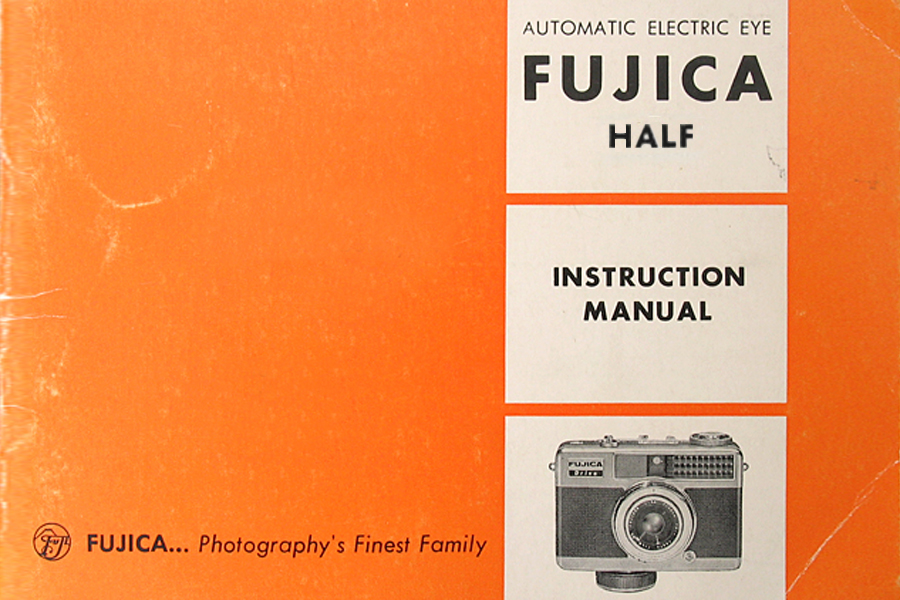
fujicaOriginally marketed as a “true candid camera,” the Fujica half was a wonderful new addition to the world of casual “economy photography” in 1963. Using standard 35mm film, this camera split the 35mm frame size in half, allowing for two vertical exposures for every single frame – hence the name “half.” Seventy-two exposures were now possible from a thirty-six exposure roll of film. Pretty snazzy.

The Fujica Half was likely developed to compete with the Olympus PEN half-frame camera, which had experienced a great deal of success. Boasting crisp pictures from a wide-angle (28mm) five-element lens, the Fujica Half could also open up to a 2.8 f/stop, making it unusually versatile. Wide angle, low-light friendly, sharp fixed-focus, extended frame count, and all in a compact design small enough to fit in your pocket.

Designed for a point-and-shoot audience, the built-in selenium light meter and compact design made the Fujica an ideal machine. It was one of the most accessible, user-friendly camera models designed until this time, delivering the practice of photography into the hands of an unprecedented number of consumers.

It was the iPhone camera of the 1960’s. Period.

As film prices dropped throughout the latter 60’s, “whole-frame” cameras supplanted the half-frame models. By the end of the decade, major manufacturers abandoned the half-frame model altogether. It was a short-lived fad, but these metal-constructed beauties were built to last. For any camera enthusiast, it’s easy to find a functioning model for a cheap price. They’re a lot of fun to shoot with.

SIGN UP FOR THE LENSEBENDER NEWSLETTER