February 15 – The Flamingo

02-16 Flamingo post1The Flamingo was originally built in 1948, providing comfort and shelter for the likes of Bing Crosby, Gene Autrey, Rudy Valley, and other members of the Hollywood and show-business elite. Before it’s doors were closed in the 1980s, it had fallen into miserable disrepair. The rooms were poorly lit, the pool was dry and cracked. The old-world gloss had given way to broken concrete and mold.

When the doors were locked and the windows boarded up, shrink-wrapped soaps still sat in their dishes, dusty towels still hung on the racks, the beds still tightly made. It only sat vacant for seven years before the padlocks were snapped open and the hotel was resurrected with new furniture, carpets, air conditioning, and placards on the doors to designate which Tinseltown stars had stayed there.

I had the pleasure of staying in Burt Reynold’s room. Above the bed was a framed poster of a 1973 Reynolds feature I had never even heard of before: The Man Who Loved Cat Dancing. I still haven’t seen it, but I think I might have to check it out and add a movie review.

The Flamingo was the first Tucson hotel I stayed at – it’s salmon colored paint drawing me in – back in the Spring of 2001. I’d taken a road trip out to Tucson with my girlfriend to check out the city, seeing as how I had just received my acceptance letter from the U of A. Thankfully the new owner respected the building’s history – rather than tear down the classic sign, it was resurfaced and adorned with new neon tubes.

Hopefully, even as the city around it modernizes, The Flamingo will hold onto its charm. The neighborhood isn’t the prime real estate it once was, but affordable rooms in a college town will always find occupants. It isn’t fancy by today’s standards, but I’ll never forget how good that hot shower felt after camping on Mount Lemon for several days.

Today’s photograph is a continuation of “Film February,” made using the Fujica Half. I think the aged aesthetic of film works quite well with a classic mid-century building.

FINE ART PRINTS AVAILABLE HERE
SIGN UP FOR THE LENSEBENDER NEWSLETTER
February 14 – Stone Avenue Garage

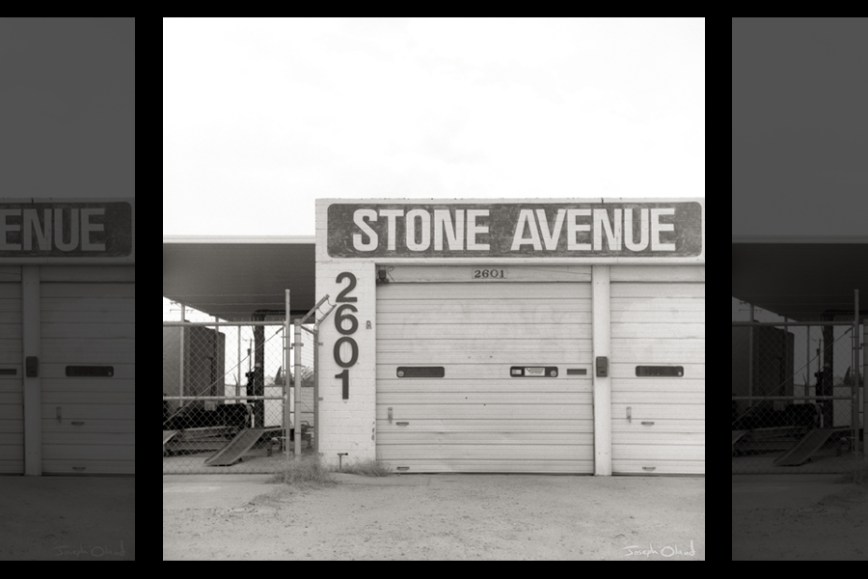
02-14 Stone Ave Garage postOne of the things I enjoy most about photographing using traditional film methods is the aesthetic. The ease of digital photography has ushered in a new era of thoughtlessness; we are free to machine-gun the shutter and then pick-and-choose which images we like after the fact. There’s nothing inherently wrong with this, but it’s a time-consuming approach. I genuinely believe that the time, limited frame-count, and money involved with film photography naturally motivates the photographer to be more thoughtful regarding what to photograph and how to photograph it.

I made today’s photograph of the day using my twin-lens Yashica-D vintage view camera.

There is also a built-in aesthetic that comes along with black and white photography. Removing the color element, the photograph is more focused on the architecture and balance of composition. These photographs appear more “classic” or “timeless” because of the reticulation of the film grain and the lack of vibrant color. I’m reminded of a lecture delivered by one of the best professors I ever had, Mr. Keith McElroy.

I’ll paraphrase:
“If any of you are interested in your photographs being important, remembered, recirculated, studied in text books, there’s one sure-fire way to help your chances. Go to the grocery store, the shopping mall, the warehouse markets. Go up and down the isles and photograph a catalog of all the merchandise on the shelves. In fifty years, the global marketplace is going to be different. Many of those products will have changed, will not exist, will be antiquated. People will be interested in seeing what they were like.”

It doesn’t sound like a glamorous project, but there’s so much truth to this. Photographs of turn-of-the-century Main Street, of general stores with apron-clad mustachioed men with monocles, New York street scenes with horse-drawn carriages, or street scenes with early model Ford cars and horses both navigating the thoroughfare – these are interesting photographs, even if the skill used to execute them is pedestrian. It’s the document that’s important and, in conjunction with the happenstance “aesthetic of age,” these photographs become unique (and sometimes important) historical specimens.

We never know what’s going to be considered important or interesting to future eyes. For all we know, a snapshot of t-shirt wearing shoppers at your local Wal-Mart will be republished in a History of Photography anthology at the dawn of the next century.

With the proliferation of photography, I expect to be reminded that such a snapshot would be but one of millions floating around. But computers crash and hard-drives fail. Not nearly as many photographs are printed as we might imagine. Digital file formats change, and can be corrupted; they disappear. Physical prints that survive the ages will be somewhat more significant.

Take a close look, too. Your one-hour photo prints are usually printed improperly, with exhausted film chemistry  by unskilled technicians. You may notice your old family photo albums are filled with fading coloring prints. And do-it-yourself printing is even worse. Inkjet prints fade faster and are highly susceptible to water damage. But then look at great-grandpa’s album. Those black and white albumen prints probably still look pretty darn good.

If I were you, I would scan and re-print all of your cherished prints before they fade entirely.

FINE ART PRINTS AVAILABLE HERE
SIGN UP FOR THE LENSEBENDER NEWSLETTER
 

February 13 – Paul Bunyan

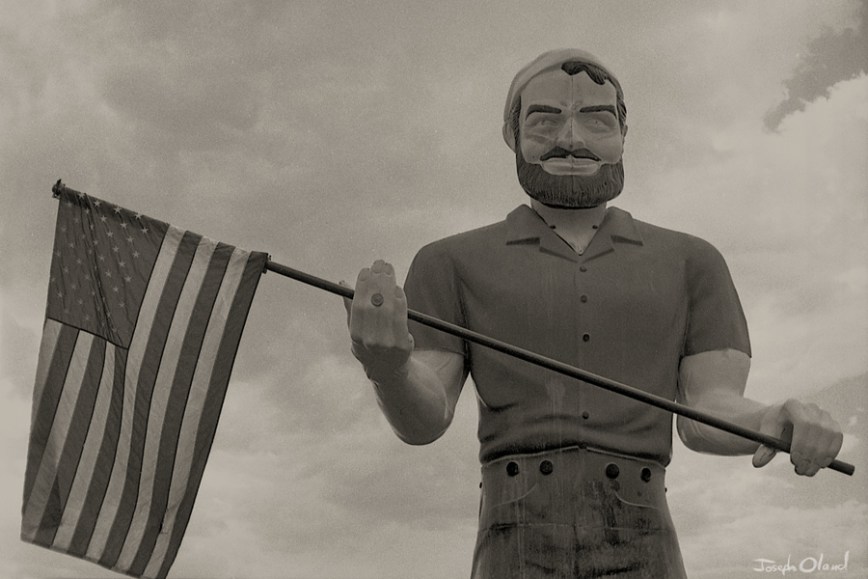
02-13 Paul Bunyon postIt was entertaining to learn that this statue of Paul Bunyan has a Yelp! review, which is about as nonsensical as the statue itself. I never looked into why or how this fifteen foot fiberglass statue arrived at the intersection of Glenn & Stone, but I definitely had to photograph it – this time with my Fujica Half vintage camera, on vintage film stock from the 1960s, on vintage photo paper from the 1960s. The film and photo paper was fogged from age, but I rather enjoyed the distressed look of the final print. Not a lot of trees for a lumberjack in Tucson, but he’s definitely become a landmark.

FINE ART PRINTS AVAILABLE HERE
SIGN UP FOR THE LENSEBENDER NEWSLETTER
 

February 12 – Suicide Alley

02-12 Suicide Alley post

FINE ART PRINTS AVAILABLE HERE

In October a train hits and kills a pedestrian around 7am. Officials investigate the incident as a suicide.

In November, a man kneels down in front of a train. The conductor tells police the man walked out of the bushes near the tracks and bent down to place something on the tracks. He then knelt down, facing away from the oncoming train. A note is found on the body, along with a single dollar bill. The note says goodbye to a friend and requests that whoever should find the note to please deliver the dollar, a debt, to the mentioned friend.

In December a man steps in front of a train and remains there until he is crushed. Witnesses tell police that the man intentionally stood in front of the train; the engineer sounded his whistle and flashed his lights and was unable to stop before killing the man.

Sixteen years ago, the Tucson Citizen published an article about railroad deaths after a series of tragic incidents, accidents and acts of suicide. Although the number of railroad suicides isn’t known, they’re not uncommon. The article included an interview with Dan Hicks, a veteran railroad conductor who has worked in the Tucson area.

“Hicks, 48, said he’s experienced the trauma of rail accidents several times,” the article reads. “Engine’s he’s operated have hit trucks, cars, and in one horrifying instances, a drunken woman who had been beaten and left on the tracks.”

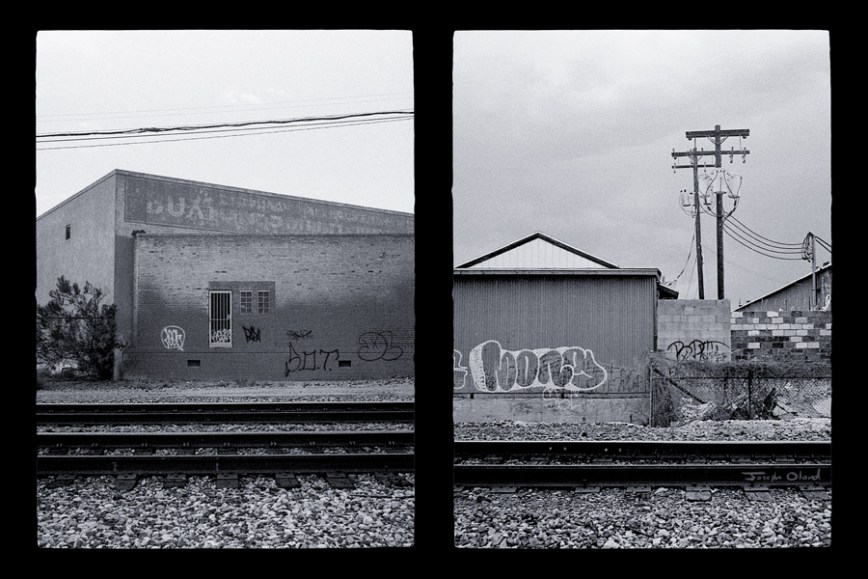
Today’s photograph – two exposures made with my handy-dandy Fujica Half – shows an area south of downtown Tucson. Around the time these two images were made, I met an engineer at Hotel Congress. I was sipping a beer and waiting for some food at the lobby restaurant, The Cup Café. He was dating one of the women who worked there, a woman I’d known for a little while. He told me about the number of accidents he’d witnessed, and the number of suicides. He also talked about a stretch of train tracks nearby that area rail-workers referred to as “suicide alley,” where a cluster of deaths had occurred. He told me how certain determined people would arrange their bodies on the ground, laying their necks directly on the track.

I’d recently been walking around that very stretch of tracks. Taking photographs was actually a challenge while I was studying photography – an irony I can’t even begin to describe – and it was an activity usually undertaken on the weekends. I’d never considered that suicide by train was a problem in this shiny new modern world. I remember thinking I hadn’t heard anybody talking about it. I hadn’t heard anything on the news.

But then – I’d  pretty much been living in the basement of the Theater Arts Building (where the photo lab was), so how would I know? For the past several months that’s the only place anybody could ever find me. I ate there, worked there as an employee and worked there as a student. Hell, I had a sleeping bag and pillow, a hot plate and a wet-bar (rum, coke, tonic water, and whiskey) in my private, closet-sized darkroom in the bowels of that institution. I only ever emerged to meet my girlfriend downtown for food and drink, or to fetch a pack of cigarettes from the 7Eleven across the street.

It shook me to think about what it must feel like, to be that determined to end one’s own life. It shakes me still.
I can’t look at these photos without thinking about it.

FINE ART PRINTS AVAILABLE HERE
SIGN UP FOR THE LENSEBENDER NEWSLETTER

February 11 – Smith Pipe and Steel

02-11 Smith Steel post


In the warehouse district south of Downtown Tucson, beyond the night clubs & restaurants, Armory Park & El Barrio Viejo, one might happen upon this peculiar sight. It appears to be a life-size – perhaps larger than life-size – sculpture of a velociraptor, sitting comfortably on the corner of Euclid & East 25th Street. It keeps constant watch over the parking lot of Smith Pipe & Steel, an industrial warehouse of some kind.

Sometimes a photograph speaks for itself, and I believe this would be one of those times.

Head down to Tucson’s South Park (no joke) neighborhood. According to a GoogleMaps search, this interestingly out-of-place character was still there in 2013. Chances are, it’s still there, like so many rotting beer cans in the desert.

FINE ART PRINTS AVAILABLE HERE
SIGN UP FOR THE LENSEBENDER NEWSLETTER


February 08 – Tap-Dancin’ Granny

02-08 Granny postThe first several years I lived in Tucson, I lived right off of 4th Avenue. Close enough to walk, far enough away to have only had my car vandalized about a dozen times during my tenure,

Some of the grime has been polished off the 4th Avenue I remember from those days, but hey – nothing stays the same forever. Shirtless days on the front porch, cold beer in the summer, an embarrassing amount of hackysack. Brooklyn Pizza’s garlic knots and walks over to The Grill at three o’clock in the morning for some tots. The old underpass, bathed in dim yellow light, always wreaked of urine; most of the young ladies I knew – a generous portion of which who’d smack me across my smug face for referring to ’em as “ladies” – preferred not to walk through by their lonesome.

I magic-markered a piece of copy paper and thumb-tacked that sucker right by the exit to the one-room hovel of a guest house I lived in. “Do you have your camera?” was scrawled in smudged blue ink. That was my healthy little reminder every time I headed for the door. I hardly ever went anywhere without my camera, and only seemed to need it when I’d left it behind. This seems to always been case, even today.

I made it a habit to go down to the 4th Avenue Street Fair every autumn and every spring. It takes a certain kind of con-artist confidence to stick your lens in strangers’ faces, and the various street fairs, county fairs, political protests, and other events proved to be a healthy training ground for inexperienced street photographers like myself. Some people notice you and immediately ruin everything by smiling or posing.

Other people just have to common courtesy to threaten you with as ass kicking.

With enough experience, you learn how to lie your way out of sticky situations, charm your way through others, and – most importantly – make accurate snap judgments about the people around you.

The easiest photographs to make – and often the most fun – are of street performers. They’re used to being looked at, and usually like to dust-off their ‘A’ material when they see a camera watching. Something in my gut tells me that this woman may not be with us any longer. This photograph is somewhere in the neighborhood of ten years old, taken outside of Caruso’s Italian Restaurant on South 4th Avenue. A tap-dancing, smoking granny – how could one not take a photograph?

FINE ART PRINTS AVAILABLE HERE
SIGN UP FOR THE LENSEBENDER NEWSLETTER
 

February 07 – Changes In Perspective

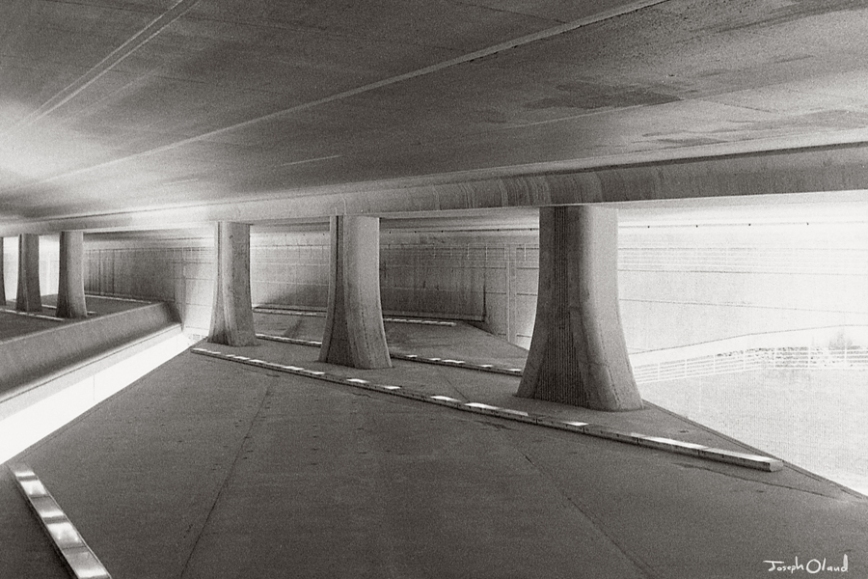
02-07 Tucson Underpass postThis Sunday’s photograph of the day is one of the older classics I’ve always loved and nobody else ever seemed interested in. That’s just one of the painful little things you have to get over when you’re an artist; almost every single painting or photograph that I love are the very paintings and photographs nobody seems to like. And those pieces that I’m not so sure about? The ones I even consider throwing away or deleting? Well, people tend to love those the most.

It’s just one of the ironies.

Nevertheless, I remember looking at the negatives, still dripping wet after being developed in my friend’s kitchen. These are Fujica Half images, so there were tons of exposures to look through. The composition of these really intrigued me. I had a small pile of proof prints eventually made, and that’s when I realized how I wanted to display these images. Thumbing through the proofs, I saw this image upside down, and it really intrigued me. It looked like an alien city or a futuristic concept.

I was reminded of the scene from Steven Soderbergh’s “Ocean’s Eleven” where the fidgety tech character is in the labyrinthine hallways to seek out the server room and tap into the security camera output for the hotel. The room itself is flooded with blue neon light and looks incredibly alien – it turns out that the film’s location scout had looked at a photograph of a server room upside-down and though it looked neat. So the set was built, complete with neon lights coming from the floor, rather than from the ceiling.

Happy little accidents. It’s the simple things we don’t think of that can really influence our work. That’s why critique is important, and why artists like to bounce ideas off each other. Some small little detail may make all the difference.

FINE ART PRINTS AVAILABLE HERE
SIGN UP FOR THE LENSEBENDER NEWSLETTER

Self Portrait As A Dissociative Patriot

Dissociative Self Portrait post“Everything that irritates us about others can lead us to an understanding of ourselves.”

~Carl Jung

– – –

I am an artist. That pretty much means I’m one rung up the ladder from a beggar. Or, more appropriately, I’m a clever beggar, intent on marketing my own neuroses. On a good day, artists are great observers, presenting novel ideas to the world. On a bad day, we’re self-destructive narcissists that only think our ideas are novel.

I avoid self-portraiture. Throughout my career, I’ve met a lot of talented and creative people, but I’ve also met a lot of hacks. College proved to be a breeding ground for self-indulgent creativity, and the “self portrait obsessed” always struck me as inauthentic and cruel.

That being said, here’s a self-portrait. My kind of self-portrait.

An associate of mine and I used to frequent several bars in Tucson. Several. We always brought our sketch books, and we were always armed with markers, pencils, and charcoal. We’d pluck our pocket watches from our vests and come up with drawing challenges. Thirty-five seconds to draw a portrait of the cute girl in the corner. Two minutes to draw one another – we’d sit across from one another and furiously claw at our sketch books. The idea was to override our own insecurities by making it flat-out impossible to make anything of value. You don’t have time to second-guess your decisions when you only have thirty seconds. Nothing terribly good usually comes from a sixty second sketch.

An aesthetic grew out of these hapless challenges, which quickly filled our portfolios. We eventually began to refer to these images as “chaos portraits.” This is a chaos portrait I did of myself. It was a one-minute drawing, made in the dim light of Danny’s Lounge, a bar out on Fort Lowell & Country Club, after a pitcher of cheep beer and a game of pool. I like to think it expresses the constant hateful insecurity of the irrelevant middle-class artist.

It also reminds me that I need to wear ties more often.

FINE ART PRINTS AVAILABLE HERE
SIGN UP FOR THE LENSEBENDER NEWSLETTER
February 04 – The Rialto Theater

02-04 Rialto post

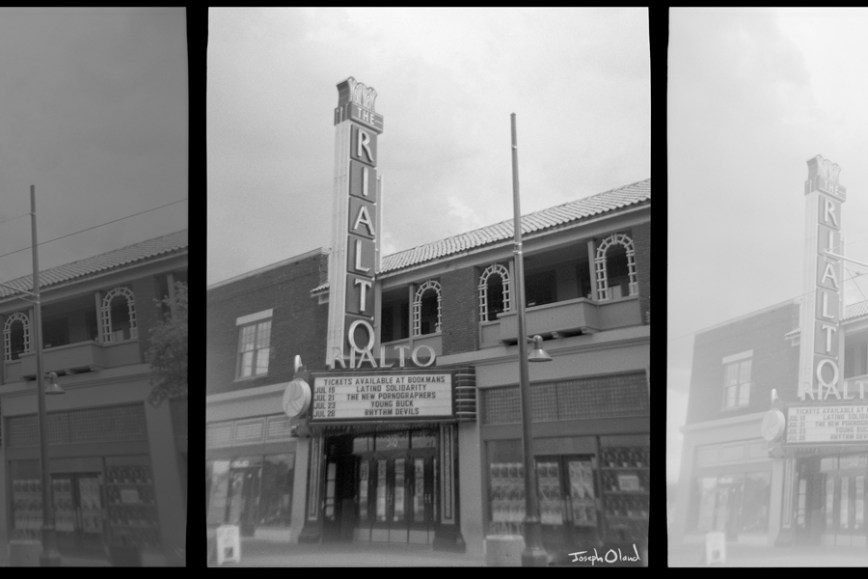
The Rialto Theater is one of the most recognizable buildings on Tucson’s most recognizable street. Situated on Congress Street across from the famous Hotel Congress, The Rialto opened its doors in 1922 with silent films and vaudeville performances.

I moved to Tucson in 2001. At the time, the University of Arizona was a construction zone, as was a great deal of University Boulevard. Congress Street felt like a ghost town during the daytime, but a handful of businesses kept the heart of downtown pumping – especially The Grill, which only recently closed its doors.

Paying the university a premium for the privilege to listen to jackhammers and to perpetually circumnavigate rent-a-fenced holes in the ground are but two of many disappointing experiences. The 24 hour availability of tater tots at The Grill and the wonderful performers that The Rialto attracted would be the other side of the coin; the downtown scene was among the greatest things I remember from those early college days.

Today’s ‘photograph of the day’ wasn’t made with a vintage camera like the others. It was made with what we’d consider a toy camera. Weighing in at only twelve ounces – the most forgiving weight of any camera – my first plastic “Holga” model camera cost about twenty bucks brand new. The unpredictable exposures, light leaks, and low-tech aesthetic these cameras produce have seen them grow in popularity over the past twenty years. When I last checked, the same model camera I’ve been shooting with costs somewhere in the neighborhood of fifty dollars.

Film isn’t dead. Neither are Daguerreotypes, for that matter. Historians, enthusiasts, and hobbyists will always keep these old methods alive. Thanks to Hollywood directors who prefer to shoot on film, popular low-tech products like the Holga (which attracts photo nerds like myself), and the infinite resource that is the internet, film will always be out there – even if it’s lost its relevance.

FINE ART PRINTS AVAILABLE HERE
SIGN UP FOR THE LENSEBENDER NEWSLETTER

February 03 – Drive Thru Liquor

02-03 DriveThru Liquor post

“Film February” continues with this little gem, taken using another one of my handy-dandy vintage film cameras.

Folding cameras were a mid-century fad, dominating the post-war market. You had the style of accordion bellows, but in a handheld package for ease of use. These were imprecise cameras, to sum them up succinctly, but black and white film stocks had a lot of latitude. A poorly exposed negative could still yield a pretty decent print.

Learn more about the Sears & Roebuck Tower Series of cameras here.

Today’s photo of the day comes from Stone Avenue in downtown Tucson, across the street from the police station. I have no hard confirmation, but the rumor goes that Texas is responsible for the grand innovation known as the drive-through liquor store. The source of so many an absurd idea, Texas seems as good a candidate as any; I’m inclined to believe it. In any event, they’re scattered across the southwest like jacks.

This was the maiden voyage of my Tower ’52. I’m pretty sure that this is the very first exposure I made with the camera, which I’d purchased at an estate sale on Tucson’s east side (along with about two dozen other camera bodies). The compression plate is bent, so the film focus falls off on the left and right edges, but it’s this kind of imprecision that makes old cameras fun to work with. Unpredictable things happen, and you never know what the film is going to look like until you develop it.

FINE ART PRINTS AVAILABLE HERE
SIGN UP FOR THE LENSEBENDER NEWSLETTER