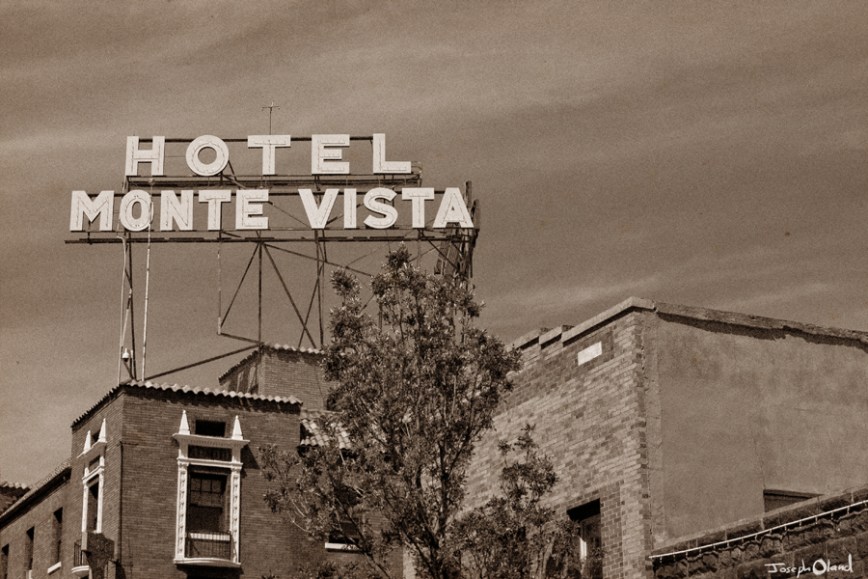
February 17 – Hotel Monte Vista

02-17 Monte Vista postAutomobile culture reached Arizona in the early 1900s and brought major roadway projects (see yesterday’s post about Miracle Mile Road) and an increase in tourism, which delivered new money to Flagstaff in the 1920s. Fundraising began in 1926 by local community leaders to establish first-class accommodation to replace some of the outmoded and run-down hotels.

Ground broke for the 73 room Community Hotel (named in honor of the prominent citizens who funded its construction) on June 8 of that year. It was finished in six months, opening its doors on New Years Day, 1927.

My first visit was back in 2005 or 2006, when I had the chance to tag along with a friend of mine. We worked together at a local Tucson photo lab and he happened to be a drummer in a band called “The Deludes.” I was able to hop aboard for a show they’d booked at the hotel’s “Cocktail Lounge.” It was a prohibition-era bootlegging operation, but the secret wasn’t kept long – local officers disrupted the illegal business in 1931. Ironically, the speakeasy reopened only two years later when prohibition was lifted.

It is one of the oldest operating hotels in Flagstaff and is a registered historic landmark, and its sign is one of the most recognizable landmarks in Flagstaff.

FINE ART PRINTS AVAILABLE HERE
SIGN UP FOR THE LENSEBENDER NEWSLETTER

February 13 – Paul Bunyan

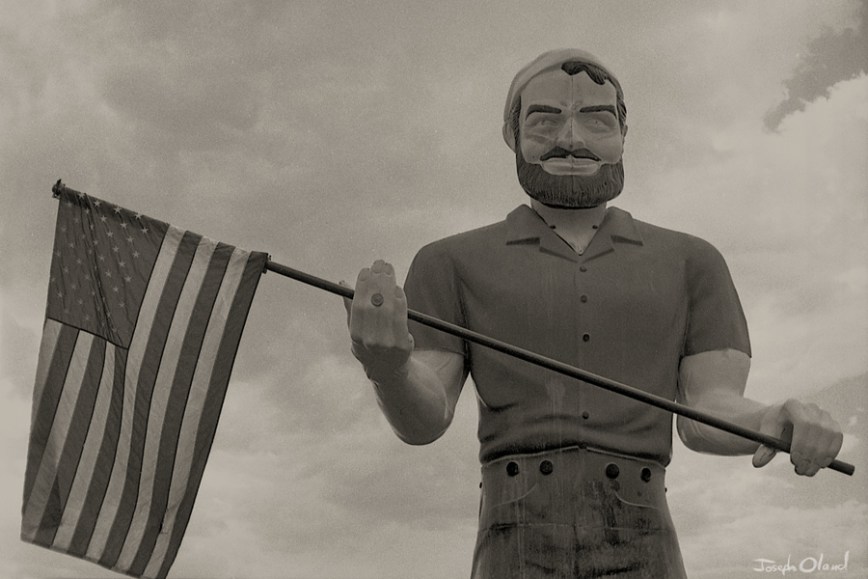
02-13 Paul Bunyon postIt was entertaining to learn that this statue of Paul Bunyan has a Yelp! review, which is about as nonsensical as the statue itself. I never looked into why or how this fifteen foot fiberglass statue arrived at the intersection of Glenn & Stone, but I definitely had to photograph it – this time with my Fujica Half vintage camera, on vintage film stock from the 1960s, on vintage photo paper from the 1960s. The film and photo paper was fogged from age, but I rather enjoyed the distressed look of the final print. Not a lot of trees for a lumberjack in Tucson, but he’s definitely become a landmark.

FINE ART PRINTS AVAILABLE HERE
SIGN UP FOR THE LENSEBENDER NEWSLETTER


January 31 – Farm Country

01-31 Kansas Barn post“You must live in the present, launch yourself on every wave, find your eternity in each moment.”

~Henry David Thoreau

– – –

One of my occupations, of late, has involved walking around the city. During these urban hikes I keep a sharp eye out and I try to keep in mind my own individual, physical perspective. As a challenge to myself, I’ve been re-imagining the familiar neighborhoods, shopping centers, roadways, and walking paths. The city – the concrete and steel, the timber boxes of row houses and the carved-out subdivisions – has so thoroughly consumed all of the wild, untouched areas I grew up around, so I’ve been looking for spaces untouched by development.

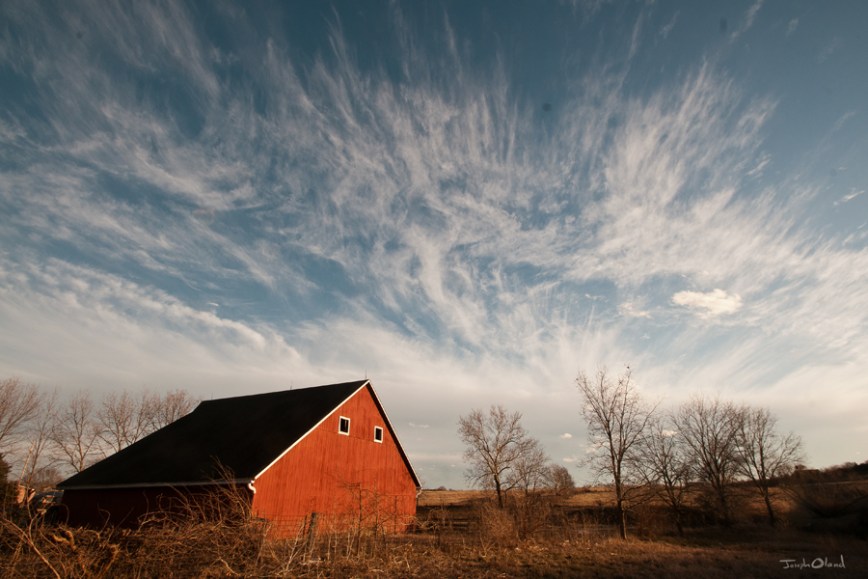
This barn sits on the intersection of Interstate-435 and 87th Street Parkway. It is in the eye of the storm. To the right of this red barn, just off-camera, is the off-ramp and a line of cars waiting to merge onto 87th Street. Behind the barn is a field, probably two miles deep, before a thicket of housing, strip malls, and office buildings. Across the street from this barn is a McDonald’s, a Taco Bell, and a supermarket.

I don’t know the story behind this tract of land, but I’m guessing there’s a stubborn landowner who has refused generous offers on his property. I applaud such action, if only because I enjoy the basic concept of a person saying no to cold hard cash – it forces each of us to consider the possibility that there are indeed things more important than money.

I this small slice of untouched land. A little reminder of what the whole surrounding territory probably looked like a generation ago, before all of this “progress.”

FINE ART PRINTS OF TODAY’S PICTURE ARE AVAILABLE HERE
SIGN UP FOR THE NEWSLETTER HERE

January 30 – The Connecticut River

01-30 Connectitcut River post

In New England the character is strong and unshakable.”

~Norman Rockwell

– – –

Yesterday was an amazing day – like all good days, it was too short. I found myself being guided along by my uncle Rick, who has lived in this territory for the past twenty years. There’s no such thing as a transition between the southwest and the east coast – they are different worlds altogether. We didn’t cover a tremendous amount of territory, but New England is so dense with architecture & history, I imagine I could spend ten weeks in a ten mile radius and not ever – not for a single moment – feel bored.

Along the Connecticut River are a number of beautiful places to make pictures. This is just one of them, a position adjacent to the historic Goodspeed Opera House in East Haddam, Connecticut.

FINE ART PRINTS HERE
SIGN UP FOR THE NEWSLETTER HERE

January 28 – The Lone Tree

01-28 The Lone Tree post“Lord save us all from old age and broken health and a hope tree that has lost the faculty of putting out blossoms.”

~Mark Twain

– – –

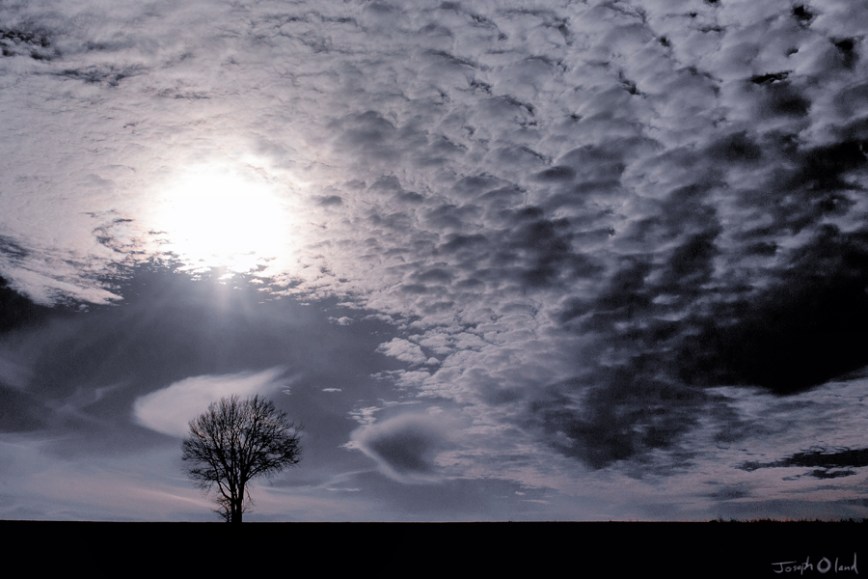
There’s a lone tree in a field along Kenneth Road south of the city. It’s a tiny family-owned plot of earth with a sign that proudly boasts “Welcome To Kenneth – Population 10” in drips white paint. A couple of ramshackle barns litter the adjacent field. Along the fence-line on the south end of the property is the family plot; a dozen or so headstones jut out from the island of manicured grass.

Family farms are becoming rare in the post-industrial age, but every now and again there’s a slice of land owned by hardened farm workers, proud to have held onto the family farm, and exclaim with bravado the number of generations their bloodline has worked the soil.

This place is the epitome of the Midwest – open spaces, flat fertile fields, and the whisper of the prairie wind in your ears. There’s a calm to the Great Plains that’s as unique a sensation as standing on the rim of the Grand Canyon. An ocean of water flows beneath your feet. On a cloudy day at dusk, there’s electricity in the air – a current strong enough that you can feel it on your skin and the hair on your arms stands up.

There’s nothing more beautiful on this planet than looking across a field uncorrupted by concrete and automobiles, monumental spires and neon light. Our cities are a grand thing, too, but in a different way. And certainly these fields have been sculpted by human hands. But to my mind, a properly run family farm is one of the last places a person can find a healthy balance between human intervention and nature.

FINE ART PRINTS AVAILABLE HERE
SIGN UP FOR THE NEWSLETTER HERE

January 21 – The Drifter

01-21 The Drifter post

“I will never lose the love for the arriving, but I’m born to leave.”
~Charlotte Eriksson

– – –

I couldn’t leave it with just one. Yesterday’s image led to me pouring through several folders of photographs that I hadn’t looked at in a good long while, most of them from Tucson and other areas scattered throughout the southwest. I could probably put a photograph of a vintage sign out every day for a year without having to entertain another theme.

Old motor lodges are about as classic as Americana can get. We are a car-loving people, and cars have taken us up and down the country, from east coast to west. We’ve carved paths through this territory, and all we have to do is fill the tank and push the pedal down. Because we are a car-loving people, we are also an adventurous people – or at least we used to be. Today, the world is at our fingertips; with technological innovations we couldn’t have imagined a generation ago, there is less of a need or desire to step out into the sun and get lost in a foreign land. Comfort is a hell of a drug, and our culture has become much more homogenized.

Americans abroad look for familiar fast food like McDonald’s because we’ve forgotten how marvelous newness can be. We’d prefer guaranteed mediocrity than uncomfortable novelty. We drive hundred of miles to lock ourselves in a room and watch the same television shows we could watch at home, nibbling on Pizza Hut pizza, emerging occasionally to grab a soda from the vending machine down the hall. This kind of “travel” has been lampooned, it’s a new discussion topic in university classrooms, and it’s written about in novels.

I wouldn’t necessarily frame all of this negatively. It’s just an observation. I’ve done the same thing myself. I’ve driven in a car for six hours, wanting nothing more than delivery pizza and the passive, lazy novelty of cable television after checking into the hotel room. Perpetually worried about utilities, rent, food, and car maintenance, I find myself taking that extra-long hot shower and cranking the air-conditioner to absurd temperatures that I would never indulge in were I at home. I get it. Comfort is a thing we all have a weird and twisted relationship with, and I guess my only point would be that we should at least acknowledge this.

If we can just accept that we’ve kinda turned into wimps, maybe we can change it a little. Maybe we’ll take a walk down that dark alley that’s always sacred us, take a risk, cross that busy street, brave the noise and discomfort. Maybe, if we do, we’ll be a little less timid, a little more self-assured, and maybe we’ll be reminded again how big and beautiful this world really is, despite all of the treachery and violence and uncertainty.

Be a drifter. I dare you.

PRINTS AVAILABLE HERE
SIGN UP FOR THE NEWSLETTER HERE
 

January 19 – The Old Aztec Theater

01-19 Art & Athletics post

“Unless we tell stories about ourselves, which is all that theater is, we’re in deep trouble.”
~Alan Rickman

– – –

Winter-time in Kansas City is like summer-time in Tucson – the streets looks deserted most of the day, as if everybody packed in the middle of the night and fled without notice. Instead of tumbleweeds, the crisp air carries dead leaves and newspapers.

I went on a walk in downtown Shawnee, through the nearby cemetery and up towards city hall. The temperature has been hovering in the teens and twenties; needless to say, I didn’t see any other pedestrians, save for the poor pitiful fool dressed as the statue of liberty, promoting a tax prep service on the corner. There ought to be a law against that kind of cruelty.

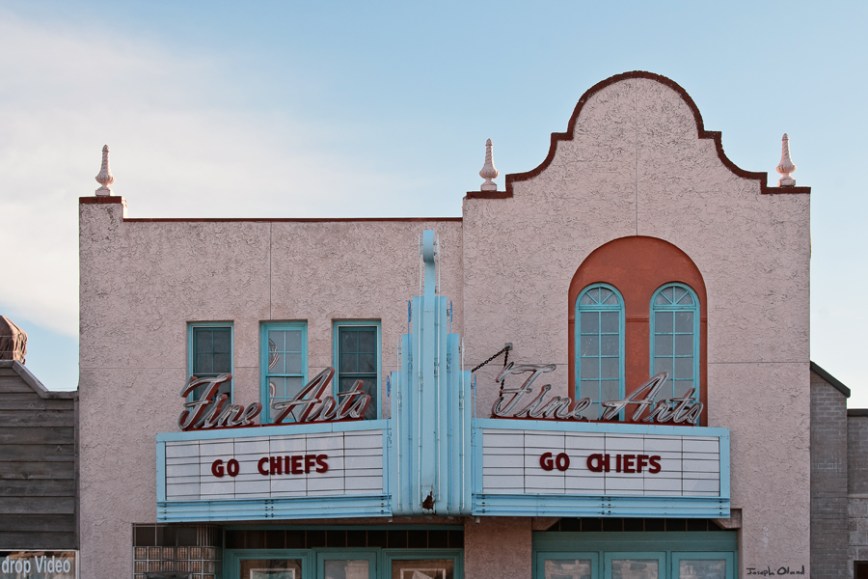
Pictured here is the Old Aztec movie theater.

The Old Aztec was designed by the Boller Brothers architectural firm of downtown Kansas City, Missouri. Their designs ranged widely in size and style, from minor vaudeville houses to grand movie palaces. To date, about twenty surviving Boller Brothers theaters are listed on the National Register of Historic Places. The Old Aztec is clearly among the smaller houses, commissioned by Shawnee’s third mayor, Mr. Marion Summeror, and opened on Labor Day in 1927.

It was named Aztec in the 1940s after it was acquired by Dickinson Theaters. The current signage was installed in 1972 after the theater was purchased by the Pflumm family. Closed for renovations in the summer of 1975, the theater never reopened. There was a time in 2005 when the building changed hands again. Renovations began again, too. The outside has been finished, but the project stalled and the status of the theater is not known.

I like the way old towns feel, although that sense of Main Street life has largely melted away. This little intersection in Shawnee is surrounded by an ocean of strip malls and shopping centers, traffic congestion and highways. But for one block, you can dig your hands into your pockets, bury your head between your shoulders, and walk down the sidewalk against the wind. You can look up at the old marquis and consider a time, almost a hundred years ago, when people walked the same streets, through the threshold and into theater, to watch a silent film dance across the canvas screen of a true American movie house.

PRINTS AVAILABLE HERE
SIGN UP FOR THE NEWSLETTER HERE