The Sears And Roebuck Tower ’52

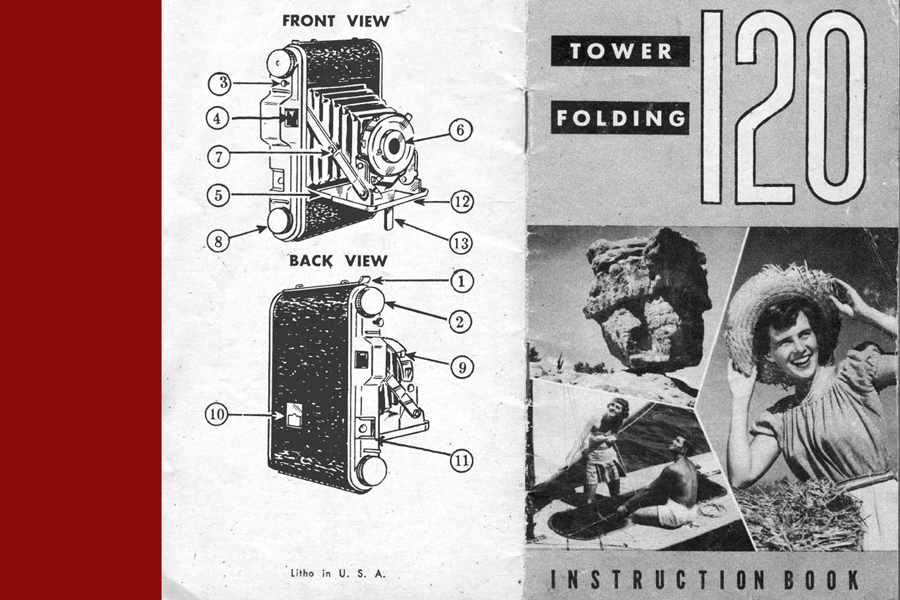
tower folding postThe 1950s saw continued expansion in casual consumer photography. Film costs were prohibitive, but newer models with ease-of-use features attracted new buyers. Bulkier, double-lens cameras (the twin-lens reflex model) were still considered the gold-standard for press photographers, but folding cameras had quickly begun to replace box cameras. Kodak’s turn-of-the-century innovations – the ‘Brownie’ and ‘Brownie No.2’ – fell out of fashion as cameras such as the 1950s Tower series arrived, manufactured and distributed by Sears, Roebuck & Company.

A folding camera is precisely that – a camera with bellows that can be folded down so that it occupies less space when not in use. The self-erecting bed camera has a fixed viewfinder, a simple pre-set lens aperture, and a synchronized shutter. Without having to adjust the aperture, shutter speed, or focal length of the lens, the user literally only has to “point and shoot.” Using medium format 120 film – the most common film size before the transition to 35mm – the Sears & Roebuck Tower produces negatives measuring 6×8 centimeters.

Most folding cameras I come into contact with are metal-construction models, although I’ve read that Bakelite models were also used. Metal models are durable and almost always function (so long as they haven’t rusted). Bakelite models, on the other hand, are infinitely less common (most likely because Bakelite plastics become brittle with age). Folding cameras in circulation today usually require some rudimentary maintenance if they’re to be used – torn bellows will leak light into the camera and fog your film. This is easily remedied with a bellows repair kit, or even black gaffers tape or shoe-repair liquid rubber.

The beauty of old cameras – of old technology in general – is that they can pretty much be held  together with rubber cement & tape and still produce interesting images.

Images produced using my personal 1952 model are quite good, especially when you consider how rudimentary this series of cameras is. Images made with these cameras weren’t intended to be enlarged, but rather contact-printed, yielding prints the exact same size as the negative. Because of the fixed lens and lack of adjustable focus, enlarged prints will reveal a lack of sharp focus. The only other downside is the frame-count – you can only get eight exposures from a standard roll of 120 film. Large negatives make for fewer exposures, and there’s just no way around it.

In my experience, a limited frame-count usually means that the photographer has an incentive to make every picture count. In the age of digital cameras and smart phones, where we can just delete whatever doesn’t turn out, we wind up making a lot of junk that we have to sift through later on. If nothing else is to be celebrated about the era of film, it forced the camera operator to actually think before they pressed the button.

TAKE A LOOK AT THE FILM-ONLY SECTION
SIGN UP FOR THE LENSEBENDER NEWSLETTER

Murder Of Crows At The Cemetery

Murder of Crows postThe wind came from the southwest yesterday afternoon, bringing with it the threat of colder days. Flags whipped their heavy canvas sounds into the air, popping in the sky, rattling the halyards. A cluster of dry, cotton candy clouds slid across the darkening landscape.

I took a walk out to Lenexa Cemetery, a small patch of land we used to drive past on our way to church every Sunday morning. I know a few people buried there, but I’d never walked the grounds – only driven past. It strikes me as odd, these cemeteries, tucked in, flanked on either side by apartment buildings, within eyesight of the Hy-Vee Supermarket, FedEx Office, the McDonald’s. I’ve grown used to cemeteries always being on the outskirts, but that model doesn’t work in cities like this, which continue to expand their circumference, slowly devouring the pastures that I remember from my childhood.

A murder of crows were perched on the mausoleum in the center of the yard. One would occasionally pop into the air, circle around fighting the wind, only to settle back down onto it’s original perch. As I approached, their rhythmic cawing rose. Their heads would shoot left, shoot right, cock to the side, as if considering whether or not to fly away from me and into the unforgiving wind.

Save for the sound of their cawing, the wind in my ears, everything seemed still, despite the tide-pool of traffic that circled around the cemetery. Life in the city continued to pulse forward – just not here, in the crunching yellow grass, amid the blackbirds and the headstones.

FINE ART PRINTS AVAILABLE HERE
SIGN UP FOR THE LENSEBENDER NEWSLETTER

February 02 – Tucson Streetside

02-02 DoubleFrame post

Monday saw the start of Film February – only film photographs for this month during the 2016 ‘Photo A Day’ project. I began with an image taken using one of my favorite vintage cameras from the 1960’s. I realized that my explanation about how the Fujica Half works might not be entirely coherent to those of you who aren’t as absurdly gear-headed as I am.

For more detailed specs, read about the Fujica Half here.

Today’s image is intended to illustrate a little more clearly what the Fujica Half accomplishes. Instead of one horizontal picture, like what you would get using a regular old 35mm film camera, the Fujica half makes a series of small vertical exposures – two exposures fit in the same space that one standard 35mm picture would go. It takes some getting used to; when you look through the viewfinder, the image plane is vertical. I can’t think of any other camera out there that operates like this.

These two images were taken a few years ago. I used to carry the Fujica Half everywhere I went because it was such a compact camera. In my free time, I would go on bike rides all over Tucson, looking for interesting things to photograph. If memory serves correctly, the palm tree is from the center median along Swan Road, just north of the Rillito River wash. The statue on the right is from Evergreen Cemetery, located near Oracle Road & Miracle Mile.

FINE ART PRINTS AVAILABLE HERE
SIGN UP FOR THE LENSEBENDER NEWSLETTER

Tombstone & Tianya Milagro

Tianya - Big Nose Kates postThere’s nothing more dangerous than a beautiful woman packing attitude…and pistolas.

Everybody knows Tombstone from the movies. A few folks are lucky enough to travel through the desert valleys of Southern Arizona and lay their own eyes on it. It’s a small town, and one’s liable to miss it if they blink. It’s a bit of a theme park now, a mixture of pageantry and bravado, with an entertaining contingent of leather-clad bikers who walk the boardwalks side-by-side with entertainers dressed in 19th Century Western attire.

The West was won and the mining operations eventually slowed down. There are no Apaches in the hills to threaten the camp. The barges that ran north along the San Pedro River are just about forgotten, and the short-line railroads that carried the ore North to the Union Pacific line have been decommissioned. Daily reenactments of the famous “Shootout at the OK Corral” and a healthy flow of live music and adult beverage have prevented the town from turning into a wax museum.

Tombstone attracts a certain kind of person. Eccentricity is a prerequisite for anybody who’d move to a town and wear 1880’s period clothing for a living, adopt the language & mannerisms of frontiersmen and women, and exist under the punishing heat of Sonoran Desert summers. It also takes a certain kind of madman to spot the pretty girl in the saloon and hand her two pistols and insist she hop up on the bar for a photograph.

But that’s what Tianya did. She was performing with the Cochise College Dance Club, and that attractive specimen – fair skin in the sun-drenched thoroughfare, belly-dance threads, all hips and legs – turned a lot of heads. She finished her shot of tequila, plucked those pistols from his mitts and, with a puckish grin, hopped up onto the bar. She takes to the spotlight quite well, and the world is most certainly her stage.

To my own lamentations, the photographs didn’t turn out well enough to publish; the saloon was crowded and the light was pitifully low. Rather than scrap them entirely, it made a lot more sense to paint the scene instead. This would be the result of those efforts and, if I’m to toot a high note from my own little horn, it captures her spirit quite well.

FINE ART PRINTS AVAILABLE HERE
SIGN UP FOR THE LENSEBENDER NEWSLETTER

February 01 – San Pedro Chapel

02-01 San Pedro post

Film is not dead! It’s only kinda, sorta, half-way, a little bit, almost dead.

February over here at LenseBender Design is going to be the month of film. Every single day I’ll be contributing a new film-based photograph made exclusively with one of my vintage film cameras. I have an extensive collection of old cameras – and even some vintage film stock – so this should be a pretty fun ride.

The first photograph of the month was made using a little-known camera known as the Fujica Half. For more information on this nifty little hand-held miracle machine, you can read about it here.

The San Pedro Chapel (pictured above) is located in the historic Fort Lowell neighborhood near the Rillito River north of Tucson. The neighborhood is named after the military outpost that once stood nearby. Fort Lowell was an Army outpost active from 1873 to 1891 and was intentionally placed on the outskirts of Tucson at the confluence of the Tanque Verde and Pantano Creeks. Year-round water at the mouth of the Rillito River made this area prime real-estate for a camp.

Once the fort was decommissioned, the Department of the Interior put the fort’s lumber, windows, doors, and other salvageable items up for sale; the fort was quickly dismantled and hauled off. The old adobe structures were already disintegrating back into the desert by the turn of the Twentieth Century, when immigrant families from Sonora, Mexico began to settle into the territory.

The migrants occupied the remaining fort structures and replaced the missing windows, roofs, and doors. The enclave eventually became known as El Fuerte. The community mainly raised livestock and sold lumber to residents in the town of Tucson.

The community developed strong roots. They built new houses in the Sonora Ranch style, dug wells (finding water at less than thirty feet), built a school house, and established a cemetery and built a church. The first church on this site was just large enough for the Carmelite Fathers to stand in while serving mass; the congregation would gather under the mesquite trees outside.

A more permanent structure was built in either 1915 or 1917 (the records are not clear on this), but was destroyed by a tornado in 1929. The San Pedro Chapel that survives today was built directly over the ruins of the previous chapel in the Mission Revival Style and dedicated in 1932.

In the 1940s, as Tucson was growing, the Church and general store of the El Fuerte community made this area a de facto town center. Mexicans living in the east of the territory would travel to El Fuerte to attend mass & school as well as  enjoy family parties, baptisms, and other social events. The Chapel is still in use today, as it was then, for baptisms and weddings. At its height, the community was only about three-hundred people, and this building is one of the few reminders of what once existed here.

And I just happened to stumble across San Pedro Chapel on a bike ride.
Pretty darn neat.

FINE ART PRINTS AVAILABLE HERE
SIGN UP FOR THE NEWSLETTER HERE

The Fujica Half

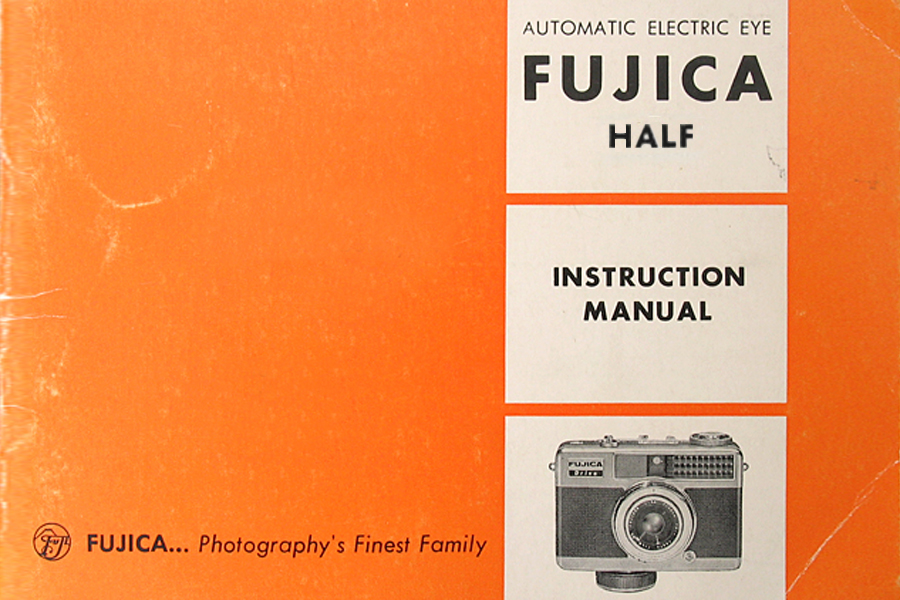
fujicaOriginally marketed as a “true candid camera,” the Fujica half was a wonderful new addition to the world of casual “economy photography” in 1963. Using standard 35mm film, this camera split the 35mm frame size in half, allowing for two vertical exposures for every single frame – hence the name “half.” Seventy-two exposures were now possible from a thirty-six exposure roll of film. Pretty snazzy.

The Fujica Half was likely developed to compete with the Olympus PEN half-frame camera, which had experienced a great deal of success. Boasting crisp pictures from a wide-angle (28mm) five-element lens, the Fujica Half could also open up to a 2.8 f/stop, making it unusually versatile. Wide angle, low-light friendly, sharp fixed-focus, extended frame count, and all in a compact design small enough to fit in your pocket.

Designed for a point-and-shoot audience, the built-in selenium light meter and compact design made the Fujica an ideal machine. It was one of the most accessible, user-friendly camera models designed until this time, delivering the practice of photography into the hands of an unprecedented number of consumers.

It was the iPhone camera of the 1960’s. Period.

As film prices dropped throughout the latter 60’s, “whole-frame” cameras supplanted the half-frame models. By the end of the decade, major manufacturers abandoned the half-frame model altogether. It was a short-lived fad, but these metal-constructed beauties were built to last. For any camera enthusiast, it’s easy to find a functioning model for a cheap price. They’re a lot of fun to shoot with.

SIGN UP FOR THE LENSEBENDER NEWSLETTER
January 31 – Farm Country

01-31 Kansas Barn post“You must live in the present, launch yourself on every wave, find your eternity in each moment.”

~Henry David Thoreau

– – –

One of my occupations, of late, has involved walking around the city. During these urban hikes I keep a sharp eye out and I try to keep in mind my own individual, physical perspective. As a challenge to myself, I’ve been re-imagining the familiar neighborhoods, shopping centers, roadways, and walking paths. The city – the concrete and steel, the timber boxes of row houses and the carved-out subdivisions – has so thoroughly consumed all of the wild, untouched areas I grew up around, so I’ve been looking for spaces untouched by development.

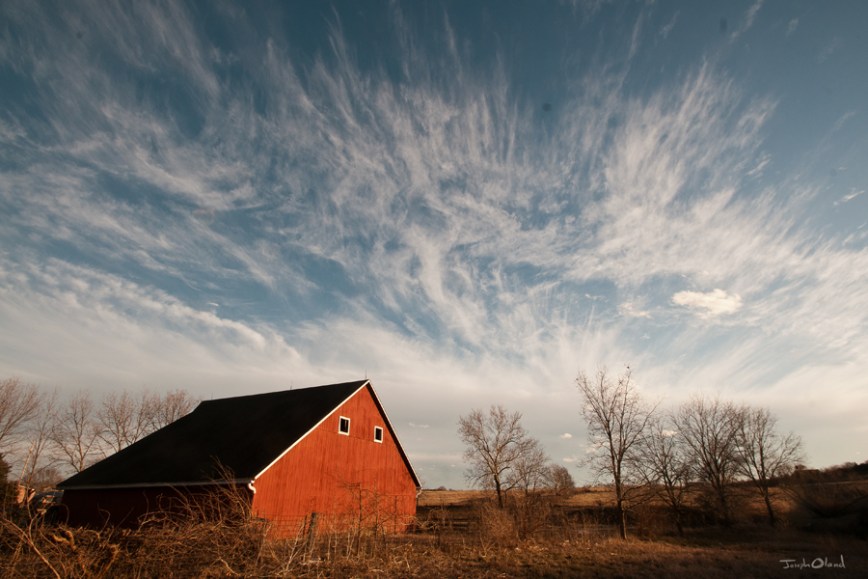
This barn sits on the intersection of Interstate-435 and 87th Street Parkway. It is in the eye of the storm. To the right of this red barn, just off-camera, is the off-ramp and a line of cars waiting to merge onto 87th Street. Behind the barn is a field, probably two miles deep, before a thicket of housing, strip malls, and office buildings. Across the street from this barn is a McDonald’s, a Taco Bell, and a supermarket.

I don’t know the story behind this tract of land, but I’m guessing there’s a stubborn landowner who has refused generous offers on his property. I applaud such action, if only because I enjoy the basic concept of a person saying no to cold hard cash – it forces each of us to consider the possibility that there are indeed things more important than money.

I this small slice of untouched land. A little reminder of what the whole surrounding territory probably looked like a generation ago, before all of this “progress.”

FINE ART PRINTS OF TODAY’S PICTURE ARE AVAILABLE HERE
SIGN UP FOR THE NEWSLETTER HERE

January 30 – The Connecticut River

01-30 Connectitcut River post

In New England the character is strong and unshakable.”

~Norman Rockwell

– – –

Yesterday was an amazing day – like all good days, it was too short. I found myself being guided along by my uncle Rick, who has lived in this territory for the past twenty years. There’s no such thing as a transition between the southwest and the east coast – they are different worlds altogether. We didn’t cover a tremendous amount of territory, but New England is so dense with architecture & history, I imagine I could spend ten weeks in a ten mile radius and not ever – not for a single moment – feel bored.

Along the Connecticut River are a number of beautiful places to make pictures. This is just one of them, a position adjacent to the historic Goodspeed Opera House in East Haddam, Connecticut.

FINE ART PRINTS HERE
SIGN UP FOR THE NEWSLETTER HERE

January 29 – Grandma

01-29 Grandma Goodmans post

“True terror is to wake up one morning and discover that your high school class is running the country.”

~Kurt Vonnegut

– – –

I’ll be spending the better part of today in airports, threading my way through Chicago and onto Hartford where my aunt and uncle live. Connecticut is one of the most beautiful states that I have absolutely no knowledge of; sadly, this will not be the voyage that finds me discovering much. My grandmother needs assistance traveling back home to Kansas City, and I will be the steady arm for her to hold onto.

These posts may not arrive until after I return; since I will be traveling far to see my grandmother for the first time in several months, and because I know our time is limited, I will be focusing on enjoying the trip and spending time with dear relatives that I woefully do not often get to see.

I’ll be gathering pictures and stories throughout.

I leave this short post pointing to the image above. For any soul who has traveled the roads south of Tucson, along the San Pedro river, you may have driven through the peculiar and verdant valley town of Saint David. The store’s full name is “Grandma Goodman’s” and I cannot recall a time that it was ever open for business. I like to imagine that it was a small general store, and I like to imagine that it was as quaint as its name suggests.

FINE ART PRINTS AVAILABLE HERE
SIGN UP FOR THE NEWSLETTER HERE


Remember That Starbucks Cup Incident?

Indiana Jones postThis is a soap box. Allow me to stand on it.

Whoever designed the 2015 Starbucks holiday cup was looking for a fresh Christmas design- one that hadn’t been done to death over the past sixty years, which have seen a ruthless increase in holiday commercialism. Sometimes, in a ‘diminishing-returns’ design scenario, brick walls are hit. Santa and snow men and snow flakes and sleighs – they’ve been used to death; it’s not like any of those things are “Christian” either, but that’s a whole other load of knuckle-dragging logic-fail that needn’t be addressed here.

The design team likely had a meeting, looked at a few dozen proposals, and opted for the one design that didn’t look like any of the others (or any of the designs from previous years that had already been used). Minimalism isn’t a bad thing, people. And we all know that red and green are the colors of the season – just look at the trees, candy canes, and mistletoe.

Shake it off. Nobody’s coming for your bible.

VISIT MY ONLINE STOREFRONT HERE
SIGN UP FOR THE NEWSLETTER HERE