Carl – We Have An Eye Donor For You

Doc Denise postFINE ART PRINTS AVAILABLE HERE – You sick bastards.

It didn’t take long for the inter-webs to begin flooding with outcry after the latest gruesome death in AMC’s “The Walking Dead,” but this outcry is a little different than usual. Most of the time, the audience is saddened by the unexpected loss, or horrified when pivotal characters are presumed dead – let us not forget the miserable weeks when Glenn’s fate was left completely up in the air. While several plot-lines have been changed in order, presumably, to keep the narrative fresh for fans – and to prevent comic book enthusiasts like myself from spoiling upcoming events – Mr. Abraham Ford was spared the eyeball-skewering he was destined for.

Abraham Death

The problem? His replacement on the post-apocalyptic chopping block was Doctor Denise, one of the series’ only gay characters. If fact, it was only two episodes ago that Denise told her girlfriend Tara before an extended supply run that she can’t go. “I need to be here,” she said. “I’m the only doctor now. I can’t. But I want to.” This week, Denise admits that she could have gone, that she could have confessed her love to Tara, but was unable to because she was afraid. The moment she appears to arrive at romantic clarity – and the humorous macguffin of the orange soda is satisfied – Denise is killed.

The macho alpha-male is spared his scripted death, replaced by one of the only gay characters on the show. Given the nature of the show, one likely has nothing to do with the other, but that doesn’t prevent message boards and conspiracy theorists from beating their chests about what this may possibly imply.

The show has gone off-script in a variety of ways, in a calculated and creative attempt to make the content as surprising and narratively strong as possible. In this instance, the turn of events may be as easily explained as the availability of an actor on set. Tara (played by Alanna Masterson) is off for the foreseeably near-future because of a pregnancy, preventing any resolution with the Tara/Denise subplot by the end of the current season.

It ought also be noted that Denise doesn’t survive the comic book, either. She makes it much further on the written page, sure, but she is no more immune than any other beloved character. Additionally, the Denise character is straight in the graphic novel, not gay. But a little bird tells me these tidbits likely won’t quell the current outrage.

I can’t speak for the writers, producers, show-runners, or anybody else on “The Walking Dead,” but I’m guessing that the current insult was unintentional. Besides, there’s still that lingering speculation that Daryl is gay, so we may yet be able to reexamine this topic as the story continues to unfold. And what’s that, I hear? Jesus – you know, that devilishly handsome blue-eyed little thing – might be gay? Time will tell, I suppose…

For the time being, let’s raise a glass while we mourn the loss of yet another undeserving victim. The loss is always hardest to accept when the character is so intrinsically good. Let’s hope she is avenged. It couldn’t happen soon enough.

Cheers.

FINE ART PRINTS AVAILABLE HERE – You’re still sick bastards
– – –
SIGN UP FOR THE LENSEBENDER NEWSLETTER
Better Call Saul 2.06 – Bali Ha’i

The Cousins postFINE ART PRINTS AVAILABLE HERE
– – –
SEE LAST WEEK’S EPISODE REVIEW HERE

“How about your payment is that you get to live?”
“Not enough.”

Mike is once again confronted with certain dangerous elements, and on two separate occasions on this week’s episode of “Better Call Saul.” What is truly fascinating about the construction of the character is that, given an event where any reasonable audience member would fear for his certain doom, we already know that Mike is going to survive – he’s already in a chronologically much-later sequence of events in “Breaking Bad.” Knowing beforehand that he’s going to make it through, the suspense is remarkably just as palpable here, as we wait to see exactly how the plodding old man manages to wriggle free from closing nets.

Mike’s apparent disregard for his own life, it must be noted, allows him to battle beyond his means. Bravery and intellect help him compensate for ‘bad knees’ and age. And his devotion to what remains of his family makes him easily the most sympathetic character of the show’s entire ensemble (he assumed the throne once Saul quit making ice & food deliveries to Chuck). The total of Mike’s written dialogue for any episode of “Better Call Saul” could be scrawled on a note-card, but a tremendous amount of his thought process is acted through body movements, eye rolls, facial expressions. What’s most interesting about Mike – a character I’ve already insisted is the most interesting character in the whole of the Gilligan-verse – is how his character seems to very closely mirror the trajectory of Walter White in “Breaking Bad.” He is a man with little or nothing to lose, willing to go to any length for his family, loses himself, and dies in the process.

It’s just a bonus to us, I suppose, that the circle finally closes with Mike dying at Walter’s hands. It’s an almost Shakespearean way for the character to die.

The connections to “Breaking Bad” have been steady over the past several episodes, including cameos of Krazy-8, last week’s introduction of Hector Salamanca, and now this week’s reintroduction of “The Cousins.” The arrival of The Cousins was like something out of a horror film, a startling moment in a television program that, thus far, has been noted for its deliberate, slow pace.

Speaking of those connections, it has dawned on me that Nacho Varga isn’t a character in the “Breaking Bad” series. I thought long and hard about this while he sat in the background at the shop at the end of this week’s episode, overseeing Mike’s meeting with Hector and The Cousins. Nacho is still stuck in the middle of all of this, and when Mike hands a conciliatory $25k bundle of bills to the side-dealing Latino, I began to immediately speculate what kind of untimely and grotesque fate awaits the man. At this point it’s just conjecture, but I suspect that Nacho isn’t going to survive the series.

– – –

This week also finds Kimmy and Jim running an almost identical series of professional mishaps and frustrations. Kimmy suffers under the lunch-denying thumb of Howard Hamlin. Jimmy struggles under the constant and corrective watch of Davis & Main’s 2nd year stickler, a role expertly and irritatingly played-off like the most loathsome of teachers’ pets. Jimmy is miserable and resentful and Kim becomes increasingly aware of the tenuousness of her position at HHM.

In a brilliant sequence, we watch Jimmy unable to sleep in his king-sized, well-adorned corporate palace. He wrestles with the bed-sheets, kills time bowling with condiments, and eventually gives in, returning to the cramped office at the nail salon. I’m reminded of the Brooks character from “The Shawshank Redemption.” The aged criminal, finally released from his concrete cage, can’t adjust to life in the real world. He has nightmares, forgets where he is when he wakes up, and daydreams about committing a crime just so he can get back to the life he was used to at the penitentiary. In many ways, Jimmy is so used to his hand-to-mouth former life, all of the rewards of the corporate life are actually more of a burden. He’s Tom Hanks from “Cast Away,” preferring to sleep on the floor rather than the comfy pillow-top bed in his hotel suite.

This effectively illustrates how ill-suited he is to his new life, and suggests to us that he is beginning to realize he needs to find a different, more independent path.

– – –

Up to this point in the series – and in this episode in particular – what has been accomplished is a thorough setting of the table – all the chess pieces are in place. Mike’s conflict with Hector Salamanca and the Juárez Cartel, Kim and Jimmy’s parallel dissatisfaction in their respective workplaces, and an eventual statement of purpose between the two.

All of the loose ends appear to have been trimmed, and we’re ready for the mad-dash to resolution. I don’t think that Jimmy’s coffee cup – “World’s 2nd Best Lawyer” – is just a throwaway joke. Every time he sits in his fancy new car, he gets angry that it won’t fit in the cup holder. Even though the car is nice and new, and represents everything Jimmy thought he would want out of a career, it just doesn’t fit – literally. So how does he solve his problem? He breaks it. He breaks the cup-holder to make it fit. Just like he breaks any law or rule that prevents him from getting what he wants, or what he thinks he wants.

FINE ART PRINTS AVAILABLE HERE
– – –
SIGN UP FOR THE LENSEBENDER NEWSLETTER

The Walking Dead – “Twice As Far”

Rick Grimes Portrait postFINE ART PRINTS AVAILABLE HERE
– – –
READ LAST WEEK’S REVIEW HERE

With only two episodes left in the season, I think it’s safe to assume that the terror that is Negan won’t be revealed until the season finale – probably during the final act of the episode. This defied expectations that the “All-Out War” narrative from the comic books would consume the back-end of this season. This is not wholly disappointing – it shows that the producers and writers are deliberately building tension and plan on spending more than half a season on the group’s confrontation with Negan and The Saviors. Chances are, “All Out War” will take up the full-run of season seven.

This week’s episode, titled “Twice As Far,” has revealed that the writers have completely flipped the script, leaning further and further away from the source material in a deliberate (and successful) attempt to keep the story engaging. After last week’s encounter with The Saviors, the episode opens with a ‘clockwork’ montage, showing the guards at their posts, doing rounds, keeping watch on inventories, and exchanging knowing glances with one another. Alexandria is keeping watch on the walls, and things take on a slightly tense, ‘business as usual’ tone.

Morgan has built a jail cell in his downtime, an obvious attempt to inject some civilization into the violence of Alexandria’s leadership. In a brief exchange, Rick looks around at the cinder-block cell and asks Morgan why he built it. “It’ll give us some choices next time,” Morgan responds. We’re reminded what happened with the Alpha Wold that Morgan captured, the division it created, and the danger it presented when the Wold absconded with Doctor Denise.

The world is getting bigger, and it dawns on us that a holding cell, an interrogation room, even a permanent prisoner residence may eventually become necessary. Summary execution is a quick solution, but the world has gotten bigger. The exchange between Morgan and Rick transitions back to Carol, fingering her crucifix, smoking cigarettes on the porch swing, clearly conflicted after slaughtering the small holdout of Saviors in the previous episode.

There’s a lot of heavy-lifting with the narrative of “The Walking Dead,” but the show transitions between Eugene and Abraham over to Rosita and Daryl, escorting Doctor Denise on a pharmacy run, with ease. With so many characters getting screen time this week, we’re reminded of how securely the fates of the Alexandrians are tethered together. Father Gabriel with his rifle, Sasha at her guard tower, Morgan practicing his martial arts in the grass, Eugene thinking much more ‘big picture’ with his plan to manufacture bullets, the newly-erected jail cell – this episode, despite some spoiler-heavy action, is largely quiet, representing the planing stages, the quiet before the storm.

Dwight knows where Alexandria is, we discover during a tragic encounter on the train-tracks outside of town. If Dwight knows where Alexandria is, Negan won’t be too far behind.

FINE ART PRINTS AVAILABLE HERE
– – –
SIGN UP FOR THE LENSEBENDER NEWSLETTER

So Long, Carol – It’s Been Fun

Carol's Cookies postFINE ART PRINTS AVAILABLE HERE

Well, somehow the lion-hearted warrior woman we’ve come to know and love has left us. Only a few episodes earlier, she was the one to strike fear into the hearts of children, travel incognito through a swarm of Wolves with a bloody ‘w’ on her forehead, and even come to blows with Morgan over his peacenik philosophy.

Carol is an enigmatic character, a wonderful dramatic foil to Daryl. In many ways, the two of them were abused, tamped-down by their life’s circumstance. Daryl was abused by absentee parents and a bully older brother, Carol by a husband’s fist. The characters have evolved organically, and are unique to “The Walking Dead” television series. Neither character exists in the comic book, so there’s no source material they need to adhere to. I think this is one of the reasons why they stand out, and why there’s been such a pronounced outcry from fans that the two develop a romantic arc. But those aren’t who these characters really are. They are more open and vulnerable with one another than anybody else in the community, and their intimacy doesn’t hinge on bedroom antics – there’s something more concrete and serious about how they relate to one another.

I think we all know we’ll be seeing Carol again. She won’t be dismissed this unceremoniously. I’m guessing she gets herself kidnapped by The Saviors, hastening a confrontation between communities. The incident on the railroad tracks will require a response from Negan and his people, and it’ll be swift and bloody. But hey, maybe they’ll like her cooking.

FINE ART PRINTS AVAILABLE HERE
– – –
SIGN UP FOR THE LENSEBENDER NEWSLETTER

Happy St. Patrick’s Day!

FireFight postFINE ART PRINTS AVAILABLE HERE

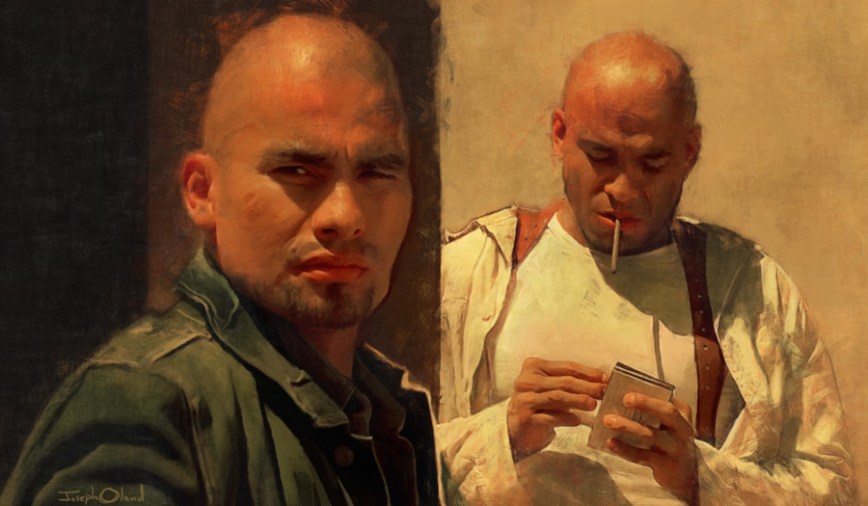
I don’t have any Irish blood – at least not to my knowledge. Nevertheless, it’s challenging not to celebrate a holiday that – in this sick, sad modern world – is predicated on beer drinking and revelry. Every year, my own personal tradition is to watch “The Boondock Saints.” The sequel may be a train-wreck, and director Troy Duffy may not have any more to give us, but I never tire of this delightful little film.

For you, I raise my glass and present you with an illustration inspired by the film.
Cheers!

FINE ART PRINTS AVAILABLE HERE
– – –
SIGN UP FOR THE LENSEBENDER NEWSLETTER

Fight Club – I Am Jack’s Lost Sense Of Self

Fight Club Embrace postFINE ART PRINTS AVAILABLE HERE

One of the first movies that ever inspired me to create fan artwork was “Fight Club.” Looking back, there are plenty of opportunities to tear holes in the ethos of the film, but the film is intentionally self-critical, which buttresses it against any concrete philosophical criticism – this is one of the things that’s so brilliant about it. It expresses an anti-corporate, crypto-fascist morality, but it’s also laden with ad placement from Pepsi, IKEA, Tommy Hilfiger, 7Eleven, and many, many others. What I think helped the film overcome its abysmal box office numbers – and eventually achieving cult status in the years following its release – was it’s exquisite illustration of disenfranchisement, job dissatisfaction, and a gnawing frustration with consumer culture.

Today’s illustration is yet another addition to my collection of “Fight Club” inspired illustrations, with the unnamed narrator played by Edward Norton and his only emotional anchor, Marla Singer, played by Helena Bonham Carter. I hope you enjoy it as much as I enjoyed making it, and I hope you might consider adding a print to your art collection. Cheers!

FINE ART PRINTS AVAILABLE HERE
– – –
SIGN UP FOR THE LENSEBENDER NEWSLETTER

Watching The World Burn

Joker In Jail postFINE ART PRINTS AVAILABLE HERE

Heath Ledger’s performance isn’t anything to be overshadowed by his untimely passing. Comic book film adaptations, even today (in the golden age of comic book feature-length films), have never been taken seriously. They are relegated to “special effects-driven extravaganza” status among Hollywood elites and film critics. Box office numbers are good, but even as revenues climb, most of the world doesn’t take Marvel and DC properties very seriously. They’re just comic books. They’re fun rides. They’re cash in the bank.

Christopher Nolan, while not the lone savior of the comic book film adaptation, certainly spear-headed this new wave. After the monumental failure of “Batman and Robin” and the forgettable bombs of “Daredevil” and “Green Lantern,” even moderately successful comic book properties like “The Crow” and “Blade” couldn’t take the stink out of Hollywood executive’s nostrils. And hell – who could blame them?

Alongside Bryan Singer’s take on the X-Men franchise and Jon Favreau’s infinitely accidental smash-hit success with the first “Iron Man” feature, the age of the Hollywood comic book feature has truly arrived. Part of this has to do with technology – the digital effects that make the extraordinary subjects of these films come to life – and part of this has to do with genuine investment in storytelling and world-building, something that graphic novels have done for decades and Hollywood executives have failed to do for an almost equal number of decades.

Well, the ‘Marvel Cinematic Universe’ has arrived. Actually, it arrived about two months after “Iron Man.” And DC has been struggling to catch up with it’s own cinematic universe ever since, re-booting Superman not once, but twice, in the interim. Most of these stories are old-hat, but known largely to comic book collectors and fan-boys. Most of us, even knowing the stories, don’t decry these film adaptations, but rather look forward to seeing how the material will be interpreted and adapted for the screen.

We’ll be seeing the Caped Crusader (the world’s greatest detective), in not one, but two feature length films in the coming months. The chances are very good that the upcoming iteration of the Batman character will be somewhat different from the Christopher Nolan films that helped breathe life back into the character over the past ten years. If anything, it appears as though the upcoming films will adhere more firmly to the comic book origins of the character, which should make a lot of ‘true believers’ quite happy – but it may alienate fans of the Nolan-verse, who have little or no attachment to the Batman character before “Batman Begins” and it’s two sequels.

The problem with the DC properties is that the focus seems scattered. From the carnival and neon-light camp of “Batman and Robin” to the Christopher Nolan “Dark Knight” trilogy, the shift in tone is undeniable. The Marvel camp has found a way to swing from the early expression of Bryan Singer’s “X-Men (2000)” into “Future Past (2014)” and “Apocalypse (2016)” without skipping a beat and without a radical change in tone. The Marvel Cinematic Universe is much more cohesive, while the DC Cinematic Universe is still struggling to find it’s identity.

Only time will tell if DC will be able to compete with the other heavy hitter on the block. For all we know, “Suicide Squad” and “Batman Versus Superman” will be the great wins of the year. Based on what we’ve seen from the two camps, and despite how powerful the characters from them are, my money is still on Marvel.

Excelsior!

FINE ART PRINTS AVAILABLE HERE
– – –
SIGN UP FOR THE LENSEBENDER NEWSLETTER

The Walking Dead – “The Same Boat”

Maggie postFINE ART PRINTS AVAILABLE HERE

This week’s episode of “The Walking Dead” demonstrates precisely how a ‘bottle episode’ should be executed. Almost all forty-two minutes take place on a single cramped set, but the emotional complexity and character-driven dialogue keeps the pace lively and the tension palpable. With Maggie and Carol held hostage by a small contingent of Negan’s foot soldiers, the entire episode concerns itself with how they are going to escape. What distinguishes this episode is how Negan’s group is portrayed. These aren’t throw-away two-dimensional “bad guys.” Rather, they motivate us to consider, for just a moment, that this group may be no better or worse than the Alexandrians.

This is also an episode that focuses on a predominantly female cast, with the leader of Negan’s group serving as a dramatic foil to Carol. The two women have been traumatized by the loss of their children, have both traveled down a blood-drenched path of self-interested survival, and have both managed to make it this far. The only difference? Carol still struggles with her morality, she has a strong attachment to her people, she is riddled with remorse. So, just as we began to suspect that Carol has crossed into territory from which she will be unable to return, the past two episodes of “The Walking Dead” have provided her with some sharp turns. Struggling with the people she’s killed, once again forced into violent confrontation, she escapes her captors wracked with sadness; she doesn’t want to kill any more, even though she knows she has to. She intentionally wounded her male captor, rather than kill him outright. She wanted to give Paula a chance, and was devastated when her hand was forced.

We already know how brutal characters like Carol and Maggie can be, but this episode was relentless. Trapping and burning people alive, Maggie caving-in the skull of one of her captors with the butt of a handgun. The violence of this episode is counterbalanced by constant reminders of Maggie’s pregnancy, and reminders of Carol and Paula’s lost children. These are all mothers, and we see how each of them reacts to their situation based on their individual experiences as nurturers. Paula lost her soul along with her children, Carol struggles with her morality in a world without her family, and Maggie fights tooth-and-nail to defend her unborn child.

This was an emotionally charged episode, revealing a growing exhaustion among the Alexandrians. And we haven’t even met Negan, seen his camp, or have any idea how many people he has.

FINE ART PRINTS AVAILABLE HERE
– – –
SIGN UP FOR THE LENSEBENDER NEWSLETTER

Happy Pi Day!

Pi Day postFINE ART PRINTS AVAILABLE HERE

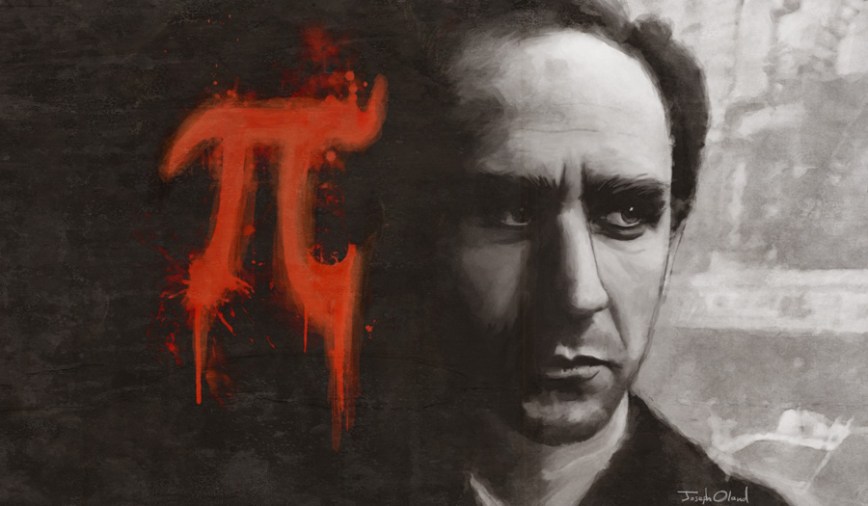
Forget the smattering of delicious home-baked goodies swarming social media. “Pi Day” will always remind me of the pseudo-noir psychological thriller from esteemed director Darren Aronofski. It’s a difficult plot to summarize, but suffice it to say that it has the feeling of an experimental film, shot in cheap black-and-white film-stock with golf ball sized film grain that serves to hugely influence the dark tone of the film. The main character is a supremely brilliant mathematician that becomes obsessed with the number Pi, an obsession that leads him down a severely dark path. If you haven’t seen it, I highly, highly, recommend  it.

In honor of the day, I sat down and hammered out this illustration, which is now for sale at my online storefront.
Cheers!

FINE ART PRINTS AVAILABLE HERE
– – –
SIGN UP FOR THE LENSEBENDER NEWSLETTER

Better Call Saul 2.05 – Rebecca

Kim Wexler postFINE ART PRINTS AVAILABLE HERE

The female characters in the works of Vince Gilligan often come to represent family, responsibility, order, and process. The audience inherently regards the Skylar White character from “Breaking Bad” with disdain, not because she is morally wrong, but because a hijinx-appreciative audience wants to watch Walter White continue on his destructive trajectory. The women who would reign in these corrupt figures are intuitively the “bad” guys.

That’s the conundrum of Kim Wexler. In many regards, we haven’t been provided the appropriate opportunity to sympathize with her, even if we recognize her as the voice of reason, perpetually trying to talk Jimmy away from bending and breaking the rules. We have seen moments of quiet intimacy between Kim and Jimmy, and we even got to watch her execute a confidence scheme in a hotel bar alongside her wayward friend. This is what elevates her from the status of Skylar White; we know that Kim is drawn to shenanigans, even has an appreciation for how artfully Jimmy is able to find his angle, but she also occupies a moral realm. She can taste the fruit, but life goes back to normal in the morning.

This week’s episode, titled “Rebecca,” gives us an opportunity to walk in Kim’s shoes for a bit, and we understand how she has come to occupy the “nagging wife” archetype. Jimmy himself is experiencing his own form of house arrest, with a new babysitter named Erin, hired specifically to shadow slippin’ Jimmy and make sure he plays by the rules. Kim’s in the dog house and Jimmy’s on a leash, and we watch as they both attempt to adapt to their new circumstance.

The cold open is a also an interesting and revealing glimpse into the past, a dinner with Jimmy and Chuck immediately following Jimmy’s move out west to begin his new career in the mail room at HHM. Chuck’s mental illness hasn’t gripped him yet. Polished utensils, chandeliers, jazz music on the hi-fi stereo adorn the scene. And we’re introduced to a new character: Rebecca, Chuck’s wife, a celebrated violinist and a personal acquaintance of Yo-Yo Ma. The scene is underplayed and deceptively simple, but what it reveals is Chuck’s refined bourgeois lifestyle being disrupted by his brother’s beer-swilling and artless boorishness.

Rebecca is taken with Jimmy’s charm, laughing at his jokes and smiling while Chuck is left aside to scowl. There is resentment, here. Jimmy has an ease and charm about himself that Chuck cannot comprehend, and certainly doesn’t appreciate. At the end of the flashback, Chuck tries telling a joke to Rebecca, hoping for a similar laughing response – but he fails. This undercurrent of anger and resentment colors the entire dynamic between the brothers, and we become much more aware of the Biblical ‘Cain and Abel’ dynamic at play.

The brothers are engaging in silent war. The book-end of the McGill conflict occurs at the end of the episode, with Chuck telling a story about his father to Kim. We learn that Chuck blames Jimmy for their father’s death, and his story is an obvious attempt to poison Kim against her friend and sometimes lover. Simultaneously, he insist that he will talk to Hamlin and try to get her out of the doc-prep dog house and back into an office. At the beginning of his sermon, he points out how destructive and self-interested Jimmy is. He ends his sermon by demonstrating that he is the only McGill that’s willing to go to bat for her. It will be some time before we see how she responds to the brothers, each yanking her in different directions.

The most interesting aspect of the episode is in it’s title, which doesn’t only refer to the introduction of Chuck’s absent wife. A.R. Magalli of CutPrintFilm astutely observes:

“‘Rebecca,’ the 1938 novel by Daphne du Maurier, is the story of a woman caught between fighting in the present over the wrongs of the past, largely the death of the titular Rebecca. The novel’s protagonist is used as a pawn when those devoted to the deceased try for revenge on who they feel is responsible. Here we see another Rebecca disappeared, and the man once devoted to her, Chuck, using another woman as a weapon against the man he may feel is responsible for her death or disappearance, Jimmy.”

There is little chance in the Gilligan-verse for this to be a coincidence. Painterly sweeps of light, the color palette of the offices of HHM, the connective-tissue of the narrative – all are carefully mapped-out, infusing “Better Call Saul” with a tension and an identity that sets it apart from anything else on television. This is among one of the most literate programs ever produced, asking more questions than it answers and peeling away at the layers of each individual character with slow deliberation.

FINE ART PRINTS AVAILABLE HERE
– – –
SIGN UP FOR THE LENSEBENDER NEWSLETTER