January 30 – The Connecticut River

01-30 Connectitcut River post

In New England the character is strong and unshakable.”

~Norman Rockwell

– – –

Yesterday was an amazing day – like all good days, it was too short. I found myself being guided along by my uncle Rick, who has lived in this territory for the past twenty years. There’s no such thing as a transition between the southwest and the east coast – they are different worlds altogether. We didn’t cover a tremendous amount of territory, but New England is so dense with architecture & history, I imagine I could spend ten weeks in a ten mile radius and not ever – not for a single moment – feel bored.

Along the Connecticut River are a number of beautiful places to make pictures. This is just one of them, a position adjacent to the historic Goodspeed Opera House in East Haddam, Connecticut.

FINE ART PRINTS HERE
SIGN UP FOR THE NEWSLETTER HERE

January 29 – Grandma

01-29 Grandma Goodmans post

“True terror is to wake up one morning and discover that your high school class is running the country.”

~Kurt Vonnegut

– – –

I’ll be spending the better part of today in airports, threading my way through Chicago and onto Hartford where my aunt and uncle live. Connecticut is one of the most beautiful states that I have absolutely no knowledge of; sadly, this will not be the voyage that finds me discovering much. My grandmother needs assistance traveling back home to Kansas City, and I will be the steady arm for her to hold onto.

These posts may not arrive until after I return; since I will be traveling far to see my grandmother for the first time in several months, and because I know our time is limited, I will be focusing on enjoying the trip and spending time with dear relatives that I woefully do not often get to see.

I’ll be gathering pictures and stories throughout.

I leave this short post pointing to the image above. For any soul who has traveled the roads south of Tucson, along the San Pedro river, you may have driven through the peculiar and verdant valley town of Saint David. The store’s full name is “Grandma Goodman’s” and I cannot recall a time that it was ever open for business. I like to imagine that it was a small general store, and I like to imagine that it was as quaint as its name suggests.

FINE ART PRINTS AVAILABLE HERE
SIGN UP FOR THE NEWSLETTER HERE


January 28 – The Lone Tree

01-28 The Lone Tree post“Lord save us all from old age and broken health and a hope tree that has lost the faculty of putting out blossoms.”

~Mark Twain

– – –

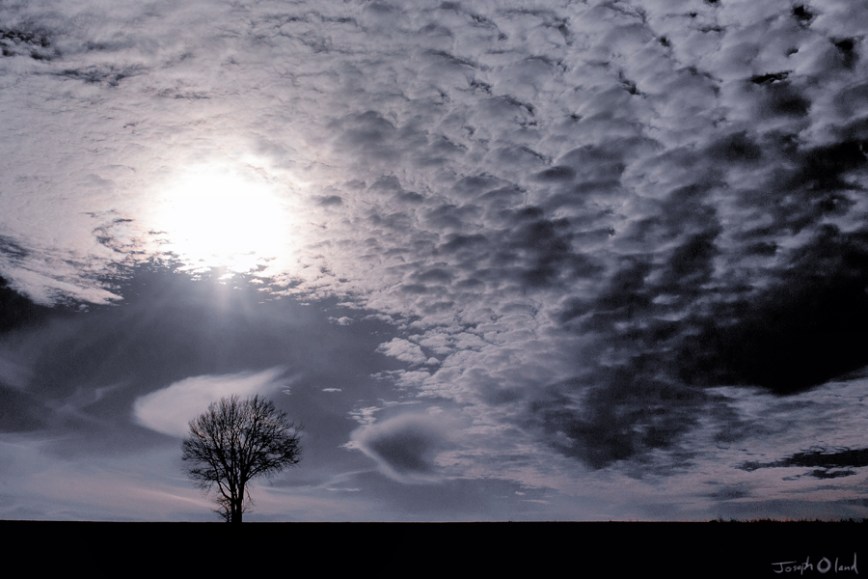
There’s a lone tree in a field along Kenneth Road south of the city. It’s a tiny family-owned plot of earth with a sign that proudly boasts “Welcome To Kenneth – Population 10” in drips white paint. A couple of ramshackle barns litter the adjacent field. Along the fence-line on the south end of the property is the family plot; a dozen or so headstones jut out from the island of manicured grass.

Family farms are becoming rare in the post-industrial age, but every now and again there’s a slice of land owned by hardened farm workers, proud to have held onto the family farm, and exclaim with bravado the number of generations their bloodline has worked the soil.

This place is the epitome of the Midwest – open spaces, flat fertile fields, and the whisper of the prairie wind in your ears. There’s a calm to the Great Plains that’s as unique a sensation as standing on the rim of the Grand Canyon. An ocean of water flows beneath your feet. On a cloudy day at dusk, there’s electricity in the air – a current strong enough that you can feel it on your skin and the hair on your arms stands up.

There’s nothing more beautiful on this planet than looking across a field uncorrupted by concrete and automobiles, monumental spires and neon light. Our cities are a grand thing, too, but in a different way. And certainly these fields have been sculpted by human hands. But to my mind, a properly run family farm is one of the last places a person can find a healthy balance between human intervention and nature.

FINE ART PRINTS AVAILABLE HERE
SIGN UP FOR THE NEWSLETTER HERE

January 27 – The Back Alley

01-27 The Back Alley post“In any art, you don’t know in advance what you want to say – it’s revealed to you as you say it. That’s the difference between art and illustration.”

~Aaron Siskind

– – –

The thing about photography I find so wonderful is that it affords me the opportunity to look through the viewfinder and examine the world in a way that we rarely do in our day-to-day lives. Yes, that’s a sizable blanket statement, I know. But it’s true. It’s the only thing in my life that forces me to slow everything down – my thoughts, my heart rate, my emotions. It’s my meditation. Several years ago, while I was still in college, I used to walk around Tucson by myself, camera in hand.

Rather than the staid art of street photography – or the grainy, black and white portraits we often associate with ‘street photography’ – I found myself investigating the spaces in-between buildings and behind them. I would go to the warehouse district, down to the railroad tracks, out to the tire yards. Traveling at the speed-of-car, everything around us is a blur, save for what’s in the windshield – which is usually just traffic. When conducting noble battle with other 45 mile-per-hour aluminum projectiles, it’s a good idea to keep one’s head in the game. But we miss out on an awful lot.

After a couple of my earliest urban walkabouts, certain visual themes began to surface. Without even thinking about it while I was photographing, it was clear looking at the proof-sheets that my eyes were drawn to right angles. All of the pictures were nearly abstract, minimalistic compositions of windows, doorways, power conduits & boxes, architectural features, concrete slabs, and corrugated metal. A photographic DeStijl quickly became my new visual language

I would set aside time between university lectures and my job at the photo lab just so I could pack my camera and head out on my bicycle in search of new textures and colors. I photographed scenes like the one above for about two years. I haven’t revisited them in a while, but I occasionally think about the series. It’s meaning is still elusive to me, but it continues to feel significant. In a way that I haven’t been able to articulate, some of these images are deeply moving to me.

I think it might be time to put a show together, to reexamine this series, and see if I can crack the code.
Wish me luck.

FINE ART PRINTS AVAILABLE HERE
SIGN UP FOR THE NEWSLETTER HERE
January 26 – Agave Americana

01-26 Agave Americana post

Several years ago, I was in the habit of hiking the hilltop behind my house. I did this on an almost daily basis – sometimes early in the morning to try and capture photographs of the hummingbirds, and sometimes at dusk, as the light turned golden yellow. During the monsoon season, the skies swell with dramatic light-grabbing clouds. I think I made so many pictures of the area at that time, I began to forget how truly dazzling the scenery was; most of the pictures remain in the dark, unpublished and under-utilized in my catalog.

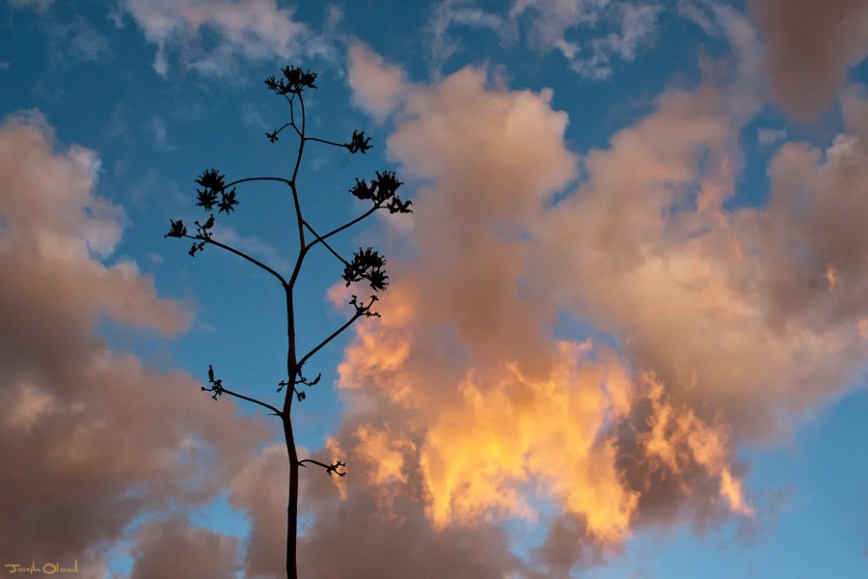
The silhouette is the dried corpse of an agave americana plant. These spires line the hills in the mountains of Southern Arizona and are as recognizable in the borderlands as the Saguaro Cactus (think Roadrunner and Wile W. Coyote cartoons) is just a hundred miles north in Tucson and the Coronado National Forest.

Commonly referred to as a “century plant,” they don’t actually live quite that long. These drought-resistant buggers typically live between ten and thirty years.

I figured a sunset photograph would be a nice book-end to my birthday. Thirty-three years ago I arrived on this peculiar organic spaceship, this mossy rock flying through the cosmos. A wetware android, my brain has been gathering information and making connections ever since that day, furiously trying to make sense of everything.

I’m not sure how successful I’ve been, but it sure is fun trying.
Most of the time.

PRINTS AVAILABLE HERE
SIGN UP FOR THE NEWSLETTER HERE

January 25 – The Sunflower

01-25 Sunflower State post

It is said that on the darkest days, the sunflower will still stand tall and seek out the light. I rather like that sentiment.

It may just be because I was raised in Kansas – the sunflower state – but I always assume everybody’s seen those time-lapse videos, fields of sunflowers craning their delicate necks from east to west, tracking the movement of the sun. It’s a marvelous thing to consider, that these organisms bend so literally to that glowing orb in the heavens. Everything that we enjoy is because of that mysterious object, and it’s promise to return in the springtime.

Entire populations have bowed in worship of the sun. It is the light that lets us see, the warmth that keeps us alive, the energy that draws life from the soil beneath our feet. Even in an age where the sun itself isn’t deified, it’s rising and setting provide powerful metaphors.

Today’s photograph doesn’t require much explanation. This is ‘pretty for the sake of being pretty,’ or ‘ars gratia artis.’ At the same time, I have a lot of memories anchored to this image.

Two summers ago, I walked by a small patch of sunflowers on my daily walk up Brewery Gulch in Bisbee, Arizona, on my way to Mimosa Market. The tiny brick bodega is another Bisbee landmark, although it’s far enough up the thoroughfare that many tourists never manage to set eyes on it (and those that do are often stymied by the cash-only practice). The proprietor had grown a little patch of sunflowers in the side yard, and I made sure to bring my camera with me one day to photograph the frenzy of bees rolling in the pollen like excited children in a snowbank.

I remember one monsoon season, years before I ever moved to Bisbee, walking up the road past Mimosa Market toward Zacatecas Canyon; the entire road was a river of water from the rains tumbling down the mountain from that morning’s rain-shower. A family was in the middle of the near-vacant road, and a baby in a bloated diaper from the water was sitting in the middle of the stream slapping her hands in the water and giggling. I’ll never forget how excited that fat-cheeked, mostly-toothless face looked.

There’s nothing like an Arizona monsoon. There’s nothing like saying hello to a beautiful flower as you walk by, every single day. There’s nothing like the collection of simple little pleasures that, together, are what make life grand.

PRINTS AVAILABLE HERE
SIGN UP FOR THE NEWSLETTER HERE
 

January 24 – Downtown Tucson

01-24 Rio Nuevo post

I was a freshman at The University of Arizona back in 2001. The whole of downtown Tucson has completely changed in the years since then. University Boulevard was a third-world country; the old brick buildings at the intersection of Park & University were a shelled-out scene reminiscent of 1980s East St. Louis. The only missing set-piece would be an arrangement of chopped cars on cinder-blocks. The old drug store was razed that year, piles of bricks and construction equipment lined the streets, and the sound of jackhammers provided the background music audible from my eighth story dorm room in Coronado Hall.

Downtown wasn’t entirely different. Congress Street, the main thoroughfare, had it’s own share of problems. The Screening Room still had events every weekend, Hotel Congress was a hub for live music & adult beverage, and The Grill – open twenty-four hours – always had coffee, beer, and tater tots for the restless insomniac artist. The scene was markedly different in the light of day, though; many of the storefronts on Congress were shuttered and vacant, rents were low, and a series of businesses seemed to play musical chairs with commercial space.

A lot has changed since then.

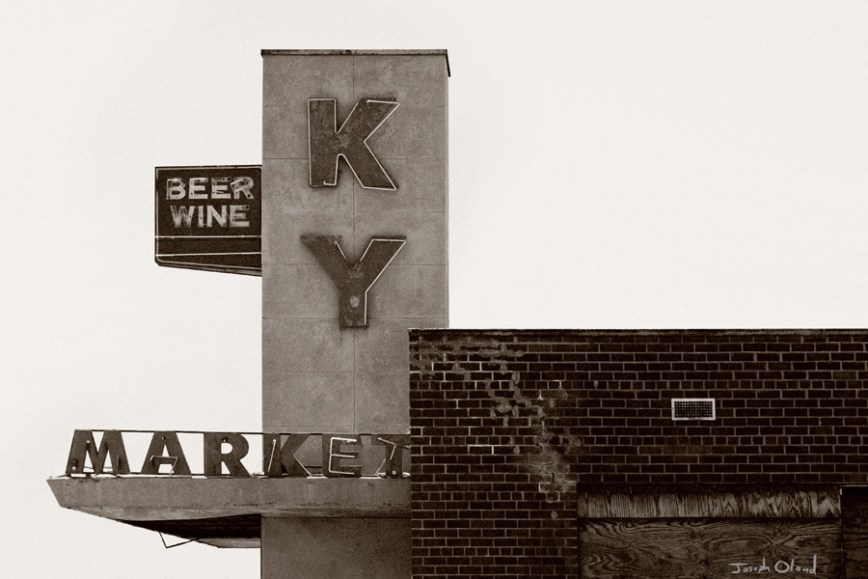
Today’s ‘photograph of the day’ is an old market just south of Tucson’s downtown area on 6th Avenue. I don’t have a lot of information about the old business, but I’m guessing it was one of the many bodegas near Barrio Viejo that eventually fell into irrelevancy. The structure appeared to sit vacant during the entirety of my tenure in Tucson, the ten years stretching from 2001 to 2011.

Revitalization hasn’t just hit Congress and 4th Avenue – the old KY Market has been purchased by a gentleman named Danny Vinik and converted into a multimedia space for his company, Brink Media. I worked for the company, briefly, but I don’t think I possessed quite the skill-set, and the project I was working on didn’t seem to be too tremendously focused. The people that work there, however, are some of the most brilliant web developers, graphic designers, and videographers I’ve ever met. I was happy to be a part of the operation, short-lived and fruitless as it may have ultimately proved to be.

I have a lot of pre-restoration photographs of downtown Tucson, and this is one that has a little bit of meaning for me. Progress happens, and I’m happy knowing that the building is finally being put to use; one of the greatest friends I’ve ever had works there today. But I also selfishly enjoy the rustic aesthetic of abandonment. Maybe I just have sour grapes that the whole time I lived in Tucson, the whole of downtown was like a pile of rusting beer cans in the desert, and now it all seems to have sprung to life – you know, now that I’m not there to enjoy it.

So it goes.

PRINTS AVAILABLE HERE
SIGN UP FOR THE NEWSLETTER HERE

January 23 – Arizona Winter

01-23 Arizona Winter post

While a wall of snow pummels the east coast, it’s customary for Arizonans to post memes about how nice the weather is in their own neck of the woods. I must admit, I did my fare share of that, too, and I know I will in the future.

We live in a world of comparisons. The east coast has culture and history that the southwest can’t boast quite so easily. The east coast has mass transit that would slap a smile on anybody who’s ever conducted battle on California’s 405 Freeway. There are upsides and downsides, and nobody’s existence is ever really any better than anybody else’s. That’s just the damn truth. The trick is finding the dysfunction that we, individually, can roll with – and run headlong toward it.

For me, I’ll take the heat and political madness of Arizona over anything else. Bad public schools, rogue governors, perpetual arguments about immigration. I’ll take it. The hills have stories to tell, and the desert landscape is beautiful for its surface simplicity, and it’s deep, volcanic complexity. These hills provided lead for the civil war, copper for the stock market, lawlessness for the lawless. The adventurous spirit of this nation’s early years lead straight out into these hills, among warring tribes, labor camps, and a relentless, fearless draw toward independence.

Most of the mines are gone. Most of the camps were never built to last, so the thoroughfares sank back into the ground and were reclaimed by nature. The shacks the workers lived in had no foundations – they, too, sank back into the earth. In the Mule Mountains, we can today look out into a wilderness where, just a century ago, industry was thriving. Once wars ended, once the ore gave out, the communities vanished and moved onward toward the next venture. Only sparse skeletal remains can be found today, of sunken shafts and splintered timber. The path of the short-line railroad still exists along the San Pedro River, even though the steel rails have been plucked back up and reassembled into a fence along the Mexico border.

Open spaces are hard to find, but not in the valleys of southern Arizona, where my heart resides.

PRINTS AVAILABLE HERE
SIGN UP FOR THE NEWSLETTER HERE
January 22 – Piano Guts

01-22 Piano Guts post

“Music is a moral law. It gives soul to the universe, wings to the mind, flight to the imagination, and charm and gaiety to life and to everything.”
~Plato

– – –

This past week I have been spending my days in church; most of that time has been spent tearing it apart.

But no. I’m not a rock star and this sanctuary isn’t a hotel room. I’ve been remodeling it with a carpenter friend who’s been teaching me some of the finer points of woodworking and repair. This week’s project had us redesigning & rebuilding a stage. Sledge hammers and circular saws aren’t anything I ever associated with church when I was growing up. Back then, church was this big room where people mutter the same responses like wind-up toys, kneel and stand over and over, and I always left feeling more perplexed about religion than when I arrived.

Even after being forced into catechism, most of my lingering questions remained unanswered or ignored. The King James Bible isn’t the most relatable piece of literature to a twelve-year-old. Hell, it barely makes sense to most adults. Religion was a frustrating experience altogether, which is probably why I elected to reject religion outright from an early age. I have since made peace with those adolescent frustrations. I still haven’t found god, but I don’t feel like I’m being judged just because I stopped looking. There’s a really big club called the Catholic Church, and I just happen to not belong to that club. And that’s okay with me.

Morality and decency isn’t defined by your faith. It’s defined by your actions. I made a house of worship look a little more grand today, and I have every expectation that the congregation will enjoy the things that I have built for them. At least that’s the hope.

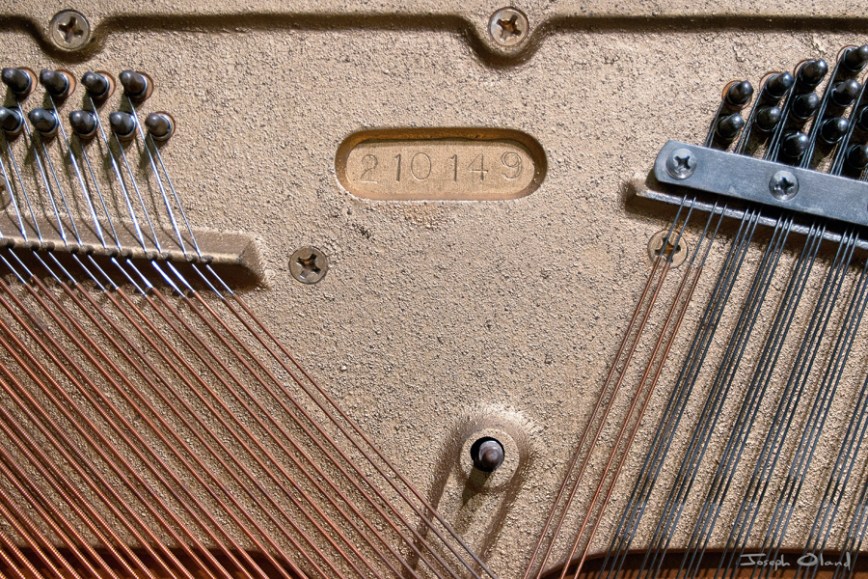
There’s this upright piano that the church is remodeling, too; they’re going to install a keyboard but keep the veneer of the old piano. Keyboards don’t go out of tune quite so easily, and the church had been spending over a hundred bucks a month just to keep the old piano in tune. Earlier tonight, before grabbing my water bottle and coat, I snapped a few pictures of the piano’s interior. I’d never actually seen what the inside of one of those vessels actually looks like, and I thought it was a fascinating, industrial arrangement.

PRINTS AVAILABLE HERE
SIGN UP FOR THE NEWSLETTER HERE

January 21 – The Drifter

01-21 The Drifter post

“I will never lose the love for the arriving, but I’m born to leave.”
~Charlotte Eriksson

– – –

I couldn’t leave it with just one. Yesterday’s image led to me pouring through several folders of photographs that I hadn’t looked at in a good long while, most of them from Tucson and other areas scattered throughout the southwest. I could probably put a photograph of a vintage sign out every day for a year without having to entertain another theme.

Old motor lodges are about as classic as Americana can get. We are a car-loving people, and cars have taken us up and down the country, from east coast to west. We’ve carved paths through this territory, and all we have to do is fill the tank and push the pedal down. Because we are a car-loving people, we are also an adventurous people – or at least we used to be. Today, the world is at our fingertips; with technological innovations we couldn’t have imagined a generation ago, there is less of a need or desire to step out into the sun and get lost in a foreign land. Comfort is a hell of a drug, and our culture has become much more homogenized.

Americans abroad look for familiar fast food like McDonald’s because we’ve forgotten how marvelous newness can be. We’d prefer guaranteed mediocrity than uncomfortable novelty. We drive hundred of miles to lock ourselves in a room and watch the same television shows we could watch at home, nibbling on Pizza Hut pizza, emerging occasionally to grab a soda from the vending machine down the hall. This kind of “travel” has been lampooned, it’s a new discussion topic in university classrooms, and it’s written about in novels.

I wouldn’t necessarily frame all of this negatively. It’s just an observation. I’ve done the same thing myself. I’ve driven in a car for six hours, wanting nothing more than delivery pizza and the passive, lazy novelty of cable television after checking into the hotel room. Perpetually worried about utilities, rent, food, and car maintenance, I find myself taking that extra-long hot shower and cranking the air-conditioner to absurd temperatures that I would never indulge in were I at home. I get it. Comfort is a thing we all have a weird and twisted relationship with, and I guess my only point would be that we should at least acknowledge this.

If we can just accept that we’ve kinda turned into wimps, maybe we can change it a little. Maybe we’ll take a walk down that dark alley that’s always sacred us, take a risk, cross that busy street, brave the noise and discomfort. Maybe, if we do, we’ll be a little less timid, a little more self-assured, and maybe we’ll be reminded again how big and beautiful this world really is, despite all of the treachery and violence and uncertainty.

Be a drifter. I dare you.

PRINTS AVAILABLE HERE
SIGN UP FOR THE NEWSLETTER HERE