DiCaprio – Academy Award For Best Actor

The Revenant postFINE ART PRINTS AVAILABLE HERE

One can scarcely name a more deserving recipient of the Best Actor In A Leading Role award. Stretching all the way back to some of his earliest performances, like his 1993 role as mentally challenged Arnie Grape in “What’s Eating Gilbert Grape,” DiCaprio has delivered some of the most consistently brilliant performances of any American actor. The 88th Academy Awards on Sunday night highlighted incredibly stiff competition, reminding us that 2015 was a remarkable year for cinema. After masterful performances in “Gangs of New York,” “The Departed,” “The Aviator,” “Inception,” “Catch Me If You Can,” and many others, Lenardo DiCaprio’s name was finally inside that envelope.

“The Revenant” is a unique film in a lot of ways, but what’s most interesting is how common – even boring – the story really is. Based on historical figures, the narrative travels down a well-worn path. The principal character is betrayed, overcomes great obstacles, and exacts his revenge – nothing too terribly complicated. It’s something in the movement of the camera, of the locations, of the orchestra, the cello being treated almost percussively – hinting at the danger, solitude, and sadness of the film – that leaves the viewer feeling awakened, disturbed, saved. The transcendental tale and panoramic vistas remind us of how beautiful and dangerous this world is.

There is something spiritual about “The Revenant,” about watching Hugh Glass, mortally wounded, crossing the snow-capped mountains. He is a single-minded character with only one motive: bring his son’s murderer to justice. Once he has accomplished this goal – as we already knew he would – we watch him stare onward for a moment. We cannot tell if there is satisfaction in his vengeance, if he has found peace. It is this ambiguity that stays with us after exiting the theater. We aren’t told how we’re supposed to feel about the movie. We’re left to think about it and come to our own conclusion.

Director Alejandro González Iñárritu likewise earned his statue for best director. He respects his audience. He challenges his audience, but does so without pulling punches or treating us cavalierly. He’s a leader who doesn’t take the audience on an amusement park ride; we don’t fasten our belts and wait for it to eventually end. He takes us on a hike, on a rafting expedition; we have to use our own muscles to get through it to the other end.

We live in a golden age of film and television and “The Revenant” is a noble addition.

FINE ART PRINTS AVAILABLE HERE
– – –
SIGN UP FOR THE LENSEBENDER NEWSLETTER
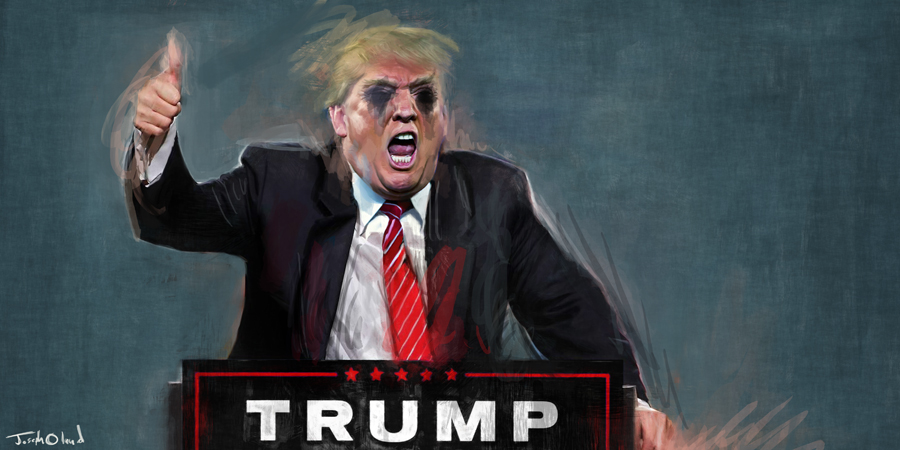
Trump – We Should Be Afraid

Fascist Trump postWe can talk about the politics of fear. It happens during every major election. We are reminded that everything is terrible, that morality is splitting at the seams, that the world is falling apart. Talking points hinge on inflaming our sense of injustice, and sensationalizing tragedy.

Our elections are run like a Hellman’s Mayonnaise commercial.
Product ‘A’ is better than product ‘X.’

And people are buying it.
A lot of people.

There is no civility. There is no interest in policy. There is no desire to improve the lives of the American people. This is all business – business and entertainment. The crowds at the last Republican debate could easily have been borrowed from the nearest WWE performance. We laud the contenders as boxing opponents, and the cult of personality has blinded any real discussion about what these figures actually stand for. “People love me,” isn’t a good argument when we consider education reform. “I love the uneducated,” would probably be worse. “I can do stuff.” How does that inspire confidence, among any demographic?

Tell me about the wall you’re going to build. Tell me about how you’re going to dismantle the Affordable Care Act. Spend all of your time highlighting perceived failures. Terrify me when you spend no time telling me what you would actually do differently. The best thing Trump has achieved? He has illustrated how profoundly disconnected the political class is from the working class. He has illustrated just how dangerous we have become. All talk, no policy, but definitely great at nabbing ratings.

This isn’t a run for class president. We aren’t in high school. Trump, with his decidedly undiplomatic rhetoric and grandiosity, will get Americans killed. He is dangerous. And we are marching down a very perilous path, toward greater internal conflict, and international paralysis. “Listen to me, I’m awesome” just doesn’t cut the mustard.

A lot of words. No action.
Much pomp. No circumstance.

What the fuck is actually going on here?

– – –

FINE ART PRINTS AVAILABLE HERE
– – –
SIGN UP FOR THE LENSEBENDER NEWSLETTER


Crystal Bonner

crystal

“Riches do not exhilarate us so much with their possession as they torment us with their loss.”
~Epicurus

– – –

Crystal passed away a year ago. She was a genuine creature. Flawed and unpredictable, honest and bright. I am so terribly sorry for her husband’s loss, for our loss. She was a friend to everybody, specifically because she always spoke her truth and spoke it without fear. She was rude as hell, too. But fearlessness is a virtue few can boast. Crystal had it. And anybody who spoke with her for more than two minutes knew that, and remembered her.

I will always remember her. And now, even those of you who didn’t have the chance, please take a look at this face. The constant rebel, the rule-breaker who never took a second’s thought to ask “why.” No, no, no. Crystal, like all good thinkers, wasn’t too sophisticated to realize that the best question is never ‘why?’ The best question is ‘why not?’

I don’t make prints of this painting available for purchase because I refuse to profit from this kind of loss.
As I did last year, I offer to send a free card to anybody who would like a print. Send a message to my Facebook page with your name and address, and I will send you a small print to remember her by.

– – –

SIGN UP FOR THE LENSEBENDER NEWSLETTER
The Walking Dead – Who Is Michonne?

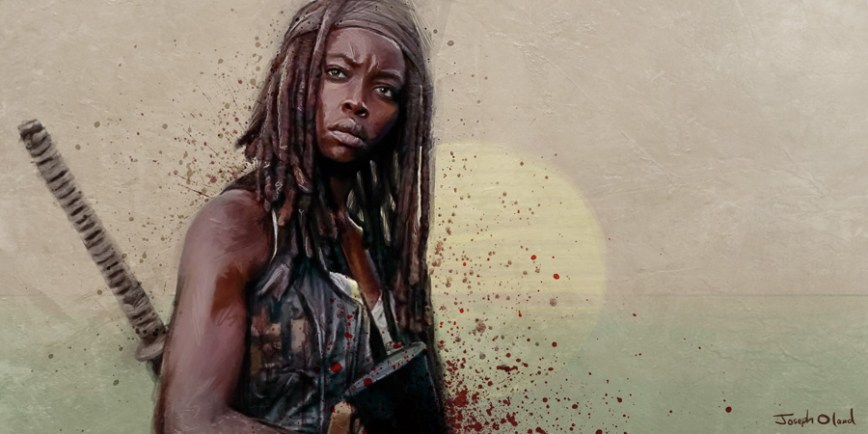
Michonne POST

Something’s always going to happen when resources are tight and survival is the game. With our stalwart knife-slinger, neo-samurai Michonne holds her cards close to the vest, which is part of her appeal. “The Walking Dead” has let her tragic back-story leak in, in slow deliberate drops. She is the ultimate stoic – even by Rick Grimes standards – laying in the prison doing crunches while discussing the group’s next move. She is the unsmiling guard above the gates to Alexandria. She is unattached, emotionless, and lethal.

Until recently.

She has had her moments, crying alone, caring for the wounded, considering the odds and calculating her risks. We appear to have entered into a new chapter, a new age of domestic bliss with Rick and Carl. But it isn’t going to last. Nothing ever does in “The Walking Dead.” Negan is out there, and the communities on the hill will add muscle to Alexandria, but Ezekiel’s tiger – spoilers – and bigger numbers won’t necessarily be enough.

The ‘next world’ is nascent. Michonne won’t be hanging up her sword anytime soon.
That’s a promise.

– – –

“”Everyone has a job and that job never stops. You work until you feel like your back is going to break and then you collapse and sleep like you’ve never slept before. And that’s only if things are going well, which almost never happens. We had some shit go down…it’s hard. There’s no time to think about what happened to you, or what you did. You just work.”

– – –

FINE ART PRINTS AVAILABLE HERE
– – –
SIGN UP FOR THE LENSEBENDER NEWSLETTER


The Walking Dead – “The Next World”

Jesus Saves postJesus saves. Or does he?

After spending a painful amount of time on the lives of the Alexandrians – the first half of season six takes place over only a couple of days – we break with the comic book narrative and jump ahead two months. The comic spends time watching the community develop while Carl is bedridden, but we begin here with Carl upright and able-bodied, albeit with a certain lack of depth perception.

“The Walking Dead” hasn’t ever taken such a positive turn. We see domestic quibbles over who used the last of the toothpaste. We see clean-shaven faces and signs that the community has tethered it’s resources and established a new sense of unity. There’s a confidence in this new-found domesticity and cooperation. It’s something that viewers haven’t seen since Hershel’s farm. And even back then, there were serious problems.

It feels alien to have the show’s trademark ‘horror film’ violin music fade-in for the opening credits when nothing bad has actually happened. Quite the contrary, we’re actually left chuckling at Rick’s ultimate redneck honkytonk music as he and Daryl drive off in a plume of dust on a scavenging run.

Given how the story of “The Walking Dead” has unfolded, it’s unlikely that this newfound repose will last. The real question is, what terrible thing is going to happen to disrupt the peace?

Is Jesus going to be a savior? Doubtful. Fans of the comic book will be delighted that this mysterious new character has been introduced, and it’s the opinion of this writer that the nature of Jesus need not be prematurely revealed here.

One of the wonderful things about “The Walking Dead” is that the writers have gone to great lengths to change key plot points. This is likely an effort to keep the story relevant and prevent fans of the graphic novel from spoiling the television show. In the end, both formats have strengths and weaknesses, and the adaptation to the screen exploits every opportunity to remain it’s own distinct experience.

In the comic book, for instance, there isn’t even a Daryl Dixon character – he was written for the early episodes and was never intended to survive. He become such a beloved character so quickly, the decision was made to keep him in. Similarly, it’s Michonne who first encounters Jesus, at the gates of Alexandria, and not Rick and Daryl out on the road. And no, Michonne doesn’t share an intimate moment with Rick at all in the books. Chances are, the producers felt inclined to bend to the will of the fans, who have been more than vocal about their desire to see the two hard-core survivor-leaders, the two characters with the thickest skin, fall into bed together. It’s pleasantly disarming to see these two, hardened warriors both, actually smiling – a lot. In a world so broken, with characters who have endured as much tragedy as these two, it was something akin to relief to see them come together in one peaceful moment.

Will it last? Who is Jesus, and does he have anything to do with Negan and his band of highwaymen? It is true that he wasn’t carrying a weapon, and he didn’t attack Rick and Daryl. He might have stolen from them, but he didn’t hurt them. Hell, he even managed to save Daryl from a walker. Is he going to play a larger role in “the next world” he makes mention of? Are there really other communities out there that can be trusted? Only time will tell. The one thing we do know is that the show leaves us with more questions than answers, and it definitely keeps things interesting.

FINE ART PRINTS AVAILABLE HERE
SIGN UP FOR THE LENSEBENDER NEWSLETTER
– – –

Bonus factoids.

  1. Rick is no longer wearing his wedding ring.
  2. The comic book we see Carl reading in the woods is “Invincible,” another comic series penned by “Walking Dead” creator Robert Kirkman.
  3. You can see Glenn’s name scratched off the casualties list at the beginning of this episode.
  4. In the comics Jesus’ real name is Paul Monroe. It’s changed to Paul Rovia to avoid confusion with him being a member of Alexandria’s Monroe family.
  5. Rick shares a passionate kiss with Andrea, not Michonne, in the opening to ‘Volume 16: A Larger World’

The Walking Dead – “No Way Out”

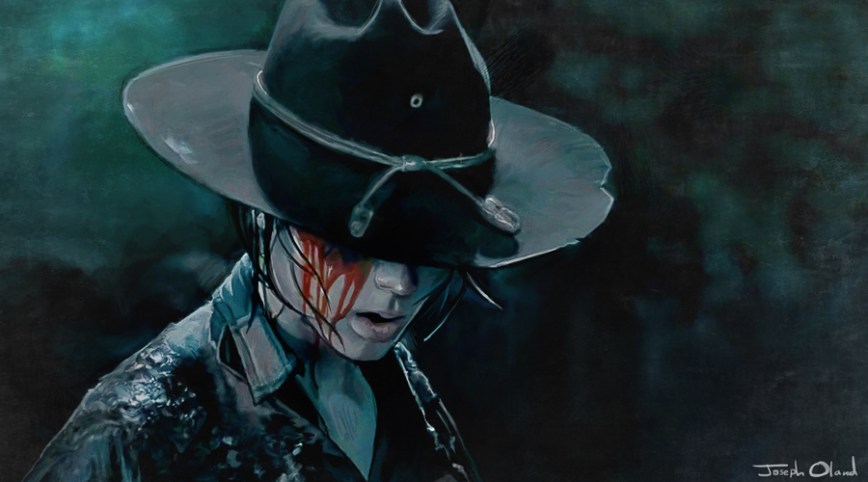
Carl's Eye postFINE ART PRINTS AVAILABLE HERE

“The Walking Dead” returned on Sunday from the mid-season break and, in the show’s well-established style, nobody is safe. Alexandria’s wall has been breached and we watched while various citizens were predictably devoured by the walking dead. This might actually be what’s most problematic about the series; despite interesting turns and high-tension moments, the show’s rhythms and repetitions are overwhelmingly obvious. Previous seasons have routinely established a pattern in which the core characters appear to find long-term safety, only to be pushed out by larger and larger herds of walkers or competing survivor groups. The countryside of Atlanta, Hershel’s Farm, the State Penitentiary, Terminus, and Alexandria have all fallen in a predictable series of missteps and misfortune. Corrupt and despotic leaders have also become a common element, from The Governor to the cannibals of Terminus to the still-mysterious (but soon-to-be-revealed) Negan.

If “The Walking Dead” has common themes of corruption, perennially unsafe shelters, and the promise of “unkillable” characters being killed, then the shocking moments become less shocking. We still care, but we see the writing on the wall. We oscillate between moments of sadness and moments of relief, but with less and less impact. In an attempt to ratchet-up the stress, the show has begun playing unfairly to our emotions. The incident with Glenn and the dumpster is our best example. It was a relief to see the show’s most loved character pull through, but it was an unnecessarily manipulative cheap shot. The story should be able to achieve these levels of emotional impact by itself, not through slights of hand.

The show still has tremendous momentum and consistently delivers strong performances, but that doesn’t mean we don’t need something to change in order to disrupt these increasingly played-out patterns. This may have already begun to happen, of course, as we consider how the early episodes of season six began to fragment the timeline. The architecture of the narrative has changed dramatically as the story has been compressed, telescoped, and as the moments of decisive action have begun to occur with greater frequency. Where in the beginning a season would take place over several weeks or months, the whole of season six has (at least thus far) taken place over only a couple of days. We also have one unique 90 minute episode that looks backwards in time, showing us how Morgan transformed after a chance encounter with a kind loner. It is truly a magnificent episode that could just as easily have been a stand-alone film.

The best “zombie” features actually focus little on the zombies themselves. Rather, the best zombie stories are preoccupied with exploring humanity. “The Walking Dead” is no different. Most of the story is about a group of people struggling to reason and fight their way through an extraordinary situation. This is a survival story, in which disparate personalities collide, pecking orders are established, and drama unfolds. Everybody in the zombie apocalypse wants the same thing: to live to see another day. But everybody has their own idea how to accomplish that goal. Others have the opportunity to seize control, become leaders, ascend the dictator’s throne, or become sacrificial and selfless. That’s what is so darn good about “The Walking Dead.” We all watch these characters, study their struggle, and we all have an idea of what it is we would do if placed in that situation.

George A. Romero’s original zombie masterpiece, “Night of the Living Dead,” set the stage. It’s a brilliant thought experiment as we watch a half dozen strangers, marooned in a  farmhouse, arguing about the best course of action. Zombies occupy less than five minutes of screen time and most of the violence is implied. The script was written like a brilliant one-act play, and the moral questions are so compelling that we barely realize there’s hardly any action driving the plot forward, just words.

“The Walking Dead” could be a compelling television show even after the last walker collapses in dry-rot and melts back into the earth; the world is still a wasteland, filled with roving bands of survivors, scavengers, and highwaymen. Civilization still has to be rebuilt, infrastructure established, townships reclaimed. If the show can find a way to break out of it’s rinse-repeat cycle, it could be around for a long time to come.

FINE ART PRINTS AVAILABLE HERE
SIGN UP FOR THE LENSEBENDER NEWSLETTER

Lover’s Embrace

Embrace postFINE ART PRINTS AVAILABLE HERE

“Love is that condition in the human spirit so profound that it empowers us to develop courage; to trust that courage and build bridges with it; to trust those bridges and cross over them so we can attempt to reach each other.”

~Maya Angelou

– – –

Love is difficult to quantify, impossible to explain. I don’t possess the skill to describe the feelings of love that I have experienced in this short life. There have been moments of incredible intensity and tremendous pain, giddy uncertainty and unrelenting ecstasy. I’m certain that anybody reading these words will agree that passionate love is a glorious thing, that each of our experiences are unique and, somehow, surprisingly similar.

On this Valentine’s Day, I decided to forego with the condemnation I typically feel inspired to express. We have, all of us, already heard the arguments against the expense, the crowded restaurants, the expectations and the pressure. Rather than hammer-out a screed about the pitfalls of the holiday, I decided instead to nestle into the corner of a coffee shop and come up with a image of love that suits me.

This is the result, and I hope you enjoy it.
Happy Valentine’s Day.

FINE ART PRINTS AVAILABLE HERE
SING UP FOR THE LENSEBENDER BLOG

What’s So Special About “Fury Road” Anyway?

Blue Ange postFINE ART PRINTS AVAILABLE HERE

This is a question that’s been plaguing a lot of moviegoers this Oscar season. After news broke that the George Miller’s fourth “Mad Max” film had fetched ten – that’s right, ten – Oscar nominations, many heads flew atilt with confusion. A film with such clichés as maidens in distress, revving motorcycle engines, and great big dumb explosions can’t possibly make the cut – or can it? That’d be like giving “Lethal Weapon” an Oscar nod, and that just doesn’t happen!

Even with the disappointment with “Birdman” winning best picture last year (just go see “Boyhood,” then think long and hard about it), at least audiences could sit back and remind themselves of that movie’s half-sensical whimsy. We actually kind of get it when an “artsy fartsy” film is trying to be clever and avant-garde. We actually kind of get it when a film is intentionally bizarre and eventually fetches a lot of awards; it’s happened a thousand times before, even if it isn’t quite to our liking. But that still doesn’t explain why an action beat-em-up like “Fury Road” is getting so much attention. So what’s the deal?

The deal is this. We’re currently entrenched in an era of film-making that largely produces only two kinds of mainstream feature: special-effects-driven action films and dialogue-heavy or otherwise “literary” films. The former represents, as an example, just about any comic-book movie out there. The latter represents your so-called “art” films, those “Oscar bait” features like “The Hateful Eight” or “The Revenant.” I advocate for all category of film, to be sure, and I enjoyed “The Force Awakens” as much as anybody else. That being said, I think we all knew going into the theater, 3-D glasses in hand, that the new “Star Wars” flick wasn’t going to win a ton of awards (save, of course, for visual effects, sound engineering, and the like). It’s just the way that particular cookie crumbles.

So where does “Mad Max: Fury Road” fit into this bifurcated cinematic equation? It doesn’t – simple as that.

I will concede that, on the surface, it certainly does have the appearance of a brainless visual effects parade. Upon closer investigation, the film reveals itself to be infinitely more creative than that. Rather than confuse plot complexity with artistic brilliance, director George Miller reversed course, using a basic and straightforward narrative as a foundation from which to explore a relatively dormant style of visual storytelling.

The first thirty minutes of “Fury Road” present a deeply sophisticated visual rhythm that explains everything the moviegoer needs to know without relying on standard Hollywood action tropes. In almost every regard, the setup for “Fury Road” is a sublime sequence of pictures that approach a “silent film” quality unlike any other movie in the action genre, or any other 2015 title of any genre. I challenge any reader to re-watch the beginning of the film with no sound (or with any old song of your choosing – I’m quite convinced this would play remarkably well with a Chopin nocturne) and consider how marvelously rich and detailed the mythology of this “Mad Max” story is – and all without the aid of narration or expositional dialogue.

That is the brilliance of “Fury Road.” It is deceptively simple, but speaks in a universal, wholly accessible visual language that doesn’t rely overmuch on historical allusion and the tropes of “avant-garde” or “high” art cinema. It is a primal story that presents itself in primal, pictographic language. It’s honest with itself, it’s honest with it’s audience, and it accomplishes what very few films today accomplish. It’s visually remarkable but behaves as though its practical and digital effects aren’t important; that’s a rare quality in the action and adventure genre, and I’m pleased to see that the Academy has taken note.

FINE ART PRINTS OF THE ABOVE IMAGE AVAILABLE HERE
SIGN UP FOR THE LENSEBENDER NEWSLETTER HERE


A Look Back At “Dumb And Dumber”

Seabass postI loved “Dumb & Dumber.” Absolutely loved it. I saw it at the perfect time in my life to truly appreciate its magnificent stupidity while also getting a hint that there was a thoughtful craft behind the crude humor, a quiet genius necessary for this kind of movie to work. That’s right, the perfect time in my life: adolescence.

Two years ago, after finishing the first season of “The Newsroom,” I was pleased to see a picture of Jeff Daniels dressed as his “Dumb & Dumber” character, Harry Dunne, on my newsfeed. Talk about timing, right? As it turns out, the actor went immediately from wrapping the most recent season of his amazingly well-performed – and somewhat serious – HBO drama to once again act the fool with compatriot James Carrey. Twenty years later.

I could have guessed, even before the teaser trailer was released, that this was going to be a throw-away nostalgia grab-bag, a “hey, let’s cash a check” kind of movie. Comedy sequels have this awful habit of ham-fistedly repackaging the same jokes from their franchise, recycling winning punch-lines and tropes. It is a stupid trick that rarely, if ever, works. This usually doesn’t prevent one or two sequels from dribbling out of successful film properties. Quite frankly, after twenty years of lying dormant, I’m surprised this one even got made.

I enjoyed seeing the characters again, and I dusted off my old VHS copy of the original “Dumb & Dumber,” a hunk of plastic I bought previously viewed from a supermarket in Kansas. If you put a gun to my head, I wouldn’t be able to tell you a single thing about “Dumb and Dumber To.” It was just that forgettable. I laughed a few times, I think, but nothing really stands out. One might suppose that being forgettably bland is a notch above being memorably awful. And hey, I had an excuse to watch the original one more time, and that was enough to put a smile on my face.

Please consider supporting independent artists like myself.

FINE ART PRINTS OF THE ABOVE ILLUSTRATION ARE HERE
SING UP FOR THE LENSEBENDER NEWSLETTER HERE

Self Portrait As A Dissociative Patriot

Dissociative Self Portrait post“Everything that irritates us about others can lead us to an understanding of ourselves.”

~Carl Jung

– – –

I am an artist. That pretty much means I’m one rung up the ladder from a beggar. Or, more appropriately, I’m a clever beggar, intent on marketing my own neuroses. On a good day, artists are great observers, presenting novel ideas to the world. On a bad day, we’re self-destructive narcissists that only think our ideas are novel.

I avoid self-portraiture. Throughout my career, I’ve met a lot of talented and creative people, but I’ve also met a lot of hacks. College proved to be a breeding ground for self-indulgent creativity, and the “self portrait obsessed” always struck me as inauthentic and cruel.

That being said, here’s a self-portrait. My kind of self-portrait.

An associate of mine and I used to frequent several bars in Tucson. Several. We always brought our sketch books, and we were always armed with markers, pencils, and charcoal. We’d pluck our pocket watches from our vests and come up with drawing challenges. Thirty-five seconds to draw a portrait of the cute girl in the corner. Two minutes to draw one another – we’d sit across from one another and furiously claw at our sketch books. The idea was to override our own insecurities by making it flat-out impossible to make anything of value. You don’t have time to second-guess your decisions when you only have thirty seconds. Nothing terribly good usually comes from a sixty second sketch.

An aesthetic grew out of these hapless challenges, which quickly filled our portfolios. We eventually began to refer to these images as “chaos portraits.” This is a chaos portrait I did of myself. It was a one-minute drawing, made in the dim light of Danny’s Lounge, a bar out on Fort Lowell & Country Club, after a pitcher of cheep beer and a game of pool. I like to think it expresses the constant hateful insecurity of the irrelevant middle-class artist.

It also reminds me that I need to wear ties more often.

FINE ART PRINTS AVAILABLE HERE
SIGN UP FOR THE LENSEBENDER NEWSLETTER