January 18 – Farewell, Glenn (take it easy)

Glenn Frey post

“You can check out any time you like, but you can never leave.”
– – –

I don’t care how Jeff Lebowski feels about it, I’ve always loved The Eagles.

I was hiking along the Kansas River again this afternoon waiting for the sun to go down, hoping for some good color in the sky and some glassy reflections in the water. I looked at my phone and saw the notification from The Associated Press that The Eagles founding member Glenn Frey had passed away; he and drummer Don Henley formed the band in Los Angeles in the early 1970s, along with guitarist Bernie Leadon and bassist Randy Meisner. He passed away in New York in the company of loved ones. He was 67 years old.

It seems like a cruel joke to have so many beloved artists and musicians dying in such quick succession. Lemmie, Bowie, Rickman, and Frey are on a lot of minds right now, and the world seems a little colder knowing these people have left us. We’re all in the process of learning how to mourn in a way that we hadn’t a generation ago. Our rituals are changing, and social media is playing a significant role; it’s a magnificent engine that drives sad news into viral proportions in faster-than-light speed.

As with the previous deaths over the past week, I present you tonight not with a photograph of the day, but an illustration in commemoration of our friend. As with Bowie and Rickman, Frey will remain with us in our mix tapes and records, on the screen, and in our memories.

And I feel it important to echo what a friend of mine wrote earlier today:
“Someone needs to get a team of doctors to [keep an eye on] McCartney, Mick Jagger, Simon, and Taylor stat! We demand wellness checks!”

Now turn on the radio. Live in the fast lane or take it easy. Whichever makes you happy.

PRINTS AVAILABLE HERE

SIGHT UP FOR THE NEWSLETTER HERE


January 17 – The Good Book

01-17 Bibliophile post

“Good friends, good books, and a sleepy conscience: this is the ideal life.”
~Mark Twain

– – –

I have a massive collection of books. A massive collection.

Like many of my ilk, I’ve looked back and realized that I have always been a collector. My younger self collected a wide variety of useless things, from wall posters and semiprecious stones (every family vacation had me on the lookout for rock shops) to previously-viewed VHS tapes and pogs (when  those were in fashion – yeesh, how embarrassing). I continue to collect music, but the most obvious thing I collect, quite naturally, are photographs.

Thinking on it, I collected baseball cards even though I was never, ever a sports fan. Things went pretty sideways once I discovered that trading cards existed for comic books. Heck, my obsession even took me down the path of outright criminality; I got caught stealing Marvel Ultra trading cards at the local supermarket when I was probably twelve or thirteen. I was absolutely terrified by that experience, and painfully ashamed. I also survived and would you believe it, I didn’t steal cards any longer. Instead, I started collecting actual comic books.

The early 1990s were a wonderful time to get into comic books and, for twenty years, I’ve been waiting for those lovely creative people in Hollywood to tell some of those stories on the silver screen. The first major series I got into was an X-Men story-line called “Legion Quest,” in which Professor Charles Xavier’s son travels back in time to execute Magneto, thus preventing all of the damage Magneto has done in his lifetime. It’s another iteration of the “if you could go back in time and kill Hitler” thought experiment. I have always loved this about the X-Men stories. They’re thoughtful, and thought-provoking. Initially, the X-Men were a vehicle through which the authors discussed American prejudice, mirroring the experiences of ethnic minorities. Today, stories of exclusion and oppression also reflect the marriage equality movement. The world is always so quick to point at a group and shout “freaks!” And the X-Men, in these stories, are the freaks. It takes the anguish of real-life problems and de-contextualizes them, allowing us to think about these issues from a fresh perspective. It’s brilliant.

Hero stories are all morality plays in the end, and they’re infinitely more sophisticated than they might appear to be on the surface. It has been fun watching media like graphic novels and video games achieve the mantle of high art and experience legitimacy in the eyes of the wider public. Once upon a time, comic books were for kids and video games were nothing more than a waste of time (and yes, they still can be, so don’t get me wrong). The video game industry has now surpassed Hollywood in generated revenue, and graphic novels are now being made into feature length films.

Progress, ladies and gentlemen. The nerds have won, world. Deal with it.

The “Legion Quest” story-line was jam-packed with the what-if’s of time travel tales, and it laid the foundation for an even larger and monumentally engaging story: “The Age of Apocalypse.” I’m venturing to guess that this is what the next movie, “X-Men: Apocalypse,” will be presenting. It’s an exciting time to be a fan-boy, indeed!

– – –

Needless to say, graphic novels also led to plain-old books. Large-print illustration books, art history books, some first-edition Steinbeck novels, throwaway Vampire Chronicles and Stephen King tomes, and hallowed American classics from the greats like Conrad, Faulkner, Hemingway, and Fitzgerald. Every move, from dorm room to apartment, apartment to house, city to city, has seen me lugging impossibly heavy twenty-eight gallon Rubbermaid containers stacked with books. I can’t seem to let them go, and I often will pluck a book off the shelf and thumb through it for inspiration. Hell, I rarely even sold my textbooks back in college.

The picture above is a studio photograph of a pocket bible. On the University of Arizona campus, probably my sophomore year, there was a day when a group of missionaries stood on damn-near every street corner, every intersection, and every entrance to the student union handing these things out. Green vinyl covers and tissue-thin pages. I took every single one that was offered to me as I crisscrossed the campus on my way to class – until there wasn’t any room left in my backpack. I probably made off with about thirty copies. I went immediately to task making art projects out of them, and a series of photographs like the one here. In retrospect, it was probably a little scandalous that I collected all of those books, but I don’t think the world is in short supply of King James Bibles.

I guess the jury’s out, but I’m banking on the Good Lord being as forgiving as they say.

PRINTS AVAILABLE HERE

SIGN UP FOR MY NEWSLETTER HERE

January 16 – Those “Creative Types” We Know…

01-16 Creative Types post

Artists and egos go together like milk and cookies, now, don’t they? Where you find the one, you’re likely to find the other. It’s as though creative people are perpetually prepared to defend their work. And we all know what defensive personalities can do, don’t we? That’s right. They can lash out viciously like frightened wild animals. Bisbee boasts a wonderful arts scene in Southern Ariona, and that wouldn’t be a lie. But the happy-go-lucky vibe Bisbee also likes to boast about itself? Well, that’s not entirely correct. The fact is, the economy there is contracting and the town has gentrified significantly from the dirt-cheap 1960s of yore. Rents are higher, fewer dollars are flowing into the town, and there’s greater competition for a seat at the winner’s table. Sometimes there are hurt feelings when you struggle to promote your work, and sometimes you get thrown under the bus. Sometimes our melt-downs are very, painfully public.

That kind of thing happens in a small town, I guess.

During my tenure, I created enough problems for myself with this big old dumb mouth of mine. I’ve also quietly watched other peoples’ struggles unfold like a great big dusty rug on social media, ready for a thorough beating. We take our licks and hopefully learn something from the experience. We also discover who those people are that never seem to enter the arena, but always sit on the sidelines like carnival barkers, ready to cut you down to size, and ready to help fan the flames of a small conflict into a dangerous firestorm. Having a creative passion is something of a spectator sport, especially in a small town, but heck – criticism is part of the game, too.

People that can’t handle criticism should never pursue a career in the arts. Period.

In my humble opinion, when an artist is surrounded only by cheerleaders who celebrate each attempt as though it were the Mona Lisa itself? That’s absolutely freaking wonderful! We all need positive support. But it also means that the artist may be in the perfect position to experiment with something new, to try a new subject, style, venue, audience. The real danger of a town like Bisbee is that it’s such an incredibly small and insular place, and there are a lot of big fish. Things can get ugly when resources are scarce.

– – –

I say all of this not to stoke the flames of malcontent. It appears as though the most recent round of conflict in the Bisbee art scene has played itself out (at least in social media). I say all of this in relation to the image above, made by a gentleman who used to live in the brick building on Brewery Gulch across from the dog park. That is, if anyone ever really recognized it as a dog park. At one point or another, I think I remember people jokingly referring to it as “parvo park,” which didn’t inspire much confidence. Nevertheless, the brick building was festooned with mesh wire, painted mannequins, Christmas lights, and other random, presumably “found” objects. Some viewed it as an eyesore, others loved it. Visitors could be seen taking pictures of it with their smartphones every weekend.

I can’t pick sides. I don’t know the whole story. I just know that the eccentric old beast who decorated that building doesn’t live in Bisbee any longer. He may have brought it upon himself, or maybe somebody just didn’t like the cut of his jib. The extent of my knowledge is that he was run out of town. The right mixture of hubris, ego, madness, creativity, and drugs will always yield interesting results – and I’m confident all of those elements were at play. When creative types collide, sparks fly.

It’s my understanding he lives in Jerome now and he’s happy there, so there’s that. I don’t miss the dog park, but I do kind of miss the crazy decorations on that old building.

Oh well. Time marches on.

PRINTS AVAILABLE HERE

January 15 – On A Hill In Bisbee

01-15 Hilltop Bisbee post

“The aim of art is to represent not the outward appearance of things, but their inward significance.”
~Aristotle

– – –

I decided to dig through the archives for today’s photograph. I have a mountain of pictures that not only haven’t been published, but have almost been forgotten. I like to sift through old files, look back on all the faces and scenery I’ve been blessed enough to photograph. When my motivation is languishing – when I’m feeling the impulse to create something but don’t know where to begin – going through old photographs always helps.

One of my favorite places in the whole world is the hilltop that overlooks Brewery Gulch and all of Old Bisbee. That old Arizona town is unspeakably picturesque. Years ago, I’ve been told, a local man – I wish I could recall his name – could be seen hauling materials, an armload at a time, up and down the rocky path that winds up the hill. And anybody who visits Bisbee eventually sees the big white cross on the hill. Most folks aren’t able to find the trail without being shown the way.

Local folks have added their own candles, keepsakes, statues, prayer flags and vials of water. A local woman placed her husband’s ashes up there. A small red dollhouse-sized memorial was fixed onto the hilltop when Derrick and Amy Ross – our Nowhere Man and Whiskey Girl – passed away a couple years ago. On the backside of the hill is a makeshift shrine for those who braved the desert heat in an attempt to cross into America. Toothbrushes, children’s shoes, baby bottles, rosaries, backpacks, sunglasses, and clothing have been collected and hung atop the rocks beneath the visage of the Guadalupe Virgin.

I hiked up there several times a week, not often running into other people. I never grew tired of the view. Just thinking about it, I can almost feel the sense of calm in the wind in the summertime, watching monsoon storms roll in from the distance. It is a very special place. I look forward to being there again soon.

PRINTS AVAILABLE HERE

January 13 – Ars Gratia Artis

01-13 Ars Gratia Artis post

Art for its own sake. It’s a cavalier expression that has ascended the mantle to cliché. I understand that it follows, perhaps correctly, that this is the motto of the unserious artist or hobbyist. The expression is employed almost as a throw-away, to explain away unimaginative works. It can even seem dismissive, like the art student who mutters these famous last words after the critique: “You just don’t get what I do, man.”

I’ve met many artists who cloak themselves in intellectualism & self-aggrandizement, and gravitate towards the hot-button political issue of their day. If you dislike their work, then you must not be intelligent enough to appreciate its brilliance. Go to any university art department, throw a rock, and you’re bound to hit one. Their passion and intensity disappear pretty quickly once they leave the classroom. That great big world out there, and the time spent trying to cobble together a living, extinguishes the ambitions of a lot of young artists. This is a sad fact of life. But consider the possibility that it also separates the wheat from the chaff. Some people go to art school because it’s the cool thing to do before graduating and going to work for the family business. My studio art classes were filled to the brim with people who had no interest in pursuing a career in the arts, and my education suffered because of them.

That being said, I believe in art for art’s sake. It’s a declaration that has lost its meaning through repetition, possibly the result of our current social or political climate. Our leadership often disregards the arts as being impractical, unproductive, and unimportant. The National Endowment for the Arts has a long history of falling under attack. Attempts are made, routinely, to defund arts programs; in public education, it’s generally understood that when budgets are cut, the arts are the first to hit the chopping block. The arts aren’t mentioned on capital hill much, either. When discussing education infrastructure, our leaders have been focusing heavily of STEM education (science, technology, engineering, and math). What we fail to realize, time and again, is that creativity and creative problem solving are integral to each one of those disciplines.

Trying to make something where there was nothing before requires a kind of risk. Risk of failure and embarrassment. But risk is critically important in order to develop skill. The act of creating – be it a haiku or a bar napkin doodle, a piano melody or The Mona Lisa – is an instinctual behavior. It’s part of what makes us human. When we talk about culture, we typically aren’t talking about politics or GDP – usually we’re talking about music and dance, architecture, literature, religious artifacts and great big paintings and sculptures. We are all artists, but our creative instincts are all-too-often beaten out of us by our education, by a political and social climate that devalues or disregards it.

Today’s picture is a photograph intentionally taken out-of-focus. I layered another photograph on top to add texture. It is a photograph in the most basic sense, in that it’s a two-dimensional image of color and light. Like all abstract artwork, it is in no way functional, and serves no other purpose than to be looked at. The hope is that my audience finds it interesting to look at. The hope is that it sparks a memory or stirs an emotion. The beauty part is that this image can mean a million things to a million people, and I can appreciate that kind of ambiguity from time to time.

Until tomorrow, I hope you have a creative day.

PRINTS AVAILABLE HERE

January 12 – Shawnee At Dusk

01-12 Edge Of Town post

“Not until we are lost do we begin to understand ourselves.”
~Henry David Thoreau

– – –

The light is different in the winter here in Kansas. The earth grows cold and colorless. Leaves fall and die. The grass turns grey and lays down. We wrap our bodies in cloth and strap on boots; we remove ourselves from the world, burrow in, shutting the elements out. Having lived in the Southwest for the past ten years or so, I really had forgotten what it’s like to watch the world transform around you. The tempo shifts in Arizona, too. The light is different there, too. But the colored orange landscape remains largely unchanged.

I don’t care much for the kind of intense cold that comes with a Midwestern winter, but at dusk there is a kind of magic that’s unique to this place. The ground is cold ice and  the sky, ablaze. Looking at the fire and ice reflecting off each other in the growing darkness makes you feel small. Not in a bad sense, mind you, but in the kind of way that genuinely inspires adoration and awe. It’s no wonder our ancestors worshiped the sun; the nuclear color and the distant promise of warmth while stumbling, shivering through the cold, would be enough to bewilder any sentient being. Winter makes you feel alone. It awakens a dormant primal emotion. Heat becomes everything; a feeling of safety from the crushing force of nature. Like an evolutionary twitch, surviving the night feels oddly like a task, rather than a given.

I walked along the shores of the Kansas River today and watched the sky slowly turn from blue, to red, into purple. On the edge of Shawnee, a couple of miles from the Interstate, few people walk the pavement. At rush hour, the highway is a maelstrom of anxiety and noise. Just a short distance down the road, and you can sit on a rock and watch the starlings dancing from tree to tree, looking for a place to rest for the night. It feels like another country altogether when you can get away from the huge thoroughfares. I watched the five-thirty train roll along the line, carrying it’s freight westward. I watched my breath drift up into the darkening veil.

You know what? It’s true what they say about the value of a good walk.

PRINTS AVAILABLE HERE


January 10 – Bisbee Snow Days


2012(12-31)-13

“Winter is a season of recovery and preparation.”

~Paul Theroux

– – –

True bitter cold has arrived in Kansas. It was bound to happen eventually, and mother nature appears to be making up for lost time. It is a surreal scene, to look out the window and see green lawns in the neighborhood and sunlight punching through the clouds; it almost looks pleasant. It is far from forgiving outdoors. It is downright freezing. It’s days like this thst remind me why I moved so far away, all those years ago. I would trade a desert for the Midwestern Winters without a second thought, and without regrets.

The cold weather front that delivered this icy change was a little further West a few days ago. The storm brought some of the only snow Southern Arizona has seen in almost three years. My news-feed has been flooded with beautiful photographs of the snow-covered Mule Mountains. My heart aches, to think that I’m not there to take-in those panoramas with my own two eyes. I am, at the very least, thankful that I live in an age where I can see everybody else’s happiness, even if from a distance. And, knowing that there’s little utility in dwelling on it, I decided to look back to some photographs I made those three years ago, when I actually was there.

Bisbee is a beautiful and well-kept secret along the Mexican border. It’s a wholly unique town that arose from a copper mining camp that fueled the local economy until the mining operation shut down. Low rents attracted artists and vagabonds – and other…unpredictable types – and the character of the town transformed from saloons and whorehouses and mining to just saloons and whore houses – and one hell of an arts and music scene.

After the weight of the snow, the slippery steps and fallen tree limbs, I hope that the handful of people I know and love out there are enjoying the view just a little bit extra, for me.

VIEW THE EXTENDED GALLERY HERE

If you are interested in prints of any of the images, please contact me via Facebook messenger. Thank you.

January 09 – Old Lenexa

01-09 Old Lenexa post

“History never looks like history when you are living through it.”

– – –

Na-Nex-Se Blackhoof, widow of Chief Blackhoof, was the signer of an 1854 treaty. Over one and a half million acres of the Kansas Shawnee Indian reservation was ceded to the United States government. In 1865, shortly before the widow’s death, the Kansas and Neosho Valley Railroad was organized; a railroad depot was erected and a civil engineer platted a town. In 1869 the name “Lenexa,” a derivation of Na-Nex-Se, was adopted. The old Santa Fe Trail ran directly through this little corner of the cosmos.

I only write these words because I didn’t know about this until today. I was raised a few miles away from the railroad depot. The city of Lenexa was my home until I turned eighteen and left for Arizona’s warmer climates. It dawns on me that there’s an awful lot that I don’t know that I probably ought to.

The historic downtown area is small. If you’re driving through and you blink your eyes, you might just miss it. Today it’s pretty much only comprised of this old rail house, a saloon, and a barber shop. I never spent any time here. For one reason or another, the idea struck me yesterday that it might be a good idea to drive over and make a few pictures. It may well have proved to be a waste of time. The weather was disagreeable, and I’m not so sure I’m pleased with any of the photographs I got out of the deal. But at least I learned about my hometown’s namesake.

There are lots of little details that slip through the cracks. It can be argued every which way that the details of our history are important. The details also rarely seem to be very glamorous. In fact, most of the time the details of our history seem decidedly mundane. Nevertheless, the importance of our history is argued regularly. It has been my experience, however, that rarely are our words ever put into proper practice. The business of life overwhelms us. At the end of the day, the television seems to be a greater comfort than a history book.

I’m wholly confident that this is not a good thing.

PRINTS AVAILABLE HERE

January 08 – Tragedy In Tucson

01-08 Tragedy in Tucson post

“We can easily forgive a child who is afraid of the dark; the real tragedy of life is when men are afraid of the light.”

~Plato

– – –

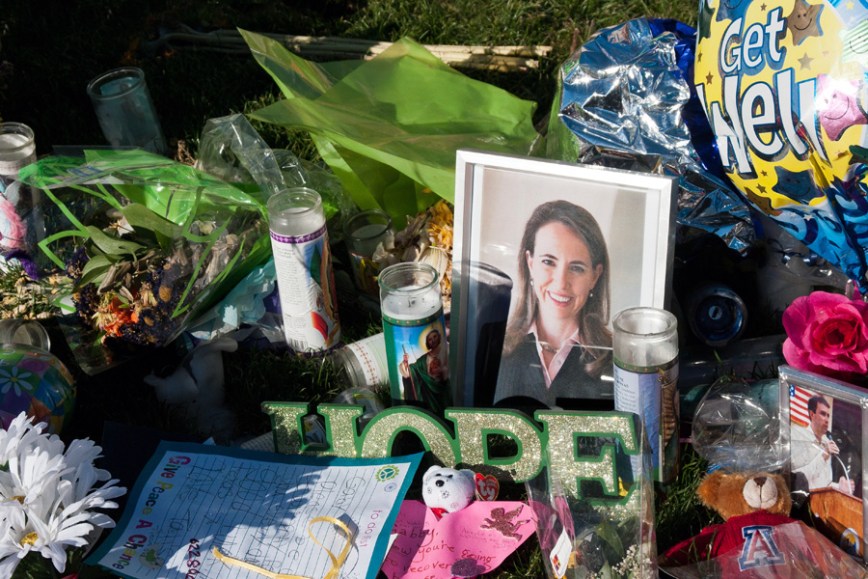
Five years ago violence was visited upon Tucson when a gunman opened fire at a grocery store parking lot. Nineteen individuals were shot, including United States Representative Gabrielle Giffords. Six people lost their lives. I expect that this anniversary will be marked by many in the media, especially after President Obama’s executive order earlier this week. Gun control legislation continues to be a huge point of contention among American voters, but gun violence continues to be an undeniable problem. This isn’t the forum for an individual like myself to hammer out a screed about the issue. All I know is that I was in Tucson that day and I remember how it felt.

I had only just heard the news when my phone rang. A gentleman from SIPA Press introduced himself. He had received my name from a journalist friend of mine, who had explained I’d likely be available to cover the story. This would be the first time I was ever hired to work as a photographic journalist. With shaky hands and shallow breath, I packed up my gear and headed down to the University Medical Center where the wounded, including Representative Giffords, were being treated. I wasn’t sure how I was going to do this job, and I certainly didn’t know what to expect. But I knew I had to go and try my best to do a decent and respectful job.

The next several days were a blur of people in mourning, of funerals and press conferences, of being pressured to go to Jared Loughner’s home and try and get pictures. Any time when I began to feel like a paparazzo, I put my camera down. There were some things I wouldn’t do. Cristina Green – the nine-year-old girl who lost her life in the shooting – was particularly challenging. The media predictably poured in like ghouls for the funeral, sticking microphones into crying faces and asking people “how do you feel, sitting out here” while they choked and sobbed their responses. I was thankful, in that moment, to be a photographer; I was able to do my job from a distance rather than invade people’s space in a moment of sadness.

There is a lot more I could say – about violent political rhetoric, about the second amendment, about the moments years later when I got to sit down with Mark Kelly and Gabby for a brief cup of coffee – but again, I don’t really think this is the place. Gabby has made more of a recovery than any of us could have ever hoped or expected. Jared Loughner, the wild-eyed gunman, is serving seven consecutive life sentences. The world is still here, even if it has been deprived of a not-so-insignificant portion of peace and happiness.

VIEW THE EXTENDED GALLERY HERE


January 07 – The Plaza

01-07 The Plaza post

“The photographer is a manipulator of light.”

~Laszlo Moholy-Nagy

– – –

A photograph of somebody else’s artwork. Is it really even appropriate for a photographer to take such an image and claim it for themselves? It’s an interesting dilemma because the photographer is still engaged in making decisions about the light, the framing, the angle of the shot. All of these variables – and many, many others – influence the emotional impact of the photograph. I tend to tread lightly with topics like this, but I make efforts to exploit my own skills to capture the subject as dramatically or uniquely as possible.

The fountains and statuary of The Country Club Plaza – known by most folks simply as The Plaza – have been photographed by countless thousands of people throughout the years. It’s just on the Missouri side in the Kansas City Metro area, near downtown. It boasts upscale shopping and fine dining, beautiful lights around Christmas, and horse-drawn carriage rides. A couple of city blocks away, though, and you’ll see some of the most impoverished neighborhoods in the city. This is the case all over the country, though, isn’t it? The Plaza is the kind of place where the local police will pick up the panhandlers, drive them over a few blocks, and drop them back off where, presumably, they belong. I’ve see it happen with my own eyes. And I get it. I just don’t like it, is all.

I remember my first high school photography class, using this old metal hunk of a manual Canon film camera my father bought me. A friend of mine from school – you know, who actually had a driver’s license – drove us out to The Plaza. I remember thinking I’d get some great shots. I hadn’t even considered how truly unoriginal the idea was, but hell, it was all new to me. I have to remind myself of the same thing today. “Sure,” I’ll tell myself. “The Grand Canyon’s been photographed a thousand times before. But not by me.”

We have to have our own experiences, now, don’t we?

I still have the negatives from that trip to The Plaza – most of them under-exposed – sitting in an old three-ring binder with many other of my early failed attempts at the whole ‘photography’ thing. I read about a New York photographer who set their camera up on a tripod in their apartment and pointed it straight out the window to the street scene below. He took one photograph every day for a year. Not the most ambitious project, but it’s something. I think we’ve all seen videos of people who do this with self-portraits, to document how much they have (or haven’t) changed in one years’ time. But this photographer did it in 1918, and nobody had every done anything like it before. The modern photographic method hadn’t even reached the century mark; there were lots of things that hadn’t been done with the camera yet. So this photographer’s year-long project made the history books, and the photographs are preserved in some archive or another, probably at the Eastman House in New York.

I’m sure there are plenty of things that have yet to be done with photography, too. It just always seems like it’s all been done before, but that’s just the lie we tell ourselves so we can talk ourselves out of trying. It’s really just a matter of figuring it out. So I guess I’d better get back to it.

PRINTS AVAILABLE HERE