February 19 – Liberty

02-19 Liberty postOne of the little tricks film photographers sometimes employ is known as “cross processing,” in which slide film is developed using chemicals designed to for regular color film. The results vary, but are characterized by a dramatic color shift, with punched-out contrast and deep tonal saturation. These effects can be applied to digital images with relative ease using editing software like Photoshop; the film photographer, however, is forced to accept the final result rather than having the opportunity to endlessly tweak the effect in post production.

Basically, cross processing is controlled chaos. It’s a method of embracing “happy accidents.”

This photograph was made in Jerome, Arizona, a small mining town outside of Prescott Valley in the Black Hills of Yavapai County. The copper mining operation saw a huge boom in the 1920s, pushing the population to around ten thousand. Today there are only about five hundred people, but it gets a lot of traffic from Phoenix – it’s a wonderful weekend getaway. I’ve always enjoyed walking around and looking at the old buildings, the narrow alleys, and the wrecks of brick rotting on the hillsides. It is a quiet place with a rich history. If you’re lucky, you might even bump into Tool and Puscifer front-man Maynard James Keenan, who moved to Jerome to start a winery in the early 2000s.

FINE ART PRINTS AVAILABLE HERE
SIGN UP FOR THE LENSEBENDER NEWSLETTER

February 18 – The High Plains (cyanotype)

cyanotreeRather than discuss a vintage camera, today’s Film February photograph highlights an antiquated printing process that, unlike the abnormally frail Daguerreotype or the albumen paper negative print, is still in somewhat frequent use today.

The “cyanotype” is a printing process that produces a blue-tinted print – cyan colored, even – so it’s an unironic name. Using basic ferric (iron) salts, this is one of the most affordable printing processes ever invented. This is why engineers used the process, with frequency, well into the 20th century; you would recognize them as “blueprints.”

The process uses two chemicals: ammonium iron(III) citrate and potassium ferricyanide.

During the latter half of the 19th century, photographers used horses and donkeys to carry their mobile darkrooms, consisting of photo chemicals, containers, camera equipment (view cameras were quite cumbersome) and a tent that served as dark room. Organic compounds commonly referred to as ‘ethers’ were used to dissolve collodion silver for wet-plate photography – never mind what wet-plate photography is, just know that it was the dominant method. The instances of field photographers being overcome by ether fumes and dying were not rare. In fact, the chemical nature of print photography has represented significant risk to all photographers prior to the digital revolution.

The pyrogallol (“pyro”) film developing process functions to tan and harden film images in a low sulfite environment. In the era prior to darkroom tongs, latex gloves, and ventilators, this chemical caused serious nerve damage to a generation of photographers. It’s most famously linked to Edward Weston, America’s founding father of photography. If you don’t know who Edward Weston is, don’t worry – you know his most famous pupil. Weston taught a young Ansel Adams. He had previously been though to have died of Parkinson’s disease. The symptoms of Parkinson’s are identical to prolonged exposure to pyrogallol, and he worked with this chemical for most of his life.

Selenium toners are used to make silver gelatin prints more archival. The selenium metal is less prone to aging, fading, or degrading than the silver halide crystals that it replaces. It also gives prints additional tonal density and a slight brown color tone that many photographers find appealing in their black-and-white work. Selenium toner poses cancer risks and respiratory damage if inhaled or absorbed through the skin.

Cyanotype printing is widely believed to be a harmless process, but potassium ferricyanide can be incredibly dangerous if improperly handled. Reactions can occur with other darkroom chemicals, producing a noxious gas that can be fatal.

Why do I say all of this? Well, I suppose because I find it all very interesting. Photography is both a science and an art, and I think that we forget that sometimes, especially with how easy photography has become with our smartphones. Prior to the digital revolution, photographers weren’t just ‘witnesses with cameras.’ They didn’t simply “Point. shoot. Viola! Here’s your print.”We were visual composers, yes, but we were also reasonably experienced chemists, often coming up with our own chemical mixtures – our own recipes – to produce desired film grain, image density, contrast, print aesthetic, and color tone. We don’t often think about the photographer in his darkroom (nor, contemporaneously, hunched over a computer screen). We prefer to think of the photographer in the field, riding in the back of a muddied Jeep, sitting on the 50-yard-line, credentialed and in the front row at the press conference. Photography is spent half out in the world, gathering images, and half in the dark, fine-tuning the images we’ve gathered.

Photographers have always had a history of risking health and personal injury in order to execute their craft, and I’m proud to consider myself among that cohort. I haven’t covered war, traveled to a third-world nation, been kidnapped. I’m no hero, but I like to think that I’ve had the opportunity to bear witness to extraordinary events, and I was there with my camera. I have participated, in my own small way, to that rich history.

The lessons I learned in the darkroom are lessons of patience, an appreciation for chemistry, and the rewards of diligence. Pulling prints from a negative is an involved process, and no amount of Photoshop can replace the sheer joy of walking into the light with fresh, wet print. To walk out of the red light in the darkroom and see what your print actually looks like, to have been working for hours and hours, and finally see that you’ve dialed it in, that you have the perfect print.

You stink. You’re tired. It’s three o’clock in the morning. And damn is it exhilarating. That’s why I still shoot film when I can.

FINE ART PRINTS AVAILABLE HERE
SIGN UP FOR THE LENSEBENDER NEWSLETTER


February 17 – Hotel Monte Vista

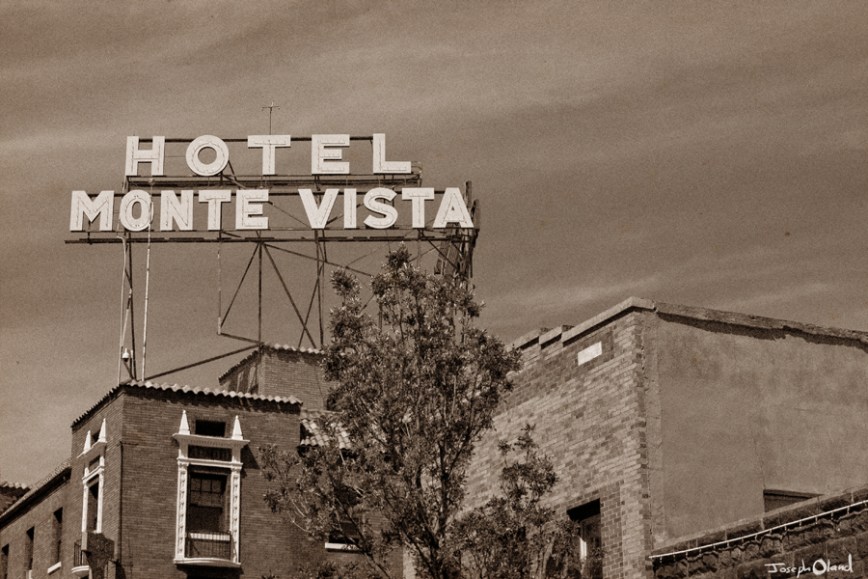
02-17 Monte Vista postAutomobile culture reached Arizona in the early 1900s and brought major roadway projects (see yesterday’s post about Miracle Mile Road) and an increase in tourism, which delivered new money to Flagstaff in the 1920s. Fundraising began in 1926 by local community leaders to establish first-class accommodation to replace some of the outmoded and run-down hotels.

Ground broke for the 73 room Community Hotel (named in honor of the prominent citizens who funded its construction) on June 8 of that year. It was finished in six months, opening its doors on New Years Day, 1927.

My first visit was back in 2005 or 2006, when I had the chance to tag along with a friend of mine. We worked together at a local Tucson photo lab and he happened to be a drummer in a band called “The Deludes.” I was able to hop aboard for a show they’d booked at the hotel’s “Cocktail Lounge.” It was a prohibition-era bootlegging operation, but the secret wasn’t kept long – local officers disrupted the illegal business in 1931. Ironically, the speakeasy reopened only two years later when prohibition was lifted.

It is one of the oldest operating hotels in Flagstaff and is a registered historic landmark, and its sign is one of the most recognizable landmarks in Flagstaff.

FINE ART PRINTS AVAILABLE HERE
SIGN UP FOR THE LENSEBENDER NEWSLETTER

February 16 – Sunland Motel

02-16 SunLand Motel postAs car culture began to take root in Arizona, the Old Spanish Trail Highway was established in 1916. This route represents a massive construction project intended to thread from Southern California to Florida. Motels and gas stations sprung up from the route, and some of the old remnants just so happen to survive today.

The Old Spanish Trail merged with other routes on the north side of Tucson, creating a network throughout the city. In the 1920s, the road became US Highway 80, which snaked down through Benson, Bisbee, and onto Douglas. Another vein sprung up, US Highway 89, stretching down through Tubac, Tumacacori, and on toward to the port of entry in Nogales along the Mexican border. Highway 84, known as the Casa Grande Highway, is now called Miracle Mile – it led north to Casa Grande and Phoenix.

Miracle Mile is today a somewhat notorious stretch of road, with low-rent rooms, weekly rates, a strip club, and a bowling alley. But that isn’t news. The area began to decline in the late 1960s, and Miracle Mile became synonymous with drugs, prostitution, and other illicit activity.

Only recently has the area has begun to shed it’s negative reputation, and it may be a while yet before the old stories fade away. Reinvestment has seen renovation, but many of the motels still seem relatively neglected, and the low rates still have the appearance of attracting a particular type of clientele. I guess time will tell what’s in store for old Miracle Mile road.

FINE ART PRINTS AVAILABLE HERE
SIGN UP FOR THE LENSEBENDER NEWSLETTER

February 13 – Paul Bunyan

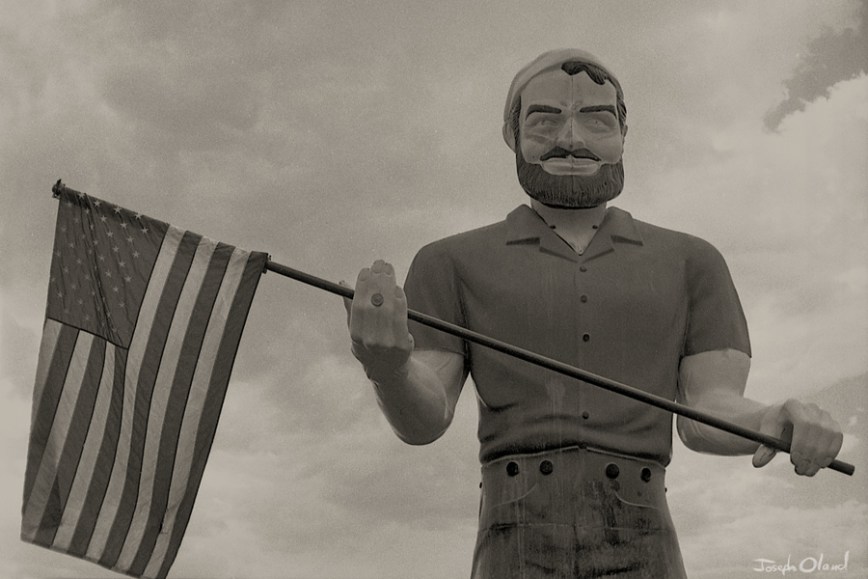
02-13 Paul Bunyon postIt was entertaining to learn that this statue of Paul Bunyan has a Yelp! review, which is about as nonsensical as the statue itself. I never looked into why or how this fifteen foot fiberglass statue arrived at the intersection of Glenn & Stone, but I definitely had to photograph it – this time with my Fujica Half vintage camera, on vintage film stock from the 1960s, on vintage photo paper from the 1960s. The film and photo paper was fogged from age, but I rather enjoyed the distressed look of the final print. Not a lot of trees for a lumberjack in Tucson, but he’s definitely become a landmark.

FINE ART PRINTS AVAILABLE HERE
SIGN UP FOR THE LENSEBENDER NEWSLETTER


February 12 – Suicide Alley

02-12 Suicide Alley post

FINE ART PRINTS AVAILABLE HERE

In October a train hits and kills a pedestrian around 7am. Officials investigate the incident as a suicide.

In November, a man kneels down in front of a train. The conductor tells police the man walked out of the bushes near the tracks and bent down to place something on the tracks. He then knelt down, facing away from the oncoming train. A note is found on the body, along with a single dollar bill. The note says goodbye to a friend and requests that whoever should find the note to please deliver the dollar, a debt, to the mentioned friend.

In December a man steps in front of a train and remains there until he is crushed. Witnesses tell police that the man intentionally stood in front of the train; the engineer sounded his whistle and flashed his lights and was unable to stop before killing the man.

Sixteen years ago, the Tucson Citizen published an article about railroad deaths after a series of tragic incidents, accidents and acts of suicide. Although the number of railroad suicides isn’t known, they’re not uncommon. The article included an interview with Dan Hicks, a veteran railroad conductor who has worked in the Tucson area.

“Hicks, 48, said he’s experienced the trauma of rail accidents several times,” the article reads. “Engine’s he’s operated have hit trucks, cars, and in one horrifying instances, a drunken woman who had been beaten and left on the tracks.”

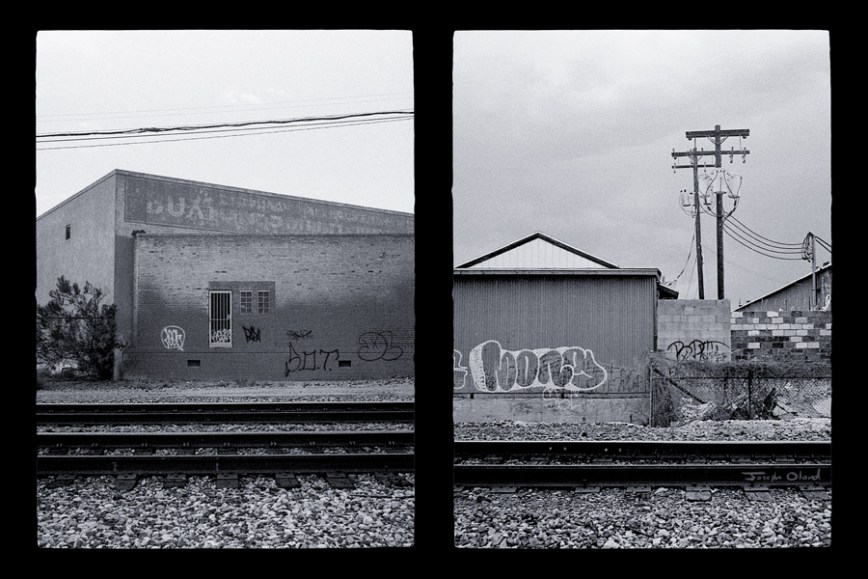
Today’s photograph – two exposures made with my handy-dandy Fujica Half – shows an area south of downtown Tucson. Around the time these two images were made, I met an engineer at Hotel Congress. I was sipping a beer and waiting for some food at the lobby restaurant, The Cup Café. He was dating one of the women who worked there, a woman I’d known for a little while. He told me about the number of accidents he’d witnessed, and the number of suicides. He also talked about a stretch of train tracks nearby that area rail-workers referred to as “suicide alley,” where a cluster of deaths had occurred. He told me how certain determined people would arrange their bodies on the ground, laying their necks directly on the track.

I’d recently been walking around that very stretch of tracks. Taking photographs was actually a challenge while I was studying photography – an irony I can’t even begin to describe – and it was an activity usually undertaken on the weekends. I’d never considered that suicide by train was a problem in this shiny new modern world. I remember thinking I hadn’t heard anybody talking about it. I hadn’t heard anything on the news.

But then – I’d  pretty much been living in the basement of the Theater Arts Building (where the photo lab was), so how would I know? For the past several months that’s the only place anybody could ever find me. I ate there, worked there as an employee and worked there as a student. Hell, I had a sleeping bag and pillow, a hot plate and a wet-bar (rum, coke, tonic water, and whiskey) in my private, closet-sized darkroom in the bowels of that institution. I only ever emerged to meet my girlfriend downtown for food and drink, or to fetch a pack of cigarettes from the 7Eleven across the street.

It shook me to think about what it must feel like, to be that determined to end one’s own life. It shakes me still.
I can’t look at these photos without thinking about it.

FINE ART PRINTS AVAILABLE HERE
SIGN UP FOR THE LENSEBENDER NEWSLETTER

February 11 – Smith Pipe and Steel

02-11 Smith Steel post


In the warehouse district south of Downtown Tucson, beyond the night clubs & restaurants, Armory Park & El Barrio Viejo, one might happen upon this peculiar sight. It appears to be a life-size – perhaps larger than life-size – sculpture of a velociraptor, sitting comfortably on the corner of Euclid & East 25th Street. It keeps constant watch over the parking lot of Smith Pipe & Steel, an industrial warehouse of some kind.

Sometimes a photograph speaks for itself, and I believe this would be one of those times.

Head down to Tucson’s South Park (no joke) neighborhood. According to a GoogleMaps search, this interestingly out-of-place character was still there in 2013. Chances are, it’s still there, like so many rotting beer cans in the desert.

FINE ART PRINTS AVAILABLE HERE
SIGN UP FOR THE LENSEBENDER NEWSLETTER


February 10 – Virgin And Child

02-10 Virgin And Child post“Men do not fear a powerful hostile army as the powers of hell fear the name and protection of Mary.”

~St. Bonaventure

– – –

A stroll through the graveyard can do wonders.

Ever since I was in high school, I would go out of my way to walk the rows and read the headstones. I’m not sure why, but the company of the dead can be delightful and soothing. Rapscallions, ruffians, and other forms of ne’er–do–well manage to cobble together some civility in the graveyard; I have yet to see an individual act the fool in such a place. The grounds feel calm and safe.

I made this image on a camera I haven’t yet mentioned during Film February – the Yashica Twin Lens Reflex (TLR). It’s a wonderful two-lens camera (obviously) with a few fine-tune controls that allow for selective focus and a variety of shutter speeds in order to capture dynamic scenes with an accurate, properly-exposed shot.

To read more about the Yashica series, check it out here.

I certainly don’t celebrate the decapitated head of a child-savior, but it caught my eye. It seemed poetically appropriate, as the statue seemed to represent, on a smaller scale, what a cemetery represents on a larger scale – everything falls apart, and nothing lasts forever. We also might want to remind ourselves that Mary The Blessed Virgin outlived her extremist rabble-rouser of a son, which also makes this image ironically apropos.

FINE ART PRINTS AVAILABLE HERE
SIGN UP FOR THE LENSEBENDER NEWSLETTER

February 09 – Industry, Steel, And Aaron Siskind

02-09 Industry post“Stone, steel, dominions pass,
Faith too, no wonder.
So leave alone the grass
That I am under.”

~A.E. Housman

– – –

I’m not sure who said it first, but it always stuck with me: there is nothing as unnatural as a perfectly straight line.

There’s actually some truth to this. Straight lines don’t really just occur in nature. Every natural process with the potential to create a straight line is subject to other processes that disrupt it. Theoretically, trees would grow straight up were they not subjected to wind, rain, gravity, uneven soil. If the distribution of air, sunlight, nutrients, gravity, and other factors were perfectly even, we would have straight-edge trees. These elements aren’t even, have never been even, cannot be even, and so they produce randomly mutated fractal patterns.

Interestingly, we humans now we live in environments wholly based on the straight edge; I-beams and milled lumber, the foundations of our homes, our streetlamps, television screens, windowpanes. There is no greater example that I can think of that represents the unbroken human endeavor to conquer nature.

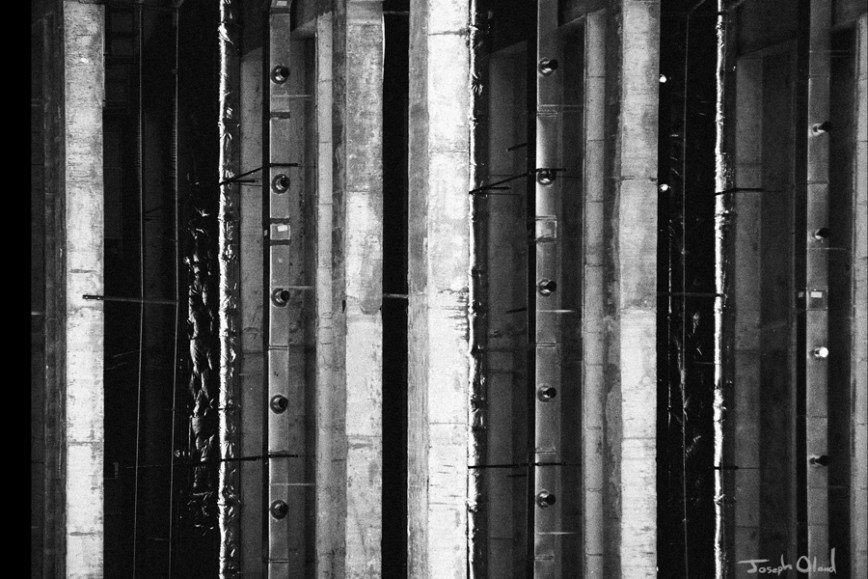
Today’s photograph is how I present the tension between humankind and the natural world – steel beams, the skeletal structure of a half-complete hotel in Albuquerque. I made this image when I was in my “Aaron Siskind” period. It was my second or third year of college, and I refused to photograph anything other than sub-par replicas of his patented abstract style. For those of you unfamiliar with Siskind, he was a prolific American photographer considered to be closely involved with the Abstract Expressionist movement, whose works focused primarily on the details of nature and architecture. At his height in the 1950s, his works were often described as blurring the line between painting and photography – something I’m personally interested in as an artist.

I was working as a research assistant at The Center for Creative photography on starvation-level wages under the Federal Work-Study Program. At the time it didn’t bother me; access to so many wonderful, historically significant photographic prints and photographer archives was plenty enough for me. Hell, I considered it an honor (and still do).

Then, recently, I found a faded, crinkled pay stub in an old suitcase. Boy was I being robbed.
But that’s a story for another day.

They say that emulation is the greatest form of flattery. I hope Mr. Siskind was looking down on my  from high with his notoriously crooked smile. I learned a lot trying to copy the masters, and I believe this is how many artists begin their journey. Not from square-one, but on the shoulders of giants, borrowing their voice while we struggle to find our own.

FINE ART PRINTS AVAILABLE HERE
SIGN UP FOR THE LENSEBENDER NEWSLETTER


February 08 – Tap-Dancin’ Granny

02-08 Granny postThe first several years I lived in Tucson, I lived right off of 4th Avenue. Close enough to walk, far enough away to have only had my car vandalized about a dozen times during my tenure,

Some of the grime has been polished off the 4th Avenue I remember from those days, but hey – nothing stays the same forever. Shirtless days on the front porch, cold beer in the summer, an embarrassing amount of hackysack. Brooklyn Pizza’s garlic knots and walks over to The Grill at three o’clock in the morning for some tots. The old underpass, bathed in dim yellow light, always wreaked of urine; most of the young ladies I knew – a generous portion of which who’d smack me across my smug face for referring to ’em as “ladies” – preferred not to walk through by their lonesome.

I magic-markered a piece of copy paper and thumb-tacked that sucker right by the exit to the one-room hovel of a guest house I lived in. “Do you have your camera?” was scrawled in smudged blue ink. That was my healthy little reminder every time I headed for the door. I hardly ever went anywhere without my camera, and only seemed to need it when I’d left it behind. This seems to always been case, even today.

I made it a habit to go down to the 4th Avenue Street Fair every autumn and every spring. It takes a certain kind of con-artist confidence to stick your lens in strangers’ faces, and the various street fairs, county fairs, political protests, and other events proved to be a healthy training ground for inexperienced street photographers like myself. Some people notice you and immediately ruin everything by smiling or posing.

Other people just have to common courtesy to threaten you with as ass kicking.

With enough experience, you learn how to lie your way out of sticky situations, charm your way through others, and – most importantly – make accurate snap judgments about the people around you.

The easiest photographs to make – and often the most fun – are of street performers. They’re used to being looked at, and usually like to dust-off their ‘A’ material when they see a camera watching. Something in my gut tells me that this woman may not be with us any longer. This photograph is somewhere in the neighborhood of ten years old, taken outside of Caruso’s Italian Restaurant on South 4th Avenue. A tap-dancing, smoking granny – how could one not take a photograph?

FINE ART PRINTS AVAILABLE HERE
SIGN UP FOR THE LENSEBENDER NEWSLETTER