Colossus – Gay Icon?

Colossus Tires postFINE ART PRINTS AVAILABLE HERE

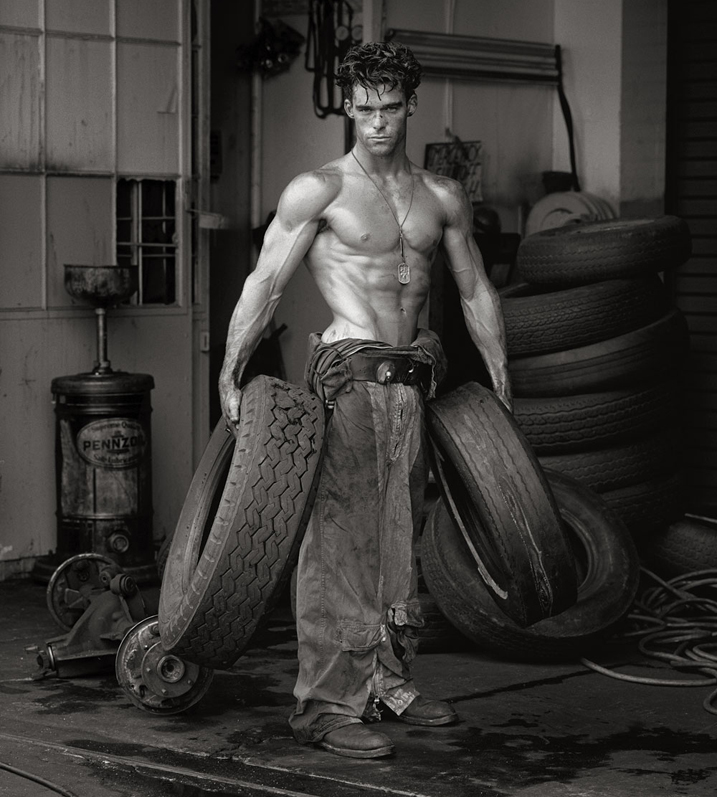
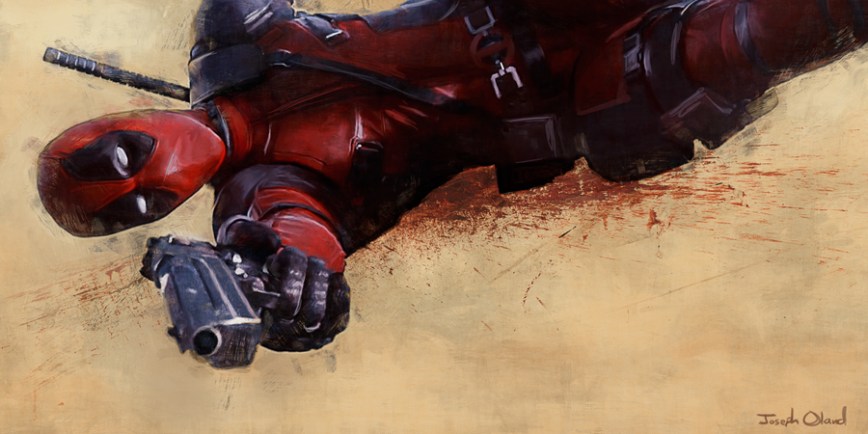
It had to happen. While watching the new “Deadpool” film opening night, this image immediately struck my psyche. I was immediately reminded of famous fashion and celebrity photographer Herb Ritts and one of his famous – and famously gay – portraits of a muscled man holding tires. His body of work is impressive, and I count him among one of the photographers who truly inspired me, even though I never developed in to a studio portraitist.

herb ritts

This image took a few hours to render, but I’m pretty happy with the way it turned out. Let me know what you think.

READ THE “DEADPOOL” MOVIE REVIEW
SIGN UP FOR THE LENSEBENDER NEWSLETTER

Movie Review – Deadpool

DeadShoot post

FINE ART PRINTS AVAILABLE HERE

Marvel and DC have mapped-out a half-decade of comic book movies. The market is saturated. Superhero movies are way overdue for self-satire and tonal variation. And that is precisely what we get with “Deadpool,” an incredible breath of fresh air in a crowded arena.

Mainstream reviews of Marvel’s recent release have been mixed, but this isn’t a shocking revelation. The titular character in “Deadpool” isn’t the most accessible – at least not to a broad audience. With self-referential humor, endless threads of inside jokes and constant forth-wall breaks, it takes a genuine fan to fully appreciate this cinematic gem. But a gem indeed it is. Regardless of what the naysayers have published, first-time director Tim Miller has cracked the code of the R-rated comic book movie in stunning fashion. The numbers speak for themselves.

While we have other R-rated movies like “Watchmen,” “300,” and “Sin City,” those are all dark horse examples, and their success remains somewhat questionable. “Deadpool,” on the other hand, is the first R-rated release in the Marvel Cinematic Universe, and this is significant; the success of “Deadpool” will determine whether or not Marvel Studios will roll the dice again. The production is already famously stalwart for facing-down pressure from Twentieth Century Fox to make a PG-13 cut. Larger audiences and a boost to box offices sales is the primary pressure of adventure properties like this (can you imagine what an R-rated “Star Wars” movie could accomplish?), but an R-rating gives directors much more latitide. Tim Miller & Co stood their ground and the gambit is paying off handsomely.

As of this writing, “Deadpool” has already outperformed the previous Thursday box office record for an R-rated feature. In fact, “Deadpool” blew the top spot out of the water. The previous record holder was “Fifty Shades Of Gray,” banking $8.6 million on its Thursday release. One year later, “Deadpool” managed to rake in $12.7 million. This is a coup that nobody predicted. The weekend total is expected to top $123 million, a tall margin ahead of Fox’s $60 million projection.
– – –
“Deadpool” is, at its heart, the smart-ass teenager too clever for his own good, filled with fits of irreverence that hinge on nihilism. He’s been described by some as that kid “who pretends to be too cool to care, but wants you to like him so badly it hurts.” This isn’t an entirely unfair description, and it identifies where the film character is separated from the print character. The comic book anti-hero is a sharp-tongued mercenary anti-hero. The film character is, more or less, a sarcastic hero-hero. He tickles our reptilian brain with slaughter, but he only slaughtering bad guys, and he’s made sympathetic and accessible by the love story that drives the plot forward. These are perfectly acceptable concessions – unavoidable, even – in the superhero movie marketing system. If we elect not to split hairs, “Deadpool” is an incredibly fun movie that brings a larger-than-life personality to the screen with a deep sense of respect for the source material.

The film establishes its irreverent tone straight at the open, with title cards that intentionally mock Hollywood (“Directed By: An Overpaid Tool,” “Produced By: Some Asshats,” “Starring: A Gratuitous Cameo,” “Starring: A CGI Character,” and on and on, to wonderful comic affect), as well as thumbing its nose at The Director’s Guild of America, which has famously sued directors like George Lucas for not crediting the director of “Star Wars” (himself) and “The Empire Strikes Back” (Irvin Kershner).*

After an action sequence opening, most of “Deadpool” plays out in flashback. We learn that Deadpool (Ryan Reynolds) used to be a mercenary named Wade Wilson. We’re introduced to his girlfriend Vanessa (Morena Baccarin) and his best friend Weasel (TJ Miller). Wade and Vanessa are veritable quip-machines, whose quirky and fast-paced humor seem to be the linchpin of future marital bliss. They’re both crazy, and both crazy in love with each other. Then, an unexpected late-stage cancer diagnosis burns the Happily-Every-After to the ground.

A mysterious recruiter gives Wilson an offer he can’t refuse: enlist in the Weapon X program (the same program that created Wolverine), and cure your cancer. Distraught by how his illness is affecting Vanessa, Wilson reluctantly agrees. He is experimented on, and tortured ruthlessly, by a man who calls himself Ajax (Ed Skrein) and his masochistic partner Angel Dust (Gina Carano). He becomes a mutant, with strength and regenerative powers, but is left horribly disfigured. When Ajax leaves him in a burning building, Deadpool begins preparing for his revenge.

Debut director Tim Miller is the head of Blur Studios and is well-equipped to tackle a project like “Deadpool.” His background in animation led to the dazzling title sequence to “The Girl With The Dragon Tattoo” and an astonishingly effective TV spot for the video game “Batman: Arkham Origins.” With a pedigree like that, he has created an energetic movie that vacillates between serious romance/tragedy and humorous (albeit violent) superhero antics. Some may find this manic pacing off-putting, but it effectively balances the action with the slower (and necessary) narrative beats.

Die hard fans may criticize how the film handles the forth-wall breaks, and a sense of humor that could have been more intelligently satirical of the comic book genre. Instead, the humor opts for the faster-paced machine-gunning of smaller meta-jokes. This is a stylistic choice that I think serves the film adequately. More sophisticated satire is better left on the printed page. Some jokes miss their mark, but they’re thrown around so rapidly that it barely matters. Ajax isn’t the most memorable villain, but this, too, is no surprise in a Marvel property; superhero movies seem constitutionally incapable (or unwilling) to spend the necessary time to flesh-out a compelling bad guy.

Weasel is a wonderful pace-shifting character that gives breathing room to the narrative. TJ Miller seems to strike the perfect balance of calm in his scenes, which serve as punctuation marks throughout the story. That being said, Reynolds flat-out owns this film, from beginning to end, leaving little room for the other characters to shine. This isn’t a bad thing; it plants the seeds for future iterations of the “Deadpool” story.
– – –
If you knew who Deadpool was ahead of this weekend’s release, you’re going to love the film. It constantly makes fun of the X-Men franchise that gave birth to the Deadpool character, so it’s fair to say that fans of the franchise are going to “get” the humor. The famously bad Deadpool origin story that was shoe-horned into “Wolverine: Origins” is directly addressed during the film’s opening moments. When dragged away by Colossus (a beautiful motion-capture performance by Stefan Kapicic) to visit Professor X, Deadpool shoots a quick look to the camera and says “McAvoy or Stewart?” referencing the two actors – James McAvoy and Patrick Stewart – who have played the Charles Xavier character in previous X-Men movies. These nods are continuous, warranting multiple viewings, and the post-credit scene at the end of the film (which I will not spoil here) is worth the price of admission all by itself. Anybody outside of the bubble may not understand why the auditorium is erupting with laughter so frequently, and may walk out of the theater scratching their heads.

If you’re a comic book freak, step away from the computer and head straight to the multiplex. It’s worth it.

*George Lucas was fined $250,000 for his transgression, which ultimately led him to resign from the Directors Guild of America. Something tells me Lucas got the last laugh.

FINE ART PRINTS AVAILABLE HERE
SIGN UP FOR THE LENSEBENDER BLOG

YouTube Dragon

The Girl With The Dragon Tattoo

YouTube Gotham

Batman: Arkham Origins


February 12 – Suicide Alley

02-12 Suicide Alley post

FINE ART PRINTS AVAILABLE HERE

In October a train hits and kills a pedestrian around 7am. Officials investigate the incident as a suicide.

In November, a man kneels down in front of a train. The conductor tells police the man walked out of the bushes near the tracks and bent down to place something on the tracks. He then knelt down, facing away from the oncoming train. A note is found on the body, along with a single dollar bill. The note says goodbye to a friend and requests that whoever should find the note to please deliver the dollar, a debt, to the mentioned friend.

In December a man steps in front of a train and remains there until he is crushed. Witnesses tell police that the man intentionally stood in front of the train; the engineer sounded his whistle and flashed his lights and was unable to stop before killing the man.

Sixteen years ago, the Tucson Citizen published an article about railroad deaths after a series of tragic incidents, accidents and acts of suicide. Although the number of railroad suicides isn’t known, they’re not uncommon. The article included an interview with Dan Hicks, a veteran railroad conductor who has worked in the Tucson area.

“Hicks, 48, said he’s experienced the trauma of rail accidents several times,” the article reads. “Engine’s he’s operated have hit trucks, cars, and in one horrifying instances, a drunken woman who had been beaten and left on the tracks.”

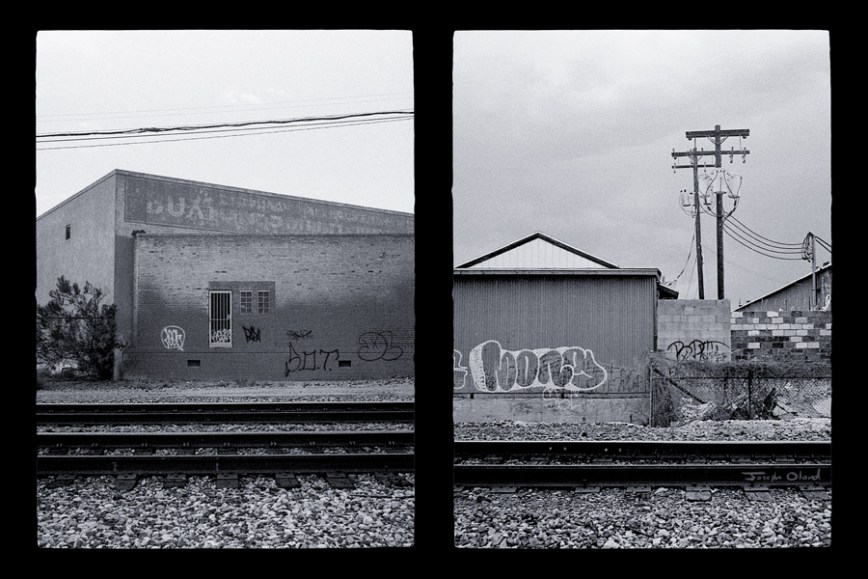
Today’s photograph – two exposures made with my handy-dandy Fujica Half – shows an area south of downtown Tucson. Around the time these two images were made, I met an engineer at Hotel Congress. I was sipping a beer and waiting for some food at the lobby restaurant, The Cup Café. He was dating one of the women who worked there, a woman I’d known for a little while. He told me about the number of accidents he’d witnessed, and the number of suicides. He also talked about a stretch of train tracks nearby that area rail-workers referred to as “suicide alley,” where a cluster of deaths had occurred. He told me how certain determined people would arrange their bodies on the ground, laying their necks directly on the track.

I’d recently been walking around that very stretch of tracks. Taking photographs was actually a challenge while I was studying photography – an irony I can’t even begin to describe – and it was an activity usually undertaken on the weekends. I’d never considered that suicide by train was a problem in this shiny new modern world. I remember thinking I hadn’t heard anybody talking about it. I hadn’t heard anything on the news.

But then – I’d  pretty much been living in the basement of the Theater Arts Building (where the photo lab was), so how would I know? For the past several months that’s the only place anybody could ever find me. I ate there, worked there as an employee and worked there as a student. Hell, I had a sleeping bag and pillow, a hot plate and a wet-bar (rum, coke, tonic water, and whiskey) in my private, closet-sized darkroom in the bowels of that institution. I only ever emerged to meet my girlfriend downtown for food and drink, or to fetch a pack of cigarettes from the 7Eleven across the street.

It shook me to think about what it must feel like, to be that determined to end one’s own life. It shakes me still.
I can’t look at these photos without thinking about it.

FINE ART PRINTS AVAILABLE HERE
SIGN UP FOR THE LENSEBENDER NEWSLETTER

February 11 – Smith Pipe and Steel

02-11 Smith Steel post


In the warehouse district south of Downtown Tucson, beyond the night clubs & restaurants, Armory Park & El Barrio Viejo, one might happen upon this peculiar sight. It appears to be a life-size – perhaps larger than life-size – sculpture of a velociraptor, sitting comfortably on the corner of Euclid & East 25th Street. It keeps constant watch over the parking lot of Smith Pipe & Steel, an industrial warehouse of some kind.

Sometimes a photograph speaks for itself, and I believe this would be one of those times.

Head down to Tucson’s South Park (no joke) neighborhood. According to a GoogleMaps search, this interestingly out-of-place character was still there in 2013. Chances are, it’s still there, like so many rotting beer cans in the desert.

FINE ART PRINTS AVAILABLE HERE
SIGN UP FOR THE LENSEBENDER NEWSLETTER


Movie Review – Jane Got A Gun

Jane02 postFINE ART PRINTS AVAILABLE HERE

It isn’t possible to have a frank discussion about “Jane Got A Gun” without mentioning it’s labored creation. Originally announced in 2012, an avalanche of problems tossed this movie into production purgatory. It’s important to note these troubles because, without mincing words, it absolutely shows in the final cut. I can scarcely recall a film with such a short run time that felt so relentlessly long.

Billed as a western co-starring Natalie Portman, Joel Edgerton, and Michael Fassbender – to be directed by Lynne Ramsey – this esteemed property hit a wall at breakneck speed. In 2013, Fassbender abandoned the project in pursuit of a more ambitious “X-Men” feature. Edgerton was shifted into the vacated role and Jude Law was hired to replace Edgerton. Director Lynne Ramsey then abandoned the project, thrusting the whole production into legal proceedings before Gavin O’Connor stepped in to direct. Director of photography Darius Khondji then left. Then Jude Law left, expressing that he’d only stepped in to work with Lynne Ramsey.

I could go on, but it’s the same game of “musical chairs” that isn’t worthy of further discussion. Slated for an August 2014 release, the date was postponed – twice. It finally landed in the post-holiday wasteland of mid-January 2016. With virtually no marketing, no press screenings, and no hopes of finding a staid audience, it’s a near-miracle it’s even in theaters. No resemblance to an Aerosmith song title could help. This one was dead on arrival.

If we consider these woes, however, we aren’t surprised to learn that “Jane Got A Gun” missed its mark. To its credit, the film isn’t half as bad as one might expect, delivering a couple of well-staged scenes and solid performances  (especially by Natalie Portman). The film plays like a classic Western, and this is where it simply doesn’t work. Rather than attempt to reinvent or deconstruct the genre – as contemporary moviegoers might mildly expect – the narrative is weighed down by poorly developed characters and a staggering snail’s pace, with a series of ham-fisted flashbacks used, poorly, to elucidate the emotional complexity of the characters.

The film is clunky, and where modern audiences might expect dynamism in the characters, we see tired archetypes, caricatures that hop about the stage like marionettes. We can barely bring ourselves to care about their fates. That’s a problem.

– – –

Set in 1870s New Mexico Territory, the film opens as retired outlaw Hammond (Noah Emmerich) returns to his remote home where his wife (Portman) is waiting. Riddled with bullets, he collapses from his horse and informs her that “The Bishop Boys are coming.” So-called “mystery box” setups like this are a wonderful device – “who are the Bishop boys?” – that can engage the audience, but in this instance it carries no gravity. We don’t know who he’s speaking of. All we see is that Jane knows who they are, and that they’re definitely bad news.

She dresses his wounds and leaves him to convalesce, delivering their daughter to a neighboring ranch for safety. She then seeks help from from Dan Frost (Edgerton) to help defend herself from the inexorable onslaught.

Through a series of clumsy flashbacks, we learn that Frost was once Jane’s fiance. He left to fight in the Civil War, unaware that she was pregnant. He is eventually declared dead and she she decides to leave their Missouri home, heading west in search of a new life. Believing John Bishop (Ewan McGregor) will help secure safe passage, she is instead sold into sexual slavery and her daughter is murdered by one of Bishop’s underlings. She is rescued by another of Bishop’s cohort, Ham, who steals her away to start a quiet life together.

Enter Dan Frost, who we learn is alive and well, and has tracked Jane across the country only to learn of her new life and her new daughter with another man. Needless to say, he isn’t excited about the prospect of defending Jane and her wounded husband. Naturally, he shows up at the last minute to lend a hand. What the film establishes is that at least four or five years have passed since Ham betrayed his dapper and ruthless employer (his daughter with Jane is our clue), and the film never adequately explains why Bishop is so hell-bent on exacting his revenge. Sure, one of his men quit. Perhaps Bishop took a loss when Jane escaped the brothel – but we don’t even know if the brothel belonged to Bishop or if he simply sold her, in which case he wouldn’t have lost anything. Is it his pride that was wounded? Is there an “honor among theives” theme that’s playing out? We are never satisfied with an answer.

There is a final showdown, but I will spare the details. It plays out largely as we might expect, with a shoe-horned twist at the very end that the cast does its absolute best to play seriously. The bad guys lose, of course, but I won’t tell you what happens with Ham and Frost and their uncomfortable love triangle with Jane.

The stand-alone performances are admittedly good. Edgerton plays a terse and heartbroken rancher as stiff and stoic, nihilistic and whiskey-sipping as we might expect from a heartbroken lonely man. Throughout most of the film he staggers around like a haggard ghost who’s lost its way. Portman does an excellent job breathing life into her character. Half the appeal of the film is seeing her in boots and dress, smudges of dirt on her face, confidently wielding a rifle. I never would have imagined her in a role such as this, but hers is a compelling performance of feminine strength, spitting words through clenched teeth with a convincing mid-western Oklahoma drawl. McGregor is good, too, playing the snake-like villain so expertly I expect some viewers will fail to recognize it’s even him.

The problem isn’t in the performances. It’s mostly the pacing and the flashback structure, which attempts to fill in the background story before the guns-blazing finale. This serves to distract more than inform the film, not necessarily for their content but for how inelegantly these rocks are thrown through the windowpane of the story. The Bishop character is poorly written. He is the most archetypal “Snidely Whiplash” villain one could possibly expect. Perpetually clad in black, swarthy, mustachioed, a cigar clenched between his teeth in every single scene. All that this cartoon character lacked was a moment to twist his mustache and laugh exaggeratedly at just about nothing for just about too darn long.

This film must be filed under “potential for greatness but didn’t get there.” The skeletal structure is there. Not every story needs to be complex in order to be eloquent and compelling. The problem is that the emotional undercurrent isn’t properly expressed; the connective tissue of the plot just isn’t good. Gavin O’Connor brings this story to the screen, but it doesn’t have any personal touch to it, nothing to elevate it to greatness.

I can’t remember rolling my eyes so much at a feature film. It’s a forgettable movie that could have been special but just doesn’t make it. It isn’t worth the price of admission, although it could make for a fun home viewing. At the very least, I’m happy to see films like this and “The Hateful Eight” coming out – the western genre is in need of a revival. We are almost at full saturation with comic book films, and the comic book bubble will eventually burst – mark my words. It looks like the western might just be making a comeback.

FINE ART PRINTS AVAILABLE HERE
SIGN UP FOR THE LENSEBENDER NEWSLETTER

The Yashica-D

Yashica-DThis camera is closely associated with what press photographers carried during the 1950s and 1960s, although I must admit that the Yashica is a bit of a knock-off; the Rolleiflex is the original sensation. The reason these were considered more professional had a lot to do with the lens specifications and the selective-focus feature, allowing for more artful and aesthetically pleasing compositions.

This is a medium format camera – accepting 120mm medium format film – and makes 6×6 centimer square images.
Most of the latter models were equipped with a three-element 80mm lens capable of opening up to f/2.8 – this is considerably “faster” glass than many contemporaneous camera models, allowing for faster exposures, effectively giving the photographer the power to ‘freeze’ moving objects on the film plane. Earlier camera models had darker glass and slower shutter speeds, so moving objects would render as a blurry jumbled mess.

– – –

With the discovery of Vivian Maier‘s work and the release of her books, the often ignored TLR style camera has seen renewed interest. Prices for the Rolleiflex have risen significantly, leaping from as low as $150 to figures closer to $1,000. The Yashica (and the Rollei) are relatively easy to find, and because they aren’t as user friendly as your smart phone, I’m confident this fad will die down. When the fad dies down, so will the price.

If you’re a camera freak like me, I suggest you keep your eyes peeled – get one of these as soon as possible. They’re cumbersome to work with compared to modern DSLRs, but they are reliable, sharp, and produce stunning negatives. Like any tool, a well-built camera is a joy to work with.

And if you haven’t heard the name Vivian Maier, go and see  John Maloof & Charlie Siskel’s documentary “Finding Vivian Maier” immediately. It’s blasphemous if you haven’t at least heard the name.

SIGN UP FOR THE LENSEBENDER NEWSLETTER HERE

Vivian YouTube

February 10 – Virgin And Child

02-10 Virgin And Child post“Men do not fear a powerful hostile army as the powers of hell fear the name and protection of Mary.”

~St. Bonaventure

– – –

A stroll through the graveyard can do wonders.

Ever since I was in high school, I would go out of my way to walk the rows and read the headstones. I’m not sure why, but the company of the dead can be delightful and soothing. Rapscallions, ruffians, and other forms of ne’er–do–well manage to cobble together some civility in the graveyard; I have yet to see an individual act the fool in such a place. The grounds feel calm and safe.

I made this image on a camera I haven’t yet mentioned during Film February – the Yashica Twin Lens Reflex (TLR). It’s a wonderful two-lens camera (obviously) with a few fine-tune controls that allow for selective focus and a variety of shutter speeds in order to capture dynamic scenes with an accurate, properly-exposed shot.

To read more about the Yashica series, check it out here.

I certainly don’t celebrate the decapitated head of a child-savior, but it caught my eye. It seemed poetically appropriate, as the statue seemed to represent, on a smaller scale, what a cemetery represents on a larger scale – everything falls apart, and nothing lasts forever. We also might want to remind ourselves that Mary The Blessed Virgin outlived her extremist rabble-rouser of a son, which also makes this image ironically apropos.

FINE ART PRINTS AVAILABLE HERE
SIGN UP FOR THE LENSEBENDER NEWSLETTER

Fiorina Drops Out – But The Damage Has Been Done

Fiorina postAfter demonstrating unexpected prowess on the debate stage during the fall season, the meteoric rise reversed course; technology executive Carly Fiorina has quietly excused herself from the table. After declining poll numbers and her absence from the most recent debate, news of her quitting comes as little surprise. After the indictment of anti-abortion activists David Daleiden and Sandra Merritt – the individuals responsible for the altered Planned Parenthood video that Fiorina relied so heavily on – Fiorina’s dismissal from the race couldn’t have occurred soon enough.

– – –

Fiorina entered the GOP race in April 2015. Extolling the virtues of small government, she relied heavily on her business experience – especially her “elegance under pressure” during her tenure as CEO of Hewlett Packard. She effectively handled critics who drew attention to her firing from Hewlett-Packard after a merger with Compaq – an action that led to 30,000 layoffs – as well as critics of her stance toward de-funding Planned Parenthood.

“While I suspend my candidacy today, I will continue to travel this country and fight for those Americans who refuse to settle for the way things are and a status quo that no longer works for them. I will continue to serve in order to restore citizen government to this great nation so that together we may fulfill our potential.”

Pretty words to conclude an ugly presidential bid.

While Fiorina’s bid has ended, her repeated lies continue to circulate, and promise to continue influencing the Planned Parenthood and abortion debate well into the future. Hers is a legacy of dangerous disinformation. Even though she lost, she has once again proved how influential and effective a well-told lie can be.

FINE ART PRINTS AVAILABLE HERE
SIGN UP FOR THE LENSEBENDER NEWSLETTER

February 09 – Industry, Steel, And Aaron Siskind

02-09 Industry post“Stone, steel, dominions pass,
Faith too, no wonder.
So leave alone the grass
That I am under.”

~A.E. Housman

– – –

I’m not sure who said it first, but it always stuck with me: there is nothing as unnatural as a perfectly straight line.

There’s actually some truth to this. Straight lines don’t really just occur in nature. Every natural process with the potential to create a straight line is subject to other processes that disrupt it. Theoretically, trees would grow straight up were they not subjected to wind, rain, gravity, uneven soil. If the distribution of air, sunlight, nutrients, gravity, and other factors were perfectly even, we would have straight-edge trees. These elements aren’t even, have never been even, cannot be even, and so they produce randomly mutated fractal patterns.

Interestingly, we humans now we live in environments wholly based on the straight edge; I-beams and milled lumber, the foundations of our homes, our streetlamps, television screens, windowpanes. There is no greater example that I can think of that represents the unbroken human endeavor to conquer nature.

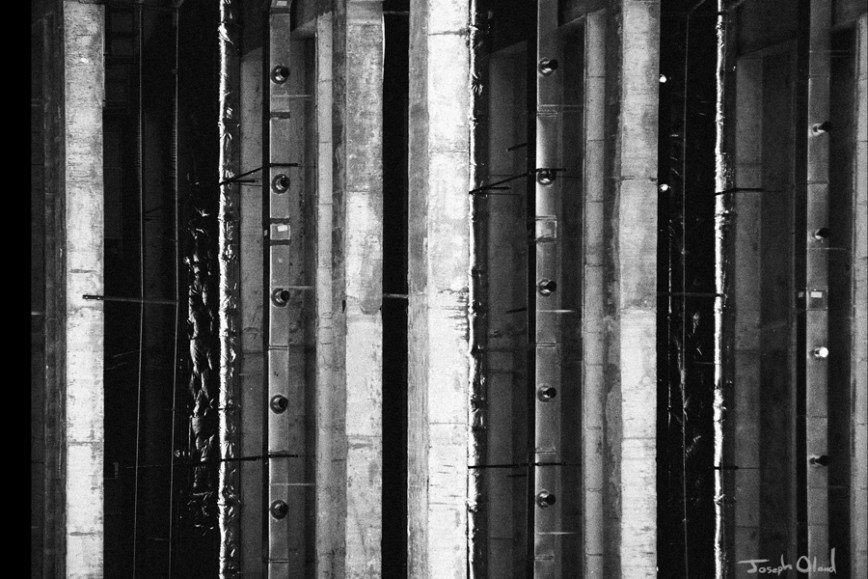
Today’s photograph is how I present the tension between humankind and the natural world – steel beams, the skeletal structure of a half-complete hotel in Albuquerque. I made this image when I was in my “Aaron Siskind” period. It was my second or third year of college, and I refused to photograph anything other than sub-par replicas of his patented abstract style. For those of you unfamiliar with Siskind, he was a prolific American photographer considered to be closely involved with the Abstract Expressionist movement, whose works focused primarily on the details of nature and architecture. At his height in the 1950s, his works were often described as blurring the line between painting and photography – something I’m personally interested in as an artist.

I was working as a research assistant at The Center for Creative photography on starvation-level wages under the Federal Work-Study Program. At the time it didn’t bother me; access to so many wonderful, historically significant photographic prints and photographer archives was plenty enough for me. Hell, I considered it an honor (and still do).

Then, recently, I found a faded, crinkled pay stub in an old suitcase. Boy was I being robbed.
But that’s a story for another day.

They say that emulation is the greatest form of flattery. I hope Mr. Siskind was looking down on my  from high with his notoriously crooked smile. I learned a lot trying to copy the masters, and I believe this is how many artists begin their journey. Not from square-one, but on the shoulders of giants, borrowing their voice while we struggle to find our own.

FINE ART PRINTS AVAILABLE HERE
SIGN UP FOR THE LENSEBENDER NEWSLETTER


February 08 – Tap-Dancin’ Granny

02-08 Granny postThe first several years I lived in Tucson, I lived right off of 4th Avenue. Close enough to walk, far enough away to have only had my car vandalized about a dozen times during my tenure,

Some of the grime has been polished off the 4th Avenue I remember from those days, but hey – nothing stays the same forever. Shirtless days on the front porch, cold beer in the summer, an embarrassing amount of hackysack. Brooklyn Pizza’s garlic knots and walks over to The Grill at three o’clock in the morning for some tots. The old underpass, bathed in dim yellow light, always wreaked of urine; most of the young ladies I knew – a generous portion of which who’d smack me across my smug face for referring to ’em as “ladies” – preferred not to walk through by their lonesome.

I magic-markered a piece of copy paper and thumb-tacked that sucker right by the exit to the one-room hovel of a guest house I lived in. “Do you have your camera?” was scrawled in smudged blue ink. That was my healthy little reminder every time I headed for the door. I hardly ever went anywhere without my camera, and only seemed to need it when I’d left it behind. This seems to always been case, even today.

I made it a habit to go down to the 4th Avenue Street Fair every autumn and every spring. It takes a certain kind of con-artist confidence to stick your lens in strangers’ faces, and the various street fairs, county fairs, political protests, and other events proved to be a healthy training ground for inexperienced street photographers like myself. Some people notice you and immediately ruin everything by smiling or posing.

Other people just have to common courtesy to threaten you with as ass kicking.

With enough experience, you learn how to lie your way out of sticky situations, charm your way through others, and – most importantly – make accurate snap judgments about the people around you.

The easiest photographs to make – and often the most fun – are of street performers. They’re used to being looked at, and usually like to dust-off their ‘A’ material when they see a camera watching. Something in my gut tells me that this woman may not be with us any longer. This photograph is somewhere in the neighborhood of ten years old, taken outside of Caruso’s Italian Restaurant on South 4th Avenue. A tap-dancing, smoking granny – how could one not take a photograph?

FINE ART PRINTS AVAILABLE HERE
SIGN UP FOR THE LENSEBENDER NEWSLETTER