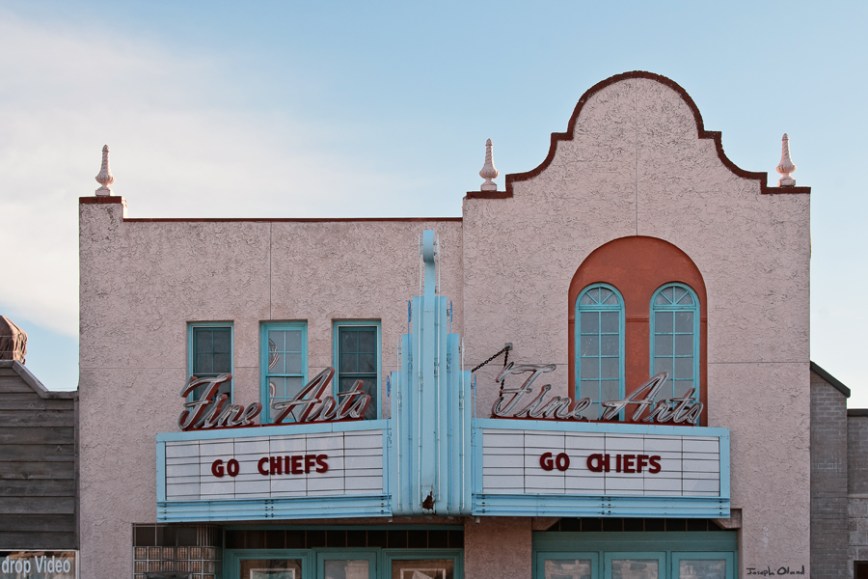
January 19 – The Old Aztec Theater

01-19 Art & Athletics post

“Unless we tell stories about ourselves, which is all that theater is, we’re in deep trouble.”
~Alan Rickman

– – –

Winter-time in Kansas City is like summer-time in Tucson – the streets looks deserted most of the day, as if everybody packed in the middle of the night and fled without notice. Instead of tumbleweeds, the crisp air carries dead leaves and newspapers.

I went on a walk in downtown Shawnee, through the nearby cemetery and up towards city hall. The temperature has been hovering in the teens and twenties; needless to say, I didn’t see any other pedestrians, save for the poor pitiful fool dressed as the statue of liberty, promoting a tax prep service on the corner. There ought to be a law against that kind of cruelty.

Pictured here is the Old Aztec movie theater.

The Old Aztec was designed by the Boller Brothers architectural firm of downtown Kansas City, Missouri. Their designs ranged widely in size and style, from minor vaudeville houses to grand movie palaces. To date, about twenty surviving Boller Brothers theaters are listed on the National Register of Historic Places. The Old Aztec is clearly among the smaller houses, commissioned by Shawnee’s third mayor, Mr. Marion Summeror, and opened on Labor Day in 1927.

It was named Aztec in the 1940s after it was acquired by Dickinson Theaters. The current signage was installed in 1972 after the theater was purchased by the Pflumm family. Closed for renovations in the summer of 1975, the theater never reopened. There was a time in 2005 when the building changed hands again. Renovations began again, too. The outside has been finished, but the project stalled and the status of the theater is not known.

I like the way old towns feel, although that sense of Main Street life has largely melted away. This little intersection in Shawnee is surrounded by an ocean of strip malls and shopping centers, traffic congestion and highways. But for one block, you can dig your hands into your pockets, bury your head between your shoulders, and walk down the sidewalk against the wind. You can look up at the old marquis and consider a time, almost a hundred years ago, when people walked the same streets, through the threshold and into theater, to watch a silent film dance across the canvas screen of a true American movie house.

PRINTS AVAILABLE HERE
SIGN UP FOR THE NEWSLETTER HERE

Sarah Palin Endorses Trump In Iowa

Palin Trump post

Many initial responses, especially among the political left, may hinge on shrugs. After all, it’s no secret that Sarah Palin is the darling of the Tea Party movement. In her own way, she’s just as bombastic as Donald Trump. It would follow that anybody who likes Sarah Palin probably already enjoys the aggressive rhetoric of the GOP front-runner. As pitiful as the reality is, celebrity endorsements work. And this one is a big win for the Trump campaign.

Tuesday afternoon, Sarah Palin, former governor of Alaska and 2008 vice presidential nominee, officially endorsed Donald Trump for the office of president of the United States. This is the first major endorsement for any candidate on either side. With narrow poll numbers between the Trump and Cruz camps , this type of endorsement may prove to have a significant impact in Iowa. Despite being a consistent and trustworthy punch-line, Palin remains well-loved and influential among Tea Party voters. This move, just thirteen days before the caucuses, may be the ammunition Trump needs to emerge victorious.

Like Trump, Palin is a successful reality television personality who is unusually gifted at deflecting negative attention and recovering quickly from scandal. A generation ago, Trump’s rhetoric would not be tolerated. Among the conservative Christian crowd, his multiple marriages alone would be enough to raise eyebrows. In today’s political climate, denying refugees entrance and promising to use nuclear arms against Islamic State are positions welcomed with applause.

This begs the question: what does it say about the GOP when authoritarian, arrogant, and often ill-informed reality television stars are knocking on the doors of the White House? Palin’s endorsement shouldn’t mean anything, but that isn’t the reality. It’s a new book deal, more media exposure for Trump, and probably renewed discussions for yet another television show. It’s all theater, we know it, and we gobble it up like hungry pigs anyway.

Just as any Hollywood celebrity endorsing a candidate shouldn’t mean anything, the American voter is more inclined to support a candidate because Johnny Depp says so, without ever so much as reading an article, watching a debate, or crunching a number. This needs to change, and it can’t happen quick enough.

PRINTS AVAILABLE HERE
SIGN UP FOR THE NEWSLETTER HERE


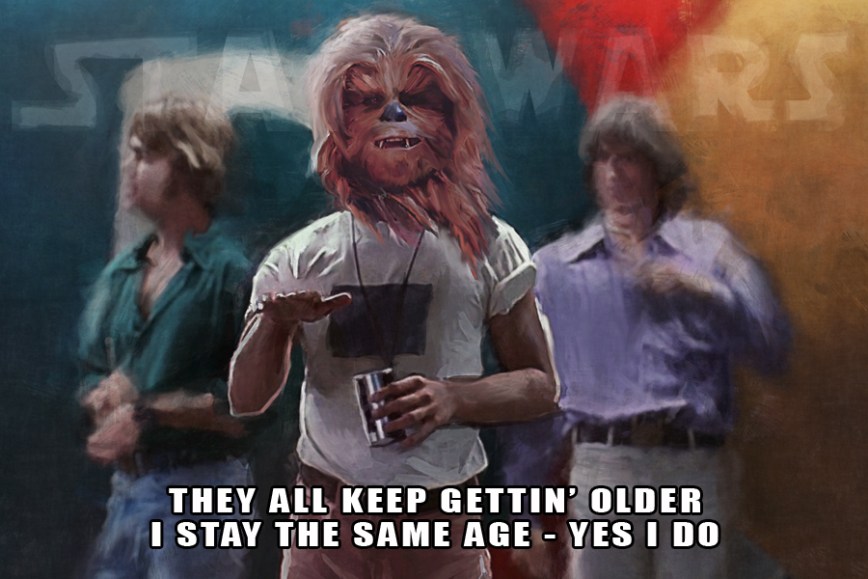
Chewbacca Meets ‘Dazed and Confused’

Chewie Meme

I don’t care how much people want to tell me that Chewbacca was given a few grey hairs. Compared to the list of human counterparts in “The Force Awakens” he’s barely aged a day. Naturally, it had to be meme’d.

PRINTS AVAILABLE HERE
SIGN UP FOR THE NEWSLETTER HERE

Glenn Frey (1948-2016)

Lebowski to Eagles post

Rest in peace, Glenn Frey.
The Eagle’s were great, man.

PRINTS (SANS TEXT) AVAILABLE HERE
SIGN UP FOR THE NEWSLETTER HERE

January 18 – Farewell, Glenn (take it easy)

Glenn Frey post

“You can check out any time you like, but you can never leave.”
– – –

I don’t care how Jeff Lebowski feels about it, I’ve always loved The Eagles.

I was hiking along the Kansas River again this afternoon waiting for the sun to go down, hoping for some good color in the sky and some glassy reflections in the water. I looked at my phone and saw the notification from The Associated Press that The Eagles founding member Glenn Frey had passed away; he and drummer Don Henley formed the band in Los Angeles in the early 1970s, along with guitarist Bernie Leadon and bassist Randy Meisner. He passed away in New York in the company of loved ones. He was 67 years old.

It seems like a cruel joke to have so many beloved artists and musicians dying in such quick succession. Lemmie, Bowie, Rickman, and Frey are on a lot of minds right now, and the world seems a little colder knowing these people have left us. We’re all in the process of learning how to mourn in a way that we hadn’t a generation ago. Our rituals are changing, and social media is playing a significant role; it’s a magnificent engine that drives sad news into viral proportions in faster-than-light speed.

As with the previous deaths over the past week, I present you tonight not with a photograph of the day, but an illustration in commemoration of our friend. As with Bowie and Rickman, Frey will remain with us in our mix tapes and records, on the screen, and in our memories.

And I feel it important to echo what a friend of mine wrote earlier today:
“Someone needs to get a team of doctors to [keep an eye on] McCartney, Mick Jagger, Simon, and Taylor stat! We demand wellness checks!”

Now turn on the radio. Live in the fast lane or take it easy. Whichever makes you happy.

PRINTS AVAILABLE HERE

SIGHT UP FOR THE NEWSLETTER HERE


January 17 – The Good Book

01-17 Bibliophile post

“Good friends, good books, and a sleepy conscience: this is the ideal life.”
~Mark Twain

– – –

I have a massive collection of books. A massive collection.

Like many of my ilk, I’ve looked back and realized that I have always been a collector. My younger self collected a wide variety of useless things, from wall posters and semiprecious stones (every family vacation had me on the lookout for rock shops) to previously-viewed VHS tapes and pogs (when  those were in fashion – yeesh, how embarrassing). I continue to collect music, but the most obvious thing I collect, quite naturally, are photographs.

Thinking on it, I collected baseball cards even though I was never, ever a sports fan. Things went pretty sideways once I discovered that trading cards existed for comic books. Heck, my obsession even took me down the path of outright criminality; I got caught stealing Marvel Ultra trading cards at the local supermarket when I was probably twelve or thirteen. I was absolutely terrified by that experience, and painfully ashamed. I also survived and would you believe it, I didn’t steal cards any longer. Instead, I started collecting actual comic books.

The early 1990s were a wonderful time to get into comic books and, for twenty years, I’ve been waiting for those lovely creative people in Hollywood to tell some of those stories on the silver screen. The first major series I got into was an X-Men story-line called “Legion Quest,” in which Professor Charles Xavier’s son travels back in time to execute Magneto, thus preventing all of the damage Magneto has done in his lifetime. It’s another iteration of the “if you could go back in time and kill Hitler” thought experiment. I have always loved this about the X-Men stories. They’re thoughtful, and thought-provoking. Initially, the X-Men were a vehicle through which the authors discussed American prejudice, mirroring the experiences of ethnic minorities. Today, stories of exclusion and oppression also reflect the marriage equality movement. The world is always so quick to point at a group and shout “freaks!” And the X-Men, in these stories, are the freaks. It takes the anguish of real-life problems and de-contextualizes them, allowing us to think about these issues from a fresh perspective. It’s brilliant.

Hero stories are all morality plays in the end, and they’re infinitely more sophisticated than they might appear to be on the surface. It has been fun watching media like graphic novels and video games achieve the mantle of high art and experience legitimacy in the eyes of the wider public. Once upon a time, comic books were for kids and video games were nothing more than a waste of time (and yes, they still can be, so don’t get me wrong). The video game industry has now surpassed Hollywood in generated revenue, and graphic novels are now being made into feature length films.

Progress, ladies and gentlemen. The nerds have won, world. Deal with it.

The “Legion Quest” story-line was jam-packed with the what-if’s of time travel tales, and it laid the foundation for an even larger and monumentally engaging story: “The Age of Apocalypse.” I’m venturing to guess that this is what the next movie, “X-Men: Apocalypse,” will be presenting. It’s an exciting time to be a fan-boy, indeed!

– – –

Needless to say, graphic novels also led to plain-old books. Large-print illustration books, art history books, some first-edition Steinbeck novels, throwaway Vampire Chronicles and Stephen King tomes, and hallowed American classics from the greats like Conrad, Faulkner, Hemingway, and Fitzgerald. Every move, from dorm room to apartment, apartment to house, city to city, has seen me lugging impossibly heavy twenty-eight gallon Rubbermaid containers stacked with books. I can’t seem to let them go, and I often will pluck a book off the shelf and thumb through it for inspiration. Hell, I rarely even sold my textbooks back in college.

The picture above is a studio photograph of a pocket bible. On the University of Arizona campus, probably my sophomore year, there was a day when a group of missionaries stood on damn-near every street corner, every intersection, and every entrance to the student union handing these things out. Green vinyl covers and tissue-thin pages. I took every single one that was offered to me as I crisscrossed the campus on my way to class – until there wasn’t any room left in my backpack. I probably made off with about thirty copies. I went immediately to task making art projects out of them, and a series of photographs like the one here. In retrospect, it was probably a little scandalous that I collected all of those books, but I don’t think the world is in short supply of King James Bibles.

I guess the jury’s out, but I’m banking on the Good Lord being as forgiving as they say.

PRINTS AVAILABLE HERE

SIGN UP FOR MY NEWSLETTER HERE

So What’s With The Iran Nuclear Thing?

Iran Nuke post

Primer: We all have that friend who appears to thrive on delivering bad news. There’s a good chance we might be that person. People love giving bad news. Negative information empowers the messenger. Giving bad news makes us feel important. The only reason why is because people listen. The information impacts people and exploits the recipient’s sense of decency to not respond ambivalently. This is what the news media has become. It tells us on a daily basis that violent crime is up, that terrorist threat levels are rising, that common household items will kill us. Bad news always grabs more attention.

A parade of talk radio personalities and editorialists know this. Once we’ve gotten used to seeing more and more negativity around us, we actually begin to actively seek it out. The more awful it is, the more we want it. This is why a myriad of misinformation has surrounded the arms deal with Iran. The truth is that world is not a vortex of despair, and the nuclear agreement with Iran has been, at least up to this point, successful.

– – –

Saturday afternoon the Associated Press reported that Ban Ki-moon, the United Nations secretary-general, is welcoming the implementation of the nuclear agreement reached with Iran in 2015. Iran has met all of the commitments outlined in the deal. According to his statement, Saturday’s achievement shows that “dialogue and patient diplomacy are the best ways to address worries about weapons proliferation.”

The optimistic view would be that Iran will continue to respect it’s commitments and that this agreement will remain unmolested. The hope is that cooperative dialogue will continue between Iran, the United States, and the five other world powers who negotiated the fifteen-year agreement. There is enhanced possibility for security and stability in a region that has been unstable, unpredictable, and antagonistic towards the west for decades.

Saturday afternoon, President Barak Obama signed an order to lift economic sanctions on Iran. This was done only after the International Atomic Energy Agency (IAEA) certified that Iran had met its obligations to curb its nuclear program. While this deal concretely deprives Iran of pathways to develop a nuclear arsenal, critics have been loud and steadfast in insisting that this agreement will have the opposite effect.

The administration’s case has been to open dialogue and delay Iran’s nuclear ambitions. In this, the administration has been successful. After decades of contention and lack of communication between governments, the United States is engaged in active, productive dialogue with the Republic of Iran. As President Obama expressed in his address Saturday, “A strong, confident America should advance our national security by engaging directly with the government of Iran.”

VIEW THE PRESIDENTIAL ADDRESS HERE

There are material benefits, as well. Two thirds of Iran’s centrifuges have been removed. More than 98% of Iran’s nuclear stockpile has been shipped outside of it’s borders; it now holds less material needed to manufacture a single nuclear bomb. After decades of expansion, Iran’s material progress towards developing a nuclear arsenal hasn’t just been stopped, it has been reversed.

The most legitimate criticism cites the time-frame of the nuclear agreement; constraints on Tehran’s nuclear program will terminate after fifteen years. With the lifting of sanctions, it is expected that Iran’s economy will expand dramatically. Over $100 Billion dollars in assets that have been frozen overseas will be released back to Iran as a result of President Obama’s executive order. New oil, trade, and financial opportunities will empower Iran significantly over the next fifteen years, and there are fears that Iran will be in a better position to quickly and efficiently develop a nuclear arsenal once the deal expires. By that time, it is also possible that Iran’s economy would be strong enough to withstand reimposed sanctions and that it’s nuclear installations would be better  protected; it is expected that Iran will increase its air defense systems with the help of Russia.

The clock is ticking. But the time-frame is concrete, comprehensible, and provides opportunities for world governments to develop strategies should diplomacy fail. Before the nuclear agreement, the global community had “it’s only a matter of time.” The anxiety generated by the unpredictable nature of Iran’s nuclear program buttressed the resolve of war hawks, and served to reinforce the idea that armed conflict would be the only solution. Nobody knows what Iran will look like in fifteen years, who it’s leaders may be, and what our relationship to their government will be like. In the interim, the United States will be in a better position to negotiate deals with Iran for the future, even after the nuclear deal expires, and maintain peaceful relations.

Misinformation has circulated that Iran will be allowed to select it’s own inspectors, allowing ample opportunity for corruption. These reports surfaced in August of 2015 and were refuted within hours by the IAEA. This did not stop radio hosts and media pundits from repeating this misinformation. This did not prevent a contingent of our political leadership from repeating this misinformation.

There are claims that the agreement protects Iran from punishment for future violations. The truth is that no aspect of the agreement prevents the United States from re-implementing sanctions should inspectors discover that Iran has violated the agreement.

A consensus of polls reflects that an overwhelming majority of American citizens support this deal, despite the near fifty-fifty divide we see on capital hill. When messages are tirelessly repeated on the airwaves, it does not make them any more factual. The call to arms from Netanyahu, Huckabee, Cruz, Kristol, et al, does not represent the attitude of the majority of Americans. These politicians, it would be important to note, were on the wrong side of history leading up to the conflict with Iraq, and there is no reason to believe that their aggressive posturing towards Iran is any more legitimate.

It is surprising that individuals often don’t take the advice they routinely give their children: use your words. Every opportunity should be made to exhaust dialogue and diplomacy with foreign governments before we commit our armed forces to lethal combat. No conflict has ever been as easy as our leadership has tried to pursued us it will be. The costs are always higher. The collateral damage is always greater. The lives lost are always much, much more.

Fallout – Stephen King’s “The Shining”

The Shining post

Today’s “Fallout” easter egg is a simple one, but it’s also one of my favorites.

To the uninitiated, there’s a location on the map in The Capital Wasteland where people have survived, barricaded behind a mountain of k-rails, slabs of salvaged pavement, and the walls of a lone surviving structure. Tenpenny Tower, a rotting spire of concrete named after it’s founding inhabitant, is a fortified settlement in the territories west of the Downtown DC ruins. Formerly a luxury hotel, it is the tallest surviving building on the map, with the Washington Memorial a likely second.

The residents of Tenpenny Tower are a collective of elitist snobs who, behind their reinforced concrete barricades and a well-armed security force, do not take a liking to the poor and hungry drifters who occasionally stumble across the dusty cracked monolith. Allistair Tenpenny only allows affluent and “cultured” individuals inside his hotel, prejudiced against the pour and against the ugly so-called “ghouls.”

For those of you who don’t know – and if you don’t, the why the heck are you even reading this?! – ghouls are humans who have been deformed due to exposure to high levels of radiation. Some ghouls are feral and will attack anybody on-sight, but there are underground societies of mentally acute ghouls. These are perfectly sound, rational human beings with a serious case of flesh-rot. Prejudice against them is rampant in settlements across the wastes because of their unsightly appearance and fears that they may become feral. Their presence in the “Fallout” universe is a clever way to inject themes of racial prejudice into the narrative without invoking actual real-world ethnicities.

(this is also one of the reasons I’m such a huge fan of “District 9”)

On the mid-floor apartments in Tenpenny, there’s a tricycle in the hallway, along with blood-stains on the walls and an overturned chair. This is a direct reference to Stanley Kubrick’s classic horror film “The Shining,” based on the novel by Stephen King. Midway through the film, Danny Torrence happens upon two little girls dressed in blue while riding his big-wheel through the corridors of the hotel. In a flash, Danny sees a murder scene with the two girls laying on the ground, butchered, with blood covering the walls and an upturned chair on the floor.

Little nods like this are everywhere in the “Fallout” universe, but this one is absolutely marvelous.

For ever, and ever, and ever…

– – –

Bonus Game Fact: Emil Pagliarulo, lead game designer and lead writer on the “Fallout 3” project confirmed that Tenpenny Tower (and its associated game quest) was partially inspired by Fiddler’s Green, the skyscraper in George A. Romero’s “Land of the Dead.” The story line is similar enough, with arrogant elites inside, and ghoulish creatures outside, looking for a way in.


PRINTS OF THE COVER IMAGE AVAILABLE HERE

January 16 – Those “Creative Types” We Know…

01-16 Creative Types post

Artists and egos go together like milk and cookies, now, don’t they? Where you find the one, you’re likely to find the other. It’s as though creative people are perpetually prepared to defend their work. And we all know what defensive personalities can do, don’t we? That’s right. They can lash out viciously like frightened wild animals. Bisbee boasts a wonderful arts scene in Southern Ariona, and that wouldn’t be a lie. But the happy-go-lucky vibe Bisbee also likes to boast about itself? Well, that’s not entirely correct. The fact is, the economy there is contracting and the town has gentrified significantly from the dirt-cheap 1960s of yore. Rents are higher, fewer dollars are flowing into the town, and there’s greater competition for a seat at the winner’s table. Sometimes there are hurt feelings when you struggle to promote your work, and sometimes you get thrown under the bus. Sometimes our melt-downs are very, painfully public.

That kind of thing happens in a small town, I guess.

During my tenure, I created enough problems for myself with this big old dumb mouth of mine. I’ve also quietly watched other peoples’ struggles unfold like a great big dusty rug on social media, ready for a thorough beating. We take our licks and hopefully learn something from the experience. We also discover who those people are that never seem to enter the arena, but always sit on the sidelines like carnival barkers, ready to cut you down to size, and ready to help fan the flames of a small conflict into a dangerous firestorm. Having a creative passion is something of a spectator sport, especially in a small town, but heck – criticism is part of the game, too.

People that can’t handle criticism should never pursue a career in the arts. Period.

In my humble opinion, when an artist is surrounded only by cheerleaders who celebrate each attempt as though it were the Mona Lisa itself? That’s absolutely freaking wonderful! We all need positive support. But it also means that the artist may be in the perfect position to experiment with something new, to try a new subject, style, venue, audience. The real danger of a town like Bisbee is that it’s such an incredibly small and insular place, and there are a lot of big fish. Things can get ugly when resources are scarce.

– – –

I say all of this not to stoke the flames of malcontent. It appears as though the most recent round of conflict in the Bisbee art scene has played itself out (at least in social media). I say all of this in relation to the image above, made by a gentleman who used to live in the brick building on Brewery Gulch across from the dog park. That is, if anyone ever really recognized it as a dog park. At one point or another, I think I remember people jokingly referring to it as “parvo park,” which didn’t inspire much confidence. Nevertheless, the brick building was festooned with mesh wire, painted mannequins, Christmas lights, and other random, presumably “found” objects. Some viewed it as an eyesore, others loved it. Visitors could be seen taking pictures of it with their smartphones every weekend.

I can’t pick sides. I don’t know the whole story. I just know that the eccentric old beast who decorated that building doesn’t live in Bisbee any longer. He may have brought it upon himself, or maybe somebody just didn’t like the cut of his jib. The extent of my knowledge is that he was run out of town. The right mixture of hubris, ego, madness, creativity, and drugs will always yield interesting results – and I’m confident all of those elements were at play. When creative types collide, sparks fly.

It’s my understanding he lives in Jerome now and he’s happy there, so there’s that. I don’t miss the dog park, but I do kind of miss the crazy decorations on that old building.

Oh well. Time marches on.

PRINTS AVAILABLE HERE

Politicians – Willful Ignorance And Dangerous Oversimplification

Ben Carson post

“The regulation of anonymous and pseudonymous communications promises to be one of the most important and contentious Internet-related issues of the next decade.”

~ A. Michael Froomkin

– – –

Yes, it’s primary season. We all know it and it’s difficult to escape the constant pandering, posturing, and promoting. Each candidate is trying to provide their best sales pitch to the greatest number of people. At this point in the race, we are in an information loop; with so many candidates on the GOP stage, we’re hearing the same messages on repeat. If you’ve watched one debate, that’s enough to understand what the candidates stand for.

Statements from these debates are dissected, scrutinized by newsrooms,  and they’re stripped of context and converted into soundbites by radio personalities. During the GOP debate on Wednesday, each candidate spent a significant amount of time on outrage, on how President Obama has failed, and on what programs and executive orders they intend to eviscerate should they win the seat. What’s troubling about this is that very little time was committed to explaining precisely what they would do instead. It’s disconcerting, listening to ambitious political leaders pounding the podium and insisting on burning the building to the ground without explaining what they would build in its place. When fewer personalities cling desperately to the stage, perhaps we’ll be presented with a clearer picture.

One of Mr. Ben Carson’s statements stood out to me. It was emblematic of how truly uncombed the GOP’s philosophy has become. To call the GOP disconnected is a kindness; if their oversimplified statements are more calculated than they appear, there’s only one conclusion we can take from the debate: the GOP does not respect the intellect of its constituents.

– – –

Midway through the GOP debate, Ben Carson connected two dots that any reasonable person should find outlandish:

“When you go to the Internet, you start reading an article and you go to the comment section. You cannot go five comments down before people are calling each other all manner of names. Where did that spirit come from in America? It does not come from our Judaeo-Christian roots, I can tell you that.”

The auditorium, predictably, erupted with applause. If we are to paraphrase his statement, though, it would appear to condemn America for falling into an attitude of meanness and contention, and the problem comes from prevailing secular attitudes that threaten to divorce America from is great religious traditions. I didn’t hear much discussion about this particular statement following the debate, but it clearly resounds with the Republican party and with GOP supporters. The implications are important.

First and foremost, Carson unwittingly evoked the parable of the invisible man, although he missed the point entirely. He also insisted that religion, specifically Christianity, is the panacea to help resurrect civility in the industrialized world. Like many in his cohort, Carson attempted to evoke a vision of a more civilized and cooperative American past, a 1950s pastiche of “simpler times.” The problem with that is that there has never in our history been a time of social perfection, and the ethnic strife and Cold War anxieties of mid-century America are the reality that “Leave It To Beaver” denies.

What Carson failed to realize is that anonymity is a problematic concept, and the lack of accountability that it promotes will almost always result in mischief. Bank robbers wear masks for a reason. White collar criminals are good at erasing their tracks. YouTube comment sections are rife with hateful rhetoric because nobody is held accountable for the words that stream anonymously from their fingertips. No amount of religion is going to change that.

What our leaders should be doing is promoting an atmosphere of accountability, not religious piety. They should not only preach from the pulpit of truth and transparency, but they should follow it up with sound legislation that reinforces that transparency. That is infinitely more American than insisting Christianity is the answer, than denying refugees because of their race or creed, than stripping regulation from the financial sector, of which every America citizen has a stake.

Watching politicians making broad statements about the decline of culture is offensive. Insisting on a monolithic one-shot solution – be it religion, a giant wall, or a fleet of gunships – is an unrealistic and dangerous lie. We need thinking leaders who do not pander to the lowest common denominator, but instead inspire greater conversation and comprehension of our status as a nation-state. Don’t tell me about how President Obama has failed. Tell me what you are going to do that is so much better. And while you’re at it, you had better tell me why.