February 07, 2017 – Vida Graffiti

vidagraffiti-post

FINE ART PRINTS AVAILABLE HERE
– – –
OTHER ‘IMAGE OF THE DAY’ PRINTS AVAILABLE HERE

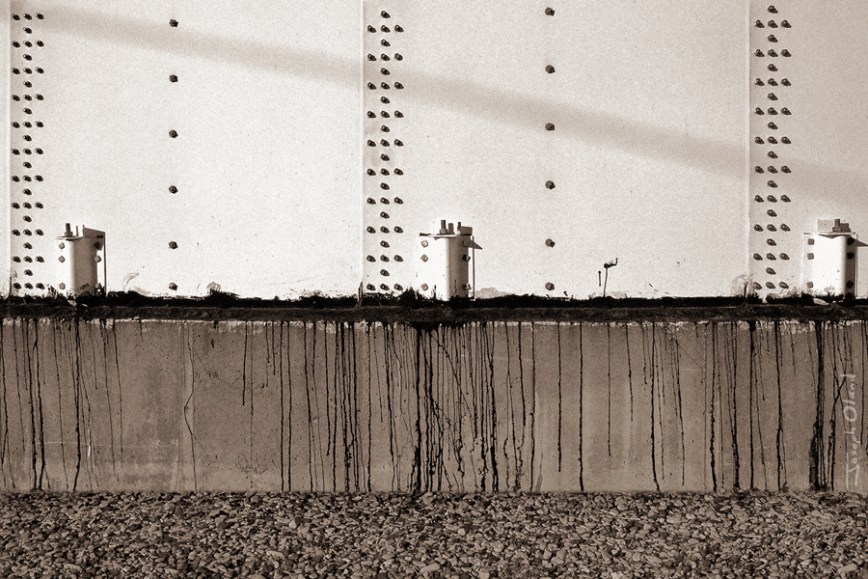
I make a lot of pictures that don’t necessarily mean anything. My intent isn’t evident, and I have no specific audience in mind. I just see something that captivates me, often the ignored and banal details of our everyday lives, and I make the picture, I secure the image, I file the document away for future study.

I think a lot of photographers feel that way – that their work doesn’t necessarily have any intrinsic value in the exact moment that they made the picture. But there’s this strange sense that it might mean something to somebody, someday in the future. It’s like a contract with a shadow figure. It’s faith. I’m not a religious person, and I don’t believe in an afterlife. Photography is the closest thing to faith that I will ever have.

“The camera is an instrument that teaches people how to see without a camera.”
Dorothea Lange

SIGN UP FOR THE LENSEBENDER NEWSLETTER

February 05, 2017 – Textures On The Trail

cactus-texture-postFINE ART PRINTS AVAILABLE HERE
– – –
OTHER ‘IMAGE OF THE DAY’ PRINTS AVAILABLE HERE

One of my favorite things to do is train my camera on the ground. It’s painfully easy to walk around your own neighborhood and find absolutely nothing interesting. And hell – It’s completely natural for the places we spend the most of our time to become completely innocuous to us. Looking through the camera lens is a way to help renew one’s vision. There are amazing things all around, just waiting to be discovered. You just have to have the eyes and the right mindset to see.

“In photography there is a reality so subtle that it becomes more real than reality.”
Alfred Stieglitz

SIGN UP FOR THE LENSEBENDER NEWSLETTER

February 04, 2017 – Back Alley

backalley-post

FINE ART PRINTS AVAILABLE HERE
– – –
OTHER ‘IMAGE OF THE DAY’ PRINTS AVAILABLE HERE

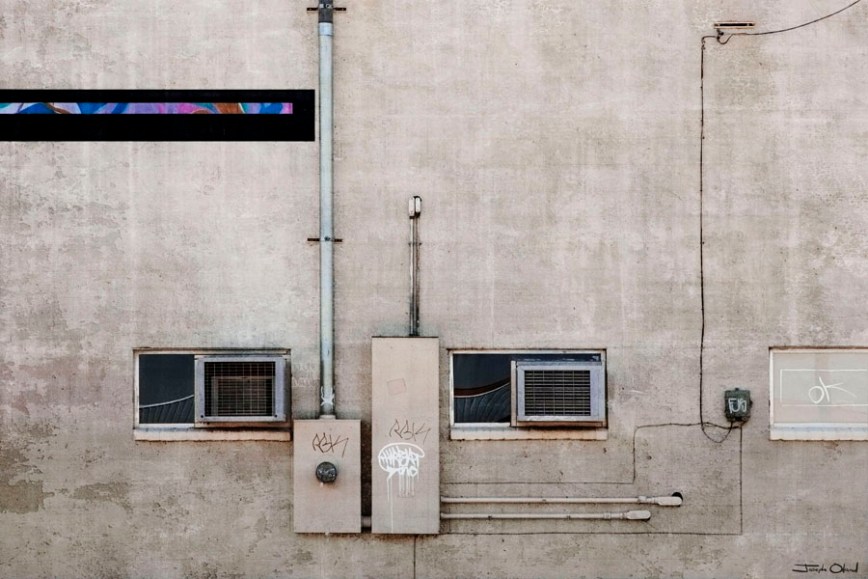
This is one of my more elaborate designs from this series. The textures and compositions of back-alleys – behind store fronts, grease traps from restaurants, and rusted dumpsters – have always fascinated me. These are the areas we ignore, behind the neon and spruced-up facade of our local shopping centers, and I like taking my camera to the places that are right there, practically right in front of us, but that we ignore.

I will likely be publishing this as a completed series sometime soon, so please to check back in if you find these interesting.

SIGN UP FOR THE LENSEBENDER NEWSLETTER

Save

January 30, 2017 – How I Hated Mondrian

sewergratepostFINE ART PRINTS AVAILABLE HERE
– – –
OTHER ‘IMAGE OF THE DAY’ PRINTS AVAILABLE HERE

Unless you went to art school, chances are good that you don’t know who Piet Mondrian was. He was born in the 1870s and contributed to a European form of proto-cubism that is known De Stijl. The only contemporary iteration of this term that I can think of is the The White Stripes album of the same name, with cover art that mimics Mondrian’s style.

de-stijl

I was introduced to this artist as a child. My elementary school art teacher, Mr. Clinton, showed us all kinds of art from various periods, and brilliantly made projects for us built around these influential artists.

There are people who look at the works of Jackson Pollack, Mark Rothko, and even the later works of Pablo Picasso, and think to themselves “What’s so damn special about that? Even I could do that. My kids could do that!” I had a similar attitude, especially about Piet Mondrian. Right angles, always primary colors, blocks of paint. To this day, I still don’t understand what his motivation might have been, but I have begun to understand what a personal artistic compulsion is. I find myself gravitating toward subject matter that many of my viewers find utterly boring, banal, and insignificant, but I can’t stop myself from making these images. Art is deeply personal to the creator, and only personal to a select few of their audience – and there’s no way of predicting what colors, compositions, or themes are going to resonate with the audience.

I’m still not a huge fan of Piet Mondrian, but I don’t disregard his work as amateur, pedestrian, or boring – not anymore. He was a driven artist, and influenced a generation of artists that followed, even if his influence was a subtle and often overlooked one.

SIGN UP FOR THE LENSEBENDER NEWSLETTER

January 28, 2017 – The Drip

thedrip-post

FINE ART PRINTS AVAILABLE HERE
– – –
OTHER ‘IMAGE OF THE DAY’ PRINTS AVAILABLE HERE

Today’s image, like many that came before, is a throwback to the days when I was making mostly abstract artwork. Rather than rattle on about my interest in abstract photography, I will simply leave today’s image with the following quote by Pablo Picasso:

“There is no abstract art. You must always start with something. Afterward you can remove all traces of reality.”

SIGN UP FOR THE LENSEBENDER NEWSLETTER

January 26, 2017 – Black and White

industrialabstractpostFINE ART PRINTS AVAILABLE HERE
– – –
OTHER ‘IMAGE OF THE DAY’ PRINTS AVAILABLE HERE

One of my friends – more of an activist, politically motivated, and extreme personality – once commented that my work specifically seeks to “mean nothing at all.” This was over a decade ago, but I remember the comment; it made me think a lot about the kinds of images I was making at the time. I didn’t feel insulted, but I did feel compelled, initially, to try and defend myself.

My natural instinct was to disagree (and I did disagree), but it was the first time I really sat down and tried to apply meaning to the photographs and paintings I was making. And it made me think about the utility of abstract imagery in a broad and general sense, too.

I don’t think all artwork needs to be a didactic teaching tool, or direct the thoughts and emotions of the viewer. In fact, in many circumstances, I have a contrary opinion. I am seduced by abstract compositions specifically because they can mean any number of things to any number of people. The possibilities aren’t infinite. Color, movement, composition, film grain, delicate or light brush strokes – these all guide our interpretation and emotional response. But abstract compositions allow us to think broadly about how an image impacts us, and the experience of viewing abstract art becomes very personal. An abstraction can remind us of a specific event, a movie we watched, an experience we had – and in an almost slight-of-hand kind of way, through some peculiar magic, an image made by a complete stranger can ascend to significance in the hearts and minds of the individuals looking at it.

I am compelled to make pictures like this for reasons that still evade me, but I make them because they affect me, they move me, they touch a part of my subconscious and tickle a part of my mind. I can’t expect images like this to be universally adored, but I have to have faith, as an artist, that there are other people out there, like me, who find this kind of composition interesting.

The hardest thing for an artist to do is follow their instincts. If I listened to all of the criticism, all I would do is try to mimic the landscapes of Ansel Adams or take endless ‘desert sunset’ pictures. There are plenty of those images in the world, and I just need to make images of my very own.

SIGN UP FOR THE LENSEBENDER NEWSLETTER

January 22, 2017 – Blood Box

bloodbox-postFINE ART PRINTS AVAILABLE HERE
– – –
OTHER ‘IMAGE OF THE DAY’ PRINTS AVAILABLE HERE

Back to the old obsession.

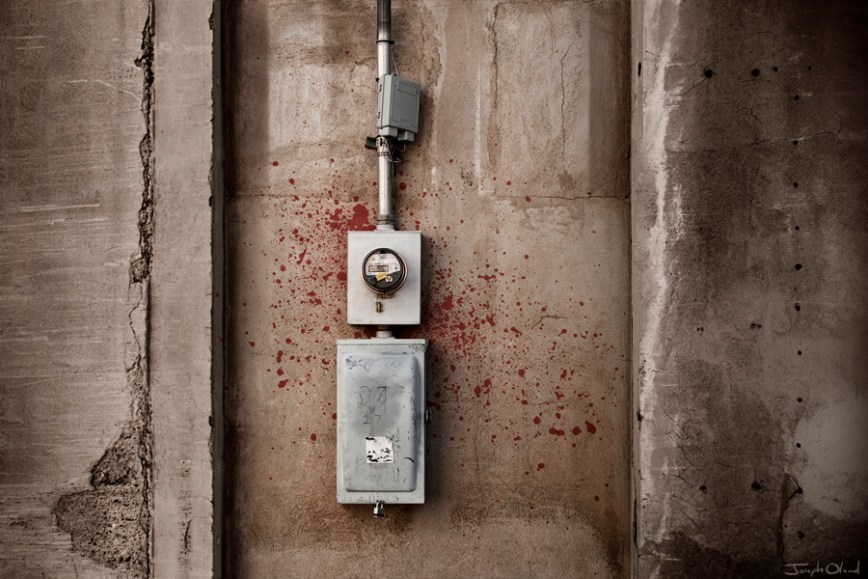
I can’t really justify it, and I typically don’t spend a terrible amount of time at home mapping-out symbolism and structure to my series, but that’s just the way it goes. On the surface it might sound unwise, haphazard, and foolish for a visual artist to operate almost entirely from instinct – and that’s probably an accurate assessment. But I hate the stuffy pretensions and relentless insistence that everything has to mean a specific thing. I’ve never been the kind of creator that felt the need to bludgeon his audience with ideas of how they ought to feel about the images he makes.

Half the time I don’t even have a vague idea why I’m drawn to certain types of imagery. I walk around with my camera discover interesting objects and textures, and I make pictures of them. Over time, themes bubble to the surface and I spend some time looking at these themes and I try just as hard as anybody else might – probably harder – to try and figure out what it is that draws me to certain subjects.

Electrical boxes, storefronts, garbage bins, and gas meters? They attract me. Could they be symbols of our interconnectedness – interlocking roadways, an electrical grid, a dependence on natural gas? Maybe that’s what it is. Is it the uniform right angles, the unnatural ninety-degree angle that divides us from the rest of the natural world? Sure. Why not, right? Whatever the seed is for this curiosity, I find these things incredibly fascinating, and I’ve been thinking about them and photographing them for over a decade.

SIGN UP FOR THE LENSEBENDER NEWSLETTER

January 15, 2017 – Rusted Car

rusted-carpostFINE ART PRINTS AVAILABLE HERE
– – –
OTHER ‘IMAGE OF THE DAY’ PRINTS AVAILABLE HERE

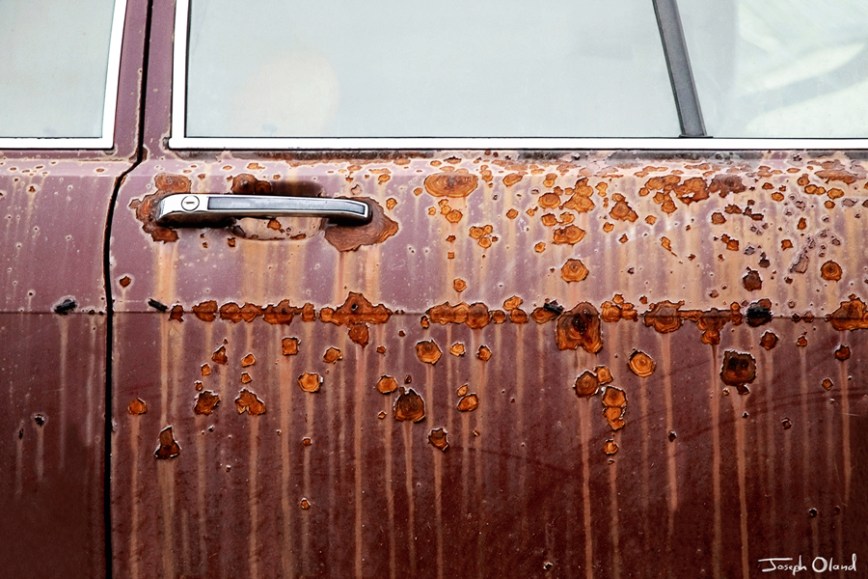
Today’s image – like most of them – is pretty self-explanatory. I mean, it’s photography, right?

Usually – but hey, not necessarily always – it’s almost always obvious what a photographic image is actually of. Even a brickwork of primary-colored Mondrian tiles is imbued with subtext and pregnant with meaning. So why not a portrait of a rusted heap, rotting in the desert like a disposed of beer can baking under the sun?

But it isn’t my job to tell anybody how they’re supposed to feel about an image like this. Much of my work, I’ve been told, carries with it, or conveys, a certain ambivalence. This isn’t even halfway close to true. I compose my images carefully, but I’m not concerned, at least not at all times, with being explicit with personal meanings. Ambiguity allows for different experiences, and I think that ambiguity can be a very powerful tool when creating artwork – especially photographic artwork, which is often disregarded as an easy, unimportant happenstance that occurs between the photographer and whatever happens to fall before his or her camera lens.

I am drawn to textures, contrasts, and colors. And I love the camera’s ability to take everyday objects and completely re-frame them. We all know what a car is – wheels and a seat, a hood and door-handles. But when we encounter cars in our day-to-day lives, we’re always taking in the whole thing. It’s a familiar object and, because of its familiarity, it’s easy to disregard. But when you look at the details, the scratches, the design of the body, the wear on the upholstery, the scuffs on the tires, something else emerges. I wouldn’t want to give that ‘something’ a name, really, but the camera has given me, if nobody else that looks at my photographs, the ability to recognize absolutely insane beauty in the unutterably mundane.

In a world filled with cars – to an almost sickening degree – I was walking down the road and saw the age and rust on this particular vehicle, and I was drawn to it. So…I dunno. Do with that anecdote what you will.

SIGN UP FOR THE LENSEBENDER NEWSLETTER

Save

Save

January 08, 2017 – Skull

201701-08-blog

FINE ART PRINTS AVAILABLE HERE
– – –
OTHER ‘IMAGE OF THE DAY’ PRINTS AVAILABLE HERE

One of the things I love the most about photography is that the camera lens has the ability to reveal things that we would otherwise not ever notice. Infrared sensors (and infrared film) and macro lenses, much like the microscope and the telescope, reveal whole worlds that exist beyond our natural senses.

Sometimes, when I’m at a loss, I take a deep breath and put on my magnifiers. There’s a whole universe of textures, colors, insects, and fascinating patterns, all within five feet of where you are. Take the time to look, and you’ll be surprised.

This detail photograph of a cow’s skull reminds me of the grand canyon – the striated lines and the textures are reminiscent of a craggy peak. This isn’t the first time I’ve done up-close studies of skeletal remains, and it probably won’t be the last.

SIGN UP FOR THE LENSEBENDER NEWSLETTER

January 03, 2017 – Muddy Stream

201701-03-blog

FINE ART PRINTS AND MERCHANDISE AVAILABLE HERE
– – –
FOLLOW LENSEBENDER ON INSTAGRAM

Textures – a long obsession of mine.
Without spending too much time being overwhelmingly boring, I will say that I have spent weeks – probably months – of my life with a macro lens in my hands and earbuds piping music into my brain, photographing cracks in pavement, tree bark, broken patches of clay-rich earth, rusty garbage containers, and just about anything you can find on a rusting old car or in a back alley, in order to expand my collection of texture images.

My library is extensive.

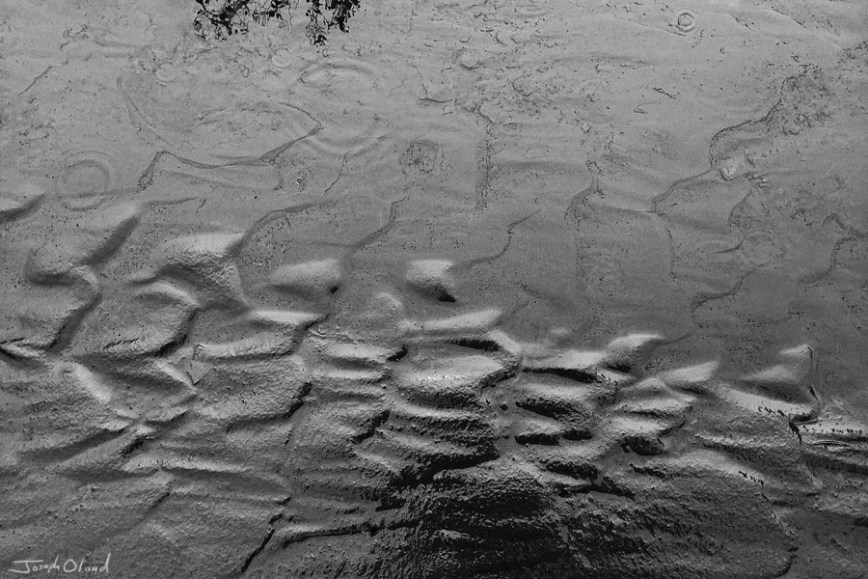
Some of these images are used to add grit and texture to other photographs I’ve taken (as overlays and double exposures). Some of them reveal themselves to be stand-alone pieces. The image above just so happens to be one of those stand alone pieces. While hiking through the rain-drenched red mud of Sedona, Arizona, there was a moment when I realized I had been paying too much attention to the mountains towering over me – that’s what always captures people’s attention – and I needed to take a moment and start looking around.

So I trained my lens on the ground, rather than the high peaks. To the streams and the insects, the animal tracks and the budding cacti, rather than the red rock spires that dominate the landscape. And this is what I got – a portrait of the tiny little stream, the stream that traveled a long distance from a large rock formation, from a mist of rain, to soak into my boots and ensure that my feet would be wet and itchy all day long.

Small price to pay to be reminded how beautiful the world is.

The details, the small little things? They really are beautiful. And they really do matter.

“The past becomes a texture, an ambience to our present.”
~Paul Scott

SIGN UP FOR THE LENSEBENDER NEWSLETTER