Fallout – Sputnik

sputnik post

One of the more obvious references in the “Fallout” universe would be the design of the game’s ubiquitous “eye-bots.” In “Fallout 3”, these little machines roam around The Capital Wasteland, clustering around developed and semi-developed human settlements. Their only apparent purpose is to broadcast propaganda messages from President John Henry Eden, a mysterious figure during a majority of the game’s narrative. The speeches themselves are inspirational, with themes of patriotism and national resolve; they borrow heavily from the very real speeches delivered by President Franklin Delano Roosevelt’s “Fireside Chats.”

There is only one eye-bot in the following iteration of the Fallout series, “Fallout: New Vegas,” which was designed to be a potential companion character.

Of particular note is the obvious similarity to the robot’s design and a little hunk of Russian metal we refer to as “Sputnik.”

Sputnik was the first artificial Earth satellite, launched by The Soviet Union into low orbit on October 4th, 1957. It was equipped with four external radio antennae to broadcast radio pulses. The surprise success of Sputnik’s launch precipitated the American Sputnik Crisis and ignited what would be known as the Space Race, accelerating Cold War tensions between the United States and Russia. The satellite burned-up upon reentry roughly three months later, on January 4, 1958.

Sputnik contributed to a new emphasis on science and technology in American schools. With a sense of urgency, Congress enacted the 1958 National Defense Education Act, which provided low-interest college loans for math and science students. The rise of the “missile gap” also became a dominant issue in the 1960 presidential race. Simply put, the event inspired a new generation of engineers and scientists, invigorated American aerospace engineering, and ushered in the Space Age.

Perhaps my favorite detail is that the word “Sputnik” was modified by writer Herb Caen when writing an article about the Beat Generation for The San Francisco Chronicle. Without “Sputnik,” we would never have heard the colorful term “Beatnik.”

January 14 – Farewell, Alan Rickman

01-14 Alan Rickman post

“Film sets and theatre stages are all far poorer for the loss of this great actor and man.”

~Daniel Radcliffe

– – –

I didn’t expect that I’d be doing this twice in one week. We recently lost three incredibly influential artists beginning with Lemmy Kilmister, who passed away on December 28th at the age of 70. Two days ago we said farewell to another iconic musician, David Bowie, whose final album was released days before his death. Today I opened my eyes and read the news about Mr. Alan Rickman, a remarkable talent in both the theater and on the silver screen. I understand that the wild popularity of the Harry Potter series has cemented Mr. Rickman as Severus Snape for an entire generation of moviegoers. To me, he will always be Hans Gruber.

Terrible sequels aside, Die Hard (1988) is a fantastic film, with technical innovations and a thoroughly entertaining plot. It was one of the first R-rated films I ever saw, too. The forbidden fruit of violence was deeply appreciated by a much younger version of myself. I was too young at the time to concern myself overmuch with the biographies of the actors. I was all about the action, the adventure, the story. This particular film has proved to wear well with age, too. I watch it a couple of times a year, I’d say, and it has yet to lose its luster. As a matter of fact, it may just have a seat at the top of the all-time best Christmas movies. But that’s just me.

Reading through biographies and obituaries today, it appears that he lived a scandal-free life. was well-loved by his colleagues, and was incredibly generous with his heart and with his time. He will be sorely missed.

As with Mr. Bowie, I have decided upon an illustration of Mr. Rickman in my favorite role (and one of his first major film roles).

Farewell, good sir. I know what I’ll be watching tonight.

PRINTS AVAILABLE HERE

Fallout – Bugsy Siegel

Bugsy post

In an enormously detailed alternate universe, a tapestry of historic allusions provides the skeletal structure for Bethesda Game Studio’s phenomenal long-form “Fallout” video game series. Woven into the story are a remarkable number of period-specific references. Such references serve to make game-play interesting, dynamic, and rewarding to the player. In this, the first of many posts, I think that the “Fallout: New Vegas” antagonist, a charismatic villain named Benny, is a decent jumping-off place.

Benny, voiced by “Friends” alum Matthew Perry, drives the player character into the surrounding world. Having been shot in the head by Benny and left for dead, the player character survives and begins to explore surrounding communities, hunting down the would-be assassin. The narrative architecture revolves around an alternate history, and “New Vegas” exists in a retro-futuristic depiction of 1950’s Las Vegas, borrowing heavily from the popular culture of 1950’s America. There’s little doubt that the casino chairman, gangster, and smooth-talking Benny is inspired by famed mobster Benjamin “Bugsy” Siegel.

– – –

Bugsy Siegel has gone down in history as one of the most feared gangsters in the history of organized crime. Founding member of the infamous “Murder, Inc.” group, he accumulated a significant monetary warchest in the east coast during Prohibition, earning a wage as both a hitman and enforcer. Once Prohibition was repealed in 1933, he turned his attentions to gambling, leaving his native New York in 1936 for the American Southwest. Handsome and charismatic, he aligned himself with developers of the Las Vegas Strip.

If the story feels familiar, look to Martin Scorsese’s 1995 film “Casino.”

Desiring a more “legitimate” lifestyle, Siegel relocated to Las Angeles, with a keen eye on a burgeoning adult playground in the Nevada desert. He had initially seen an opportunity to provide illicit services to crewmen working on the Hoover Dam, eventually assisting in the financing of a number of Las Vegas’ original casinos. In his most monumental coup, he eventually took over operations at the Flamingo Hotel in 1945 when its initial developer, William Wilkerson, ran short of funding. Bugsy’s lieutenants, during this time, were tasked with working on a business policy to secure all gambling in Southern California – a venture that never came to fruition.

With the Flamingo, Siegel would supply gambling, liquor, and food, and worked to land the biggest entertainers possible at the most reasonable price. He was confident these attractions would lure not only high rollers, but countless vacationers and businessmen. Wilkerson was eventually coerced into selling his shares under threat of death; he went into hiding in Paris soon after.

On the night of June 20, 1947, Bugsy Siegel sat with associate Allen Smiley in his girlfriend’s Beverly Hills home. He was reading the Los Angeles Times when an unknown assailant opened fire from outside. The assailant fired at him through the window with a thirty caliber military M1 carbine, striking him multiple times. He was struck twice in the head. Nobody has been charged with the murder, and the crime remains officially unsolved.

In “New Vegas,” Benny has similar ambitions. He is revealed to be a character with a ruthless past. He is comfortable with violence, and he has his eyes on ruling the whole of the New Vegas strip. A mobster in Las Vegas, silver-tongued and ambitious, it’s the checkered coat that seals the deal. The world of “Fallout” is populated with detailed references to our history, and this is just one of many, many others.


January 13 – Ars Gratia Artis

01-13 Ars Gratia Artis post

Art for its own sake. It’s a cavalier expression that has ascended the mantle to cliché. I understand that it follows, perhaps correctly, that this is the motto of the unserious artist or hobbyist. The expression is employed almost as a throw-away, to explain away unimaginative works. It can even seem dismissive, like the art student who mutters these famous last words after the critique: “You just don’t get what I do, man.”

I’ve met many artists who cloak themselves in intellectualism & self-aggrandizement, and gravitate towards the hot-button political issue of their day. If you dislike their work, then you must not be intelligent enough to appreciate its brilliance. Go to any university art department, throw a rock, and you’re bound to hit one. Their passion and intensity disappear pretty quickly once they leave the classroom. That great big world out there, and the time spent trying to cobble together a living, extinguishes the ambitions of a lot of young artists. This is a sad fact of life. But consider the possibility that it also separates the wheat from the chaff. Some people go to art school because it’s the cool thing to do before graduating and going to work for the family business. My studio art classes were filled to the brim with people who had no interest in pursuing a career in the arts, and my education suffered because of them.

That being said, I believe in art for art’s sake. It’s a declaration that has lost its meaning through repetition, possibly the result of our current social or political climate. Our leadership often disregards the arts as being impractical, unproductive, and unimportant. The National Endowment for the Arts has a long history of falling under attack. Attempts are made, routinely, to defund arts programs; in public education, it’s generally understood that when budgets are cut, the arts are the first to hit the chopping block. The arts aren’t mentioned on capital hill much, either. When discussing education infrastructure, our leaders have been focusing heavily of STEM education (science, technology, engineering, and math). What we fail to realize, time and again, is that creativity and creative problem solving are integral to each one of those disciplines.

Trying to make something where there was nothing before requires a kind of risk. Risk of failure and embarrassment. But risk is critically important in order to develop skill. The act of creating – be it a haiku or a bar napkin doodle, a piano melody or The Mona Lisa – is an instinctual behavior. It’s part of what makes us human. When we talk about culture, we typically aren’t talking about politics or GDP – usually we’re talking about music and dance, architecture, literature, religious artifacts and great big paintings and sculptures. We are all artists, but our creative instincts are all-too-often beaten out of us by our education, by a political and social climate that devalues or disregards it.

Today’s picture is a photograph intentionally taken out-of-focus. I layered another photograph on top to add texture. It is a photograph in the most basic sense, in that it’s a two-dimensional image of color and light. Like all abstract artwork, it is in no way functional, and serves no other purpose than to be looked at. The hope is that my audience finds it interesting to look at. The hope is that it sparks a memory or stirs an emotion. The beauty part is that this image can mean a million things to a million people, and I can appreciate that kind of ambiguity from time to time.

Until tomorrow, I hope you have a creative day.

PRINTS AVAILABLE HERE

January 12 – Shawnee At Dusk

01-12 Edge Of Town post

“Not until we are lost do we begin to understand ourselves.”
~Henry David Thoreau

– – –

The light is different in the winter here in Kansas. The earth grows cold and colorless. Leaves fall and die. The grass turns grey and lays down. We wrap our bodies in cloth and strap on boots; we remove ourselves from the world, burrow in, shutting the elements out. Having lived in the Southwest for the past ten years or so, I really had forgotten what it’s like to watch the world transform around you. The tempo shifts in Arizona, too. The light is different there, too. But the colored orange landscape remains largely unchanged.

I don’t care much for the kind of intense cold that comes with a Midwestern winter, but at dusk there is a kind of magic that’s unique to this place. The ground is cold ice and  the sky, ablaze. Looking at the fire and ice reflecting off each other in the growing darkness makes you feel small. Not in a bad sense, mind you, but in the kind of way that genuinely inspires adoration and awe. It’s no wonder our ancestors worshiped the sun; the nuclear color and the distant promise of warmth while stumbling, shivering through the cold, would be enough to bewilder any sentient being. Winter makes you feel alone. It awakens a dormant primal emotion. Heat becomes everything; a feeling of safety from the crushing force of nature. Like an evolutionary twitch, surviving the night feels oddly like a task, rather than a given.

I walked along the shores of the Kansas River today and watched the sky slowly turn from blue, to red, into purple. On the edge of Shawnee, a couple of miles from the Interstate, few people walk the pavement. At rush hour, the highway is a maelstrom of anxiety and noise. Just a short distance down the road, and you can sit on a rock and watch the starlings dancing from tree to tree, looking for a place to rest for the night. It feels like another country altogether when you can get away from the huge thoroughfares. I watched the five-thirty train roll along the line, carrying it’s freight westward. I watched my breath drift up into the darkening veil.

You know what? It’s true what they say about the value of a good walk.

PRINTS AVAILABLE HERE


January 11 – Farewell, David Bowie

David Bowie post
“I don’t know where I’m going from here, but I promise it won’t be boring.”

– – –

I couldn’t sleep last night, rolled over, and saw the news on my phone.

I suppose that age hardens some people. I’m certainly not one of them. As it happens, I find myself growing increasingly sensitive as I move forward. When bad news hits the airwaves, the wind gets knocked out of me. I find myself unable to explain exactly what it’s all about. David Bowie died yesterday, and the world woke up today and learned about it. Like a lot of you, I’m sure, I spent my entire day revisiting old records. And it dawned on me earlier today – for the first time, maybe – what a real impact he had.

From everything that I can gather, he wasn’t in the business of collecting enemies. If anything, he was wholly magnetic, and drew inspiration from everything. If you were to sift through the endless hours of live concert videos online, he was a thankful performer, eternally appreciative of his audience. He was always quick to smile, make jokes, laugh. That’s the kind of weirdo we all need in our lives. Color, personality, passion, and laughter.

My knowledge is not encyclopedic. I was never a super-fan. I just knew that he was out there, and we occasionally collided. I watched “The Labyrinth” for the first time when I was twenty years old; my girlfriend at the time couldn’t believe I had missed out. Quite frankly, neither could I, especially after viewing it. He was the soundtrack to the 1980’s that I remember, “Let’s Dance” appearing in a collection of film soundtracks and inspiring a parade of imitators. His work on the “Lost Highway” soundtrack, collaborations with Trent Reznor, and appearances in goofy-ass movies like Zoolander – I’m confident in assessing that he had fun with his life. Whatever it is that he figured out, I hope I get there, too. It’s terribly depressing to know that he’s gone, but what a fun ride it must have been. What a fun ride it was for all of us.

Rather than a photograph today, I sat down to make an illustration in memory of the departed.

I think I’ll get back listening Seu Jorge, that Brazilian fellow who did all the acoustic Bowie cover songs in Wes Anderson’s “The Life Aquatic” soundtrack. If you haven’t seen the film or heard the music, I would recommend hopping online and giving it a listen.
Good night.

PRINTS AVAILABLE HERE

January 10 – Bisbee Snow Days


2012(12-31)-13

“Winter is a season of recovery and preparation.”

~Paul Theroux

– – –

True bitter cold has arrived in Kansas. It was bound to happen eventually, and mother nature appears to be making up for lost time. It is a surreal scene, to look out the window and see green lawns in the neighborhood and sunlight punching through the clouds; it almost looks pleasant. It is far from forgiving outdoors. It is downright freezing. It’s days like this thst remind me why I moved so far away, all those years ago. I would trade a desert for the Midwestern Winters without a second thought, and without regrets.

The cold weather front that delivered this icy change was a little further West a few days ago. The storm brought some of the only snow Southern Arizona has seen in almost three years. My news-feed has been flooded with beautiful photographs of the snow-covered Mule Mountains. My heart aches, to think that I’m not there to take-in those panoramas with my own two eyes. I am, at the very least, thankful that I live in an age where I can see everybody else’s happiness, even if from a distance. And, knowing that there’s little utility in dwelling on it, I decided to look back to some photographs I made those three years ago, when I actually was there.

Bisbee is a beautiful and well-kept secret along the Mexican border. It’s a wholly unique town that arose from a copper mining camp that fueled the local economy until the mining operation shut down. Low rents attracted artists and vagabonds – and other…unpredictable types – and the character of the town transformed from saloons and whorehouses and mining to just saloons and whore houses – and one hell of an arts and music scene.

After the weight of the snow, the slippery steps and fallen tree limbs, I hope that the handful of people I know and love out there are enjoying the view just a little bit extra, for me.

VIEW THE EXTENDED GALLERY HERE

If you are interested in prints of any of the images, please contact me via Facebook messenger. Thank you.

January 09 – Old Lenexa

01-09 Old Lenexa post

“History never looks like history when you are living through it.”

– – –

Na-Nex-Se Blackhoof, widow of Chief Blackhoof, was the signer of an 1854 treaty. Over one and a half million acres of the Kansas Shawnee Indian reservation was ceded to the United States government. In 1865, shortly before the widow’s death, the Kansas and Neosho Valley Railroad was organized; a railroad depot was erected and a civil engineer platted a town. In 1869 the name “Lenexa,” a derivation of Na-Nex-Se, was adopted. The old Santa Fe Trail ran directly through this little corner of the cosmos.

I only write these words because I didn’t know about this until today. I was raised a few miles away from the railroad depot. The city of Lenexa was my home until I turned eighteen and left for Arizona’s warmer climates. It dawns on me that there’s an awful lot that I don’t know that I probably ought to.

The historic downtown area is small. If you’re driving through and you blink your eyes, you might just miss it. Today it’s pretty much only comprised of this old rail house, a saloon, and a barber shop. I never spent any time here. For one reason or another, the idea struck me yesterday that it might be a good idea to drive over and make a few pictures. It may well have proved to be a waste of time. The weather was disagreeable, and I’m not so sure I’m pleased with any of the photographs I got out of the deal. But at least I learned about my hometown’s namesake.

There are lots of little details that slip through the cracks. It can be argued every which way that the details of our history are important. The details also rarely seem to be very glamorous. In fact, most of the time the details of our history seem decidedly mundane. Nevertheless, the importance of our history is argued regularly. It has been my experience, however, that rarely are our words ever put into proper practice. The business of life overwhelms us. At the end of the day, the television seems to be a greater comfort than a history book.

I’m wholly confident that this is not a good thing.

PRINTS AVAILABLE HERE

January 08 – Tragedy In Tucson

01-08 Tragedy in Tucson post

“We can easily forgive a child who is afraid of the dark; the real tragedy of life is when men are afraid of the light.”

~Plato

– – –

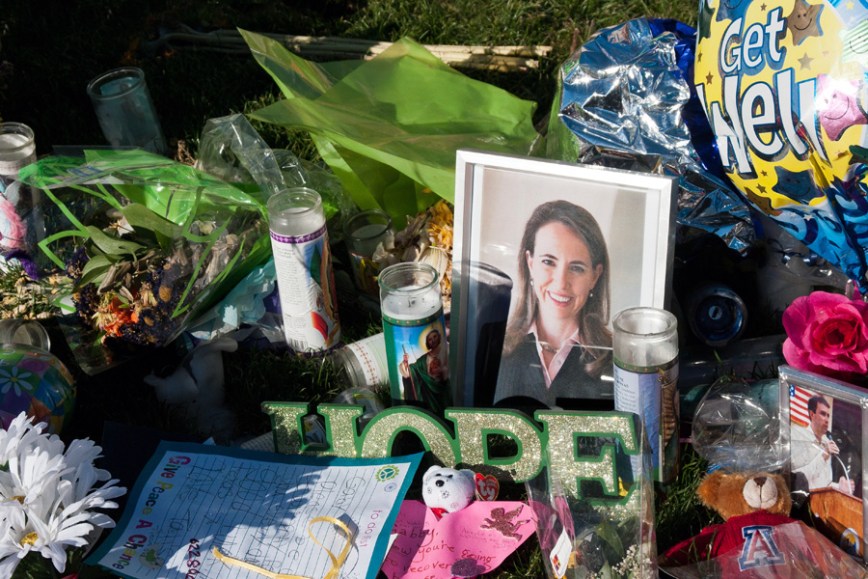
Five years ago violence was visited upon Tucson when a gunman opened fire at a grocery store parking lot. Nineteen individuals were shot, including United States Representative Gabrielle Giffords. Six people lost their lives. I expect that this anniversary will be marked by many in the media, especially after President Obama’s executive order earlier this week. Gun control legislation continues to be a huge point of contention among American voters, but gun violence continues to be an undeniable problem. This isn’t the forum for an individual like myself to hammer out a screed about the issue. All I know is that I was in Tucson that day and I remember how it felt.

I had only just heard the news when my phone rang. A gentleman from SIPA Press introduced himself. He had received my name from a journalist friend of mine, who had explained I’d likely be available to cover the story. This would be the first time I was ever hired to work as a photographic journalist. With shaky hands and shallow breath, I packed up my gear and headed down to the University Medical Center where the wounded, including Representative Giffords, were being treated. I wasn’t sure how I was going to do this job, and I certainly didn’t know what to expect. But I knew I had to go and try my best to do a decent and respectful job.

The next several days were a blur of people in mourning, of funerals and press conferences, of being pressured to go to Jared Loughner’s home and try and get pictures. Any time when I began to feel like a paparazzo, I put my camera down. There were some things I wouldn’t do. Cristina Green – the nine-year-old girl who lost her life in the shooting – was particularly challenging. The media predictably poured in like ghouls for the funeral, sticking microphones into crying faces and asking people “how do you feel, sitting out here” while they choked and sobbed their responses. I was thankful, in that moment, to be a photographer; I was able to do my job from a distance rather than invade people’s space in a moment of sadness.

There is a lot more I could say – about violent political rhetoric, about the second amendment, about the moments years later when I got to sit down with Mark Kelly and Gabby for a brief cup of coffee – but again, I don’t really think this is the place. Gabby has made more of a recovery than any of us could have ever hoped or expected. Jared Loughner, the wild-eyed gunman, is serving seven consecutive life sentences. The world is still here, even if it has been deprived of a not-so-insignificant portion of peace and happiness.

VIEW THE EXTENDED GALLERY HERE


January 07 – The Plaza

01-07 The Plaza post

“The photographer is a manipulator of light.”

~Laszlo Moholy-Nagy

– – –

A photograph of somebody else’s artwork. Is it really even appropriate for a photographer to take such an image and claim it for themselves? It’s an interesting dilemma because the photographer is still engaged in making decisions about the light, the framing, the angle of the shot. All of these variables – and many, many others – influence the emotional impact of the photograph. I tend to tread lightly with topics like this, but I make efforts to exploit my own skills to capture the subject as dramatically or uniquely as possible.

The fountains and statuary of The Country Club Plaza – known by most folks simply as The Plaza – have been photographed by countless thousands of people throughout the years. It’s just on the Missouri side in the Kansas City Metro area, near downtown. It boasts upscale shopping and fine dining, beautiful lights around Christmas, and horse-drawn carriage rides. A couple of city blocks away, though, and you’ll see some of the most impoverished neighborhoods in the city. This is the case all over the country, though, isn’t it? The Plaza is the kind of place where the local police will pick up the panhandlers, drive them over a few blocks, and drop them back off where, presumably, they belong. I’ve see it happen with my own eyes. And I get it. I just don’t like it, is all.

I remember my first high school photography class, using this old metal hunk of a manual Canon film camera my father bought me. A friend of mine from school – you know, who actually had a driver’s license – drove us out to The Plaza. I remember thinking I’d get some great shots. I hadn’t even considered how truly unoriginal the idea was, but hell, it was all new to me. I have to remind myself of the same thing today. “Sure,” I’ll tell myself. “The Grand Canyon’s been photographed a thousand times before. But not by me.”

We have to have our own experiences, now, don’t we?

I still have the negatives from that trip to The Plaza – most of them under-exposed – sitting in an old three-ring binder with many other of my early failed attempts at the whole ‘photography’ thing. I read about a New York photographer who set their camera up on a tripod in their apartment and pointed it straight out the window to the street scene below. He took one photograph every day for a year. Not the most ambitious project, but it’s something. I think we’ve all seen videos of people who do this with self-portraits, to document how much they have (or haven’t) changed in one years’ time. But this photographer did it in 1918, and nobody had every done anything like it before. The modern photographic method hadn’t even reached the century mark; there were lots of things that hadn’t been done with the camera yet. So this photographer’s year-long project made the history books, and the photographs are preserved in some archive or another, probably at the Eastman House in New York.

I’m sure there are plenty of things that have yet to be done with photography, too. It just always seems like it’s all been done before, but that’s just the lie we tell ourselves so we can talk ourselves out of trying. It’s really just a matter of figuring it out. So I guess I’d better get back to it.

PRINTS AVAILABLE HERE