The Walking Dead – “Not Tomorrow Yet”

Abraham postFINE ART PRINTS AVAILABLE HERE

The most recent episode of “The Walking Dead” once again establishes a sense of peaceful domesticity for the citizens of Alexandria, this time focusing on Carol. It opens with her going through the food pantry, plucking cans from the rack, and gathering acorns in the forested area outside the town walls. The pleasant jaunty folk music doesn’t pause when Carol has to…to machete a walker who interrupts her errand. She sighs at the blood spray on her white blouse in a manner one might expect from tracking mud into the house; there’s a nonchalance, a sense of normality, a sense of frustrated routine.

What the episode establishes here, with it’s folk music & baking montage, is still relatively new. It’s contrasting Carol’s struggle with adapting to living a real life (as opposed to the life she and the group have been forced to live, trying to survive on the road). From the third-person omnipotence of our living-rooms, we already know that Rick and the group are on their way back to the community from The Hilltop. We know that the people of Alexandria are going to have to prepare for war. We know that Carol is going to have to put down the cookies. It’s going to be time to kill people – again.

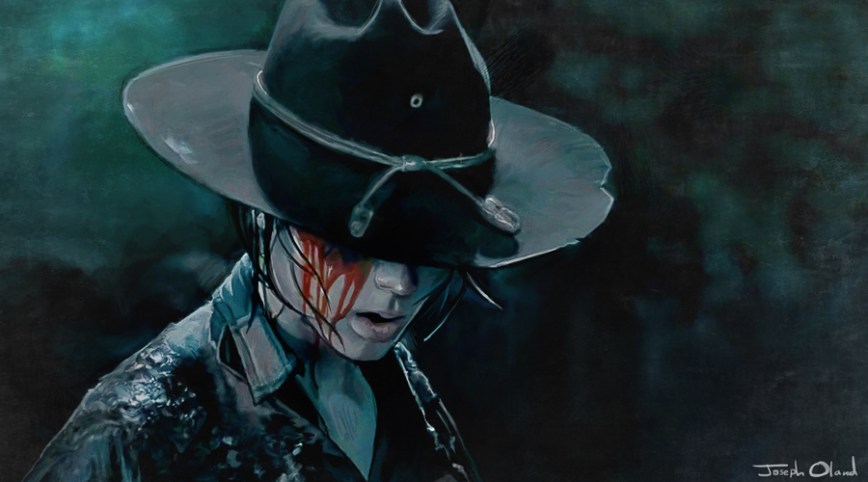
Carol has her moment with Tobin, we see her smile for the first time in what seems like an eternity, but then the RV pulls up. Her peaceful moment comes to a halt. And these are the rhythms of “The Walking Dead.” As director Greg Nicotero explains: “It becomes ‘Die Hard’ from here on out.”

And he isn’t joking when he says that.

Rick rallies the troops and they plan their attack on Negan’s outpost. A lot happens in this episode, but we still get the feeling that the writers and show-runners are still just setting up all the chess pieces. Glenn loses his innocence by killing his first living human, an action that coincides with plot-points in the comic book. Does this loss of innocence put a target on Glenn’s head, or will the television series diverge from the events of the (already-published) graphic novels in order to keep the audience guessing and the narrative fresh? If so, this certainly wouldn’t be the first time.

And what of Abraham? Since the beginning of the season he’s been showing greater and greater signs of caving into survival stress. He appears unable to adapt to his environment, has private emotional fits, and struggles to understand how or why Glenn & Maggie would actually elect to have a child in this brave new world. There have been moments of drunkenness, abandon, and pathos, as well as moments of unnecessary risk-taking. There was also the PTSD fever-dream on the rooftop with the RPG-strapped walker (an encounter which ultimately saved his life during the encounter with Negan’s foot soldiers on the highway). The show reintroduced Abraham’s problems in last weeks’ episode, and we now see him turning his back on Rosita in a brutal, heartbreaking fashion. He’s a fighter, there’s no doubt, and certainly not a bad man. But the show has gone to great lengths to illustrate that he is a man slowly coming undone. My prediction is that we had all better start saying our goodbyes; he isn’t getting out of the season alive.

If you think I’m wrong, feel free to let me know what you think is going to happen in the comment section below.

FINE ART PRINTS AVAILABLE HERE
– – –
SIGN UP FOR THE LENSEBENDER NEWSLETTER

Remembering Harold Ramis

Harold Ramis post

FINE ART PRINTS AVAILABLE HERE

A little over two years ago news came that a beloved creative personality had passed away. Harold Ramis, widely known as Egon Spengler from “Ghostbusters,” was also an insanely talented writer, a renowned director, and all-around decent human being. His works have undeniably influenced an entire generation of filmmakers, writers, and comedians.

One of the original writers for “Animal House,” his other writing credits include “Stripes,” “Caddyshack,” “National Lampoons: Vacation,” among many, many others. His particular talent revolved around sophomoric, slapstick comedy with an undercurrent moral and social philosophy. His work is known for critiquing “the smugness of institutional life,” a theme exquisitely expressed in his ultimately pleasant, non-fatalistic narrative in “Groundhog Day,” which has since achieved a cult status.

With such a pedigree behind the original “Ghostbusters,” it’s no wonder the May 3rd release of the new “Ghostbusters” trailer – a reboot project with an all-female cast – has been met with intense criticism. The original film was such a monumental, immortal hit (in part due to the genius of Harold Ramis), the deck was already stacked. The cast and crew of the upcoming release have terribly large shoes to fill; it may prove to be an impossibility.

FINE ART PRINTS AVAILABLE HERE
– – –
SIGN UP FOR THE LENSEBENDER NEWSLETTER HERE

The Walking Dead – “Knots Untie”

Daryl Dixon postFINE ART PRINTS AVAILABLE HERE

“Your world is about to get a lot bigger.”

These are the words of Jesus, the previous episode’s newest addition to “The Walking Dead.” And he isn’t joking. The world is about to expand for all of the Alexiandrians as news of other settlements is revealed. As the back-half of season six leaped forward in time, we’re also beginning to get the sense that the walkers are getting ready for a massive die-off. This is hinted at in the comic book series as well; most walkers were made during the initial wave at the beginning of the series, and a rotting body doesn’t last forever. Those who have carefully observed, each season has brought with it walkers in more and more advanced stages of decomposition. The walkers in season six are soft, sticky heaps of bone, showing evidence of butyric fermentation and advanced decay.

It can safely be assumed that walkers, while eminently dangerous, are becoming less of a threat. The more significant threat comes from other survivors, scrambling to organize, secure resources, and defend themselves. We already know how dangerous The Governor was, and we know what happened to the settlement at Terminus. The apocalypse appears to have polarized the survivors, splitting them into one of two distinct groups: weakened survivors (like the Alexandrians) and ruthless tyrants and bands of highwaymen (like the leadership at Woodbury, the cannibals at Terminus, and the raiders led by Negan). Rick and his group have managed to stay somewhere in-between these two extremes, and “The Walking Dead” is constantly examining the morale, and moral turpitude, of the group.

At the invitation of Jesus, Rick and his cohort embark to a community called “The Hilltop” with hopes of striking a trade agreement to solve their food shortage. With the threat of famine looming over them, they have little choice than to risk following their new acquaintance.

The roads aren’t swollen with walkers, but the group is wary that Jesus may be planning an ambush. Rick’s caution is understandable. In fact, the entire ‘Alexandria’ story arc of seasons five and six was intended to illustrate Rick’s developing instincts. We watched him become the capable alpha, a charge he is at first reluctant to assume over the coddled, frightened residents of Alexandria.

In “Knots Untie,” we see who Rick has really become. No longer wrestling with his morals, he is literally baptized in blood. It is perfectly natural for “The Walking Dead” to invite violence immediately upon the group’s arrival at a new sanctuary. The people of The Hilltop are cautious, weak survivors, not unlike how the people of Alexandria were. When one of The Hilltop’s scavengers attempts to assassinate their leader, Gregory, in exchange for the release of his brother (who has been kidnapped by Negan), it is Rick who swiftly intervenes. After knifing a hole into the man’s neck and a literal bloodbath – a spectacle of violence unfamiliar to the stunned villagers – Rick looks around, practically shrugging, and says, quite earnestly, “What?”

It’s a laugh-worthy moment, but a telling one, too. It explains exactly how Rick and his people view the world, from a firm black-and-white perspective: try to hurt me, I will kill you. Period.

The incident is off-putting to the people of The Hilltop; after all, Rick killed one of their people, even the man ultimately was a danger to the community. But this doesn’t prevent the two groups from coming to an agreement. Burdened with paying tribute to Negan in exchange for peace, The Hilltop has been existing under the thumbs of a tyrant. Rather than attempt to broker peace with the Negan and his gang, Rick accepts a kill mission. In fact, he is the chief architect of the kill mission.

“We’ve never had a problem with confrontation,” Rick says. And we know that’s true. The group has a base of operations, lethal skills, and an offer of protection for The Hilltop in exchange for foodstuffs. All-out war is on the horizon.

– – –

The tension is building quickly. Abraham’s narrative begins to resurface – a thread that was dropped before the mid-season finale – and we’re reminded of his tenuous grasp with reality. Along with his irrational risk-taking while guiding the mega-herd away from Alexandria, we see him wearing that curious smile once again. As the bloodshed we expect from the season finale approaches, it wouldn’t be surprising to see our militant slugger marked for death.

We also see Maggie taking a leadership role, acting as the chief negotiator with the knife-wounded Gregory. She recognizes that The Hilltop’s leader, a lecherous coward of a man, has little leverage. She confronts him head-on, standing her ground, reminding us that despite being visibly pregnant, she is a force to be reckoned with.

The group is comfortable with violence. We know this. Combat with Negan and The Saviors is acceptable if it means forging lasting peace with The Hilltop. Establishing safe trade routes between farming communities is the next step toward long-term survival. But I think we all know that the group is underestimating how dangerous Negan really is.

Time will certainly tell.

FINE ART PRINTS AVAILABLE HERE
– – –
SIGN UP FOR THE LENSEBENDER NEWSLETTER

DiCaprio – Academy Award For Best Actor

The Revenant postFINE ART PRINTS AVAILABLE HERE

One can scarcely name a more deserving recipient of the Best Actor In A Leading Role award. Stretching all the way back to some of his earliest performances, like his 1993 role as mentally challenged Arnie Grape in “What’s Eating Gilbert Grape,” DiCaprio has delivered some of the most consistently brilliant performances of any American actor. The 88th Academy Awards on Sunday night highlighted incredibly stiff competition, reminding us that 2015 was a remarkable year for cinema. After masterful performances in “Gangs of New York,” “The Departed,” “The Aviator,” “Inception,” “Catch Me If You Can,” and many others, Lenardo DiCaprio’s name was finally inside that envelope.

“The Revenant” is a unique film in a lot of ways, but what’s most interesting is how common – even boring – the story really is. Based on historical figures, the narrative travels down a well-worn path. The principal character is betrayed, overcomes great obstacles, and exacts his revenge – nothing too terribly complicated. It’s something in the movement of the camera, of the locations, of the orchestra, the cello being treated almost percussively – hinting at the danger, solitude, and sadness of the film – that leaves the viewer feeling awakened, disturbed, saved. The transcendental tale and panoramic vistas remind us of how beautiful and dangerous this world is.

There is something spiritual about “The Revenant,” about watching Hugh Glass, mortally wounded, crossing the snow-capped mountains. He is a single-minded character with only one motive: bring his son’s murderer to justice. Once he has accomplished this goal – as we already knew he would – we watch him stare onward for a moment. We cannot tell if there is satisfaction in his vengeance, if he has found peace. It is this ambiguity that stays with us after exiting the theater. We aren’t told how we’re supposed to feel about the movie. We’re left to think about it and come to our own conclusion.

Director Alejandro González Iñárritu likewise earned his statue for best director. He respects his audience. He challenges his audience, but does so without pulling punches or treating us cavalierly. He’s a leader who doesn’t take the audience on an amusement park ride; we don’t fasten our belts and wait for it to eventually end. He takes us on a hike, on a rafting expedition; we have to use our own muscles to get through it to the other end.

We live in a golden age of film and television and “The Revenant” is a noble addition.

FINE ART PRINTS AVAILABLE HERE
– – –
SIGN UP FOR THE LENSEBENDER NEWSLETTER

Better Call Saul – Jimmy’s Painting

S'all Good post

We’re only two episodes into the second season, but we can already feel how close Jimmy McGill is to leaping off the ledge. Episode two, “Cobbler,” also shows the seed of discord being sown in his relationship with Kim. Until this point, they have leaned on one another and loved one another. With Jimmy falsifying evidence to knock the police off the trail of a fumbling drug dealer, a line has been crossed.

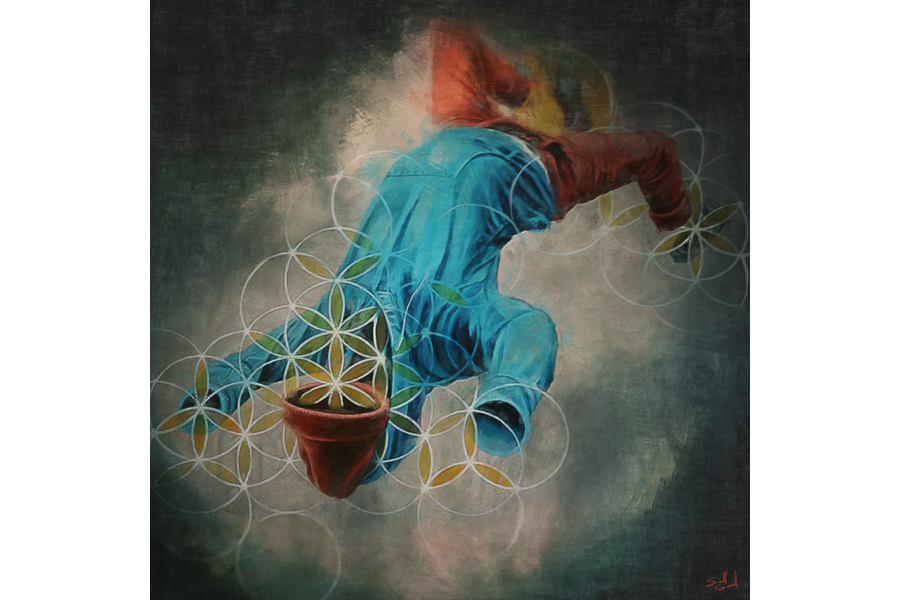
But I want to rewind for a moment to the end of episode one. The painting in Jimmy’s office – a not too terribly subtle image of a figure tumbling backward – is a representation of Jimmy McGill standing on the precipice of moral ambiguity. More on-the-nose, it also definitely pays homage to Jimmy’s con artist days when he was “Slippin’ Jimmy” back in Cicero, taking dives on ice and banking from frivolous liability lawsuits.

The image above is a quick digital sketch I made from screen shots from the show; I couldn’t find any clear representations online to link to. The image above isn’t for sale because it’s just a replica I made of somebody else’s artwork.

The painting, titled “Geometric Abductions,” is actually made by a twenty-six year old local Santa Fe artist named Miles Toland. He’s currently directing the artist residency program and gallery at Vaayu Vision Collective in Goa, India, which is where you might scope out the impressive mural.

Geometric AbductionsToland’s art merges naturalistic human forms with transcendental designs, often incorporating elements of sacred geometry. In “Geometric Abductions,” the tumbling human form is subsumed by geometric patterns – these overlapping circles are known in transcendental literature as the “flower of life.”

This image is perfect for Jimmy McGill’s law office. In the same office is also an image of a vacant boxcar, hinting at the symbolism of standing at a crossroads. Show creator Vince Gilligan is relentlessly detail-oriented. The color palette, costume design, even books on bookshelves in the background – these details have been meticulously thought out, weaving a rich tapestry of character and back-story. Even though most of these details escape us while we’re watching, it’s this intense interest in authenticity that made “Breaking Bad” such a success, and why “Better Call Saul” has captured our imaginations.

The Walking Dead – “The Next World”

Jesus Saves postJesus saves. Or does he?

After spending a painful amount of time on the lives of the Alexandrians – the first half of season six takes place over only a couple of days – we break with the comic book narrative and jump ahead two months. The comic spends time watching the community develop while Carl is bedridden, but we begin here with Carl upright and able-bodied, albeit with a certain lack of depth perception.

“The Walking Dead” hasn’t ever taken such a positive turn. We see domestic quibbles over who used the last of the toothpaste. We see clean-shaven faces and signs that the community has tethered it’s resources and established a new sense of unity. There’s a confidence in this new-found domesticity and cooperation. It’s something that viewers haven’t seen since Hershel’s farm. And even back then, there were serious problems.

It feels alien to have the show’s trademark ‘horror film’ violin music fade-in for the opening credits when nothing bad has actually happened. Quite the contrary, we’re actually left chuckling at Rick’s ultimate redneck honkytonk music as he and Daryl drive off in a plume of dust on a scavenging run.

Given how the story of “The Walking Dead” has unfolded, it’s unlikely that this newfound repose will last. The real question is, what terrible thing is going to happen to disrupt the peace?

Is Jesus going to be a savior? Doubtful. Fans of the comic book will be delighted that this mysterious new character has been introduced, and it’s the opinion of this writer that the nature of Jesus need not be prematurely revealed here.

One of the wonderful things about “The Walking Dead” is that the writers have gone to great lengths to change key plot points. This is likely an effort to keep the story relevant and prevent fans of the graphic novel from spoiling the television show. In the end, both formats have strengths and weaknesses, and the adaptation to the screen exploits every opportunity to remain it’s own distinct experience.

In the comic book, for instance, there isn’t even a Daryl Dixon character – he was written for the early episodes and was never intended to survive. He become such a beloved character so quickly, the decision was made to keep him in. Similarly, it’s Michonne who first encounters Jesus, at the gates of Alexandria, and not Rick and Daryl out on the road. And no, Michonne doesn’t share an intimate moment with Rick at all in the books. Chances are, the producers felt inclined to bend to the will of the fans, who have been more than vocal about their desire to see the two hard-core survivor-leaders, the two characters with the thickest skin, fall into bed together. It’s pleasantly disarming to see these two, hardened warriors both, actually smiling – a lot. In a world so broken, with characters who have endured as much tragedy as these two, it was something akin to relief to see them come together in one peaceful moment.

Will it last? Who is Jesus, and does he have anything to do with Negan and his band of highwaymen? It is true that he wasn’t carrying a weapon, and he didn’t attack Rick and Daryl. He might have stolen from them, but he didn’t hurt them. Hell, he even managed to save Daryl from a walker. Is he going to play a larger role in “the next world” he makes mention of? Are there really other communities out there that can be trusted? Only time will tell. The one thing we do know is that the show leaves us with more questions than answers, and it definitely keeps things interesting.

FINE ART PRINTS AVAILABLE HERE
SIGN UP FOR THE LENSEBENDER NEWSLETTER

– – –

Bonus factoids.

  1. Rick is no longer wearing his wedding ring.
  2. The comic book we see Carl reading in the woods is “Invincible,” another comic series penned by “Walking Dead” creator Robert Kirkman.
  3. You can see Glenn’s name scratched off the casualties list at the beginning of this episode.
  4. In the comics Jesus’ real name is Paul Monroe. It’s changed to Paul Rovia to avoid confusion with him being a member of Alexandria’s Monroe family.
  5. Rick shares a passionate kiss with Andrea, not Michonne, in the opening to ‘Volume 16: A Larger World’

The Walking Dead – “No Way Out”

Carl's Eye postFINE ART PRINTS AVAILABLE HERE

“The Walking Dead” returned on Sunday from the mid-season break and, in the show’s well-established style, nobody is safe. Alexandria’s wall has been breached and we watched while various citizens were predictably devoured by the walking dead. This might actually be what’s most problematic about the series; despite interesting turns and high-tension moments, the show’s rhythms and repetitions are overwhelmingly obvious. Previous seasons have routinely established a pattern in which the core characters appear to find long-term safety, only to be pushed out by larger and larger herds of walkers or competing survivor groups. The countryside of Atlanta, Hershel’s Farm, the State Penitentiary, Terminus, and Alexandria have all fallen in a predictable series of missteps and misfortune. Corrupt and despotic leaders have also become a common element, from The Governor to the cannibals of Terminus to the still-mysterious (but soon-to-be-revealed) Negan.

If “The Walking Dead” has common themes of corruption, perennially unsafe shelters, and the promise of “unkillable” characters being killed, then the shocking moments become less shocking. We still care, but we see the writing on the wall. We oscillate between moments of sadness and moments of relief, but with less and less impact. In an attempt to ratchet-up the stress, the show has begun playing unfairly to our emotions. The incident with Glenn and the dumpster is our best example. It was a relief to see the show’s most loved character pull through, but it was an unnecessarily manipulative cheap shot. The story should be able to achieve these levels of emotional impact by itself, not through slights of hand.

The show still has tremendous momentum and consistently delivers strong performances, but that doesn’t mean we don’t need something to change in order to disrupt these increasingly played-out patterns. This may have already begun to happen, of course, as we consider how the early episodes of season six began to fragment the timeline. The architecture of the narrative has changed dramatically as the story has been compressed, telescoped, and as the moments of decisive action have begun to occur with greater frequency. Where in the beginning a season would take place over several weeks or months, the whole of season six has (at least thus far) taken place over only a couple of days. We also have one unique 90 minute episode that looks backwards in time, showing us how Morgan transformed after a chance encounter with a kind loner. It is truly a magnificent episode that could just as easily have been a stand-alone film.

The best “zombie” features actually focus little on the zombies themselves. Rather, the best zombie stories are preoccupied with exploring humanity. “The Walking Dead” is no different. Most of the story is about a group of people struggling to reason and fight their way through an extraordinary situation. This is a survival story, in which disparate personalities collide, pecking orders are established, and drama unfolds. Everybody in the zombie apocalypse wants the same thing: to live to see another day. But everybody has their own idea how to accomplish that goal. Others have the opportunity to seize control, become leaders, ascend the dictator’s throne, or become sacrificial and selfless. That’s what is so darn good about “The Walking Dead.” We all watch these characters, study their struggle, and we all have an idea of what it is we would do if placed in that situation.

George A. Romero’s original zombie masterpiece, “Night of the Living Dead,” set the stage. It’s a brilliant thought experiment as we watch a half dozen strangers, marooned in a  farmhouse, arguing about the best course of action. Zombies occupy less than five minutes of screen time and most of the violence is implied. The script was written like a brilliant one-act play, and the moral questions are so compelling that we barely realize there’s hardly any action driving the plot forward, just words.

“The Walking Dead” could be a compelling television show even after the last walker collapses in dry-rot and melts back into the earth; the world is still a wasteland, filled with roving bands of survivors, scavengers, and highwaymen. Civilization still has to be rebuilt, infrastructure established, townships reclaimed. If the show can find a way to break out of it’s rinse-repeat cycle, it could be around for a long time to come.

FINE ART PRINTS AVAILABLE HERE
SIGN UP FOR THE LENSEBENDER NEWSLETTER

Nebraska Life

Fallen Saul postThe return of “Better Call Saul” on Monday has seen me reacquainting myself with the show’s first season. Anybody who has been a fan of “Breaking Bad” and “Saul” will understand that most episodes warrant multiple viewings; the narratives are layered, the characters complex, and the writers go to great lengths to embed interesting symbols – easter eggs, if you will – into each episode.

It is always fun watching genre-bound comics break through with powerful dramatic performances. With a great script, rubber-faced slapstick goof-ball comedians often turn in remarkable performances. One may never have believed Jim Carrey could play a dramatic role, but “Eternal Sunshine of the Spotless Mind” turned a lot of heads. Bill Burr, albeit a secondary character, was given an interesting opportunity as one of Saul’s fixers in “Breaking Bad.” Bob Odenkirk, who plays the titular character in “Better Call Saul” has himself spun some incredible magic bringing his character’s internal struggle and moral complexity to life.

There’s little doubt that “Saul” is a strong show, replete with powerful performances, but season one ended with a whimper. The writers have taken great care to make Jimmy McGill relatable, sympathetic, and three-dimensional. This is necessary if we’re to care at all as we watch his gradual descent into corruption and moral ambiguity. Nevertheless, the phenomenal performances and fascinating back-stories haven’t led to any concrete gasp-worthy moments, which is what we have been preparing for. I think this has a lot to do with the rhythms set up by “Breaking Bad,” but “Better Call Saul” has proven to be a different kind of program. The ten-episode set-up of season one didn’t lead to a satisfying catharsis, car chase, murder, or any other kind of earth-shaking revelation.

Season one of “Saul” is a sentence without punctuation. It’s a beautiful sentence, yes, but we are left without knowing quite how to feel. We know the ultimate fate of Mike Ehrmantraut. We know that Saul Goodman flees Albuquerque under an assumed identity, relegated to the life a low-rent fast food manager, always looking over his shoulder. What we don’t know is where he came from, not entirely. We’ve been provided with some interesting details, but the picture is still undeniably incomplete. What we’re still waiting for is a solid explanation: when, exactly, did Jimmy McGill ditch his birth name and become Saul Goodman? When did he lose his soul? How did he lose it? And why?

Hopefully, season two will satisfy some of these questions.

FINE ART PRINTS AVAILABLE HERE
SIGN UP FOR THE LENSEBENDER NEWSLETTER

Colossus – Gay Icon?

Colossus Tires postFINE ART PRINTS AVAILABLE HERE

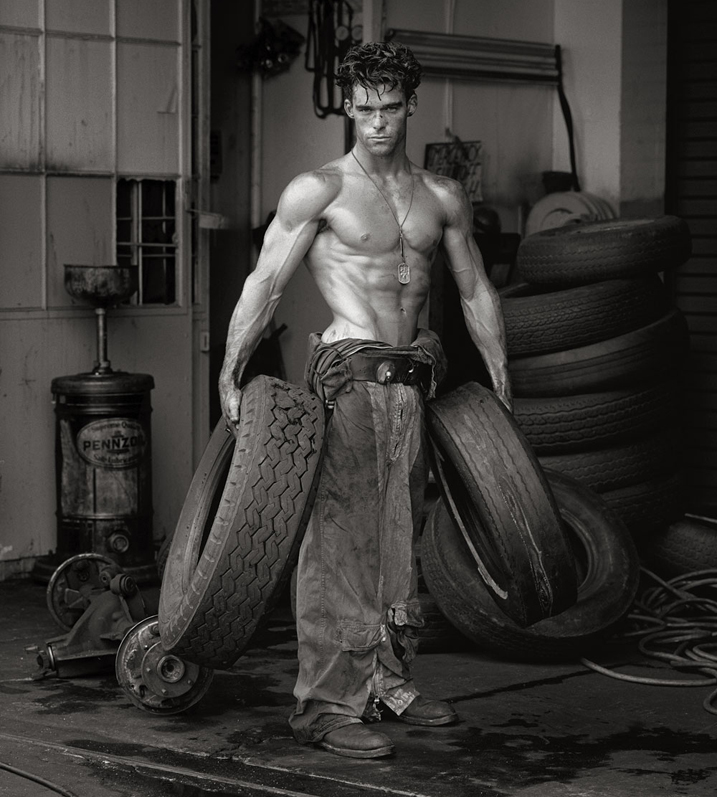
It had to happen. While watching the new “Deadpool” film opening night, this image immediately struck my psyche. I was immediately reminded of famous fashion and celebrity photographer Herb Ritts and one of his famous – and famously gay – portraits of a muscled man holding tires. His body of work is impressive, and I count him among one of the photographers who truly inspired me, even though I never developed in to a studio portraitist.

herb ritts

This image took a few hours to render, but I’m pretty happy with the way it turned out. Let me know what you think.

READ THE “DEADPOOL” MOVIE REVIEW
SIGN UP FOR THE LENSEBENDER NEWSLETTER

Movie Review – Deadpool

DeadShoot post

FINE ART PRINTS AVAILABLE HERE

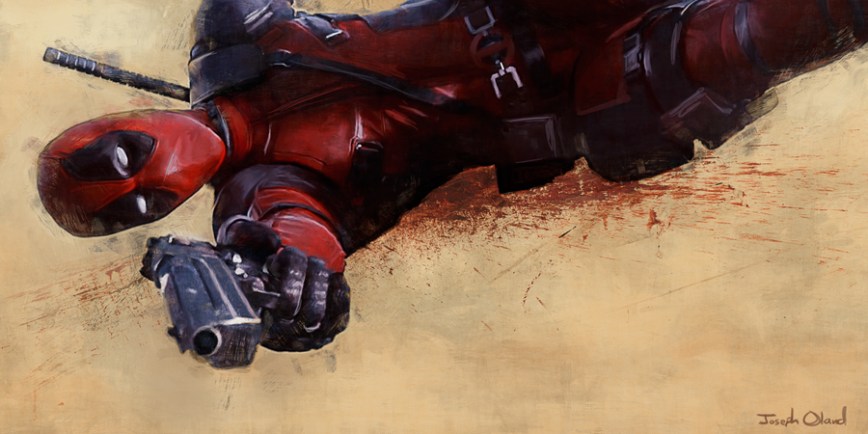
Marvel and DC have mapped-out a half-decade of comic book movies. The market is saturated. Superhero movies are way overdue for self-satire and tonal variation. And that is precisely what we get with “Deadpool,” an incredible breath of fresh air in a crowded arena.

Mainstream reviews of Marvel’s recent release have been mixed, but this isn’t a shocking revelation. The titular character in “Deadpool” isn’t the most accessible – at least not to a broad audience. With self-referential humor, endless threads of inside jokes and constant forth-wall breaks, it takes a genuine fan to fully appreciate this cinematic gem. But a gem indeed it is. Regardless of what the naysayers have published, first-time director Tim Miller has cracked the code of the R-rated comic book movie in stunning fashion. The numbers speak for themselves.

While we have other R-rated movies like “Watchmen,” “300,” and “Sin City,” those are all dark horse examples, and their success remains somewhat questionable. “Deadpool,” on the other hand, is the first R-rated release in the Marvel Cinematic Universe, and this is significant; the success of “Deadpool” will determine whether or not Marvel Studios will roll the dice again. The production is already famously stalwart for facing-down pressure from Twentieth Century Fox to make a PG-13 cut. Larger audiences and a boost to box offices sales is the primary pressure of adventure properties like this (can you imagine what an R-rated “Star Wars” movie could accomplish?), but an R-rating gives directors much more latitide. Tim Miller & Co stood their ground and the gambit is paying off handsomely.

As of this writing, “Deadpool” has already outperformed the previous Thursday box office record for an R-rated feature. In fact, “Deadpool” blew the top spot out of the water. The previous record holder was “Fifty Shades Of Gray,” banking $8.6 million on its Thursday release. One year later, “Deadpool” managed to rake in $12.7 million. This is a coup that nobody predicted. The weekend total is expected to top $123 million, a tall margin ahead of Fox’s $60 million projection.
– – –
“Deadpool” is, at its heart, the smart-ass teenager too clever for his own good, filled with fits of irreverence that hinge on nihilism. He’s been described by some as that kid “who pretends to be too cool to care, but wants you to like him so badly it hurts.” This isn’t an entirely unfair description, and it identifies where the film character is separated from the print character. The comic book anti-hero is a sharp-tongued mercenary anti-hero. The film character is, more or less, a sarcastic hero-hero. He tickles our reptilian brain with slaughter, but he only slaughtering bad guys, and he’s made sympathetic and accessible by the love story that drives the plot forward. These are perfectly acceptable concessions – unavoidable, even – in the superhero movie marketing system. If we elect not to split hairs, “Deadpool” is an incredibly fun movie that brings a larger-than-life personality to the screen with a deep sense of respect for the source material.

The film establishes its irreverent tone straight at the open, with title cards that intentionally mock Hollywood (“Directed By: An Overpaid Tool,” “Produced By: Some Asshats,” “Starring: A Gratuitous Cameo,” “Starring: A CGI Character,” and on and on, to wonderful comic affect), as well as thumbing its nose at The Director’s Guild of America, which has famously sued directors like George Lucas for not crediting the director of “Star Wars” (himself) and “The Empire Strikes Back” (Irvin Kershner).*

After an action sequence opening, most of “Deadpool” plays out in flashback. We learn that Deadpool (Ryan Reynolds) used to be a mercenary named Wade Wilson. We’re introduced to his girlfriend Vanessa (Morena Baccarin) and his best friend Weasel (TJ Miller). Wade and Vanessa are veritable quip-machines, whose quirky and fast-paced humor seem to be the linchpin of future marital bliss. They’re both crazy, and both crazy in love with each other. Then, an unexpected late-stage cancer diagnosis burns the Happily-Every-After to the ground.

A mysterious recruiter gives Wilson an offer he can’t refuse: enlist in the Weapon X program (the same program that created Wolverine), and cure your cancer. Distraught by how his illness is affecting Vanessa, Wilson reluctantly agrees. He is experimented on, and tortured ruthlessly, by a man who calls himself Ajax (Ed Skrein) and his masochistic partner Angel Dust (Gina Carano). He becomes a mutant, with strength and regenerative powers, but is left horribly disfigured. When Ajax leaves him in a burning building, Deadpool begins preparing for his revenge.

Debut director Tim Miller is the head of Blur Studios and is well-equipped to tackle a project like “Deadpool.” His background in animation led to the dazzling title sequence to “The Girl With The Dragon Tattoo” and an astonishingly effective TV spot for the video game “Batman: Arkham Origins.” With a pedigree like that, he has created an energetic movie that vacillates between serious romance/tragedy and humorous (albeit violent) superhero antics. Some may find this manic pacing off-putting, but it effectively balances the action with the slower (and necessary) narrative beats.

Die hard fans may criticize how the film handles the forth-wall breaks, and a sense of humor that could have been more intelligently satirical of the comic book genre. Instead, the humor opts for the faster-paced machine-gunning of smaller meta-jokes. This is a stylistic choice that I think serves the film adequately. More sophisticated satire is better left on the printed page. Some jokes miss their mark, but they’re thrown around so rapidly that it barely matters. Ajax isn’t the most memorable villain, but this, too, is no surprise in a Marvel property; superhero movies seem constitutionally incapable (or unwilling) to spend the necessary time to flesh-out a compelling bad guy.

Weasel is a wonderful pace-shifting character that gives breathing room to the narrative. TJ Miller seems to strike the perfect balance of calm in his scenes, which serve as punctuation marks throughout the story. That being said, Reynolds flat-out owns this film, from beginning to end, leaving little room for the other characters to shine. This isn’t a bad thing; it plants the seeds for future iterations of the “Deadpool” story.
– – –
If you knew who Deadpool was ahead of this weekend’s release, you’re going to love the film. It constantly makes fun of the X-Men franchise that gave birth to the Deadpool character, so it’s fair to say that fans of the franchise are going to “get” the humor. The famously bad Deadpool origin story that was shoe-horned into “Wolverine: Origins” is directly addressed during the film’s opening moments. When dragged away by Colossus (a beautiful motion-capture performance by Stefan Kapicic) to visit Professor X, Deadpool shoots a quick look to the camera and says “McAvoy or Stewart?” referencing the two actors – James McAvoy and Patrick Stewart – who have played the Charles Xavier character in previous X-Men movies. These nods are continuous, warranting multiple viewings, and the post-credit scene at the end of the film (which I will not spoil here) is worth the price of admission all by itself. Anybody outside of the bubble may not understand why the auditorium is erupting with laughter so frequently, and may walk out of the theater scratching their heads.

If you’re a comic book freak, step away from the computer and head straight to the multiplex. It’s worth it.

*George Lucas was fined $250,000 for his transgression, which ultimately led him to resign from the Directors Guild of America. Something tells me Lucas got the last laugh.

FINE ART PRINTS AVAILABLE HERE
SIGN UP FOR THE LENSEBENDER BLOG

YouTube Dragon

The Girl With The Dragon Tattoo

YouTube Gotham

Batman: Arkham Origins