February 24, 2017 – Tucson Rodeo

Jabe Anderson III, of Dillon, MT, earning a 6.1 second time during Thursday’s steer wrestling event.

FINE ART PRINTS AVAILABLE HERE
– – –
OTHER ‘IMAGE OF THE DAY’ PRINTS AVAILABLE HERE

Yesterday I found myself in familiar territory: the Tucson Rodeo. The Fiesta de los Vaqueros.

It’s bittersweet, now. It always will be, from this day until my last. I’ve spent my entire life pretty disinterested in sports and competition. The eye-liner and dreadlocks and high school were a pretty strong hint. I never had the time or the patience or the interest to learn the rules; football still confuses me, and baseball still bores me.

Several years ago, however, when I was unemployed and struggling to find work and fill the empty hours, an old college friend asked if I’d like to go to the Tucson Rodeo. He was a press photographer and said he’d fudge the facts a bit, call me his assistant, and get me a press pass. He was good like that, knowing that I was a motivated photographer with little that was going my way, few excuses to pick up my camera.

I hadn’t been to a rodeo since I was in elementary school, a field trip to the Kansas City Royal. I said ‘yes’ to my buddy, of course, even though I didn’t really feel any spark or drive to go. I knew I didn’t have any excuse not to go out and take pictures. And would you believe it? The fish out of water – the industrial rock androgynous artist – had a really great time behind the bucking chutes, smelling the livestock, watching the men and women riding beautiful, giant, muscled horses. It got into me, and it has never left.

For several years, my friend William and I, regardless of what was going on in our lives, found each other at the Tucson Rodeo Grounds. We photographed beside one another, and we huddled over our computers at the end of the day, flasks of whiskey or shared pitchers of beer at Danny’s Lounge, combing through all the images and critiquing one-another’s work.

Sports photography is radically different than any other kind of photography I was ever familiar with. Everything happens so incredibly quickly. You have to be focused. You have to try and anticipate what’s going to happen next. And you never walk away feeling like you did the best job; you always feel like you could have done it better. That’s good for a photographer. It’s good for an artist. It’s good to be in situations that challenge you.

My friend shot himself a couple of years ago. My best friend. He left his friends, his family, and his wife behind. This is my second rodeo without him. I almost don’t feel like going out and doing it anymore, except for this strange sense that I’m reconnecting with him every time I put on my cowboy boots and feel the crunch of dirt beneath my feet in the arena. All of the other people in the press trailer knew him, too, so we tell stories and reinforce our memories of him, our love for him.

It’s more than just cowboys and horses for me now.
SIGN UP FOR THE LENSEBENDER NEWSLETTER

February 23, 2017 – Vintage Neon

FINE ART PRINTS AVAILABLE HERE
– – –
OTHER ‘IMAGE OF THE DAY’ PRINTS AVAILABLE HERE

Before the Interstate Highway System was developed, state routes and roadside motels dotted the southwestern landscape. Privately owned businesses lined these thoroughfares with unique signage offering a variety of services for the long-distance traveler. Greasy-spoon cafés and auto-service stations shared the strip. With the introduction of the Interstate System, travel was faster and more convenient, but the quality of character was supplanted by larger chains and a decidedly more corporate appeal.

Denny’s and Auto-Zone replaced these local businesses, few of which survive today.

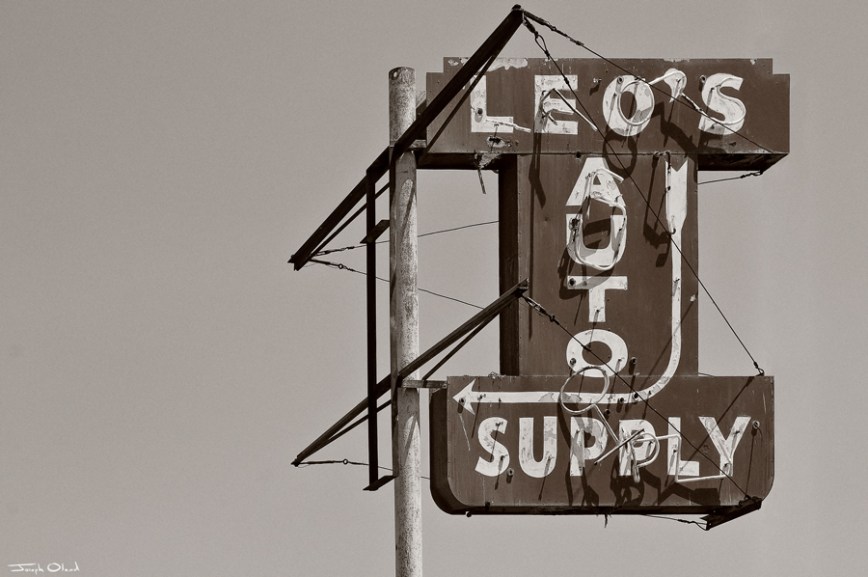
More than half a century ago now, this particular sign – a red and white vintage neon for Leo’s Auto Supply – was purchased and moved to the intersection of Glenn & Stone in Tucson, Arizona, by the proprieter of Don’s Hot Rod Shop. One of the owners, Leo Toia, had it relocated.

Along the Old Benson Highway, many of the small old roadside Motels survive, and Tucson boasts a host of vintage neon signs along the now-infamous Miracle Mile. Many of the old businesses have been lost, but there is a rich history here in Tucson, and this Leo’s Auto Supply sign is one of the survivors.

SIGN UP FOR THE LENSEBENDER NEWSLETTER

February 22, 2017 – Old Car

FINE ART PRINTS AVAILABLE HERE
– – –
OTHER ‘IMAGE OF THE DAY’ PRINTS AVAILABLE HERE

Today’s image comes from Opera Drive, a winding road on one side of the canyon known to local Bisbee, Arizona residents as Brewery Gulch. There’s new money in the old mining town, and some old money – but mostly there’s no money. Anybody who walks far enough up Brewery Gulch will see the junk houses and the yards filled with splintered lumber, old tires, bathtubs, and rusted cars. The paved road terminates, giving way to a gravel pathway with sharp rocks and small remnant shacks from the old mining days, when Bisbee produced more copper than any other mine in the United States.

Up on Opera, looking down on the gulch, are houses perched on the hillside – some little more than remnant shacks, others renovated by the nouveau riche. Regardless of income or social standing, the views are just the same, and always fantastic. I made this picture of an old car parked on the roadside while I was hiking up to the end of the gulch, where the road splits into a couple of hiking trails that wind around into the surrounding hills in the high desert.

“The goal of abstract art is to communicate the intangible, that which eludes the photograph and normal seeing.”
~Curtis Verdun

SIGN UP FOR THE LENSEBENDER NEWSLETTER

February 21, 2017 – Textures on the Trail

FINE ART PRINTS AVAILABLE HERE
– – –
OTHER ‘IMAGE OF THE DAY’ PRINTS AVAILABLE HERE

My fondness for abstract photography is inexhaustible. This image was made in the open spaces of the San Rafael Valley, in Southeastern Arizona, in a small and underutilized ranch. This is a piece of farm equipment captured in my camera’s macro lens. There’s something about the texture of rust and chipped paint that I’ve found beautiful and fascinating, like a small little landscape the size of a human thumbnail.

“I understand abstract art as an attempt to feed imagination with a world built through the basic sensations.”
~Jean Helion

SIGN UP FOR THE LENSEBENDER NEWSLETTER

February 20, 2017 – Analogue Landscapes of the Digital

digital-landscape-postFINE ART PRINTS AVAILABLE HERE
– – –
OTHER ‘IMAGE OF THE DAY’ PRINTS AVAILABLE HERE

This is probably my favorite thing about photography – it’s a tool that lets the photographer share images with the world that would otherwise remain in the shadows, ignored, misunderstood, or unrecognized. This is a photograph of the metal casing and interior parts of a computer hard drive. The steel case has corroded from humidity, giving it an organic and interesting texture, and edits have been made to the color.

There is a whole world that exists in our bedrooms, in our pockets, inside our car doors. We never see what’s inside of our television, and we usually don’t question how the light-emitting diode actually functions, even though we’re obsessed with all of the flickering screens in this modern world competing for our attention.

This image is a meditation on that invisible world.

“Beauty can be seen in all things, seeing and composing the beauty is what separates the snapshot from the photograph.”
Matt Hardy

SIGN UP FOR THE LENSEBENDER NEWSLETTER


Save

February 19, 2017 – Painted Brick

paintedbricks-postFINE ART PRINTS AVAILABLE HERE
– – –
OTHER ‘IMAGE OF THE DAY’ PRINTS AVAILABLE HERE

Midtown Tucson is slathered with foot traffic, dotted with some reasonably questionable neighborhoods, and absolutely covered in the shittiest graffiti you’ll ever see. There’s no real artistry to it, just a level of “this is the mark I’ll be making” level of hooliganism.

About a decade ago, when I last lived in the neighborhood, I remember there were several efforts for graffiti abatement; billboards and hotline numbers to report graffiti, paint donation programs through local hardware stores, and private homeowners who opted to foot the bill on their own. I used to walk the mile and a half to work at Jones Photo, Inc – it wasn’t uncommon to see a fresh coat of paint on an adobe wall on my walk home, only to see fresh spray-paint scribbles on my walk to work the next day. Folks quickly stopped even trying to match paint and they’d take whatever the hardware store was handing out, or they’d buy the cheapest primer; the walls and garage doors, businesses and restaurants, were slowly covered in sloppy bands of mismatched color, rolled despairingly over the tagged scribbles.

It’s frustrating, to be sure, but my photographer’s eye also found some interest in these textures. And it seems like the plague of artless graffiti has largely subsided – at least, compared to years ago. Most of what you’ll find today are grease-pen scribbles on light posts or at bus stops, or markings on defunct businesses, in back alleys, and on abandoned buildings like the one pictures above.

Naturally, if I have my camera with me, I’ll be taking pictures.
Until tomorrow, my friends, I hope you enjoyed today’s photograph.

“To me, photography is an art of observation. It’s about finding something interesting an ordinary place… I’ve found it has little to do with the things you see and everything to do with the way you see them.”
Elliott Erwitt

SIGN UP FOR THE LENSEBENDER NEWSLETTER

Save

February 18, 2017 – Saguaro Cactus Landscape

sahuaros-postFINE ART PRINTS AVAILABLE HERE
– – –
OTHER ‘IMAGE OF THE DAY’ PRINTS AVAILABLE HERE

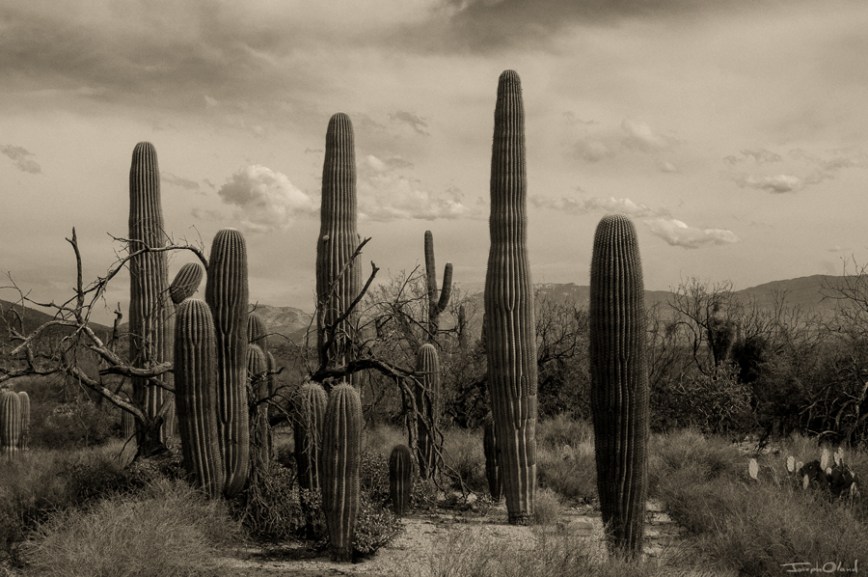
Sometimes black-and-white is the only way to go. There’s a timelessness to black-and-white landscapes that is almost universally appealing. This was taken while hiking through the mountain run-off in Sabino Canyon last week. My feet were wet and squishy from tromping through knee-deep water, tromping up to the Seven Falls area.

A thunderstorm rolled through and cut the hike short, but it was an exquisite several hours in the canyon.

Getting out into the world, walking the downtown streets or the canyons are going on my ‘urban hikes’ are terribly important to me. There’s so much to discover out there, even just walking around the block, if one takes a moment to concentrate, train themselves to really keep their eyes open all the time.

I hope you like today’s photograph. Cheers.

“If you want to be a better photographer, stand in front of more interesting stuff.”
Jim Richardson

SIGN UP FOR THE LENSEBENDER NEWSLETTER

Save

February 17, 2017 – Vintage Photos

vintage-cheerleaders-post

FINE ART PRINTS AVAILABLE HERE
– – –
OTHER ‘IMAGE OF THE DAY’ PRINTS AVAILABLE HERE

What I love about photography is that it captures a moment never to be reproduced. Photographs are the mosquito in amber of human memory, imprinted with our own projected thoughts and emotions. Snapshots, if they survive long enough, become aesthetic curios. A casual photograph of a street scene in Manhattan taken in 1915 becomes more than a snapshot, but a historical document that captures, with accuracy, what life looked like in that particular place at that particular time.

One of my history professors once told me that the best way to have my work remembered would be to regularly go to the supermarket and photograph the merchandise on the shelves. Print, save, and catalogue them, and wait for time to do the rest. His thinking is that future generations will be thirsty for ideas about how we lived in the past, that the photographer of the present has only a vague concept of how radically a society can change in the short span of a generation or two.

My great grandfather was able to tell me the story of seeing his first automobile as a child and how dazzling it was. He could tell me how, years later as a young man, that the hand-crank engine starters were frustrating as he. He and his wife – my great-grandmother – operated a single-screen silent theater; he ran the projector and she played the piano. I say all of this to point to the last years of his life, with the internet revolutionizing instant electronic mail, cable television that allowed him to watch every Minnesota Vikings football game, and even a wireless headset so he could listen to the game without the noise of the game disrupting everybody else in the house.

Things change faster than they seem. And an old snapshot of a daughter or a girlfriend at cheer-leading practice somehow becomes a nostalgic conversation piece, a document of a by-gone era that makes the viewer think about their experiences in high school, wonder where the people in the photograph are today, or even if they’re still alive. It’s a faded piece of paper that reminds us how little time we have, and how precious these small moments might actually be.

“Today everything exists to end in a photograph.”
Susan Sontag

SIGN UP FOR THE LENSEBENDER NEWSLETTER

February 16, 2017 – No Parking

no-graffiti-post

FINE ART PRINTS AVAILABLE HERE
– – –
OTHER ‘IMAGE OF THE DAY’ PRINTS AVAILABLE HERE

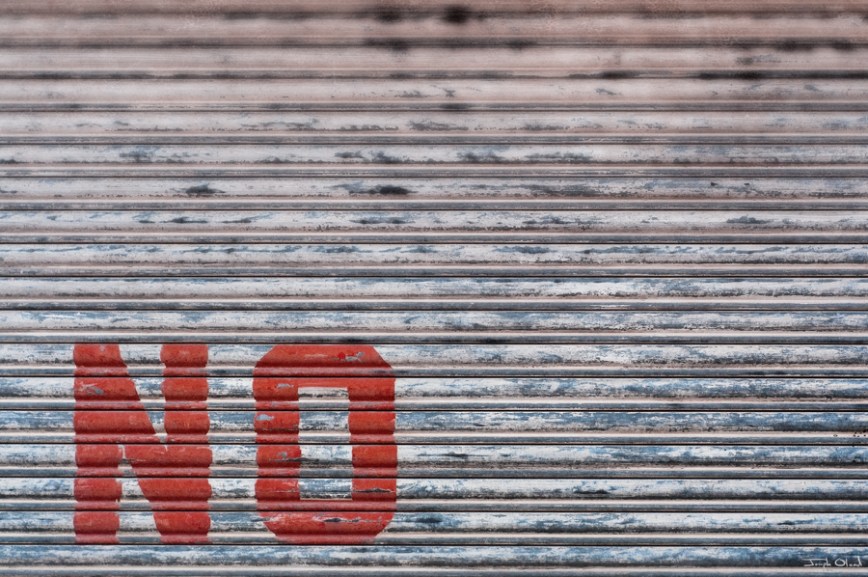
Today’s image of the day is simple and clean, but I was attracted to the faded paint and texture. I’m often criticized for making pictures that don’t have meaning, but I think there’s meaning embedded in just about any picture that anybody takes – not just professional photographers or self-proclaimed artists.

So much of the time, I really simply enjoy taking a small detail from the world and printing it big.

“I really believe there are things nobody would see if I didn’t photograph them.”
Diane Arbus

SIGN UP FOR THE LENSEBENDER NEWSLETTER

February 15, 2017 – The Circuit

the-curcuit-post

FINE ART PRINTS AVAILABLE HERE
– – –
OTHER ‘IMAGE OF THE DAY’ PRINTS AVAILABLE HERE

This is a completely synthetic landscape, the subject matter based on function over form. Whoever designed this circuit board was focused on making the disc drive it was a part of to function properly – they weren’t interested in inspiring aesthetic interest from a photographer like me. For whatever reason, though, there’s an elegant beauty here. Most of my macro photography focuses on raw textures and plants – stones and concrete, flowers and insects.

But I find something incredibly inspiring by images like this.

To me, this type of image represents possibility. It’s a representation of human creativity.
I hope you like it.

SIGN UP FOR THE LENSEBENDER NEWSLETTER