 FINE ART PRINTS AVAILABLE HERE
– – –
ALL ‘SAUL’ & ‘BREAKING BAD’ MERCHANDISE HERE
“Good and bad is not the same thing as legal and illegal.”
Entering its third season, Better Call Saul is much more of a slow burn compared to its Breaking Bad predecessor. This has some fans of the Gilligan-verse frustrated, hoping for the violence and action that the Walter White saga delivered, but Saul is a different animal altogether, much more patient with how it allows its characters to unfold. Ultimately I think this is a good thing. Especially considering that Better Call Saul is a prequel, because the audience already knows where most of the main characters eventually wind up – it’s important for this series to be more of a character study than a thriller.
Better Call Saul, when it was first announced, had the stink of ‘cash grab’ all over it. It was announced at the tail end of Breaking Bad, one of the most successful television shows of all time, occupying the same Breaking Bad universe. And let’s face it, when we hear the term ‘spin off,’ our hopes aren’t often that high. But show creator Vince Gilligan and partner Peter Gould have made something far better than a cheap knock-off – in fact, some might argue that Saul is, in many ways, superior to the show that came before.
Aside from the traditional black-and-white Nebraska Cinnabon flash-forward to the dull existence led by the show’s protagonist, season three picks up precisely where season two left off: conman turned lawyer Jimmy (Bob Odenkirk) has admitted to his mentally ill brother Chuck (Michael McKean) that he sabotaged some of Chuck’s legal paperwork in order to secure a client for himself and his nascent legal practice. Chuck, the golden child and the successful, law-abiding lawyer, reveals that he, too, knows how to run a long con. Having led Jimmy to believe that his own mental illness had truly gotten the best of him, Jimmy feels remorse – then Jimmy confesses. In the next scene, we see that Chuck is already taking down all of the space blankets taped along the walls to cocoon himself from his fear of electromagnetic waves (the primary symptom of his mental illness). Chuck wasn’t losing his mind after all, and he’d been secretly recording his conversation with Jimmy, capturing the entire confession. Chuck has already been established as an exceptional attorney; he knows his secretly taped audio confession likely won’t hold-up in court, but we all know he probably has something bigger planned.
And even though Better Call Saul is entirely its own show, fans have been excited to see the return of Gus Fring (Giancarlo Esposito), the ice-cold drug lord who masks his criminal enterprise in a collection of fast-food franchises. The conclusion of season two planted the seeds, and various easter eggs (including a clever acrostic of episode titles), have confirmed Fring’s return (as well as later-released press photos).
 It appears that audiences can look forward to seeing how Mike (Jonathan Banks) becomes one of Fring’s chief enforcers. As Mike gets ever-closer to discovering precisely who Fring is, Jonathan Banks continues to deliver a show-stealing performance. The Saul story-line dissolves when we cut to Mike, and audiences try to figure out what he’s thinking, what he’s planning.
As strong as Odenkirk, McKean, and Banks are in the show, the production’s secret weapon is Rhea Seehorn’s complex portrayal of Kim Wexler. She is the heart and soul of the Saul’s story, a character struggling to keep her head above water during the ensuing flood. She isn’t manipulative (as Jimmy and even his brother Chuck are), she isn’t greedy (as the various suits in her field of work appear to be), and she isn’t criminal (as virtually every other character in the show is). She maintains her affinity for moral uprightness, but cannot control her attraction to Jimmy’s crooked ways – that’s the primary struggle of her character. Kim portrays the most human struggle in the show, one that all audience members can relate to in one way or another. She doesn’t like it, but she continually gets wrapped-up in Jimmy’s schemes, and it is this writer’s opinion that the conclusion of Better Call Saul will include her death – that will be the final tragedy that divorces Jimmy McGill from any hope of moral redemption.
Vince Gilligan may be a one note pony – Breaking Bad and Better Call Saul are identical, Faustian tails of relatively innocent men being drawn into a criminal enterprise that threatens to overwhelm them. Jimmy’s crimes are certainly more nuanced than Walter White’s, but that’s just a detail. It is to the show’s credit – to the writing and the acting – that we continue to root for Jimmy despite the wrongs he has done – such was not the case by the time we hit the third season of Breaking Bad. Jimmy can’t outrun his lies forever – we already know that – and it is certainly entertaining to watch his character evolve while the noose begins to tighten.
– – –
There are a couple of easy-to-miss details that I would love some assistance with. As fans of Breaking Bad and Better Call Saul already know, nothing in the frame is accidental. Color scheme, costuming, editing, frame-rate, perspective, and pacing are all meticulously constructed to create an intentional, dynamic universe for the characters to inhabit. So why is the miserable Cinnabon manager reading “The Moon’s A Balloon” while on break at the mall? There isn’t a chance in hell that this particular book wasn’t chosen specifically for this character.
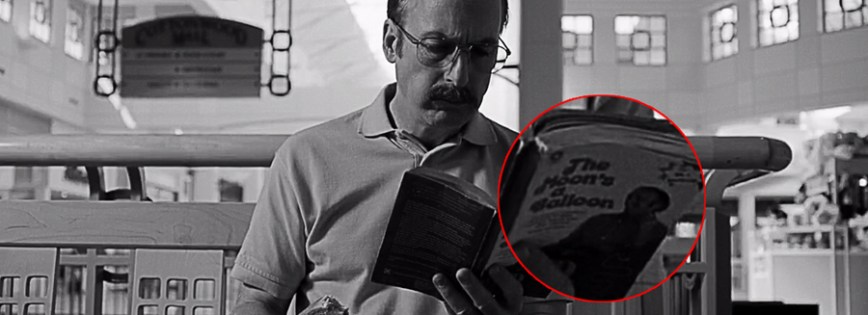 “The Moon’s A Balloon” is one of the best-selling memoirs of all time, of a man that contemporary audiences would scarcely recall: David Niven. The book is an account of his life in Hollywood during the 1950’s and 1960’s, beginning with the early loss of his aristocratic father. Stories of service during the second world war follow, and then tales of partying with legends of the silver screen. It’s a gossipy tome, at times earnest and heart-felt, but mostly boastful, about life among the stars while living in Los Angeles.
Does this somehow reflect the dim life that the once wealthy and talented Saul Goodman has been reduced to. A memoir about a long-forgotten Tinseltown big-shot perhaps reminds our character of how grand he used to be? I’d be curious to hear your opinion.
SEE OTHER ‘SAUL’ REVIEWS AND ARTWORK
– – –
SIGN UP FOR THE LENSEBENDER NEWSLETTER
 FINE ART PRINTS AVAILABLE HERE
 FINE ART PRINTS AVAILABLE HERE
 FINE ART PRINTS AVAILABLE HERE
 FINE ART PRINTS AVAILABLE HERE
 FINE ART PRINTS AVAILABLE HERE
 FINE ART PRINTS AVAILABLE HERE
 FINE ART PRINTS AVAILABLE HERE
 FINE ART PRINTS AVAILABLE HERE
 FINE ART PRINTS AVAILABLE HERE
 LenseBender