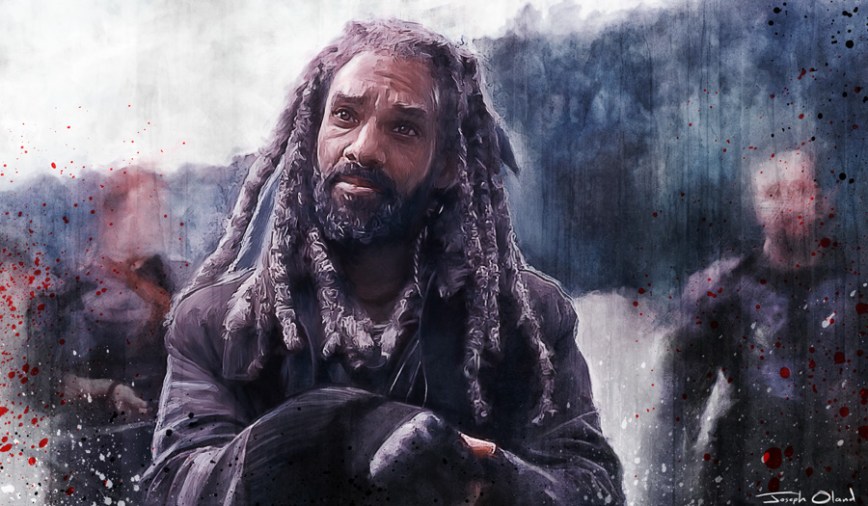
The Walking Dead 7.12 – Say Yes

FINE ART PRINTS AVAILABLE HERE
– – –
ALL WALKING DEAD MERCHANDISE HERE

The last several episodes, in my humble opinion, have been misfires. This is pretty apparent if you’ve read through my previous write-ups. It isn’t as though fans aren’t aware of the abundance of “filler episodes” in the show, and it isn’t as though any of us are unaware that there can be an effective use for these episodes when it comes to illustrating the growing connections and tensions between the show’s characters. The trend that I’ve noticed is that all of the material invented specifically for the show – rather than material taken directly from the comic books – straight-up isn’t as dynamic, interesting, or well-thought-out. And no, this isn’t “fan boy” territory, as though I personally would want to see on television exactly what I’ve already read in the comics; that’d make watching the show exceedingly boring. I adore that the writers and show-runners are actively trying to make the television show distinct from the comics in several inventive ways in order to maintain interest among pre-existing fans, create suspense, and keep audience members guessing.

The point is this: the “Oceanside” and “Garbage Picker” (as I’ve come to call them) communities have absolutely no personality to speak of, no heart or soul, and no reasonable explanation as to how they even exist. They deserve little, if any, sympathy from the show’s established communities, or from the audience. How does Oceanside surveil their town? And why haven’t they migrated to territory further away from Negan’s clutches, where they’re less likely to be discovered by scavengers under Negan’s employ? And no men, you say? At some point, this community is going to realize that the trauma delivered by The Saviors won’t be enough to quell a woman’s need for sexual intimacy – at least not indefinitely. And what of the Garbage Pickers? Surviving after making a home in the most unsanitary place they could find, a landfill, despite a massive shortage of medical professionals, medical supplies, not to mention clean food and water? In a landscape filled with rusted nails, rotting food, pack rats, and flies? Yeah – that makes perfect sense. And how are we to honestly believe that they’ve forgotten how to speak English less than two years after the collapse of civilization? No linguist is going to accept that any new form of distinct English dialect would surface from a semi-isolated community in such a painfully short period of time.

The following is a transcript, verbatim, of the words spoken by Jadis, the inexplicable leader of the Garbage Pickers, at the time when Rick delivers several dozen new firearms: “Operational? All? Yes, yes. But operational? No. Not enough. Enough to fight your fight. Us. Nearly twice. Need nearly twice. No. Our guns to take. Our deal. Still on.”

Following that ridiculous, truncated word salad is a negotiation between Rick and Jadis regarding how many of the guns Rick can keep in order to protect his people while they search for even more guns. During the negotiation – as a part of the negotiation – Jadis demands Rick give back the wire cat sculpture he took from the dump – the dump! – after his gladiatorial fight with pin-head, to give to Michonne as a gift. How could such a trivial, stupid goddamn thing enter into a serious negotiation about armaments?

Because of these things – and many, man more – these communities haven’t really earned any empathy; audiences aren’t devastatingly concerned about what’s going to happen to them. This is specifically why I think both communities are going to be decimated in the war to come. The introduction of these new communities feels almost like an afterthought. They absolutely reek of the same wooden, unsympathetic personalities that we see in Fear The Walking Dead, the ill-begotten spin-off series. Why do these things – the Garbage Pickers/Oceanside characters and the Fear The Walking Dead characters – feel so similar, you might ask? Once again,  because they aren’t inventions of Robert Kirkman, who created the whole Walking Dead universe. With no solid source material, there are no solid characters.

None of this means there isn’t an awful lot to celebrate about The Walking Dead, and it would be overly cynical of me not to admit that this week’s episode definitely got a lot right.

The series has spent far too many episodes neglecting the impact of Abraham and Glenn’s deaths on Rick’s emotional well-being. In some ways, I suspect that the season premiere – focused predominantly on Negan breaking Rick’s spirit – was intended to do just that. At the same time, I think it would’ve been better to sporadically reinforce how Rick is (or isn’t) managing his emotions in a few little ‘reminder moments’ scattered throughout the season. He is, after all, the main character of the series, and the audience largely sees the world through his eyes. It was a breath of fresh air to finally see him opening up about that sarcastic young pizza delivery boy, Glenn, who saved his life in the very first episode, when he was trapped inside that immobilized combat tank.

This episode made for wonderful character progression for Rick and Michonne. It has been a long time since we’ve been able to feel this kind of sympathy for Rick. He’s typically written in such a way that we almost always know he’s going to survive: outliving his wife, outliving a rival in love (Shane), making it through the governor’s assault, the swine flu, the hacking off of his girlfriend’s arm when Alexandria was overrun by walkers, and persevering when he had to fight that ridiculous pin-head super-walker for the Garbage Pickers earlier this season – and that’s just to name a few. A very few. And it even happens again in this episode, when that love-struck fool tries to shoot a deer in the middle of a walker assault and gets himself trapped by an encroaching wall of the stumbling but savage undead. The saving grace here is that the majority of the episode was executed incredibly well.

We are finally reinvigorated, seduced yet again into wishing for success for Rick and the gang. We want them to overcome the horrors they’ve endured. Episodes of The Walking Dead are always wonderful when they remember to let the audience see the characters smile and enjoy a small victory, despite their bleak surroundings. It’s affecting to have a moment of levity in an episode (or a whole season) mired in struggle and heartache.

How often do we actually see Michonne smile in The Walking Dead? We see her smile just about as often as we ever hear any character actually laugh (unless, of course, it’s a mustache-twirling villain preparing to bash somebody’s brains in). Hearing Rick and Michonne cackling just after falling through the roof is arguably one of my favorite moments of the episode. It was unexpected bliss, rather than an unexpected jump-scare or a tragic and untimely death.

The episode ends with the Garbage Pickers insisting they still need more guns, despite the cache delivered by Rick and Michonne. And, how convenient that we have Tara at the end of the episode – the only one who knows about those well-armed ladies in Oceanside – with something important to confess. How unutterably convenient. Ten bucks says that this plot-line won’t be addressed, at all, in next week’s episode. We’ll have to wait a week or two, if not several months into the future when the next season begins.

Cliffhangers aren’t even cliffhangers anymore. Not in The Walking Dead. You won’t tune in next week at the same bat-time, same bat-channel, and learn what happens to our heroes next. No, no. We’re all going to learn something completely unrelated, in one of the other communities, about a whole group of other characters.

In the words of foghorn leghorn: I ga-rohn-teeeee!

READ LAST WEEK’S REVIEW
– – –
SIGN UP FOR THE LENSEBENDER NEWSLETTER

The Walking Dead 7.11 – Hostiles and Calamities

FINE ART PRINTS AVAILABLE HERE
– – –
ALL WALKING DEAD MERCHANDISE HERE

As mentioned in previous commentaries – and I like to believe that the issue is rather obvious – the cast of The Walking Dead has swollen to an almost unmanageable size. It’s a problem, because the idea of the world expanding, of civilization taking root after the apocalypse, is an intriguing one. It’s a great idea, in fact, and lives well on the page in the printed comic book series. But it appears to be more of a logistical and narrative nightmare to have this expanding world come alive on the screen.

We can probably assume, however, that the “All Out War” section of the story these recent episodes are building towards will cull the herd significantly. My fingers are certainly crossed that we eventually see some of the excess baggage cut loose. The garbage pickers, guaranteed, are going to be bullet-sponges; they are the least interesting, least developed characters, and they offer the least in the way of answers as to how their society functions, how they have survived, and why eighteen-months of story-time (roughly) has been enough time to influence the very structure of their language. Who is this Jadis, and through what mechanism has she achieved a leadership position? Raw physical power, charisma, persuasion, and extortion all seem unlikely – especially that ‘charisma and persuasion’ bit – her verbal communication skills have been reduced to two word, stilted sentence fragments. I predict that these characters will be quick to die.

But we all know who’s going to be sacrificed first though, don’t we? Why of course we do! It’s going to be none other than the young and lovable Benjamin from the Kingdom. Don’t remember him? Well, he’s the young one who has taken up the bo-staff under Morgan’s instruction. He’s baby-faced and sympathetic, trying his gosh-darned best to learn how to defend the kingdom like his father before him, all while taking on the responsibility of raising his younger brother. Morgan even appears to be influencing the young lad, injecting his philosophy of non-aggression. This kid was marked for death from the moment Benjamin’s sob-story character was introduced, and every little moment with him has been specifically designed to make audiences like him, pity him, and quietly root for him, so as to make his unavoidable – I guarantee it, unavoidable! – death a sad and meaningful one.

My guess is that Benjamin’s death is what’s going to change King Ezekiel’s mind about joining in the battle against Negan. I’d put money on it.

That all being said, this episode isn’t about the Kingdom or Hilltop communities at all. With all of the different communities and the bloated cast, all of this season’s episodes have been reduced to focusing on one group at a time, save typically for the cliffhanger-heavy outros. In this episode, we get more details as to how The Sanctuary functions, more specifically focusing on Dwight, who clearly appears to be having a change of heart regarding his position, and Eugene, who has recently been kidnapped and taken under Negan’s wing.

– – –

It isn’t challenging to overlook characters like Eugene. Even dramatic moments – chomping Dwight in the crotch outside Alexandria last season – are easily funneled into humor, and Eugene has mostly been written as the butt of the joke. Despite this, actor Josh McDermitt turned in an exceptional performance. Throughout the episode, we are made to wonder whether he has some kind of secret plan to assist the Alexandrians (or maybe escape), or if he truly has accepted his role as one of Negan’s soldiers, along with all the responsibilities and, more importantly, with the sense of safety and all of the creature comforts. This question isn’t answered by the episode’s end, and I’m doubting we’ll have an answer until the season finale.

Negan’s fate is in the background of the whole episode. We wonder about Eugene’s allegiance, Rick and the Alexandrian’s are hunting for weapons and recruits to storm Negan’s compound, Dwight appears to be having second thoughts about his life with the Saviors, and even Negan’s wives are plotting to have him killed, requesting that Eugene manufacture poisonous pills. And, of course, just like Walter White’s ricin, we have some pretty obvious foreshadowing – lest we forget that we don’t ever see Eugene destroy the pills, even though he didn’t give them to the wives.

I’m guessing they’re going to make an appearance in the near future. Time will tell.

READ LAST WEEK’S REVIEW
– – –
SIGN UP FOR THE LENSEBENDER NEWSLETTER

The Walking Dead 7.10 – New Best Friends

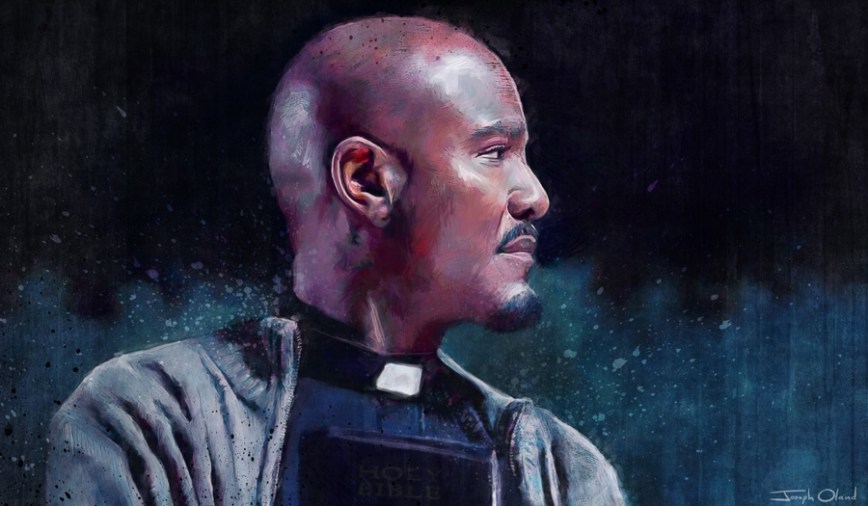
FINE ART PRINTS OF THIS IMAGE AVAILABLE HERE
– – –
ALL WALKING DEAD MERCHANDISE HERE

Inexplicable “hell-raiser” walkers. There’s no sense or reason to most of this episode, and it is painfully disappointing.

This episode, titled “New Best Friends,” is a clear example of the best and worst qualities of The Walking Dead. The small character piece between Daryl and Carol after their long-awaited reunion demonstrates a tendency toward emotional and arresting tension, depth of character, and attention to human detail. On the opposite side of the coin is the introduction of the garbage pickers, a collective of horrendously one-dimensional personalities in an already crowded cast. In these scenes, Rick – one of the only, if not the only, immortal characters – is the one pushed into danger. We already know he’s going to survive, so we don’t care when he’s fighting the most inexplicable and improbable of creatures. Meanwhile, we have characters like Rosita, a small scar on her face, now reduced to a character who is solely defined by her anger.

Roughly half of the episode concerned itself with this new community, who have set up their civilization in a garbage dump. Few details are introduced as to how this community functions – unlike The Hilltop, The Kingdom, and The Sanctuary – and there is little rhyme or reason as to how their leader, a woefully underwritten character, has ascended to a leadership position among them. The stilted language of these people, the icing on the cake, makes the explanation of their survival in the zombie apocalypse even more confusing than their terrible choice of locale.

That’s the bad part. The show hasn’t completely lost its way, and there is a great deal of solid source material – the comic book series – that the television show has to draw from.

Carol’s character is one of the show’s most complex creations, with one of the most engaging character arcs, and actress Melissa McBride has delivered consistently powerful performances. There was a palpable emotional pay-off when she and Daryl are finally reunited, after having been separated for the space of an entire season. Chemistry is real – Melissa McBride and Norman Reedus (who plays Daryl) have it.

The show is setting up, as it often does, all of the chess pieces in preparation for a grand finale. It will likely be a satisfying spectacle, and there’s nothing wrong with moments of levity. It’s just that the show has a tendency to stretch the narrative beyond it’s audience’s patience. As things stand now, not only is the narrative being drawn out, but ridiculous and improbable scenarios are cluttering up the story.

No community is going to risk its safety pouring melted pewter over a walker’s head to create some kind of “super walker” pin-head confection, only to give it up as a sacrificial lamb. Additionally, there is no sense in a community committing itself to war against total strangers (The Saviors) when other strangers (The Alexandrians) arrive and show that they have the gumption to kill their pin-head walker. This isn’t how trust is established, and this isn’t how war is waged. Period.

Rick and the Alexandrians need lots of guns, eh? Well shucks, I guess that’s why Oceanside (equally as underdeveloped as the garbage heap survivors) was introduced during the front-end of the season. Whatever will Tara do? Will she eventually tell Rick? You betcha, she will.

Yes. We all know. She’s going to betray Oceanside’s trust, and they’re probably going to join the fray against The Saviors, too. Because? Plot. Transparent, predictable, underwhelming plot.

I think we all know that Carol is eventually going to learn the truth about her fallen brothers and sisters, too. Daryl might have had her best interests at heart, but the truth will out, creating dramatic tension between these two soul-mates, and it’ll draw Carol into the conflict we all know is coming. There’s nothing wrong with foreshadowing, and there will always be predictable arcs in a serialized drama, but The Walking Dead is going too far. The surprises are never major plot points, but only involved with “which beloved character is going to die next?”

It feels lazy. It feels like the show is disrespecting its audience’s intellect.

Why does it feel like that? Because it absolutely, one-hundred-percent is doing just that.

READ LAST WEEK’S REVIEW
– – –
SIGN UP FOR THE LENSEBENDER NEWSLETTER

The Walking Dead 7.9 – A Rock In The Road

FINE ART PRINT OF THIS IMAGE AVAILABLE HERE
– – –
ALL WALKING DEAD MERCHANDISE HERE

Fans have been waiting for the ‘back end’ of season seven to begin, in lurid anticipation after the significant character deaths that have colored the ‘front end.’ Diverting from the comic book, communities like Oceanside – and the new garbage-heap group introduced in today’s episode – have surfaced, keeping fans engaged and completely disrupting the prognostications of comic-book fan-boys like yours truly.

For the first half of the season, the narrative has been exceedingly involved in illustrating the psychological wounds endured by Rick Grimes and the entire Alexandria contingent in the wake of their brutal first encounter with Negan and The Saviors. Regardless, audiences have been waiting to see the Rick Grimes character rediscover his courage and fighting spirit, and it seems pretty evident that this is exactly the theme of ‘Rock In The Road.’

Unfortunately, it also appears that this episode is falling victim to the program’s tendency toward slow-paced “filler.” Character development is important, but when the pace is slowed, it’s important for the character interactions to feel authentic and significant, and there’s something about the scripted dialogue in the opening scenes of this episode that feel painfully wooden and inauthentic. The way Jesus explains his knowledge of another community, “The Kingdom,” feels light and casual, with absolutely no gravity (even though he is forbidden from revealing details about the community). It is also important to remember that the Alexandrians have been isolated survivalists who were, just one season prior, completely shocked by the existence of “The Hilltop.” And there is something about the frenetic and exasperated utterances by The Hilltop’s leader, Gregory – “rheeee-tor-i-cal” – and the interjections by the lovable hayseed “Daryl,” that just don’t ring true when we examine the character.

“Yer either with us or you ain’t! Yer talking out of both sides of yer mouth!”

Watching those words come out of that particular character just seemed awkward and completely out of style for a reasonably unthinking rough-and-tumble man who relies on his instincts and skills and not his diplomacy and intellect. Action set-pieces like a herd of walkers being sliced apart by a taught cable strung between two cars, while visually impressive and undeniably fun, seemed like an implausible afterthought designed to help the episode recover from its painfully shallow dialogue.

Yes. We now have a unified group of people who want to fight – exactly what audiences want – but we also have flagging character development and the introduction, at the tail-end of the episode, of yet another underdeveloped community of people who may or may not aid our heroes in the war to come. And let’s face it – we know that the hooded garbage-pickers are going to fall in line, eventually, in armed conflict with Negan’s Saviors. Little has been left to the imagination and characters are being rewritten and yanked from the thoughts and actions we would naturally expect from them after seven seasons of development.

There is absolutely no reason why Rick would smile after his group is besieged by hooded, gun-wielding kidnappers. But hey, it sure does make for a great cliffhanger.

Has the show jumped the shark? Certainly not. It’s engaging and entertaining, and I can promise you that I’ll be tuning in next week. But something about this episode just didn’t feel right. Let’s see if the ship corrects itself.

SIGN UP FOR THE LENSEBENDER NEWSLETTER

February 03, 2017 – The LenseBender Tarot

thewheelpostFINE ART PRINTS AVAILABLE HERE
– – –
OTHER ‘IMAGE OF THE DAY’ PRINTS AVAILABLE HERE

This is a throwback to several years ago, to a project I desperately want to pick back up again. At the time, I was hoping to illustrate all of the Major Arcana in the standard Tarot deck. It was an ambitious project to say the least, and it quickly fell by the wayside as other developments arose in my life. My unfinished pieces have been taunting me, however, and I think I will be paying them a visit in the near future.

SIGN UP FOR THE LENSEBENDER NEWSLETTER

Save

January 25, 2017 – Dead Flowers

dead-flowerpostFINE ART PRINTS AVAILABLE HERE
– – –
OTHER ‘IMAGE OF THE DAY’ PRINTS AVAILABLE HERE

Winter isn’t over, and we’re beginning to enter that last long stretch. For me, February is almost always the longest, coldest, hardest month. But the promise of spring, dormant as it is, surrounds us. Today’s image is a watercolor and ink illustration of a dried husk of a flower, based on a photograph I took during one of the coldest winter days I lived through in Bisbee, Arizona.

I enjoy this image because we always have a tendency to connect themes of death and rebirth to the winter. Leaves fall from trees, grass withers and dies, and our gardens crumple up beneath frost and snow. This image, to me, is a reminder of the color and warmth that we can expect in the following months.

SIGN UP FOR THE LENSEBENDER NEWSLETTER

January 09, 2017 – The Love Of A Good Woman

cass-reclining-blogFINE ART PRINTS AVAILABLE HERE
– – –
OTHER ‘IMAGE OF THE DAY’ PRINTS AVAILABLE HERE

Making art is like writing a love song to the beauty of…being alive. No artist was ever inspired to scratch graphite onto paper or lay pigment onto canvas who wasn’t in love, or devastated by sorrow, with the miracle of being alive, sentient, able to experience all of the landscapes and views, colors and splendor.

Making art with a loved one is transcendent.

The painful part is when love fails. I have a catalogue of photographs, drawings, paintings, of all of the women I have loved in my life. When the relationship fails there are hard feelings and bittersweet memories, and we tend to tell stories of the mayhem and anger and frustration – but I have all of these documents of the good times, and I can’t deny that those good times actually happened.

It kinda keeps you honest, you know? We want to paint a picture of that jerk, that dysfunctional person, that demon – but at the end of the day, we were once in love with them, weren’t we? And social media is extending this, where we can all look back at the jobs that were lost, relationships that ended, sunrises and sunsets that we will never see again.

I am nostalgic about yesterday, for God’s sake. I am riddled with sadness, almost all of the time. Because, at the end of the day, it has all been good, and memorable, and inspiring. And I continue to make artwork and celebrate the experiences I’ve had with those that are close to me, because I have to believe that maybe this time the story will last longer, that feelings won’t turn sour, that the world is going to be okay, make sense, turn out okay.

That’s how I feel when I am with this woman. I feel light. And I feel comforted. And I feel inspired. And there’s no greater feeling than having the love of a good woman. No greater feeling at all.

SIGN UP FOR THE LENSEBENDER NEWSLETTER

Save

Doctor Of Journalism

hunter-s-thompson-blogFINE ART PRINTS AND MERCHANDISE AVAILABLE HERE
– – –

“No man is so foolish but he may sometimes give another good counsel, and no man so wise that he may not easily err if he takes no other counsel than his own. He that is taught only by himself has a fool for a master.”

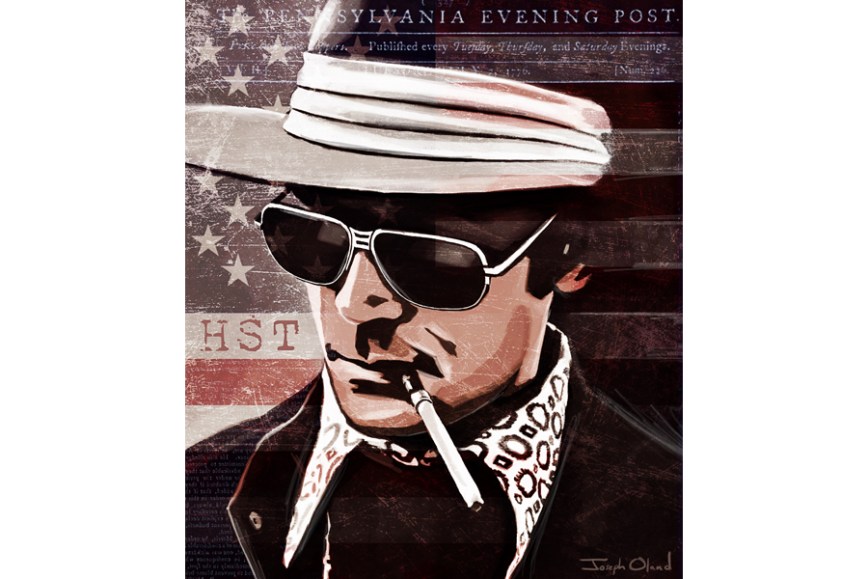
This is a years-old illustration inspired mostly by burning through several of Hunter S. Thompson’s books while licking my wounds after a failed relationship. There’s no obvious correlation between the devastation of lost love and the musings of an eccentric literary figure like Thompson.

Except maybe there is.

Losing somebody important is to feel lost oneself. Individuals like Thompson – with their preternatural ability to connect dots that otherwise seemed completely unrelated – have a unique ability to reveal the chaos beneath the order of things, and simultaneously make sense of the seemingly incomprehensible.

Words written with authority, with a voice that punches through the banal, provide comfort. I think that’s why I’ve always gravitated toward the grandiose, sometimes absurd, and – more often than not – astute observations of the ‘gonzo’ journalist.

– – –

SIGN UP FOR THE LENSEBENDER NEWSLETTER

Save

The New Joker – Scarface Juggalo

FINE ART PRINTS AVAILABLE HEREScarface Juggalo blog
– – –
MORE FROM THE DC UNIVERSE

It will be impossible for fans of Batman not to compare Jaret Leto’s version of The Joker to the monumental performance by Heath Ledger. What a lot of people don’t realize, of course, is that Christopher Nolan and Heath Ledger concocted their anarchic Joker out of thin air; their interpretation was deeply expressive in that cinematic context, but wasn’t necessarily wedded to any of the comic book versions of the character.

Neo-goth gangster – that’s what we’re seeing with this new Joker. A hybridized malcontent, a Marilyn Manson/Bugsy Siegel Frankenstein monster. In the three days that ‘Suicide Squad’ has been out, there has already been a tremendous amount of backlash. Rather than make unfair comparisons, I’m inclined to embrace this new interpretation. Low ratings and abysmal Rotten Tomato scores, these DC movies are still huge moneymakers. It’s easy to be gun-shy with these last two efforts – but when the meager ten minutes of screen-time (approximately) allotted to Jared Leto’s Joker are widely considered the best part of ‘Suicide Squad,’ I think it’s a safe bet that we’ll be seeing more from the criminally insane harlequin.

And pay attention to the fan theories. I think there might be quite a bit more to this Joker than we realize.

FINE ART PRINTS AVAILABLE HERE
– – –
SIGN UP FOR THE LENSEBENDER NEWSLETTER

Game of Thrones – Eddard Stark

Eddard blogFINE ART PRINTS AVAILABLE HERE
– – –
OTHER ILLUSTRATIONS AVAILABLE HERE

“The man who passes the sentence should swing the sword.”

In this modern world of long-form story-telling on television, the quality of ‘virtue’ almost always proves to be a death sentence. Although “Game of Thrones” is based on a series of novels that were initially published in the mid-1990s, this new age of “literate programming” has brought audiences a greater depth of character development and a newfound fearlessness on behalf of networks, writers, and show-runners to visit harm on beloved characters.

If audiences don’t care about the characters on the screen, audiences won’t feel anything if a terrible fate befalls them. That’s why we are seeing fewer and fewer “immortal” characters (central characters that audiences know will never ever die). With “Game of Thrones,” the show-runners established, during the climactic moments of season one, that absolutely nobody is safe. This ramps up interest in the story and multiplies the value of the drama.

Eddard “Ned” Stark is the enduring symbol that expresses how dangerous the continent of Westeros actually is.

In the series, Ned Stark is arguably the most honorable character, ruling over the northern kingdom of Winterfell, patriarch of House Stark. He is the moral compass of the story, inherently compelled to remain away from politics, courtly intrigue, and deception. Literarily, the family name, Stark, serves as a clever indication of his resistance to moral compromise.

After being appointed the “hand of the king,” he is duty-bound to travel to the capital city of King’s Landing. After the accident death of King Robert, we watch as Ned becomes increasingly entangled in the political upheaval of the city. He begins to struggle as his own sense of honor draws him into corrupt dealings at court. Near the end of his story arc, he is forced to choose between his family’s safety and his own sense of honor.

This is one of many paintings I have made in my ongoing series, “The Portraits of Westeros.” I hope you enjoy the work, and implore you to tell me who you would like me to paint next!

FINE ART PRINTS AVAILABLE HERE
– – –
SIGN UP FOR THE LENSEBENDER NEWSLETTER

Save