Better Call Saul 2.07 – Inflatable

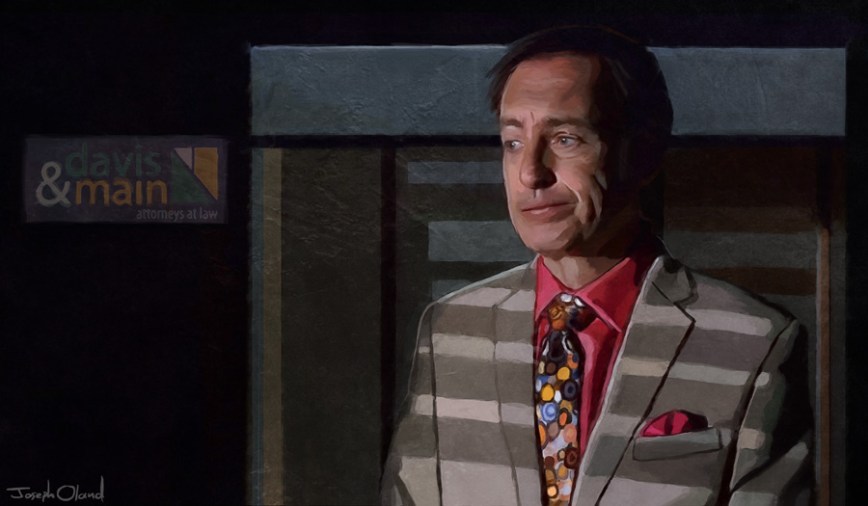
Jimmy's Fired postFINE ART PRINTS AVAILABLE HERE
– – –
READ LAST WEEK’S REVIEW

This week’s episode of Better Call Saul opens in the summer of 1973, with an establishing shot of a magazine rack reminding us of the downfall of Richard Nixon. On the cover of the magazine, with Nixon’s stern portrait, the headline reads: “Can Trust Be Restored?” As the scene unfolds, we see a young Jimmy McGill, who eventually takes a hard (and wrong-headed) lesson from a grifter.

“Listen, kid. In this world there are sheep, and there are wolves.” Any Breaking Bad fan will remember that this exact line is spoken by a fully-grown Saul Goodman to Walter White and Jesse Pinkman midway through the series.

This opening scene clearly establishes young Jimmy as a preternaturally wizened student of the human carnival. He sees right through the grifter’s con, even trying to warn his father – a message that falls on deaf ears – before taking the con-man’s advice and yanking a few bucks from the till when dad isn’t looking. It’s an oddly moving scene, witnessing a twelve-year-old boy decoding the vulnerability of his father, the man who is supposed to have all the answers.

“And so we see Jimmy steal from the till, out of resolute bitterness. With a rejection of his father’s soft-hearted gullibility, and through extension the whole sucker-generation of sheep-idealists that let themselves be cheated by the wolves of violence and corruption.”

Clearly, the theme of this episode is occupied with corruption.

As an adult, we know that Jimmy McGill is incredibly good at spotting the long-con; that’s how he landed the lucrative Sandpiper class-action case and parlay that into a company car, corporate apartment, and cushy salary. He knows how criminals work because he is, in no uncertain terms, just like them. Rather than conning convenience store clerks, he has evolved into a legal animal hoping to justify his cons by going after other con artists – for the most part.

This episode sees Jimmy admitting to certain truths about himself openly. He comes clean and admits that his atrocious behavior at Davis & Main was a ploy to escape his contract (but not the signing bonus). He admits that he’s a “square peg” that needs to do his own thing. He drops the British secretary charade when he nestles back into his nail salon back-office. Kim, having absorbed Chuck’s story about Jimmy’s youthful thievery, also confronts Jimmy in more concrete terms. She cannot allow herself to partner with Jimmy and expose herself professionally to any of his shenanigans. Jimmy can sense her distrust even if he isn’t privvy to Chuck’s meddling.

Will Jimmy accept Kim’s proposal? The episode doesn’t seem to want to reveal this until next week, but my guess is that he eventually will.

FINE ART PRINTS AVAILABLE HERE
– – –
SIGN UP FOR THE LENSEBENDER NEWSLETTER

Happy St. Patrick’s Day!

FireFight postFINE ART PRINTS AVAILABLE HERE

I don’t have any Irish blood – at least not to my knowledge. Nevertheless, it’s challenging not to celebrate a holiday that – in this sick, sad modern world – is predicated on beer drinking and revelry. Every year, my own personal tradition is to watch “The Boondock Saints.” The sequel may be a train-wreck, and director Troy Duffy may not have any more to give us, but I never tire of this delightful little film.

For you, I raise my glass and present you with an illustration inspired by the film.
Cheers!

FINE ART PRINTS AVAILABLE HERE
– – –
SIGN UP FOR THE LENSEBENDER NEWSLETTER

Fight Club – I Am Jack’s Lost Sense Of Self

Fight Club Embrace postFINE ART PRINTS AVAILABLE HERE

One of the first movies that ever inspired me to create fan artwork was “Fight Club.” Looking back, there are plenty of opportunities to tear holes in the ethos of the film, but the film is intentionally self-critical, which buttresses it against any concrete philosophical criticism – this is one of the things that’s so brilliant about it. It expresses an anti-corporate, crypto-fascist morality, but it’s also laden with ad placement from Pepsi, IKEA, Tommy Hilfiger, 7Eleven, and many, many others. What I think helped the film overcome its abysmal box office numbers – and eventually achieving cult status in the years following its release – was it’s exquisite illustration of disenfranchisement, job dissatisfaction, and a gnawing frustration with consumer culture.

Today’s illustration is yet another addition to my collection of “Fight Club” inspired illustrations, with the unnamed narrator played by Edward Norton and his only emotional anchor, Marla Singer, played by Helena Bonham Carter. I hope you enjoy it as much as I enjoyed making it, and I hope you might consider adding a print to your art collection. Cheers!

FINE ART PRINTS AVAILABLE HERE
– – –
SIGN UP FOR THE LENSEBENDER NEWSLETTER

Better Call Saul 2.04 – Gloves Off

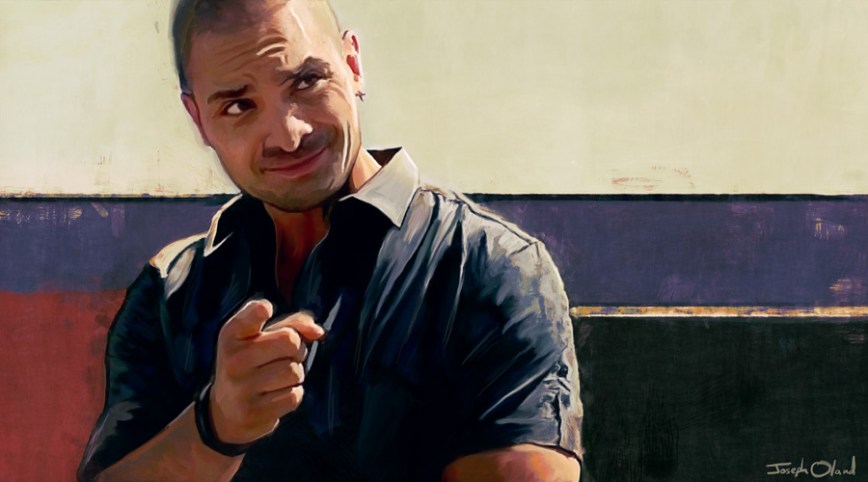
Nacho Varga postFINE ART PRINTS AVAILABLE HERE

The ‘continuity game’ with Better Call Saul is insurmountable, and this week’s episode has ratcheted-up the intrigue in new and significant ways. It also contains additional easter-eggs and call-backs to Breaking Bad (see below) to keep super-fans plugged in and on-point.

– – –

Following their late-night meeting, we find Nacho Varga (Michael Mando) laying out his plan across the street from the El Michoacano, the Mexican restaurant where drug lord Tuco Salemanca (Raymond Cruz) holds his drop-meets. With Tuco using crystal and acting erratically, Nacho needs him eliminated before Tuco learns about his side business. As we would expect, Mike Ehrmantraut (Jonathan Banks) opts to discard Nacho’s ‘up-close and ugly’ assassination plot for something more surgical.

It’s quite possible that Mike Ehrmantraut is the most interesting character in the Vince Gilligan universe. Like many others, his is a character with a dark history, having tumbled from potential greatness. He once failed to appreciate what he had, and tragedy knocked him down from his morally bankrupt ambition. The story of his life has been coming out in little drips, but in a uniquely satisfying way. The slow pacing of the series has helped with the tricky task of keeping the story mysterious and engaging; it doesn’t show all of its cards all at once.

In Breaking Bad we see Mike as a calm, calculated fixer in the employ of Gus Fring (Giancarlo Esposito). Because of this, we can reflect back and realize that he had, at some point in his past, become connected to the Salemanca drug cartel. Could this episode reveal how Mike was first acquainted? Not exactly, but the pieces are beginning to fall into place.

In season one of Better Call Saul we learn about Mike’s previous life as a police officer, that he was a corrupt cop in a corrupt precinct, and that he’s the father of a murdered son. We learn how he truly lost his soul, drawing his own son into the department’s corruption and possibly contributing, albeit in a tertiary way, to the murder.

In season two of Better Call Saul we learn just a little bit more. While shopping for the proper sniper rifle to assassinate Tuco Salemanca, it’s revealed that Mike was most likely deployed in Vietnam. In the cheap motel room, surveying military-issue hardware, we see Mike stop short after clapping eyes on a rifle he clearly has a history with. He turns to the arms dealer – a familiar face who helped equip Walter White in Breaking Bad – and says he’s changed his mind.

Jonathan Banks’ portrayal of Mike Ehrmantraut is an achievement in acting. To play such a stern and expressionless character with such exquisite finesse requires great skill. The ocean of sadness beneath Mike’s wooden veneer was revealed last season, and the audience remembers that it’s there – hidden, but there. The flash of hesitation speaks volumes of his character, and we watch as Mike chooses to take a ruthless beating – instigating a fistfight with Tuco, essentially framing him – instead of killing. It’s an emotionally complex decision for a character to make. He could have just walked away and not taken the money, but he needs that money for his daughter-in-law (and, more importantly, his granddaughter). “Gloves Off,” plain and simple, is an amazing piece of storytelling.

To quote A.R. Magalli from ‘Cut Print Film’: “How did a surly, taciturn, ruthlessly efficient, hangdog old man get to be the most tragic character in the series? If there’s a truly sympathetic character in the Gilligan-verse, it’s the man with the blood on his hands.”

– – –

EASTER EGGS:
1. Nacho tells Mike about when Tuco became erratic and paranoid while using “crank” and shot their supplier “Dawg” Paulson, leaving a piece of Dawg’s skull in Nacho. In “Breaking Bad” season two, episode two, Hank Schrader presents a profile on Tuco, mentioning that Tuco is “Reputed to have whacked one ‘Dawg’ Paulson.”

2. Mike keeps Tuco’s boxing gloves necklace as a souvenir after ensuring that he’ll spend a good five or so years in jail. The necklace is no late-addition; it can be seen back in season one.
Boxing Gloves
The gem-studded gloves may also signify that Tuco was a former competitor in the National Silver Gloves Tournament, an annual championship for young pugilists. I’m willing to bet Uncle Hector made sure Tuco knew how to fight.

3. In “Breaking Bad” we learn that Tuco’s time in jail was spent with Skinny Pete, which later leads to Jesse and Walt’s involvement with him.

4. Tuco deals with a nervous young man wearing a Tampico Furniture shirt, eventually dismissing him, saying “See you, Domingo.”

Domingo was first introduced to us in the pilot episode of “Breaking Bad,” but we knew him by a different moniker: Krazy-8. Tampico Furniture is owned by Domingo’s father, and we learn that Walt may have bought a baby crib from him when Walt, Jr. was born. If memory serves, Krazy-8 is the first person Walter White kills in the whole “Breaking Bad” series. Pretty wild, eh?

FINE ART PRINTS AVAILABLE HERE
– – –
SIGN UP FOR THE LENSEBENDER NEWSLETTER

A Look Back At “Dumb And Dumber”

Seabass postI loved “Dumb & Dumber.” Absolutely loved it. I saw it at the perfect time in my life to truly appreciate its magnificent stupidity while also getting a hint that there was a thoughtful craft behind the crude humor, a quiet genius necessary for this kind of movie to work. That’s right, the perfect time in my life: adolescence.

Two years ago, after finishing the first season of “The Newsroom,” I was pleased to see a picture of Jeff Daniels dressed as his “Dumb & Dumber” character, Harry Dunne, on my newsfeed. Talk about timing, right? As it turns out, the actor went immediately from wrapping the most recent season of his amazingly well-performed – and somewhat serious – HBO drama to once again act the fool with compatriot James Carrey. Twenty years later.

I could have guessed, even before the teaser trailer was released, that this was going to be a throw-away nostalgia grab-bag, a “hey, let’s cash a check” kind of movie. Comedy sequels have this awful habit of ham-fistedly repackaging the same jokes from their franchise, recycling winning punch-lines and tropes. It is a stupid trick that rarely, if ever, works. This usually doesn’t prevent one or two sequels from dribbling out of successful film properties. Quite frankly, after twenty years of lying dormant, I’m surprised this one even got made.

I enjoyed seeing the characters again, and I dusted off my old VHS copy of the original “Dumb & Dumber,” a hunk of plastic I bought previously viewed from a supermarket in Kansas. If you put a gun to my head, I wouldn’t be able to tell you a single thing about “Dumb and Dumber To.” It was just that forgettable. I laughed a few times, I think, but nothing really stands out. One might suppose that being forgettably bland is a notch above being memorably awful. And hey, I had an excuse to watch the original one more time, and that was enough to put a smile on my face.

Please consider supporting independent artists like myself.

FINE ART PRINTS OF THE ABOVE ILLUSTRATION ARE HERE
SING UP FOR THE LENSEBENDER NEWSLETTER HERE