Movie Review – Jane Got A Gun

Jane02 postFINE ART PRINTS AVAILABLE HERE

It isn’t possible to have a frank discussion about “Jane Got A Gun” without mentioning it’s labored creation. Originally announced in 2012, an avalanche of problems tossed this movie into production purgatory. It’s important to note these troubles because, without mincing words, it absolutely shows in the final cut. I can scarcely recall a film with such a short run time that felt so relentlessly long.

Billed as a western co-starring Natalie Portman, Joel Edgerton, and Michael Fassbender – to be directed by Lynne Ramsey – this esteemed property hit a wall at breakneck speed. In 2013, Fassbender abandoned the project in pursuit of a more ambitious “X-Men” feature. Edgerton was shifted into the vacated role and Jude Law was hired to replace Edgerton. Director Lynne Ramsey then abandoned the project, thrusting the whole production into legal proceedings before Gavin O’Connor stepped in to direct. Director of photography Darius Khondji then left. Then Jude Law left, expressing that he’d only stepped in to work with Lynne Ramsey.

I could go on, but it’s the same game of “musical chairs” that isn’t worthy of further discussion. Slated for an August 2014 release, the date was postponed – twice. It finally landed in the post-holiday wasteland of mid-January 2016. With virtually no marketing, no press screenings, and no hopes of finding a staid audience, it’s a near-miracle it’s even in theaters. No resemblance to an Aerosmith song title could help. This one was dead on arrival.

If we consider these woes, however, we aren’t surprised to learn that “Jane Got A Gun” missed its mark. To its credit, the film isn’t half as bad as one might expect, delivering a couple of well-staged scenes and solid performances  (especially by Natalie Portman). The film plays like a classic Western, and this is where it simply doesn’t work. Rather than attempt to reinvent or deconstruct the genre – as contemporary moviegoers might mildly expect – the narrative is weighed down by poorly developed characters and a staggering snail’s pace, with a series of ham-fisted flashbacks used, poorly, to elucidate the emotional complexity of the characters.

The film is clunky, and where modern audiences might expect dynamism in the characters, we see tired archetypes, caricatures that hop about the stage like marionettes. We can barely bring ourselves to care about their fates. That’s a problem.

– – –

Set in 1870s New Mexico Territory, the film opens as retired outlaw Hammond (Noah Emmerich) returns to his remote home where his wife (Portman) is waiting. Riddled with bullets, he collapses from his horse and informs her that “The Bishop Boys are coming.” So-called “mystery box” setups like this are a wonderful device – “who are the Bishop boys?” – that can engage the audience, but in this instance it carries no gravity. We don’t know who he’s speaking of. All we see is that Jane knows who they are, and that they’re definitely bad news.

She dresses his wounds and leaves him to convalesce, delivering their daughter to a neighboring ranch for safety. She then seeks help from from Dan Frost (Edgerton) to help defend herself from the inexorable onslaught.

Through a series of clumsy flashbacks, we learn that Frost was once Jane’s fiance. He left to fight in the Civil War, unaware that she was pregnant. He is eventually declared dead and she she decides to leave their Missouri home, heading west in search of a new life. Believing John Bishop (Ewan McGregor) will help secure safe passage, she is instead sold into sexual slavery and her daughter is murdered by one of Bishop’s underlings. She is rescued by another of Bishop’s cohort, Ham, who steals her away to start a quiet life together.

Enter Dan Frost, who we learn is alive and well, and has tracked Jane across the country only to learn of her new life and her new daughter with another man. Needless to say, he isn’t excited about the prospect of defending Jane and her wounded husband. Naturally, he shows up at the last minute to lend a hand. What the film establishes is that at least four or five years have passed since Ham betrayed his dapper and ruthless employer (his daughter with Jane is our clue), and the film never adequately explains why Bishop is so hell-bent on exacting his revenge. Sure, one of his men quit. Perhaps Bishop took a loss when Jane escaped the brothel – but we don’t even know if the brothel belonged to Bishop or if he simply sold her, in which case he wouldn’t have lost anything. Is it his pride that was wounded? Is there an “honor among theives” theme that’s playing out? We are never satisfied with an answer.

There is a final showdown, but I will spare the details. It plays out largely as we might expect, with a shoe-horned twist at the very end that the cast does its absolute best to play seriously. The bad guys lose, of course, but I won’t tell you what happens with Ham and Frost and their uncomfortable love triangle with Jane.

The stand-alone performances are admittedly good. Edgerton plays a terse and heartbroken rancher as stiff and stoic, nihilistic and whiskey-sipping as we might expect from a heartbroken lonely man. Throughout most of the film he staggers around like a haggard ghost who’s lost its way. Portman does an excellent job breathing life into her character. Half the appeal of the film is seeing her in boots and dress, smudges of dirt on her face, confidently wielding a rifle. I never would have imagined her in a role such as this, but hers is a compelling performance of feminine strength, spitting words through clenched teeth with a convincing mid-western Oklahoma drawl. McGregor is good, too, playing the snake-like villain so expertly I expect some viewers will fail to recognize it’s even him.

The problem isn’t in the performances. It’s mostly the pacing and the flashback structure, which attempts to fill in the background story before the guns-blazing finale. This serves to distract more than inform the film, not necessarily for their content but for how inelegantly these rocks are thrown through the windowpane of the story. The Bishop character is poorly written. He is the most archetypal “Snidely Whiplash” villain one could possibly expect. Perpetually clad in black, swarthy, mustachioed, a cigar clenched between his teeth in every single scene. All that this cartoon character lacked was a moment to twist his mustache and laugh exaggeratedly at just about nothing for just about too darn long.

This film must be filed under “potential for greatness but didn’t get there.” The skeletal structure is there. Not every story needs to be complex in order to be eloquent and compelling. The problem is that the emotional undercurrent isn’t properly expressed; the connective tissue of the plot just isn’t good. Gavin O’Connor brings this story to the screen, but it doesn’t have any personal touch to it, nothing to elevate it to greatness.

I can’t remember rolling my eyes so much at a feature film. It’s a forgettable movie that could have been special but just doesn’t make it. It isn’t worth the price of admission, although it could make for a fun home viewing. At the very least, I’m happy to see films like this and “The Hateful Eight” coming out – the western genre is in need of a revival. We are almost at full saturation with comic book films, and the comic book bubble will eventually burst – mark my words. It looks like the western might just be making a comeback.

FINE ART PRINTS AVAILABLE HERE
SIGN UP FOR THE LENSEBENDER NEWSLETTER

What’s So Special About “Fury Road” Anyway?

Blue Ange postFINE ART PRINTS AVAILABLE HERE

This is a question that’s been plaguing a lot of moviegoers this Oscar season. After news broke that the George Miller’s fourth “Mad Max” film had fetched ten – that’s right, ten – Oscar nominations, many heads flew atilt with confusion. A film with such clichés as maidens in distress, revving motorcycle engines, and great big dumb explosions can’t possibly make the cut – or can it? That’d be like giving “Lethal Weapon” an Oscar nod, and that just doesn’t happen!

Even with the disappointment with “Birdman” winning best picture last year (just go see “Boyhood,” then think long and hard about it), at least audiences could sit back and remind themselves of that movie’s half-sensical whimsy. We actually kind of get it when an “artsy fartsy” film is trying to be clever and avant-garde. We actually kind of get it when a film is intentionally bizarre and eventually fetches a lot of awards; it’s happened a thousand times before, even if it isn’t quite to our liking. But that still doesn’t explain why an action beat-em-up like “Fury Road” is getting so much attention. So what’s the deal?

The deal is this. We’re currently entrenched in an era of film-making that largely produces only two kinds of mainstream feature: special-effects-driven action films and dialogue-heavy or otherwise “literary” films. The former represents, as an example, just about any comic-book movie out there. The latter represents your so-called “art” films, those “Oscar bait” features like “The Hateful Eight” or “The Revenant.” I advocate for all category of film, to be sure, and I enjoyed “The Force Awakens” as much as anybody else. That being said, I think we all knew going into the theater, 3-D glasses in hand, that the new “Star Wars” flick wasn’t going to win a ton of awards (save, of course, for visual effects, sound engineering, and the like). It’s just the way that particular cookie crumbles.

So where does “Mad Max: Fury Road” fit into this bifurcated cinematic equation? It doesn’t – simple as that.

I will concede that, on the surface, it certainly does have the appearance of a brainless visual effects parade. Upon closer investigation, the film reveals itself to be infinitely more creative than that. Rather than confuse plot complexity with artistic brilliance, director George Miller reversed course, using a basic and straightforward narrative as a foundation from which to explore a relatively dormant style of visual storytelling.

The first thirty minutes of “Fury Road” present a deeply sophisticated visual rhythm that explains everything the moviegoer needs to know without relying on standard Hollywood action tropes. In almost every regard, the setup for “Fury Road” is a sublime sequence of pictures that approach a “silent film” quality unlike any other movie in the action genre, or any other 2015 title of any genre. I challenge any reader to re-watch the beginning of the film with no sound (or with any old song of your choosing – I’m quite convinced this would play remarkably well with a Chopin nocturne) and consider how marvelously rich and detailed the mythology of this “Mad Max” story is – and all without the aid of narration or expositional dialogue.

That is the brilliance of “Fury Road.” It is deceptively simple, but speaks in a universal, wholly accessible visual language that doesn’t rely overmuch on historical allusion and the tropes of “avant-garde” or “high” art cinema. It is a primal story that presents itself in primal, pictographic language. It’s honest with itself, it’s honest with it’s audience, and it accomplishes what very few films today accomplish. It’s visually remarkable but behaves as though its practical and digital effects aren’t important; that’s a rare quality in the action and adventure genre, and I’m pleased to see that the Academy has taken note.

FINE ART PRINTS OF THE ABOVE IMAGE AVAILABLE HERE
SIGN UP FOR THE LENSEBENDER NEWSLETTER HERE


A Look Back At “Dumb And Dumber”

Seabass postI loved “Dumb & Dumber.” Absolutely loved it. I saw it at the perfect time in my life to truly appreciate its magnificent stupidity while also getting a hint that there was a thoughtful craft behind the crude humor, a quiet genius necessary for this kind of movie to work. That’s right, the perfect time in my life: adolescence.

Two years ago, after finishing the first season of “The Newsroom,” I was pleased to see a picture of Jeff Daniels dressed as his “Dumb & Dumber” character, Harry Dunne, on my newsfeed. Talk about timing, right? As it turns out, the actor went immediately from wrapping the most recent season of his amazingly well-performed – and somewhat serious – HBO drama to once again act the fool with compatriot James Carrey. Twenty years later.

I could have guessed, even before the teaser trailer was released, that this was going to be a throw-away nostalgia grab-bag, a “hey, let’s cash a check” kind of movie. Comedy sequels have this awful habit of ham-fistedly repackaging the same jokes from their franchise, recycling winning punch-lines and tropes. It is a stupid trick that rarely, if ever, works. This usually doesn’t prevent one or two sequels from dribbling out of successful film properties. Quite frankly, after twenty years of lying dormant, I’m surprised this one even got made.

I enjoyed seeing the characters again, and I dusted off my old VHS copy of the original “Dumb & Dumber,” a hunk of plastic I bought previously viewed from a supermarket in Kansas. If you put a gun to my head, I wouldn’t be able to tell you a single thing about “Dumb and Dumber To.” It was just that forgettable. I laughed a few times, I think, but nothing really stands out. One might suppose that being forgettably bland is a notch above being memorably awful. And hey, I had an excuse to watch the original one more time, and that was enough to put a smile on my face.

Please consider supporting independent artists like myself.

FINE ART PRINTS OF THE ABOVE ILLUSTRATION ARE HERE
SING UP FOR THE LENSEBENDER NEWSLETTER HERE

The New Suicide Squad Trailer

Harley post

David Ayer’s ‘Suicide Squad’ is continuing along a new approach to film marketing that, if not outright established by ‘Star Wars: The Force Awakens,’ has been deeply influenced by it. This new style has become the gold standard for comic book and science fiction movie properties. Comic conventions, cos-players, and self-proclaimed ‘nerdists’ across the spectrum have helped transform film culture. Trailers, in and of themselves, have become event-worthy features.

Disney’s recent acquisition of the Star Wars property has proved successful, but this has been no huge surprise to industry insiders or franchise fans. It was a $4 billion purchase, but it’s recovering those costs faster than expected. ‘The Force Awakens’ has broken box office records across almost every category, although it’s appeal in foreign markets still appears to fall short of James Cameron’s ‘Avatar.’ Needless to say, nostalgia is one hell of a drug, and movie studios have taken note.

Film trailers are transforming how we look at films. They are driving internet traffic, spawning discussion boards and fan theories, and sculpting the final cut. Release dates are set not just for the picture itself, but for the trailer. Bootlegs of these trailers escape from Comic Conventions and quickly leak onto the inter-webs for everybody’s enjoyment. It has even been speculated that trailers are being intentionally leaked so as to curtail low-resolution bootlegs that simply won’t look as good. When a bootleg of the ‘Superman Vs Batman’ film was leaked last spring, Warner Brothers was essentially forced into prematurely releasing a better quality version.

To reiterate: fans are so persistent that studios are possibly leaking their own content. That is a remarkable thing.

Now, a movie trailer has commanded a half hour of television. In an extension of what has been accomplished with programs like Chris Hardwick’s “Talking Dead,” television specials are being used to market films.The Dawn of the Justice League on The CW, which aired Tuesday evening, was nothing more than a back-door pilot for ‘The Suicide Squad’ trailer. They devoted a half hour of network screen-time to debut a movie trailer.

As of this writing, the ‘Suicide Squad’ trailer has racked up 22.5 million views. These are the numbers just from the official Warner Brothers YouTube channel – several other channels have released copies of the trailer as well, all with high view rates. That is a significant number for a two minute video released only two days ago. The movie is still being made – it’s still in post-production. The final edit has not been settled upon. Audiences have seven more months before their appetites will be satiated.

Welcome to the modern film hype.

If there’s anything we all already know, this movie will cement Margot Robbi as the next hot thing in Hollywood. The CW gave a half hour of network time to a movie trailer. The movie trailer gave all of it’s energy to Margot Robbie (Harley Quinn). Fan-boys the world over have set their laser sights on the pig-tailed anti-hero, and they don’t even have to suffer through that 1950s-era Jersey accent from the Batman Animated Series.

The DC Cinematic Universe has struggled to match Marvel’s success, but the tide may be turning. Only time will tell.

PRINTS AVAILABLE HERE
SIGN UP FOR THE NEWSLETTER HERE

Fight Club And Modern Masculinity

Banner-post

For additional artwork and prints, visit my storefront: here

– – –

“Fight Club” is one of those nostalgic movies that has a special place in my heart. It wasn’t even until recently, after dusting it off and giving it a watch, that I hopped online and learned that it was heavily panned by critics and performed poorly at the box office. Even the late great Roger Ebert had some pretty sour words. Maybe it’s a ‘generation’ thing. Upon my first viewing of “Fight Club,” I knew I would never stop loving it. It is has issues – some pretty big ones, in fact. There’s a hugely problematic third act, and there does appear to be a ‘style over substance’ quality to the whole endeavor that’s pretty hard to ignore. I still think it’s pretty damn fantastic.

When “Fight Club” was released back in 1999, Roger Ebert was quick to disregard it as “macho porn.” There’s truth to this, in a sense, but I think the movie was both self-aware and intentional. Fifteen years later, considering a post-911 audience, some topics have shifted. Critics now focus on themes of sedition & terrorism, and tend to highlight the film’s wonton (and somewhat gleeful) destruction of city skyscrapers. This, I suppose, might not be as humorous to contemporary moviegoers.

The thing to keep in mind is that the film doesn’t advocate for the violence and destruction it presents. “Fight Club” is a meditation on the male animal, disenfranchisement, and the appealing but dangerous nature of herd mentality. I think it’s a careful tableaux of an imbalanced, post-modern, consumer-based society that pits “individual” and “communal” values against one another, with tragic results.

– – –

Roger Ebert opened his essay:

“Fight Club is the most frankly and cheerfully fascist big-star movie since “Death Wish,” a celebration of violence in which the heroes write themselves a license to drink, smoke, screw, and beat one another up.”

The only thing he’s correct about is the ‘fascist’ remark, but that’s kind of where I think the brilliance of the film lies. It’s anti-hero is quite literally a fascist, a charismatic sociopath who leads the members of Fight Club into a barracks and enlists them into his cult – complete with initiation rituals, hazing, forced labor, the relinquishing of individual names, and reeducation seminars. By the end of the film, these men are barely able to communicate, lest they regurgitate the nihilistic pieces of wisdom fed to them by their messiah. What I find even more fascinating is the audience who, wool over eyes, happily watch the members of Fight Club descend into destructive madness. Rather than explain precisely what was on the surface – unbridled testosterone, homo-eroticism, locker-room brawls, drinking, and sex – Roger Ebert would have done well to consider, for even an instant, what it must have been that led these men into their cult, into lives of anarchic criminality. The most fascinating thing about David Fincher’s “Fight Club” is it’s depiction of modern masculinity and the film’s ability to ask the audience a simple question: what kind of insanity can alienation & self-hatred lead to when all the dominoes are set up just right?

We all know the plot, so you’ll forgive me if I jump around a bit. It isn’t the plot that entirely interests me. The resolution plays second fiddle to the set up, and the set up is so good we can forgive the film it’s lack of focus in the final act.

The depressed, white-collar outsider of “Fight Club” is simply called “The Narrator,” and it’s effective to keep him nameless, relegating him to “everyman” status. His life presents all the hallmarks of modern American success – job stability, a well-adorned condominium, nice clothes, and a college education. The reality of his life is far different. He is lonely, wracked with insomnia and anxiety, severely discontent with his cubicle job. Not only is he dejected, but he sets the tone for every other character in the film. Foreground and background characters universally struggle with feelings of inadequacy and defeat.

Yes, indeed, “Fight Club” is macho porn, and it has gotten me off for fifteen years. But, more accurately, “Fight Club” is exquisite satire of macho porn. These aren’t the greased-up volleyball players in “Top Gun.” These are saddened and angry men who discover some sort of sick pleasure in self-destruction. It’s not a notoriously unbelievable premise. It’s not the relentless celebration of hyper-masculinity that so many critics have insisted it is. To my mind, it’s an exploration of an abstract, simplified archetype of ‘man’ and his movements in a world that has locked him in, shut him up, pumped him full of needless responsibility, rendered him fearful & subservient, and has preyed on his unrequited desire for meaning in life.

The symbolism isn’t subtle. The Narrator, quite early on, begins attending support groups – cancer, brain dementia, alcoholism, et al – as a means of putting his misery in perspective. The first group he visits is a cancer survivor group: “Remaining Men Together.” In a film about modern man’s struggle with his own masculinity, it makes sense to surround the main character with post-surgical victims of testicular cancer – men who have literally been castrated.

It becomes clear, about halfway through the film, that “Fight Club” seeks to obliterate masculine stereotypes, strangely, by employing them. The film also inverts stereotypes, allowing male protagonist to emote in ways typically reserved for female characters. For instance, The Narrator finds catharsis in these support groups; he cannot sleep without experiencing an emotional release (in this case, by being in an environment that allows him to cry). The men in “Fight Club” clobber each other in one moment, only to cry and embrace one another the next.

But in a locker-room brawl, we also remember that boys bloody-well don’t cry; an emotional man is a lesser man, probably a gay (or at least feminine) man. “Fight Club” does something interesting with this: it dismisses these negative stereotype of the emotional male. Release, be it in the form of punching somebody in the face or crying buckets of tears, proves to be empowering.

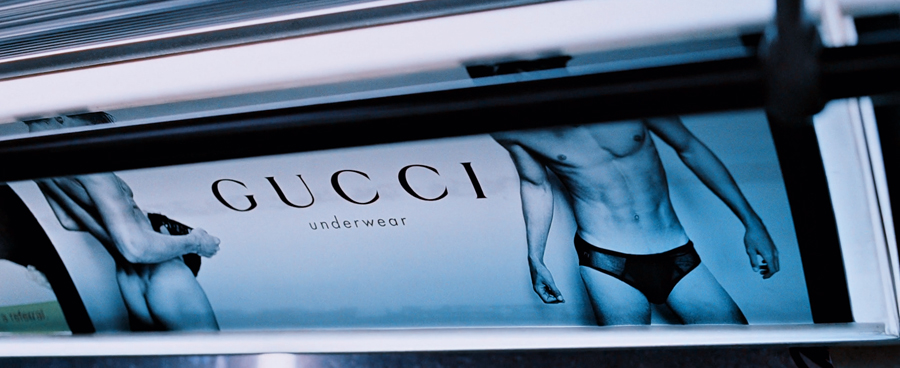
In one scene, The Narrator points to a billboard underwear ad. Taking it in – a sculpturesque man, tanned and hairless, sporting a substantial bulge and six-pack stomach – The Narrator scoffs:  “is that what a man looks like?” Anti-commercialism takes a front seat. A declaration is made about advertising and it’s negative impact on the male psyche. “I felt sorry for guys packed into gyms,” he narrates, “trying to look like how Calvin Klein or Tommy Hilfiger said they should.”

Not surprisingly, the men of “Fight Club” rally behind a renegade figure, Tyler Durden, whose condemnation of materialism and commercialism is beautifully expressed. The irony, of course, is that Tyler Durden (played by Brad Pitt) embodies the wash-board ab movie-god with clear skin and perfect teeth. We watch members of Fight Club tacitly elect a figure that, more than anything else, resembles the ideals they purport to reject. I understand, once the final reveal is made in the third act, that Tyler is a manifestation of what The Narrator views as the ideal man – good-looking, confident, and capable – but the audience doesn’t know this. The audience can’t know this in order for the story to hold any interest. It’s accidental meta-humor, our first hint that something isn’t right about Tyler’s philosophy, no matter how much we’re fooled into liking him. Remember, it’s this anarchic pseudo-messiah who convinces them to tear it all down – bathwater, baby, and all.

Along with the evolution of Tyler’s cult following, the story opines about an archetypal “primitive” man. The narrative hints not just at the reptilian brain (and the violence that comes from it), but at the notion of man as hunter-gatherer. The men fetishize Tyler, and they fantasize about a bygone era in which strength – especially strength in numbers – was essential for survival. Rejecting the conveniences of modern society, they glorify tribalism. In the dimly-lit urban backdrop of the film, we’re reminded that muscles no longer assist man the way they assisted his primitive counterpart. They’re more useful on billboards than anything else.

Underwear

So sure, Mr. Ebert took issue with the drinking, smoking, screwing, and violence. But what leads to that kind of reckless behavior – and how reckless is it, really? And why weren’t these questions asked? Discontent, in any of its forms – depression, a failing relationship or broken childhood, substance abuse, illness, et al – almost always leads to the kind of aggression, violence, and other base behaviors presented in “Fight Club.”

And beyond such base behaviors, the unhappy men in “Fight Club” are – by virtue of their discontent – susceptible to the influence of their charismatic leader. With well-constructed speeches about the evils of advertising, the fruitless pursuit of material wealth, and the helplessness of “playing along,” Tyler promises liberation – through sacrifice, obedience, and conformity. Deeply fed-up with the workaday world, these ’emasculated’ followers line up without question. The Tyler Durden character is so well-written, so wonderfully executed, that it’s easy to be taken in, even from the comfort of our living-rooms; he speaks to an oppression that we all feel.

Tyler’s more laughable pranks – urinating in soup pots and vandalizing coffee shops – give way to more severe “assignments,” which he hands out in sealed envelopes. His actions become increasingly destructive and, even though his motives seem somewhat plausible (and while many of us may be along for the ride), we ultimately know that nothing good can come from this kind of top-down leadership, and from such extreme and unquestioning obedience from his wards. Tyler manipulates his followers – using their own sadness and frustration against them – in order to achieve his goals.

“Fight Club” is a film with no heroes and only one villain (if we even want to call him that). This is precisely why things fall apart in the third act: there’s no way to effectively resolve the conflict between The Narrator and Tyler Durden. I can forgive this because the film isn’t really a ‘good versus evil’ morality play. Nobody wins in the stalemate anti-climax of the film. Nobody. Instead, we watch lost boys stumbling through life, struggling to make sense of the world – and we sympathize with them on some level. Much like in real life, nobody really wins – not even the audience. This may not have been the intended result, but it works…for the most part.

– – –

And any of you who have endured my insufferable ramblings, don’t think for a second that I’ve forgotten about Marla Singer. I’ll have more on her later.

Consumerism, Commoditization, and Courtship

The Weed


“Men always want to be a woman’s first love – women like to be a man’s last romance.”
~Oscar Wilde

Today’s a great opportunity to pretend I care about this holiday, but I can’t. It’s history has been obscured by shiny-bright advertisements, hideous department-store jingles, and a woeful pressure to shuck out hard-earned dollars for trinkets that’ll be discarded and flowers guaranteed to die. Beyond its history being bastardized in the name of making a buck, much of it is sketchy at best. At least, like so many great Christian tales, it’s history is unconfirmed, and it’s absolutely drenched in blood.

But I won’t be going into that.

Color me a cynic, but I don’t require a specific mark on the calendar to express the love and adoration I possess – for anybody. I can’t actually recall a time when this holiday inspired a legitimate exploration of love, anyway. I haven’t met a soul who can. It’s a pretty tricky subject to begin with, better left to poets, philosophers, and artists than flowers.com, Russel Stover, and Hallmark.

Love is fierce, beautiful, and agonizing, and it’s different for everybody. In my life, my dreams have been haunted by crudely lit bodies on the edge of the darkness, and I can recall those adolescent moments where romantic love and sexual desire fused together. Just like everybody else, I’ve never been able to make sense of ’em, and I suppose that’s what’s so romantic about…romance.

At the end of the day, we’re socialized in one direction, and our instincts drag us in another. There’s a tension that surrounds our sexuality in a repressed society, and that’s why it occupies every corner of our popular culture. It’s in our sit-coms, our pop songs, our art, and our literature. We’re obsessed with it, likely because it’s a puzzle that can’t be solved.

Especially not by a cheap box of chocolates or a diamond ring in a champagne glass.

Politics, Portraiture, and Painting

Takin’ A Break

– – –

I haven’t committed ink to paper since I returned home from the Tucson Rodeo.

Post production of these images is time consuming. Since I’m not purely interested in the press aspect of rodeo images, it took a good deal of time to sift through the work for potential future projects. More time was consumed working on a project designed to personally defend my interest in rodeo photography; a few individuals in my community took issue with the work – particularly from the animal rights perspective – and I saw an opportunity to convert this oppositional dialogue into something more. This project has grown large, however, and I’ve decided to refrain from publishing additional content until there’s enough for a full-fledged show.

In Politica Rodeo – the working title of the project – is slated for release in August.

– – –

In the meantime, I’ve been working with faces, with music, and with paint. The occasion to photograph has arisen frequently, such that I’ve scarcely had time to set down the camera. My community is a beacon for the outcast, the eccentric, the creative, and the wild. Musicians have poured through Bisbee, blowing through on their way to (or from) Austin, Texas for the SXSW event. I’ve had the pleasure of enjoying gypsy confections, live music on the street corners, laughter over pints – my lens hasn’t been wanting for subjects to photograph.

I have also begun a new illustration project revolving around El Dia de los Muertos, something that’s fascinated me since I was a child. It began as a simple photo shoot for fun out in the Lowell district a couple of weeks ago but, as things often do, it quickly evolved into something else while I tinkered with the images on my computer. I’ll certainly let some images find their way onto the web, but I intend to hold my cards closer to the vest until my opening in October at Art Awakenings Gallery.

– – –

Until later, I hope these words find you in a pleasant space, with reasons to smile and opportunity for laughter.
Cheers.

-joe