The Walking Dead 7.16 – The First Day…

FINE ART PRINTS AVAILABLE HERE
– – –
ALL WALKING DEAD MERCHANDISE HERE

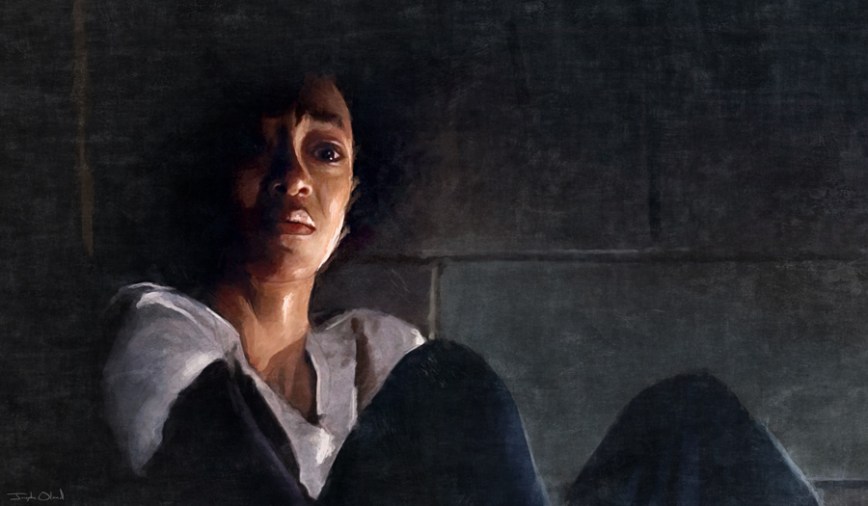
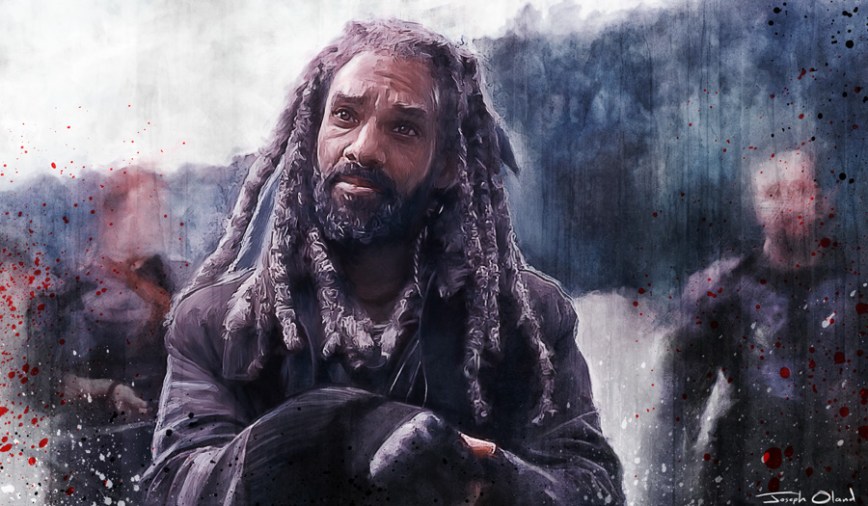
So here we have it, the finale, titled “The First Day Of The Rest Of Your Life.” We’ve been waiting since the season opener for an episode centered around Rick, and I guess this is what we have to contend with. Last week ended with Dwight (played by Austin Amelio) visiting the Alexandria camp with a truce offering and a willingness to help take down Negan – but this story-line doesn’t really go anywhere here, not to anybody’s surprise. There’s always room for next season.

I guess.

Oh. And a betrayal by the garbage-pickers? Shocking.

<rolls eyes>

“We’re going to war.”
That’s all that really happened in this episode. Sasha died (we’d been expecting it) and Eugene is a coward (which we already knew). And we all knew that there wouldn’t be a conclusion to the ‘Alexandria Versus The Saviors’ plot in an hour-long episode. So we get to see an angry Negan, more tactical maneuvers, plotting, and intrigue in the next exhausting season.

I think I’m about done.
This is getting stupid.

Great finale. Huzzah…

READ LAST WEEK’S REVIEW
– – –
SIGN UP FOR THE LENSEBENDER NEWSLETTER

Wrong Eye, Carl – The Walking Dead

ALL WALKING DEAD MERCHANDISE HERE
– – –
SEE THE WALKING DEAD EPISODE REVIEWS AND ART

Ever shot a gun before? No? Well let me speak an obvious truth – you need to be able to look down the sights in order to hit your target. In this week’s episode of The Walking Dead, titled ‘Something They Need,’ we see a wee-little mistake, as Carl Grimes looks down the barrel with his dominant (right) eye, which doesn’t actually exist – he lost his eye after a rogue bullet glanced his face while the group was attempting to navigate through a horde of walkers in season six.

In a show celebrated for its attention to detail, this is one little example of where they dropped the ball. It’s not an indictment – it seems to me that the stance of the various characters in the scene was designed for the director of photography, for visual composition. It might not look realistic if a naturally right-eyed and right-handed actor had to pantomime or pretend at being newly handicapped, but these are the details that hardcore fans notice.

I would also reference how insanely accurate Shane was, in season two, firing his sidearm at a swinging log while trying to train Andrea – rest her soul – how to shoot. He hit his moving target, with a 9mm handgun – a moving target, at distance – every single time. A well-trained officer might be able to achieve this, but it feels unrealistic how quickly he turns from admonishing her timidity, then draws his weapon, and effortlessly & with no time to aim, hits his target –  all in a fraction of a second.

Few people are that accurate with a handgun.
Just sayin’.

SIGN UP FOR THE LENSEBENDER NEWSLETTER

The Walking Dead 7.15 – Something They Need

FINE ART PRINTS AVAILABLE HERE
– – –
ALL WALKING DEAD MERCHANDISE HERE

The Walking Dead is all about setting things up, generating tension, and looking forward to future episodes – to a fault. This isn’t more obvious than in the penultimate episode to their seasons. The chess pieces are set up, the dramatic tension is well-established, and the next-to-last episode is intended to leave audiences gripping their armrests and wondering what’s going to happen next. What we’ve learned about The Walking Dead, season after season, is that the “big reveal” probably isn’t going to happen during the season finale; the show-runners and AMC prefer to string audiences along, and the “big reveal” is left for season openers, not season closers. It’s so thoroughly unsatisfying and emotionally manipulative, I cannot believe it. This might be the reason why the show’s ratings have been flagging in a seriously significant way.

It can be exhausting, always waiting for a pay-off that rarely, if ever, arrives.

We already knew that Eugene’s poison pill was going to come back – because…plot – although I suppose few of us could have predicted that Sasha would be foolish enough to rush the gates, lock Rosita out, and run in for a suicide mission against Negan’s army. There will be a reveal, and Sasha will die, but it isn’t likely that the loss is going to affect audiences like the loss of Glenn & Abraham; in that situation (season seven’s opening episode), The Walking Dead really raised a high bar for shocking audiences, and I don’t think they’re going to be able to achieve that ever again.

Something I do find compelling, at least a little bit, is that Rick and his crew of Alexandrians rolled into Oceanside and took all of their weapons, leaving them somewhat defenseless. This paints Rick and his cohort with a brush that isn’t dissimilar to Negan – taking what they need, leaving innocent people vulnerable, and not really giving much of a damn. If the Alexandrians aren’t successful in their mission against The Saviors, there’s still this vulnerable colony, who haven’t actively hurt anyone, left completely exposed.

Descend on innocents, take what doesn’t belong to you because you feel you need it more, and leave. Is that Rick, or is that Negan? Interesting moral conundrum.

Fatigue is setting in for audiences with a show that doesn’t seem to have any end-game. There’s no narrative satisfaction when it feels like a show is doing is best to keep on going, indefinitely. Audiences want a beginning, a middle, and an end. This isn’t an open-world massive multi-player online game. This is a story. And with no end in sight, we’re getting fed-up, and the proof is in the ratings.

Negan won’t die next week. Sasha will. The conflict with the saviors will, at the very least, be drawn out over the entire next season. The Walking Dead is starting to feel like Dexter. Remember Dexter? It was a hot property for a good long while, until FX kept stringing audiences along, kept repeating the same tired formula each season, and the once-promising show is barely even memorable after it’s miserable and ham-fisted conclusion.

I hope I’m wrong, but I think history is repeating itself.

READ LAST WEEK’S REVIEW
– – –
SIGN UP FOR THE LENSEBENDER NEWSLETTER

The Walking Dead 7.14 – The Other Side

FINE ART PRINTS AVAILABLE HERE
– – –
ALL WALKING DEAD MERCHANDISE HERE

Two blank slates – Rosita and Jesus – were finally given some back-story. It would take some mental gymnastics to justify why these two characters were neglected for so long, given how central they are to much of this season’s story, but it’s pleasing that we finally have some additional context for them. At this point in The Walking Dead, it isn’t unusual for random outbursts of character development – without warning or lead-up – so it’s easy to assume that these two are going to play a major role in the ‘All Out War’ story-line of season eight.

It will be a breath of fresh air to see Rosita doing something other than being angry at everything and uncooperative because…feelings. Her pouty face and clenched teeth aren’t enough. It looks like the writers are getting ready to give her a lot more to do, and it will be a welcome change of pace. This entire season, she has been a two-dimensional, boring bundle of “I hate life.” It’ll be nice to see her behave like a woman with cunning and agency, rather than a pissed-off teenager.

With regards to Jesus, backstory is nice – in this instance, however, it’s not entirely necessary. I think that the show has established, pretty clearly, that he’s something of a loner, who probably didn’t get along with a lot of people in the world before the fall. Background and motivation is always welcome – and it was touching for him to have a low-key coming-out moment – but audiences already know that he’s something of a loner, and his sexuality is immaterial. Not a tremendous amount of depth or insight, but the character is definitely becoming more three-dimensional and relatable – hopefully this doesn’t mean he’s about to be axed.

(I doubt it does)

Truthfully, not a whole lot happened during this episode, despite tense moments for Maggie & Daryl hiding in the cellar, political power-plays at The Hilltop, and Rosita & Sasha deciding it’d be a great idea to try and single-handedly assassinate Negan. This episode was about little moments, between Daryl and Maggie, Sasha and Rosita. It’s a reinforcement of Eugene’s cowardice, and it buttresses our understanding of how shaky the politics of The Hilltop are. If you think that Sasha is going to make it out alive, I’ll go ahead and leave you with this:

Actress Sonequa Martin-Green, who plays Sasha, has signed a contract and will be a recurring cast member in the next Star Trek television series. No wonder her behavior at the end of this episode seemed so painfully shoe-horned. Gee-willickers, I wonder what’s going to happen…

Sigh…

And, dollars to donuts, the crossbow-wielding silhouette isn’t Daryl. That’s Dwight. Guaranteed. And he’s willing to join the Alexandrians in their upcoming conflict with Negan. I’d place a very stiff bet on it.

READ LAST WEEK’S REVIEW
– – –
SIGN UP FOR THE LENSEBENDER NEWSLETTER

The Walking Dead 7.12 – Say Yes

FINE ART PRINTS AVAILABLE HERE
– – –
ALL WALKING DEAD MERCHANDISE HERE

The last several episodes, in my humble opinion, have been misfires. This is pretty apparent if you’ve read through my previous write-ups. It isn’t as though fans aren’t aware of the abundance of “filler episodes” in the show, and it isn’t as though any of us are unaware that there can be an effective use for these episodes when it comes to illustrating the growing connections and tensions between the show’s characters. The trend that I’ve noticed is that all of the material invented specifically for the show – rather than material taken directly from the comic books – straight-up isn’t as dynamic, interesting, or well-thought-out. And no, this isn’t “fan boy” territory, as though I personally would want to see on television exactly what I’ve already read in the comics; that’d make watching the show exceedingly boring. I adore that the writers and show-runners are actively trying to make the television show distinct from the comics in several inventive ways in order to maintain interest among pre-existing fans, create suspense, and keep audience members guessing.

The point is this: the “Oceanside” and “Garbage Picker” (as I’ve come to call them) communities have absolutely no personality to speak of, no heart or soul, and no reasonable explanation as to how they even exist. They deserve little, if any, sympathy from the show’s established communities, or from the audience. How does Oceanside surveil their town? And why haven’t they migrated to territory further away from Negan’s clutches, where they’re less likely to be discovered by scavengers under Negan’s employ? And no men, you say? At some point, this community is going to realize that the trauma delivered by The Saviors won’t be enough to quell a woman’s need for sexual intimacy – at least not indefinitely. And what of the Garbage Pickers? Surviving after making a home in the most unsanitary place they could find, a landfill, despite a massive shortage of medical professionals, medical supplies, not to mention clean food and water? In a landscape filled with rusted nails, rotting food, pack rats, and flies? Yeah – that makes perfect sense. And how are we to honestly believe that they’ve forgotten how to speak English less than two years after the collapse of civilization? No linguist is going to accept that any new form of distinct English dialect would surface from a semi-isolated community in such a painfully short period of time.

The following is a transcript, verbatim, of the words spoken by Jadis, the inexplicable leader of the Garbage Pickers, at the time when Rick delivers several dozen new firearms: “Operational? All? Yes, yes. But operational? No. Not enough. Enough to fight your fight. Us. Nearly twice. Need nearly twice. No. Our guns to take. Our deal. Still on.”

Following that ridiculous, truncated word salad is a negotiation between Rick and Jadis regarding how many of the guns Rick can keep in order to protect his people while they search for even more guns. During the negotiation – as a part of the negotiation – Jadis demands Rick give back the wire cat sculpture he took from the dump – the dump! – after his gladiatorial fight with pin-head, to give to Michonne as a gift. How could such a trivial, stupid goddamn thing enter into a serious negotiation about armaments?

Because of these things – and many, man more – these communities haven’t really earned any empathy; audiences aren’t devastatingly concerned about what’s going to happen to them. This is specifically why I think both communities are going to be decimated in the war to come. The introduction of these new communities feels almost like an afterthought. They absolutely reek of the same wooden, unsympathetic personalities that we see in Fear The Walking Dead, the ill-begotten spin-off series. Why do these things – the Garbage Pickers/Oceanside characters and the Fear The Walking Dead characters – feel so similar, you might ask? Once again,  because they aren’t inventions of Robert Kirkman, who created the whole Walking Dead universe. With no solid source material, there are no solid characters.

None of this means there isn’t an awful lot to celebrate about The Walking Dead, and it would be overly cynical of me not to admit that this week’s episode definitely got a lot right.

The series has spent far too many episodes neglecting the impact of Abraham and Glenn’s deaths on Rick’s emotional well-being. In some ways, I suspect that the season premiere – focused predominantly on Negan breaking Rick’s spirit – was intended to do just that. At the same time, I think it would’ve been better to sporadically reinforce how Rick is (or isn’t) managing his emotions in a few little ‘reminder moments’ scattered throughout the season. He is, after all, the main character of the series, and the audience largely sees the world through his eyes. It was a breath of fresh air to finally see him opening up about that sarcastic young pizza delivery boy, Glenn, who saved his life in the very first episode, when he was trapped inside that immobilized combat tank.

This episode made for wonderful character progression for Rick and Michonne. It has been a long time since we’ve been able to feel this kind of sympathy for Rick. He’s typically written in such a way that we almost always know he’s going to survive: outliving his wife, outliving a rival in love (Shane), making it through the governor’s assault, the swine flu, the hacking off of his girlfriend’s arm when Alexandria was overrun by walkers, and persevering when he had to fight that ridiculous pin-head super-walker for the Garbage Pickers earlier this season – and that’s just to name a few. A very few. And it even happens again in this episode, when that love-struck fool tries to shoot a deer in the middle of a walker assault and gets himself trapped by an encroaching wall of the stumbling but savage undead. The saving grace here is that the majority of the episode was executed incredibly well.

We are finally reinvigorated, seduced yet again into wishing for success for Rick and the gang. We want them to overcome the horrors they’ve endured. Episodes of The Walking Dead are always wonderful when they remember to let the audience see the characters smile and enjoy a small victory, despite their bleak surroundings. It’s affecting to have a moment of levity in an episode (or a whole season) mired in struggle and heartache.

How often do we actually see Michonne smile in The Walking Dead? We see her smile just about as often as we ever hear any character actually laugh (unless, of course, it’s a mustache-twirling villain preparing to bash somebody’s brains in). Hearing Rick and Michonne cackling just after falling through the roof is arguably one of my favorite moments of the episode. It was unexpected bliss, rather than an unexpected jump-scare or a tragic and untimely death.

The episode ends with the Garbage Pickers insisting they still need more guns, despite the cache delivered by Rick and Michonne. And, how convenient that we have Tara at the end of the episode – the only one who knows about those well-armed ladies in Oceanside – with something important to confess. How unutterably convenient. Ten bucks says that this plot-line won’t be addressed, at all, in next week’s episode. We’ll have to wait a week or two, if not several months into the future when the next season begins.

Cliffhangers aren’t even cliffhangers anymore. Not in The Walking Dead. You won’t tune in next week at the same bat-time, same bat-channel, and learn what happens to our heroes next. No, no. We’re all going to learn something completely unrelated, in one of the other communities, about a whole group of other characters.

In the words of foghorn leghorn: I ga-rohn-teeeee!

READ LAST WEEK’S REVIEW
– – –
SIGN UP FOR THE LENSEBENDER NEWSLETTER

The Walking Dead 7.11 – Hostiles and Calamities

FINE ART PRINTS AVAILABLE HERE
– – –
ALL WALKING DEAD MERCHANDISE HERE

As mentioned in previous commentaries – and I like to believe that the issue is rather obvious – the cast of The Walking Dead has swollen to an almost unmanageable size. It’s a problem, because the idea of the world expanding, of civilization taking root after the apocalypse, is an intriguing one. It’s a great idea, in fact, and lives well on the page in the printed comic book series. But it appears to be more of a logistical and narrative nightmare to have this expanding world come alive on the screen.

We can probably assume, however, that the “All Out War” section of the story these recent episodes are building towards will cull the herd significantly. My fingers are certainly crossed that we eventually see some of the excess baggage cut loose. The garbage pickers, guaranteed, are going to be bullet-sponges; they are the least interesting, least developed characters, and they offer the least in the way of answers as to how their society functions, how they have survived, and why eighteen-months of story-time (roughly) has been enough time to influence the very structure of their language. Who is this Jadis, and through what mechanism has she achieved a leadership position? Raw physical power, charisma, persuasion, and extortion all seem unlikely – especially that ‘charisma and persuasion’ bit – her verbal communication skills have been reduced to two word, stilted sentence fragments. I predict that these characters will be quick to die.

But we all know who’s going to be sacrificed first though, don’t we? Why of course we do! It’s going to be none other than the young and lovable Benjamin from the Kingdom. Don’t remember him? Well, he’s the young one who has taken up the bo-staff under Morgan’s instruction. He’s baby-faced and sympathetic, trying his gosh-darned best to learn how to defend the kingdom like his father before him, all while taking on the responsibility of raising his younger brother. Morgan even appears to be influencing the young lad, injecting his philosophy of non-aggression. This kid was marked for death from the moment Benjamin’s sob-story character was introduced, and every little moment with him has been specifically designed to make audiences like him, pity him, and quietly root for him, so as to make his unavoidable – I guarantee it, unavoidable! – death a sad and meaningful one.

My guess is that Benjamin’s death is what’s going to change King Ezekiel’s mind about joining in the battle against Negan. I’d put money on it.

That all being said, this episode isn’t about the Kingdom or Hilltop communities at all. With all of the different communities and the bloated cast, all of this season’s episodes have been reduced to focusing on one group at a time, save typically for the cliffhanger-heavy outros. In this episode, we get more details as to how The Sanctuary functions, more specifically focusing on Dwight, who clearly appears to be having a change of heart regarding his position, and Eugene, who has recently been kidnapped and taken under Negan’s wing.

– – –

It isn’t challenging to overlook characters like Eugene. Even dramatic moments – chomping Dwight in the crotch outside Alexandria last season – are easily funneled into humor, and Eugene has mostly been written as the butt of the joke. Despite this, actor Josh McDermitt turned in an exceptional performance. Throughout the episode, we are made to wonder whether he has some kind of secret plan to assist the Alexandrians (or maybe escape), or if he truly has accepted his role as one of Negan’s soldiers, along with all the responsibilities and, more importantly, with the sense of safety and all of the creature comforts. This question isn’t answered by the episode’s end, and I’m doubting we’ll have an answer until the season finale.

Negan’s fate is in the background of the whole episode. We wonder about Eugene’s allegiance, Rick and the Alexandrian’s are hunting for weapons and recruits to storm Negan’s compound, Dwight appears to be having second thoughts about his life with the Saviors, and even Negan’s wives are plotting to have him killed, requesting that Eugene manufacture poisonous pills. And, of course, just like Walter White’s ricin, we have some pretty obvious foreshadowing – lest we forget that we don’t ever see Eugene destroy the pills, even though he didn’t give them to the wives.

I’m guessing they’re going to make an appearance in the near future. Time will tell.

READ LAST WEEK’S REVIEW
– – –
SIGN UP FOR THE LENSEBENDER NEWSLETTER

The Walking Dead 7.10 – New Best Friends

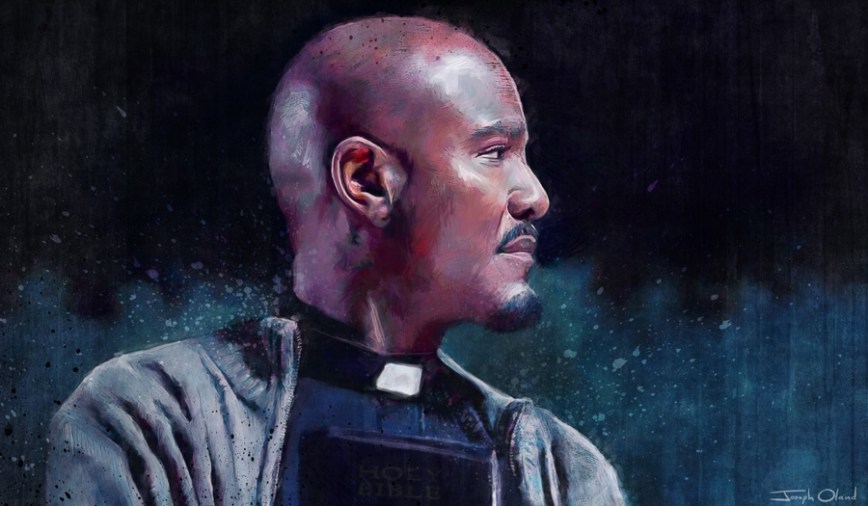
FINE ART PRINTS OF THIS IMAGE AVAILABLE HERE
– – –
ALL WALKING DEAD MERCHANDISE HERE

Inexplicable “hell-raiser” walkers. There’s no sense or reason to most of this episode, and it is painfully disappointing.

This episode, titled “New Best Friends,” is a clear example of the best and worst qualities of The Walking Dead. The small character piece between Daryl and Carol after their long-awaited reunion demonstrates a tendency toward emotional and arresting tension, depth of character, and attention to human detail. On the opposite side of the coin is the introduction of the garbage pickers, a collective of horrendously one-dimensional personalities in an already crowded cast. In these scenes, Rick – one of the only, if not the only, immortal characters – is the one pushed into danger. We already know he’s going to survive, so we don’t care when he’s fighting the most inexplicable and improbable of creatures. Meanwhile, we have characters like Rosita, a small scar on her face, now reduced to a character who is solely defined by her anger.

Roughly half of the episode concerned itself with this new community, who have set up their civilization in a garbage dump. Few details are introduced as to how this community functions – unlike The Hilltop, The Kingdom, and The Sanctuary – and there is little rhyme or reason as to how their leader, a woefully underwritten character, has ascended to a leadership position among them. The stilted language of these people, the icing on the cake, makes the explanation of their survival in the zombie apocalypse even more confusing than their terrible choice of locale.

That’s the bad part. The show hasn’t completely lost its way, and there is a great deal of solid source material – the comic book series – that the television show has to draw from.

Carol’s character is one of the show’s most complex creations, with one of the most engaging character arcs, and actress Melissa McBride has delivered consistently powerful performances. There was a palpable emotional pay-off when she and Daryl are finally reunited, after having been separated for the space of an entire season. Chemistry is real – Melissa McBride and Norman Reedus (who plays Daryl) have it.

The show is setting up, as it often does, all of the chess pieces in preparation for a grand finale. It will likely be a satisfying spectacle, and there’s nothing wrong with moments of levity. It’s just that the show has a tendency to stretch the narrative beyond it’s audience’s patience. As things stand now, not only is the narrative being drawn out, but ridiculous and improbable scenarios are cluttering up the story.

No community is going to risk its safety pouring melted pewter over a walker’s head to create some kind of “super walker” pin-head confection, only to give it up as a sacrificial lamb. Additionally, there is no sense in a community committing itself to war against total strangers (The Saviors) when other strangers (The Alexandrians) arrive and show that they have the gumption to kill their pin-head walker. This isn’t how trust is established, and this isn’t how war is waged. Period.

Rick and the Alexandrians need lots of guns, eh? Well shucks, I guess that’s why Oceanside (equally as underdeveloped as the garbage heap survivors) was introduced during the front-end of the season. Whatever will Tara do? Will she eventually tell Rick? You betcha, she will.

Yes. We all know. She’s going to betray Oceanside’s trust, and they’re probably going to join the fray against The Saviors, too. Because? Plot. Transparent, predictable, underwhelming plot.

I think we all know that Carol is eventually going to learn the truth about her fallen brothers and sisters, too. Daryl might have had her best interests at heart, but the truth will out, creating dramatic tension between these two soul-mates, and it’ll draw Carol into the conflict we all know is coming. There’s nothing wrong with foreshadowing, and there will always be predictable arcs in a serialized drama, but The Walking Dead is going too far. The surprises are never major plot points, but only involved with “which beloved character is going to die next?”

It feels lazy. It feels like the show is disrespecting its audience’s intellect.

Why does it feel like that? Because it absolutely, one-hundred-percent is doing just that.

READ LAST WEEK’S REVIEW
– – –
SIGN UP FOR THE LENSEBENDER NEWSLETTER

The Walking Dead 7.9 – A Rock In The Road

FINE ART PRINT OF THIS IMAGE AVAILABLE HERE
– – –
ALL WALKING DEAD MERCHANDISE HERE

Fans have been waiting for the ‘back end’ of season seven to begin, in lurid anticipation after the significant character deaths that have colored the ‘front end.’ Diverting from the comic book, communities like Oceanside – and the new garbage-heap group introduced in today’s episode – have surfaced, keeping fans engaged and completely disrupting the prognostications of comic-book fan-boys like yours truly.

For the first half of the season, the narrative has been exceedingly involved in illustrating the psychological wounds endured by Rick Grimes and the entire Alexandria contingent in the wake of their brutal first encounter with Negan and The Saviors. Regardless, audiences have been waiting to see the Rick Grimes character rediscover his courage and fighting spirit, and it seems pretty evident that this is exactly the theme of ‘Rock In The Road.’

Unfortunately, it also appears that this episode is falling victim to the program’s tendency toward slow-paced “filler.” Character development is important, but when the pace is slowed, it’s important for the character interactions to feel authentic and significant, and there’s something about the scripted dialogue in the opening scenes of this episode that feel painfully wooden and inauthentic. The way Jesus explains his knowledge of another community, “The Kingdom,” feels light and casual, with absolutely no gravity (even though he is forbidden from revealing details about the community). It is also important to remember that the Alexandrians have been isolated survivalists who were, just one season prior, completely shocked by the existence of “The Hilltop.” And there is something about the frenetic and exasperated utterances by The Hilltop’s leader, Gregory – “rheeee-tor-i-cal” – and the interjections by the lovable hayseed “Daryl,” that just don’t ring true when we examine the character.

“Yer either with us or you ain’t! Yer talking out of both sides of yer mouth!”

Watching those words come out of that particular character just seemed awkward and completely out of style for a reasonably unthinking rough-and-tumble man who relies on his instincts and skills and not his diplomacy and intellect. Action set-pieces like a herd of walkers being sliced apart by a taught cable strung between two cars, while visually impressive and undeniably fun, seemed like an implausible afterthought designed to help the episode recover from its painfully shallow dialogue.

Yes. We now have a unified group of people who want to fight – exactly what audiences want – but we also have flagging character development and the introduction, at the tail-end of the episode, of yet another underdeveloped community of people who may or may not aid our heroes in the war to come. And let’s face it – we know that the hooded garbage-pickers are going to fall in line, eventually, in armed conflict with Negan’s Saviors. Little has been left to the imagination and characters are being rewritten and yanked from the thoughts and actions we would naturally expect from them after seven seasons of development.

There is absolutely no reason why Rick would smile after his group is besieged by hooded, gun-wielding kidnappers. But hey, it sure does make for a great cliffhanger.

Has the show jumped the shark? Certainly not. It’s engaging and entertaining, and I can promise you that I’ll be tuning in next week. But something about this episode just didn’t feel right. Let’s see if the ship corrects itself.

SIGN UP FOR THE LENSEBENDER NEWSLETTER

Mr Robot – Season Two Premiere

Mr Robot postFINE ART PRINTS AVAILABLE HERE
– – –
MORE MR ROBOT HERE

This is an intriguing show, and the effort by director and show-creator Sam Esmail is nothing to turn your nose at. Most series have a team of writers, directors, show-runners and executives to assist in the production. Esmail has single-handedly written and directed every episode of the show – that’s borderline insane.

At the same time, the show is – in my opinion – on shaky ground. It’s a long-form version of ‘Fight Club.’ It’s a narrative with a malcontent protagonist who uses his intellect to try and cripple the global financial system. He has disossiative personality disorder – with elements of schizophrenia sprinkled-in for flavor – just like the nameless protagonist of ‘Fight Club.’ Their taget? Credit card companies and banking systems, with a specific goal to create global financial chaos.

These kinds of stories are played out. The notion of multiple personalities has been thoroughly debunked by the psychological community, which injures ‘Mr Robot’ at its premise; we, the audience, have to take a leap. And so far, the show has been reasonably convincing in it’s portrayal or this disorder, engaging in its narrative, and fun to watch. Elliot isn’t just preternaturally intelligent, but he’s mentally ill and he suffers from substance abuse – all of these things work to sell the notion that he communicates with an imagined dead father. In season two, after kicking his drug habit, the whole idea is starting to feel flimsy.

Esmail and Co. are going to have to work harder to sell this character and keep the show as interesting as it was in season one. Right now it appears to be riding on a razor’s edge – it isn’t too cliched and campy to not enjoy, but it’s structure is becoming predictable and it’s characters too wooden and archetypal.

I guess we’ll just have to wait and see what happens.

FINE ART PRINTS AVAILABLE HERE
– – –
SIGN UP FOR THE LENSEBENDER NEWSLETTER

Breaking Bad – How Does It Hold Up?

Breaking Bad - I Won blogFINE ART PRINTS AVAILABLE HERE
– – –
MORE POSTS FROM THE GILLIGAN-VERSE

It’s mid-summer. We’re in a lull. Spoiled by this, the ‘Golden Age Of Television,’ there’s a lot to look forward to, but not a whole lot to indulge in, other than second viewings of our DVR’d favorites and bingeing on Netflix – and ‘Mr Robot,’ of course. Recently, I’ve started burning through all of the old ‘Breaking Bad’ seasons, not only because I’m a fan of the show, but because I’m curious as to how well, even just a couple of years after its finale, the show really holds up.

‘Breaking Bad’ raised the bar, but it definitely does feel a little dated, which I hadn’t really expected. Coded character archetypes and narrative patterns that have been emulated by countless television series, the treads on ‘Breaking Bad’ are surprisingly thin. It’s still an enjoyable show, but I suspect it will fade quickly, as did other hit shows like ‘The Sopranos’ and ‘The Shield.’ It broke new ground, but it isn’t a stand-alone triumph. Rather, it raised the stakes and motivated other series to ‘up’ their game, raise their standards, and push forward.

When all is said and done, only period pieces manage to capture an ageless, timeless quality. ‘Rome,’ and ‘Deadwood,’ and ‘Downton Abbey’ aren’t anchored in contemporary culture and modern life, so they will never age so terribly as many other stories. Flip phones are already a thing of the past – sorry, ‘Breaking Bad,’ but your age is showing. And there was a three-season story arc in ‘The Shield’ revolving around the protagonist’s child being diagnosed with autism and a class-action lawsuit against an MMR vaccine that his daughter’s autism was blamed on – but the science is in on that one, too.

For anybody looking for a fight: the MMR vaccine doesn’t cause autism. Hit me.

It’s risky, trying to anchor story-lines in the present; things in the present change very quickly. Dangerously so when you’re a screen-writer.

The music-video jump cuts of ‘Breaking Bad’ are also slowly disappearing. Audiences recognize these montages for what they are: near-effortless attempts to kill time and compensate for a script that doesn’t quite fill the forty-two minute run-time of the episode.

‘Breaking Bad’ broke new ground, along with a few other of its contemporaries. It will be forever remembered as an innovative leap in long-form television story-telling. And I will always be a fan. But watching the shift from ‘Breaking Bad’ to ‘Better Call Saul’ has been interesting. The deliberate pace of ‘Saul’ has alienated some viewers, but it demonstrates how the show-runners and executives understand the medium, and the changes the medium has undergone. I’m very much looking forward to what Vince Gilligan & Co. have up their sleeve for seasons three.

FINE ART PRINTS AVAILABLE HERE
– – –
SIGN UP FOR THE LENSEBENDER NEWSLETTER

Save

Save