The Walking Dead – “Knots Untie”

Daryl Dixon postFINE ART PRINTS AVAILABLE HERE

“Your world is about to get a lot bigger.”

These are the words of Jesus, the previous episode’s newest addition to “The Walking Dead.” And he isn’t joking. The world is about to expand for all of the Alexiandrians as news of other settlements is revealed. As the back-half of season six leaped forward in time, we’re also beginning to get the sense that the walkers are getting ready for a massive die-off. This is hinted at in the comic book series as well; most walkers were made during the initial wave at the beginning of the series, and a rotting body doesn’t last forever. Those who have carefully observed, each season has brought with it walkers in more and more advanced stages of decomposition. The walkers in season six are soft, sticky heaps of bone, showing evidence of butyric fermentation and advanced decay.

It can safely be assumed that walkers, while eminently dangerous, are becoming less of a threat. The more significant threat comes from other survivors, scrambling to organize, secure resources, and defend themselves. We already know how dangerous The Governor was, and we know what happened to the settlement at Terminus. The apocalypse appears to have polarized the survivors, splitting them into one of two distinct groups: weakened survivors (like the Alexandrians) and ruthless tyrants and bands of highwaymen (like the leadership at Woodbury, the cannibals at Terminus, and the raiders led by Negan). Rick and his group have managed to stay somewhere in-between these two extremes, and “The Walking Dead” is constantly examining the morale, and moral turpitude, of the group.

At the invitation of Jesus, Rick and his cohort embark to a community called “The Hilltop” with hopes of striking a trade agreement to solve their food shortage. With the threat of famine looming over them, they have little choice than to risk following their new acquaintance.

The roads aren’t swollen with walkers, but the group is wary that Jesus may be planning an ambush. Rick’s caution is understandable. In fact, the entire ‘Alexandria’ story arc of seasons five and six was intended to illustrate Rick’s developing instincts. We watched him become the capable alpha, a charge he is at first reluctant to assume over the coddled, frightened residents of Alexandria.

In “Knots Untie,” we see who Rick has really become. No longer wrestling with his morals, he is literally baptized in blood. It is perfectly natural for “The Walking Dead” to invite violence immediately upon the group’s arrival at a new sanctuary. The people of The Hilltop are cautious, weak survivors, not unlike how the people of Alexandria were. When one of The Hilltop’s scavengers attempts to assassinate their leader, Gregory, in exchange for the release of his brother (who has been kidnapped by Negan), it is Rick who swiftly intervenes. After knifing a hole into the man’s neck and a literal bloodbath – a spectacle of violence unfamiliar to the stunned villagers – Rick looks around, practically shrugging, and says, quite earnestly, “What?”

It’s a laugh-worthy moment, but a telling one, too. It explains exactly how Rick and his people view the world, from a firm black-and-white perspective: try to hurt me, I will kill you. Period.

The incident is off-putting to the people of The Hilltop; after all, Rick killed one of their people, even the man ultimately was a danger to the community. But this doesn’t prevent the two groups from coming to an agreement. Burdened with paying tribute to Negan in exchange for peace, The Hilltop has been existing under the thumbs of a tyrant. Rather than attempt to broker peace with the Negan and his gang, Rick accepts a kill mission. In fact, he is the chief architect of the kill mission.

“We’ve never had a problem with confrontation,” Rick says. And we know that’s true. The group has a base of operations, lethal skills, and an offer of protection for The Hilltop in exchange for foodstuffs. All-out war is on the horizon.

– – –

The tension is building quickly. Abraham’s narrative begins to resurface – a thread that was dropped before the mid-season finale – and we’re reminded of his tenuous grasp with reality. Along with his irrational risk-taking while guiding the mega-herd away from Alexandria, we see him wearing that curious smile once again. As the bloodshed we expect from the season finale approaches, it wouldn’t be surprising to see our militant slugger marked for death.

We also see Maggie taking a leadership role, acting as the chief negotiator with the knife-wounded Gregory. She recognizes that The Hilltop’s leader, a lecherous coward of a man, has little leverage. She confronts him head-on, standing her ground, reminding us that despite being visibly pregnant, she is a force to be reckoned with.

The group is comfortable with violence. We know this. Combat with Negan and The Saviors is acceptable if it means forging lasting peace with The Hilltop. Establishing safe trade routes between farming communities is the next step toward long-term survival. But I think we all know that the group is underestimating how dangerous Negan really is.

Time will certainly tell.

FINE ART PRINTS AVAILABLE HERE
– – –
SIGN UP FOR THE LENSEBENDER NEWSLETTER
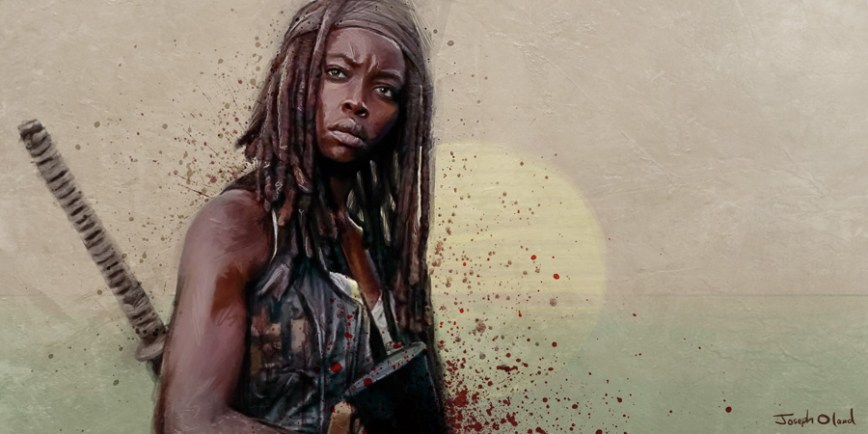
The Walking Dead – Who Is Michonne?

Michonne POST

Something’s always going to happen when resources are tight and survival is the game. With our stalwart knife-slinger, neo-samurai Michonne holds her cards close to the vest, which is part of her appeal. “The Walking Dead” has let her tragic back-story leak in, in slow deliberate drops. She is the ultimate stoic – even by Rick Grimes standards – laying in the prison doing crunches while discussing the group’s next move. She is the unsmiling guard above the gates to Alexandria. She is unattached, emotionless, and lethal.

Until recently.

She has had her moments, crying alone, caring for the wounded, considering the odds and calculating her risks. We appear to have entered into a new chapter, a new age of domestic bliss with Rick and Carl. But it isn’t going to last. Nothing ever does in “The Walking Dead.” Negan is out there, and the communities on the hill will add muscle to Alexandria, but Ezekiel’s tiger – spoilers – and bigger numbers won’t necessarily be enough.

The ‘next world’ is nascent. Michonne won’t be hanging up her sword anytime soon.
That’s a promise.

– – –

“”Everyone has a job and that job never stops. You work until you feel like your back is going to break and then you collapse and sleep like you’ve never slept before. And that’s only if things are going well, which almost never happens. We had some shit go down…it’s hard. There’s no time to think about what happened to you, or what you did. You just work.”

– – –

FINE ART PRINTS AVAILABLE HERE
– – –
SIGN UP FOR THE LENSEBENDER NEWSLETTER
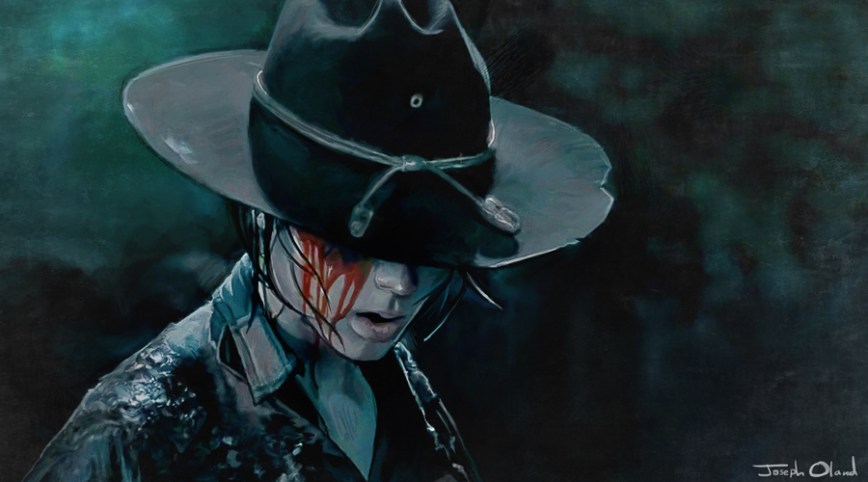
 

The Walking Dead – “No Way Out”

Carl's Eye postFINE ART PRINTS AVAILABLE HERE

“The Walking Dead” returned on Sunday from the mid-season break and, in the show’s well-established style, nobody is safe. Alexandria’s wall has been breached and we watched while various citizens were predictably devoured by the walking dead. This might actually be what’s most problematic about the series; despite interesting turns and high-tension moments, the show’s rhythms and repetitions are overwhelmingly obvious. Previous seasons have routinely established a pattern in which the core characters appear to find long-term safety, only to be pushed out by larger and larger herds of walkers or competing survivor groups. The countryside of Atlanta, Hershel’s Farm, the State Penitentiary, Terminus, and Alexandria have all fallen in a predictable series of missteps and misfortune. Corrupt and despotic leaders have also become a common element, from The Governor to the cannibals of Terminus to the still-mysterious (but soon-to-be-revealed) Negan.

If “The Walking Dead” has common themes of corruption, perennially unsafe shelters, and the promise of “unkillable” characters being killed, then the shocking moments become less shocking. We still care, but we see the writing on the wall. We oscillate between moments of sadness and moments of relief, but with less and less impact. In an attempt to ratchet-up the stress, the show has begun playing unfairly to our emotions. The incident with Glenn and the dumpster is our best example. It was a relief to see the show’s most loved character pull through, but it was an unnecessarily manipulative cheap shot. The story should be able to achieve these levels of emotional impact by itself, not through slights of hand.

The show still has tremendous momentum and consistently delivers strong performances, but that doesn’t mean we don’t need something to change in order to disrupt these increasingly played-out patterns. This may have already begun to happen, of course, as we consider how the early episodes of season six began to fragment the timeline. The architecture of the narrative has changed dramatically as the story has been compressed, telescoped, and as the moments of decisive action have begun to occur with greater frequency. Where in the beginning a season would take place over several weeks or months, the whole of season six has (at least thus far) taken place over only a couple of days. We also have one unique 90 minute episode that looks backwards in time, showing us how Morgan transformed after a chance encounter with a kind loner. It is truly a magnificent episode that could just as easily have been a stand-alone film.

The best “zombie” features actually focus little on the zombies themselves. Rather, the best zombie stories are preoccupied with exploring humanity. “The Walking Dead” is no different. Most of the story is about a group of people struggling to reason and fight their way through an extraordinary situation. This is a survival story, in which disparate personalities collide, pecking orders are established, and drama unfolds. Everybody in the zombie apocalypse wants the same thing: to live to see another day. But everybody has their own idea how to accomplish that goal. Others have the opportunity to seize control, become leaders, ascend the dictator’s throne, or become sacrificial and selfless. That’s what is so darn good about “The Walking Dead.” We all watch these characters, study their struggle, and we all have an idea of what it is we would do if placed in that situation.

George A. Romero’s original zombie masterpiece, “Night of the Living Dead,” set the stage. It’s a brilliant thought experiment as we watch a half dozen strangers, marooned in a  farmhouse, arguing about the best course of action. Zombies occupy less than five minutes of screen time and most of the violence is implied. The script was written like a brilliant one-act play, and the moral questions are so compelling that we barely realize there’s hardly any action driving the plot forward, just words.

“The Walking Dead” could be a compelling television show even after the last walker collapses in dry-rot and melts back into the earth; the world is still a wasteland, filled with roving bands of survivors, scavengers, and highwaymen. Civilization still has to be rebuilt, infrastructure established, townships reclaimed. If the show can find a way to break out of it’s rinse-repeat cycle, it could be around for a long time to come.

FINE ART PRINTS AVAILABLE HERE
SIGN UP FOR THE LENSEBENDER NEWSLETTER