The Walking Dead – “The Next World”

Jesus Saves postJesus saves. Or does he?

After spending a painful amount of time on the lives of the Alexandrians – the first half of season six takes place over only a couple of days – we break with the comic book narrative and jump ahead two months. The comic spends time watching the community develop while Carl is bedridden, but we begin here with Carl upright and able-bodied, albeit with a certain lack of depth perception.

“The Walking Dead” hasn’t ever taken such a positive turn. We see domestic quibbles over who used the last of the toothpaste. We see clean-shaven faces and signs that the community has tethered it’s resources and established a new sense of unity. There’s a confidence in this new-found domesticity and cooperation. It’s something that viewers haven’t seen since Hershel’s farm. And even back then, there were serious problems.

It feels alien to have the show’s trademark ‘horror film’ violin music fade-in for the opening credits when nothing bad has actually happened. Quite the contrary, we’re actually left chuckling at Rick’s ultimate redneck honkytonk music as he and Daryl drive off in a plume of dust on a scavenging run.

Given how the story of “The Walking Dead” has unfolded, it’s unlikely that this newfound repose will last. The real question is, what terrible thing is going to happen to disrupt the peace?

Is Jesus going to be a savior? Doubtful. Fans of the comic book will be delighted that this mysterious new character has been introduced, and it’s the opinion of this writer that the nature of Jesus need not be prematurely revealed here.

One of the wonderful things about “The Walking Dead” is that the writers have gone to great lengths to change key plot points. This is likely an effort to keep the story relevant and prevent fans of the graphic novel from spoiling the television show. In the end, both formats have strengths and weaknesses, and the adaptation to the screen exploits every opportunity to remain it’s own distinct experience.

In the comic book, for instance, there isn’t even a Daryl Dixon character – he was written for the early episodes and was never intended to survive. He become such a beloved character so quickly, the decision was made to keep him in. Similarly, it’s Michonne who first encounters Jesus, at the gates of Alexandria, and not Rick and Daryl out on the road. And no, Michonne doesn’t share an intimate moment with Rick at all in the books. Chances are, the producers felt inclined to bend to the will of the fans, who have been more than vocal about their desire to see the two hard-core survivor-leaders, the two characters with the thickest skin, fall into bed together. It’s pleasantly disarming to see these two, hardened warriors both, actually smiling – a lot. In a world so broken, with characters who have endured as much tragedy as these two, it was something akin to relief to see them come together in one peaceful moment.

Will it last? Who is Jesus, and does he have anything to do with Negan and his band of highwaymen? It is true that he wasn’t carrying a weapon, and he didn’t attack Rick and Daryl. He might have stolen from them, but he didn’t hurt them. Hell, he even managed to save Daryl from a walker. Is he going to play a larger role in “the next world” he makes mention of? Are there really other communities out there that can be trusted? Only time will tell. The one thing we do know is that the show leaves us with more questions than answers, and it definitely keeps things interesting.

FINE ART PRINTS AVAILABLE HERE
SIGN UP FOR THE LENSEBENDER NEWSLETTER

– – –

Bonus factoids.

  1. Rick is no longer wearing his wedding ring.
  2. The comic book we see Carl reading in the woods is “Invincible,” another comic series penned by “Walking Dead” creator Robert Kirkman.
  3. You can see Glenn’s name scratched off the casualties list at the beginning of this episode.
  4. In the comics Jesus’ real name is Paul Monroe. It’s changed to Paul Rovia to avoid confusion with him being a member of Alexandria’s Monroe family.
  5. Rick shares a passionate kiss with Andrea, not Michonne, in the opening to ‘Volume 16: A Larger World’
The Walking Dead – “No Way Out”

Carl's Eye postFINE ART PRINTS AVAILABLE HERE

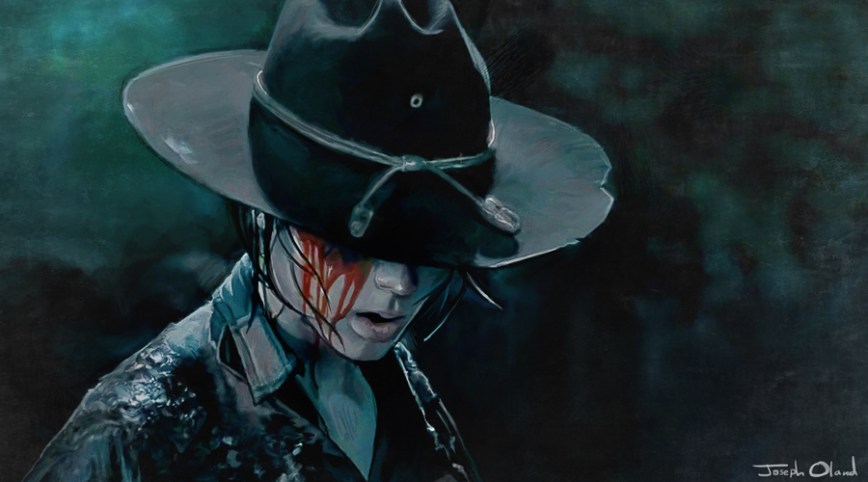
“The Walking Dead” returned on Sunday from the mid-season break and, in the show’s well-established style, nobody is safe. Alexandria’s wall has been breached and we watched while various citizens were predictably devoured by the walking dead. This might actually be what’s most problematic about the series; despite interesting turns and high-tension moments, the show’s rhythms and repetitions are overwhelmingly obvious. Previous seasons have routinely established a pattern in which the core characters appear to find long-term safety, only to be pushed out by larger and larger herds of walkers or competing survivor groups. The countryside of Atlanta, Hershel’s Farm, the State Penitentiary, Terminus, and Alexandria have all fallen in a predictable series of missteps and misfortune. Corrupt and despotic leaders have also become a common element, from The Governor to the cannibals of Terminus to the still-mysterious (but soon-to-be-revealed) Negan.

If “The Walking Dead” has common themes of corruption, perennially unsafe shelters, and the promise of “unkillable” characters being killed, then the shocking moments become less shocking. We still care, but we see the writing on the wall. We oscillate between moments of sadness and moments of relief, but with less and less impact. In an attempt to ratchet-up the stress, the show has begun playing unfairly to our emotions. The incident with Glenn and the dumpster is our best example. It was a relief to see the show’s most loved character pull through, but it was an unnecessarily manipulative cheap shot. The story should be able to achieve these levels of emotional impact by itself, not through slights of hand.

The show still has tremendous momentum and consistently delivers strong performances, but that doesn’t mean we don’t need something to change in order to disrupt these increasingly played-out patterns. This may have already begun to happen, of course, as we consider how the early episodes of season six began to fragment the timeline. The architecture of the narrative has changed dramatically as the story has been compressed, telescoped, and as the moments of decisive action have begun to occur with greater frequency. Where in the beginning a season would take place over several weeks or months, the whole of season six has (at least thus far) taken place over only a couple of days. We also have one unique 90 minute episode that looks backwards in time, showing us how Morgan transformed after a chance encounter with a kind loner. It is truly a magnificent episode that could just as easily have been a stand-alone film.

The best “zombie” features actually focus little on the zombies themselves. Rather, the best zombie stories are preoccupied with exploring humanity. “The Walking Dead” is no different. Most of the story is about a group of people struggling to reason and fight their way through an extraordinary situation. This is a survival story, in which disparate personalities collide, pecking orders are established, and drama unfolds. Everybody in the zombie apocalypse wants the same thing: to live to see another day. But everybody has their own idea how to accomplish that goal. Others have the opportunity to seize control, become leaders, ascend the dictator’s throne, or become sacrificial and selfless. That’s what is so darn good about “The Walking Dead.” We all watch these characters, study their struggle, and we all have an idea of what it is we would do if placed in that situation.

George A. Romero’s original zombie masterpiece, “Night of the Living Dead,” set the stage. It’s a brilliant thought experiment as we watch a half dozen strangers, marooned in a  farmhouse, arguing about the best course of action. Zombies occupy less than five minutes of screen time and most of the violence is implied. The script was written like a brilliant one-act play, and the moral questions are so compelling that we barely realize there’s hardly any action driving the plot forward, just words.

“The Walking Dead” could be a compelling television show even after the last walker collapses in dry-rot and melts back into the earth; the world is still a wasteland, filled with roving bands of survivors, scavengers, and highwaymen. Civilization still has to be rebuilt, infrastructure established, townships reclaimed. If the show can find a way to break out of it’s rinse-repeat cycle, it could be around for a long time to come.

FINE ART PRINTS AVAILABLE HERE
SIGN UP FOR THE LENSEBENDER NEWSLETTER