FINE ART PRINTS AVAILABLE HERE
In October a train hits and kills a pedestrian around 7am. Officials investigate the incident as a suicide.
In November, a man kneels down in front of a train. The conductor tells police the man walked out of the bushes near the tracks and bent down to place something on the tracks. He then knelt down, facing away from the oncoming train. A note is found on the body, along with a single dollar bill. The note says goodbye to a friend and requests that whoever should find the note to please deliver the dollar, a debt, to the mentioned friend.
In December a man steps in front of a train and remains there until he is crushed. Witnesses tell police that the man intentionally stood in front of the train; the engineer sounded his whistle and flashed his lights and was unable to stop before killing the man.
Sixteen years ago, the Tucson Citizen published an article about railroad deaths after a series of tragic incidents, accidents and acts of suicide. Although the number of railroad suicides isn’t known, they’re not uncommon. The article included an interview with Dan Hicks, a veteran railroad conductor who has worked in the Tucson area.
“Hicks, 48, said he’s experienced the trauma of rail accidents several times,” the article reads. “Engine’s he’s operated have hit trucks, cars, and in one horrifying instances, a drunken woman who had been beaten and left on the tracks.”
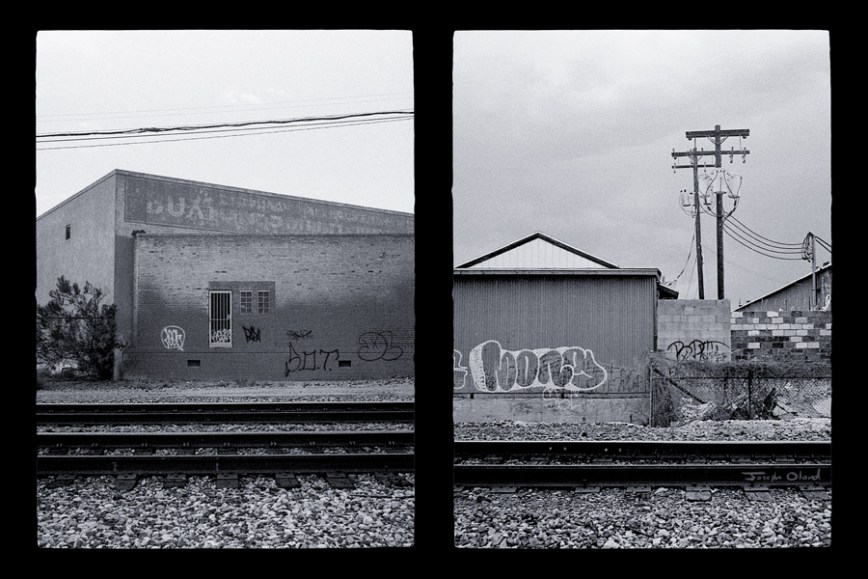
Today’s photograph – two exposures made with my handy-dandy Fujica Half – shows an area south of downtown Tucson. Around the time these two images were made, I met an engineer at Hotel Congress. I was sipping a beer and waiting for some food at the lobby restaurant, The Cup Café. He was dating one of the women who worked there, a woman I’d known for a little while. He told me about the number of accidents he’d witnessed, and the number of suicides. He also talked about a stretch of train tracks nearby that area rail-workers referred to as “suicide alley,” where a cluster of deaths had occurred. He told me how certain determined people would arrange their bodies on the ground, laying their necks directly on the track.
I’d recently been walking around that very stretch of tracks. Taking photographs was actually a challenge while I was studying photography – an irony I can’t even begin to describe – and it was an activity usually undertaken on the weekends. I’d never considered that suicide by train was a problem in this shiny new modern world. I remember thinking I hadn’t heard anybody talking about it. I hadn’t heard anything on the news.
But then – I’d pretty much been living in the basement of the Theater Arts Building (where the photo lab was), so how would I know? For the past several months that’s the only place anybody could ever find me. I ate there, worked there as an employee and worked there as a student. Hell, I had a sleeping bag and pillow, a hot plate and a wet-bar (rum, coke, tonic water, and whiskey) in my private, closet-sized darkroom in the bowels of that institution. I only ever emerged to meet my girlfriend downtown for food and drink, or to fetch a pack of cigarettes from the 7Eleven across the street.
It shook me to think about what it must feel like, to be that determined to end one’s own life. It shakes me still.
I can’t look at these photos without thinking about it.
FINE ART PRINTS AVAILABLE HERE
SIGN UP FOR THE LENSEBENDER NEWSLETTER


 LenseBender