February 14, 2017 – The Rose

technorose-postFINE ART PRINTS AVAILABLE HERE
– – –
OTHER ‘IMAGE OF THE DAY’ PRINTS AVAILABLE HERE

What else but a flower would work for Valentine’s Day?

I’ve never really been interested in this holiday. External pressure to shell out some cash to show your significant other that you love them – as though it wouldn’t be more spontaneous and romantic to do that on any other day of the calendar year. I’ve never had much luck with this holiday, and never much appreciated long lines at restaurants and the procession of perpetually dissatisfied partners; when expectations are artificially inflated by marketers, it’s hard to clear the bar.

Maybe that’s just me, though.

This year was a little different, I must admit. My lovely girlfriend seems to share my attitude toward Valentine’s Day, which is a first. We both had to work today, and we both seem to feel the same about crowded restaurants and bullshit expectations. We spent some quiet time together and watched a couple of movies, and I had the best Valentine’s Day I think I’ve ever had as an adult.

This image is one of her favorites from my archive, so it makes perfect sense to share it all with you today. I hope you like it and, despite my antipathy, I wish you all a Happy Valentine’s Day!

SIGN UP FOR THE LENSEBENDER NEWSLETTER

January 12, 2017 – Abstractions

dhay-post

FINE ART PRINTS AVAILABLE HERE
– – –
OTHER ‘IMAGE OF THE DAY’ PRINTS AVAILABLE HERE

Today’s image is a throw-back to a years-long phase in my development as a photographic artist. After working at The Center For Creative photography, I became unapologetically obsessed with the works of Aaron Siskind and Minor White and Beaumont Newhall. I had never considered the camera as an effective device to make abstract images (in the most literal sense, cameras can only document actual object that are actually in front of the lens, so the idea of ‘abstraction’ is counter-intuitive), but began seeking out compositions, colors, and textures.

I spent most of my free time walking around Tucson – where I lived at that time – looking behind dumpsters, in the more colorful and decrepit neighborhoods, behind shops, and through alleyways. Chipped paint, graffiti, rusted metal – these became my obsession.

Whenever I feel like I’m struggling with a creative idea, I know I can always take an urban hike with my camera and find something interesting. This image came from an alley in Flagstaff, Arizona. I was on a road trip with my girlfriend and, as most photographers do, I tortured her with my constant detours. This is, for reasons I’m not entirely able to articulate, one of my favorite captures from that visit.

SIGN UP FOR THE LENSEBENDER NEWSLETTER

Geometric Art, Color, and Heavy Metal

Mandala WP PostFINE ART PRINTS AVAILABLE HERE

Growing up I listened to a lot of Tool, a progressive metal band that some of you may be familiar with and some of you may not be familiar with. I still listen to my old albums. The percussionist, Danny Carey, heralded from a local community here in Kansas, giving us mid-western backwater hicks some prestige. I’ve spent my entire career as an artist trying to explain to people that the “fly-over” states are filled with creative artists and political malcontents, too.

Midway through their career, Tool began incorporating works form artist Alex Gray – anatomical cross-sections, repeating patterns, and other evocative images intended to illustrate the connection between body and spirit – into their albums. The images rely heavily on the symbolism of the third eye and chakra charts, but they also weave this content into renderings reminiscent of anatomy textbooks, esoteric symbols, and studies of celestial bodies. It’s really cool stuff.

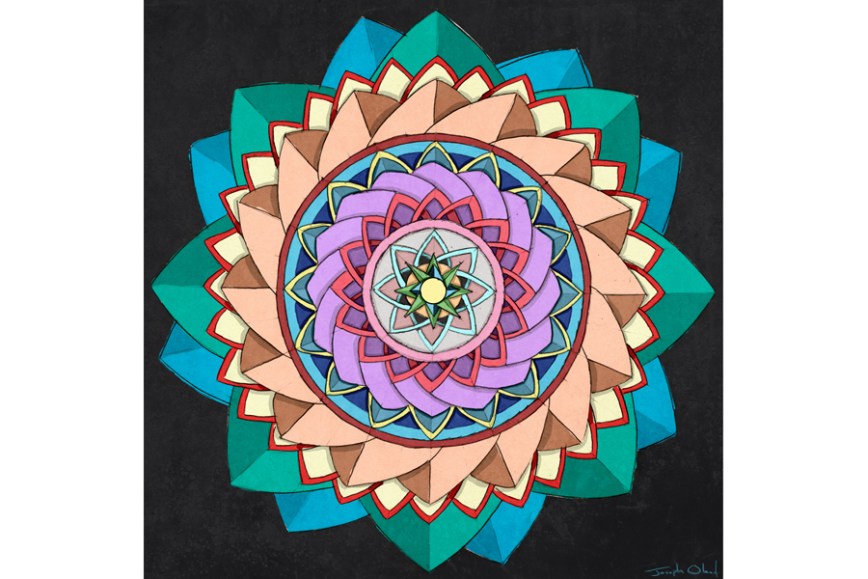
At one point or another, after looking at all of that great art (and probably after watching Martin Scorsese’s film Kundun, and after attending a talk with the Dali Lama at the Tucson convention center), I really wanted to make a mandala. There are countless designs out there, but I’d never made one of my own and, frankly, I didn’t know the first thing about making a design like that. I’m pretty confident that I still, for the most part, still don’t. Nevertheless, I nabbed my metal ruler and protractor and took to making some of the most god-awful radial line-drawings the world has ever seen (except, of course, that the world never saw them – I threw ’em all away because, well, they were terrible).

I have, of late, taken the practice up again. It’s a great meditative practice. It’s complicated and simple at the same time, mathematical and symmetrical, but layered with compositional complexity. Today’s image is my first shot out of the gate – I know I can make more interesting images, but I’m very pleased to be back in the saddle and experimenting with these designs. I’m already working on others, which I will share once they’re done.

I’m “getting my zen on,” as an old friend from the San Rafael Valley would say. The repetition, the tedious nature of making pictures like this, open doorways in the mind. These compositions require a certain kind of concentration to make, but they’re also ordered, logical, straight-forward. The perfect kind of exercise for any creative personality who isn’t feeling any other specific drive; it’s a way of exercising the brain and being creative when one is feeling stifled, uninspired, or otherwise “blocked.”

The trick is to keep the pen moving. This is how I keep moving. I hope you like it.

FINE ART PRINTS AVAILABLE HERE
– – –
SIGN UP FOR THE LENSEBENDER NEWSLETTER

February 27 – Bridge Over The Wash

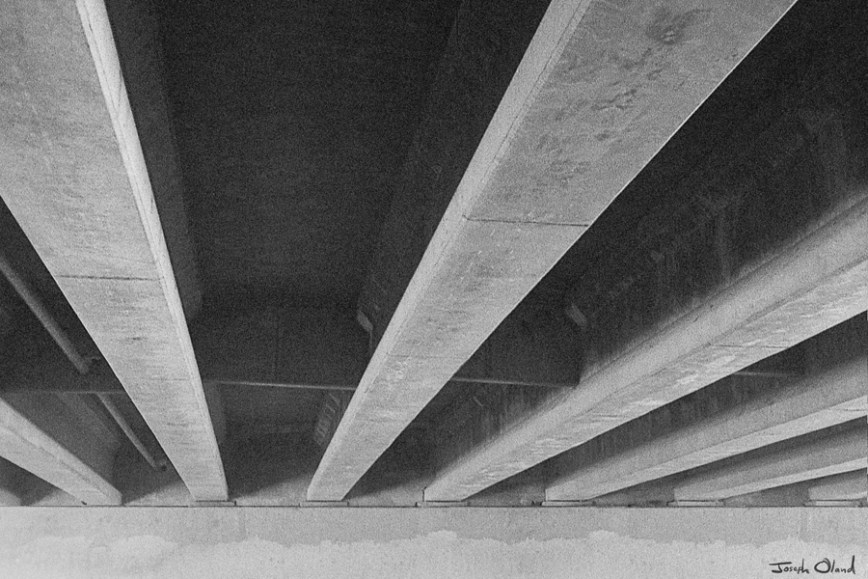
02-27 River Wash postThe Rillito River no longer runs twelve months a year, although it is credited with Tucson’s early growth. During a brief period of time, I lived along the wash and rode my bike along the hiking path whenever I could. During the monsoon season, the stretch of the river wash near my apartment would erupt with the sound of chirping frogs, and sometimes at night I would hear packs of coyotes howling.

Beneath the Swan Road bridge, I made several studies of the steel beams. It’s a simplistic composition, but I always thought it looked interesting through the viewfinder of my Fujica Half vintage camera. This is one of the many pictures I made during that time.

FINE ART PRINTS AVAILABLE HERE
– – –
SIGN UP FOR THE LENSEBENDER NEWSLETTER

February 22 – The Nebula

02-22 Nebula postExperimentation sometimes leads to the break-through. It certainly leads to some failure. Sometimes you hit an in-between result; this one lives somewhere in the middle. Today’s image wasn’t made with film, nor was it made with a camera. It was made with black-and-white photo paper, an incandescent light, some old print developer (Kodak Dektol multigrade), and a bottle of india ink.

An entire box of my photo paper was accidentally exposed to light; the material isn’t cheap, and I wasn’t amused by the loss. For those of you who don’t know what film and photo paper is, it’s a light-sensative material that’s coated in silver halide (a crystallized salt form of the metal). When light hits this material, the areas that were exposed to the greatest amount of light turn correspondingly dark. With the assistance of corrosive chemicals, you can accelerate the process of darkening the tones and then you can use another set of chemicals to fix the image permanently.

When a box of photo paper is accidentally exposed, it becomes useless for traditional printing – all prints will be slightly flat-toned or “fogged” when you go to draw a print in the darkroom. Rather than snap my fingers in defeat and pitch the useless pages into the trash, I decided to try and have some fun. The paper was already ruined, so what could I lose?

I started taking these pieces of partially-exposed paper out. I threw them into the developing bath and sprayed india ink over the prints before snapping on the overhead light. Since some of the paper was protected from the light by the dark, floating plumes of ink, strange patters begin to emerge on the paper. I’d then lift the prints before they turned completely black and put them in the fixing chemicals. The result is what you see above – atmospheric swirls and bubbles that, to my eye, are reminiscent of astral photography. I’d stumbled on a new, slightly messier form photogram, and I spent the entire afternoon experimenting, saving the best results to be toned, hand-colored, or scanned into digital files later.

Sometimes it pays just to goof off for a bit and forget that there are any rules.

FINE ART PRINTS AVAILABLE HERE
SIGN UP FOR THE LENSEBENDER NEWSLETTER