January 31, 2017 – No Parking (america)

noparkingpostFINE ART PRINTS AVAILABLE HERE
– – –
OTHER ‘IMAGE OF THE DAY’ PRINTS AVAILABLE HERE

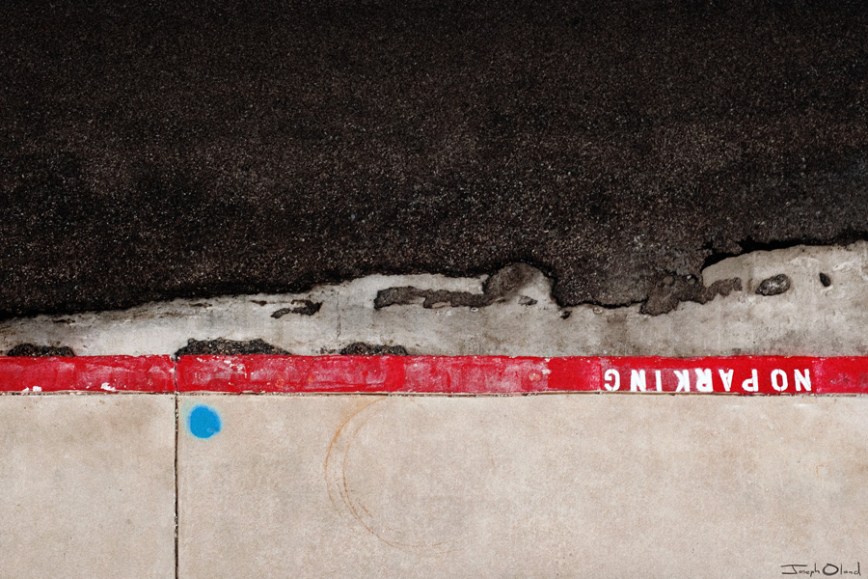
This is another image from my “Compositions In Red, White, And Blue” series. It was taken standing on the rooftop of my old apartment building on Subways Street in Bisbee, Arizona. Looking straight down, and through the lens of my camera, this composition jumped out at me.

I’m not entirely sure what it means. But I like the way it looks.

SIGN UP FOR THE LENSEBENDER NEWSLETTER

January 30, 2017 – How I Hated Mondrian

sewergratepostFINE ART PRINTS AVAILABLE HERE
– – –
OTHER ‘IMAGE OF THE DAY’ PRINTS AVAILABLE HERE

Unless you went to art school, chances are good that you don’t know who Piet Mondrian was. He was born in the 1870s and contributed to a European form of proto-cubism that is known De Stijl. The only contemporary iteration of this term that I can think of is the The White Stripes album of the same name, with cover art that mimics Mondrian’s style.

de-stijl

I was introduced to this artist as a child. My elementary school art teacher, Mr. Clinton, showed us all kinds of art from various periods, and brilliantly made projects for us built around these influential artists.

There are people who look at the works of Jackson Pollack, Mark Rothko, and even the later works of Pablo Picasso, and think to themselves “What’s so damn special about that? Even I could do that. My kids could do that!” I had a similar attitude, especially about Piet Mondrian. Right angles, always primary colors, blocks of paint. To this day, I still don’t understand what his motivation might have been, but I have begun to understand what a personal artistic compulsion is. I find myself gravitating toward subject matter that many of my viewers find utterly boring, banal, and insignificant, but I can’t stop myself from making these images. Art is deeply personal to the creator, and only personal to a select few of their audience – and there’s no way of predicting what colors, compositions, or themes are going to resonate with the audience.

I’m still not a huge fan of Piet Mondrian, but I don’t disregard his work as amateur, pedestrian, or boring – not anymore. He was a driven artist, and influenced a generation of artists that followed, even if his influence was a subtle and often overlooked one.

SIGN UP FOR THE LENSEBENDER NEWSLETTER

January 28, 2017 – The Drip

thedrip-post

FINE ART PRINTS AVAILABLE HERE
– – –
OTHER ‘IMAGE OF THE DAY’ PRINTS AVAILABLE HERE

Today’s image, like many that came before, is a throwback to the days when I was making mostly abstract artwork. Rather than rattle on about my interest in abstract photography, I will simply leave today’s image with the following quote by Pablo Picasso:

“There is no abstract art. You must always start with something. Afterward you can remove all traces of reality.”

SIGN UP FOR THE LENSEBENDER NEWSLETTER

January 26, 2017 – Black and White

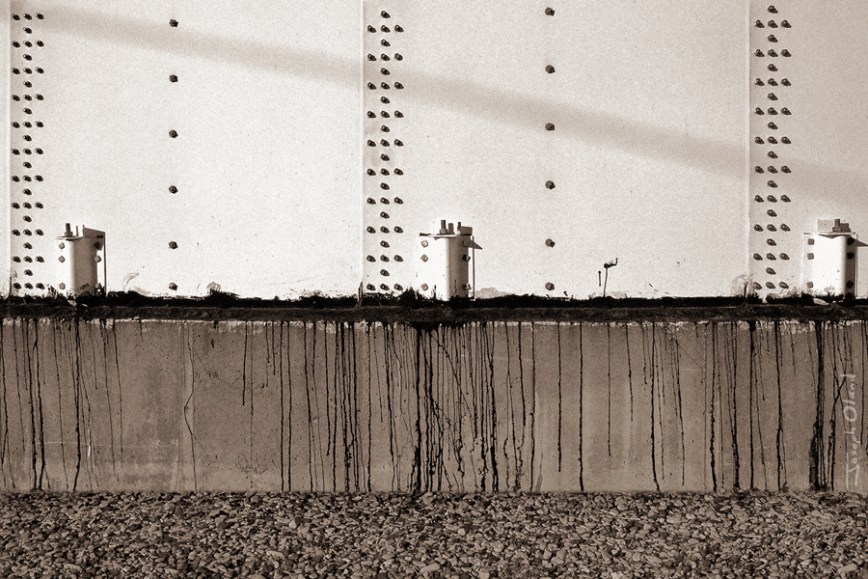
industrialabstractpostFINE ART PRINTS AVAILABLE HERE
– – –
OTHER ‘IMAGE OF THE DAY’ PRINTS AVAILABLE HERE

One of my friends – more of an activist, politically motivated, and extreme personality – once commented that my work specifically seeks to “mean nothing at all.” This was over a decade ago, but I remember the comment; it made me think a lot about the kinds of images I was making at the time. I didn’t feel insulted, but I did feel compelled, initially, to try and defend myself.

My natural instinct was to disagree (and I did disagree), but it was the first time I really sat down and tried to apply meaning to the photographs and paintings I was making. And it made me think about the utility of abstract imagery in a broad and general sense, too.

I don’t think all artwork needs to be a didactic teaching tool, or direct the thoughts and emotions of the viewer. In fact, in many circumstances, I have a contrary opinion. I am seduced by abstract compositions specifically because they can mean any number of things to any number of people. The possibilities aren’t infinite. Color, movement, composition, film grain, delicate or light brush strokes – these all guide our interpretation and emotional response. But abstract compositions allow us to think broadly about how an image impacts us, and the experience of viewing abstract art becomes very personal. An abstraction can remind us of a specific event, a movie we watched, an experience we had – and in an almost slight-of-hand kind of way, through some peculiar magic, an image made by a complete stranger can ascend to significance in the hearts and minds of the individuals looking at it.

I am compelled to make pictures like this for reasons that still evade me, but I make them because they affect me, they move me, they touch a part of my subconscious and tickle a part of my mind. I can’t expect images like this to be universally adored, but I have to have faith, as an artist, that there are other people out there, like me, who find this kind of composition interesting.

The hardest thing for an artist to do is follow their instincts. If I listened to all of the criticism, all I would do is try to mimic the landscapes of Ansel Adams or take endless ‘desert sunset’ pictures. There are plenty of those images in the world, and I just need to make images of my very own.

SIGN UP FOR THE LENSEBENDER NEWSLETTER

January 12, 2017 – Abstractions

dhay-post

FINE ART PRINTS AVAILABLE HERE
– – –
OTHER ‘IMAGE OF THE DAY’ PRINTS AVAILABLE HERE

Today’s image is a throw-back to a years-long phase in my development as a photographic artist. After working at The Center For Creative photography, I became unapologetically obsessed with the works of Aaron Siskind and Minor White and Beaumont Newhall. I had never considered the camera as an effective device to make abstract images (in the most literal sense, cameras can only document actual object that are actually in front of the lens, so the idea of ‘abstraction’ is counter-intuitive), but began seeking out compositions, colors, and textures.

I spent most of my free time walking around Tucson – where I lived at that time – looking behind dumpsters, in the more colorful and decrepit neighborhoods, behind shops, and through alleyways. Chipped paint, graffiti, rusted metal – these became my obsession.

Whenever I feel like I’m struggling with a creative idea, I know I can always take an urban hike with my camera and find something interesting. This image came from an alley in Flagstaff, Arizona. I was on a road trip with my girlfriend and, as most photographers do, I tortured her with my constant detours. This is, for reasons I’m not entirely able to articulate, one of my favorite captures from that visit.

SIGN UP FOR THE LENSEBENDER NEWSLETTER

Geometric Art, Color, and Heavy Metal

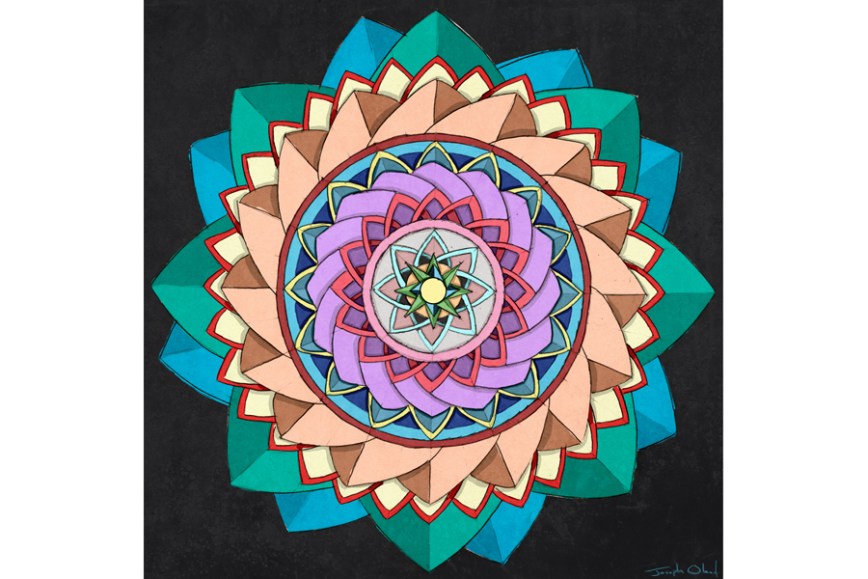
Mandala WP PostFINE ART PRINTS AVAILABLE HERE

Growing up I listened to a lot of Tool, a progressive metal band that some of you may be familiar with and some of you may not be familiar with. I still listen to my old albums. The percussionist, Danny Carey, heralded from a local community here in Kansas, giving us mid-western backwater hicks some prestige. I’ve spent my entire career as an artist trying to explain to people that the “fly-over” states are filled with creative artists and political malcontents, too.

Midway through their career, Tool began incorporating works form artist Alex Gray – anatomical cross-sections, repeating patterns, and other evocative images intended to illustrate the connection between body and spirit – into their albums. The images rely heavily on the symbolism of the third eye and chakra charts, but they also weave this content into renderings reminiscent of anatomy textbooks, esoteric symbols, and studies of celestial bodies. It’s really cool stuff.

At one point or another, after looking at all of that great art (and probably after watching Martin Scorsese’s film Kundun, and after attending a talk with the Dali Lama at the Tucson convention center), I really wanted to make a mandala. There are countless designs out there, but I’d never made one of my own and, frankly, I didn’t know the first thing about making a design like that. I’m pretty confident that I still, for the most part, still don’t. Nevertheless, I nabbed my metal ruler and protractor and took to making some of the most god-awful radial line-drawings the world has ever seen (except, of course, that the world never saw them – I threw ’em all away because, well, they were terrible).

I have, of late, taken the practice up again. It’s a great meditative practice. It’s complicated and simple at the same time, mathematical and symmetrical, but layered with compositional complexity. Today’s image is my first shot out of the gate – I know I can make more interesting images, but I’m very pleased to be back in the saddle and experimenting with these designs. I’m already working on others, which I will share once they’re done.

I’m “getting my zen on,” as an old friend from the San Rafael Valley would say. The repetition, the tedious nature of making pictures like this, open doorways in the mind. These compositions require a certain kind of concentration to make, but they’re also ordered, logical, straight-forward. The perfect kind of exercise for any creative personality who isn’t feeling any other specific drive; it’s a way of exercising the brain and being creative when one is feeling stifled, uninspired, or otherwise “blocked.”

The trick is to keep the pen moving. This is how I keep moving. I hope you like it.

FINE ART PRINTS AVAILABLE HERE
– – –
SIGN UP FOR THE LENSEBENDER NEWSLETTER
January 27 – The Back Alley

01-27 The Back Alley post“In any art, you don’t know in advance what you want to say – it’s revealed to you as you say it. That’s the difference between art and illustration.”

~Aaron Siskind

– – –

The thing about photography I find so wonderful is that it affords me the opportunity to look through the viewfinder and examine the world in a way that we rarely do in our day-to-day lives. Yes, that’s a sizable blanket statement, I know. But it’s true. It’s the only thing in my life that forces me to slow everything down – my thoughts, my heart rate, my emotions. It’s my meditation. Several years ago, while I was still in college, I used to walk around Tucson by myself, camera in hand.

Rather than the staid art of street photography – or the grainy, black and white portraits we often associate with ‘street photography’ – I found myself investigating the spaces in-between buildings and behind them. I would go to the warehouse district, down to the railroad tracks, out to the tire yards. Traveling at the speed-of-car, everything around us is a blur, save for what’s in the windshield – which is usually just traffic. When conducting noble battle with other 45 mile-per-hour aluminum projectiles, it’s a good idea to keep one’s head in the game. But we miss out on an awful lot.

After a couple of my earliest urban walkabouts, certain visual themes began to surface. Without even thinking about it while I was photographing, it was clear looking at the proof-sheets that my eyes were drawn to right angles. All of the pictures were nearly abstract, minimalistic compositions of windows, doorways, power conduits & boxes, architectural features, concrete slabs, and corrugated metal. A photographic DeStijl quickly became my new visual language

I would set aside time between university lectures and my job at the photo lab just so I could pack my camera and head out on my bicycle in search of new textures and colors. I photographed scenes like the one above for about two years. I haven’t revisited them in a while, but I occasionally think about the series. It’s meaning is still elusive to me, but it continues to feel significant. In a way that I haven’t been able to articulate, some of these images are deeply moving to me.

I think it might be time to put a show together, to reexamine this series, and see if I can crack the code.
Wish me luck.

FINE ART PRINTS AVAILABLE HERE
SIGN UP FOR THE NEWSLETTER HERE