January 30, 2017 – How I Hated Mondrian

sewergratepostFINE ART PRINTS AVAILABLE HERE
– – –
OTHER ‘IMAGE OF THE DAY’ PRINTS AVAILABLE HERE

Unless you went to art school, chances are good that you don’t know who Piet Mondrian was. He was born in the 1870s and contributed to a European form of proto-cubism that is known De Stijl. The only contemporary iteration of this term that I can think of is the The White Stripes album of the same name, with cover art that mimics Mondrian’s style.

de-stijl

I was introduced to this artist as a child. My elementary school art teacher, Mr. Clinton, showed us all kinds of art from various periods, and brilliantly made projects for us built around these influential artists.

There are people who look at the works of Jackson Pollack, Mark Rothko, and even the later works of Pablo Picasso, and think to themselves “What’s so damn special about that? Even I could do that. My kids could do that!” I had a similar attitude, especially about Piet Mondrian. Right angles, always primary colors, blocks of paint. To this day, I still don’t understand what his motivation might have been, but I have begun to understand what a personal artistic compulsion is. I find myself gravitating toward subject matter that many of my viewers find utterly boring, banal, and insignificant, but I can’t stop myself from making these images. Art is deeply personal to the creator, and only personal to a select few of their audience – and there’s no way of predicting what colors, compositions, or themes are going to resonate with the audience.

I’m still not a huge fan of Piet Mondrian, but I don’t disregard his work as amateur, pedestrian, or boring – not anymore. He was a driven artist, and influenced a generation of artists that followed, even if his influence was a subtle and often overlooked one.
SIGN UP FOR THE LENSEBENDER NEWSLETTER

January 26, 2017 – Black and White

industrialabstractpostFINE ART PRINTS AVAILABLE HERE
– – –
OTHER ‘IMAGE OF THE DAY’ PRINTS AVAILABLE HERE

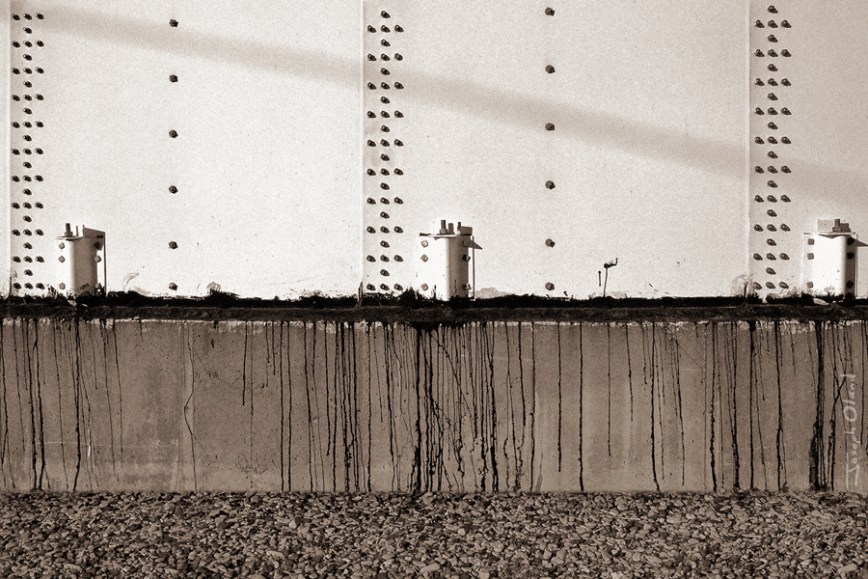
One of my friends – more of an activist, politically motivated, and extreme personality – once commented that my work specifically seeks to “mean nothing at all.” This was over a decade ago, but I remember the comment; it made me think a lot about the kinds of images I was making at the time. I didn’t feel insulted, but I did feel compelled, initially, to try and defend myself.

My natural instinct was to disagree (and I did disagree), but it was the first time I really sat down and tried to apply meaning to the photographs and paintings I was making. And it made me think about the utility of abstract imagery in a broad and general sense, too.

I don’t think all artwork needs to be a didactic teaching tool, or direct the thoughts and emotions of the viewer. In fact, in many circumstances, I have a contrary opinion. I am seduced by abstract compositions specifically because they can mean any number of things to any number of people. The possibilities aren’t infinite. Color, movement, composition, film grain, delicate or light brush strokes – these all guide our interpretation and emotional response. But abstract compositions allow us to think broadly about how an image impacts us, and the experience of viewing abstract art becomes very personal. An abstraction can remind us of a specific event, a movie we watched, an experience we had – and in an almost slight-of-hand kind of way, through some peculiar magic, an image made by a complete stranger can ascend to significance in the hearts and minds of the individuals looking at it.

I am compelled to make pictures like this for reasons that still evade me, but I make them because they affect me, they move me, they touch a part of my subconscious and tickle a part of my mind. I can’t expect images like this to be universally adored, but I have to have faith, as an artist, that there are other people out there, like me, who find this kind of composition interesting.

The hardest thing for an artist to do is follow their instincts. If I listened to all of the criticism, all I would do is try to mimic the landscapes of Ansel Adams or take endless ‘desert sunset’ pictures. There are plenty of those images in the world, and I just need to make images of my very own.

SIGN UP FOR THE LENSEBENDER NEWSLETTER

January 23, 2017 – Boxcar

boxcar-post

FINE ART PRINTS AVAILABLE HERE
– – –
OTHER ‘IMAGE OF THE DAY’ PRINTS AVAILABLE HERE

There are lots of clichés to either avoid or embrace when developing one’s own photographic style. Portraits with the horizontal bands of light from window blinds raking across the subjects face, looking for garbage on the ground and trying to find the ‘beauty’ in it, and then of course there’s always graffiti. And this is just to name a  few.

I guess my weakness is graffiti. Almost like compiling a mix tape, photographing graffiti is like appropriating somebody else’s art in order to express yourself. Knowing that it’s a common subject in college photography classes, I was always keen to try and document graffiti in a way that combined the tagger’s artistic sensibilities with my own. Not entirely sure how successful I’ve been – it’s always a challenge, evaluating your own work – but I’m quite fond of how this image turned out.

On the south side of Tucson, where faded murals and rusted boxcars sit under the desert sun, I always know where to go to find interesting textures to photograph. I hope you enjoy today’s picture of the day.

SIGN UP FOR THE LENSEBENDER NEWSLETTER