February 15 – The Flamingo

02-16 Flamingo post1The Flamingo was originally built in 1948, providing comfort and shelter for the likes of Bing Crosby, Gene Autrey, Rudy Valley, and other members of the Hollywood and show-business elite. Before it’s doors were closed in the 1980s, it had fallen into miserable disrepair. The rooms were poorly lit, the pool was dry and cracked. The old-world gloss had given way to broken concrete and mold.

When the doors were locked and the windows boarded up, shrink-wrapped soaps still sat in their dishes, dusty towels still hung on the racks, the beds still tightly made. It only sat vacant for seven years before the padlocks were snapped open and the hotel was resurrected with new furniture, carpets, air conditioning, and placards on the doors to designate which Tinseltown stars had stayed there.

I had the pleasure of staying in Burt Reynold’s room. Above the bed was a framed poster of a 1973 Reynolds feature I had never even heard of before: The Man Who Loved Cat Dancing. I still haven’t seen it, but I think I might have to check it out and add a movie review.

The Flamingo was the first Tucson hotel I stayed at – it’s salmon colored paint drawing me in – back in the Spring of 2001. I’d taken a road trip out to Tucson with my girlfriend to check out the city, seeing as how I had just received my acceptance letter from the U of A. Thankfully the new owner respected the building’s history – rather than tear down the classic sign, it was resurfaced and adorned with new neon tubes.

Hopefully, even as the city around it modernizes, The Flamingo will hold onto its charm. The neighborhood isn’t the prime real estate it once was, but affordable rooms in a college town will always find occupants. It isn’t fancy by today’s standards, but I’ll never forget how good that hot shower felt after camping on Mount Lemon for several days.

Today’s photograph is a continuation of “Film February,” made using the Fujica Half. I think the aged aesthetic of film works quite well with a classic mid-century building.

FINE ART PRINTS AVAILABLE HERE
SIGN UP FOR THE LENSEBENDER NEWSLETTER
February 09 – Industry, Steel, And Aaron Siskind

02-09 Industry post“Stone, steel, dominions pass,
Faith too, no wonder.
So leave alone the grass
That I am under.”

~A.E. Housman

– – –

I’m not sure who said it first, but it always stuck with me: there is nothing as unnatural as a perfectly straight line.

There’s actually some truth to this. Straight lines don’t really just occur in nature. Every natural process with the potential to create a straight line is subject to other processes that disrupt it. Theoretically, trees would grow straight up were they not subjected to wind, rain, gravity, uneven soil. If the distribution of air, sunlight, nutrients, gravity, and other factors were perfectly even, we would have straight-edge trees. These elements aren’t even, have never been even, cannot be even, and so they produce randomly mutated fractal patterns.

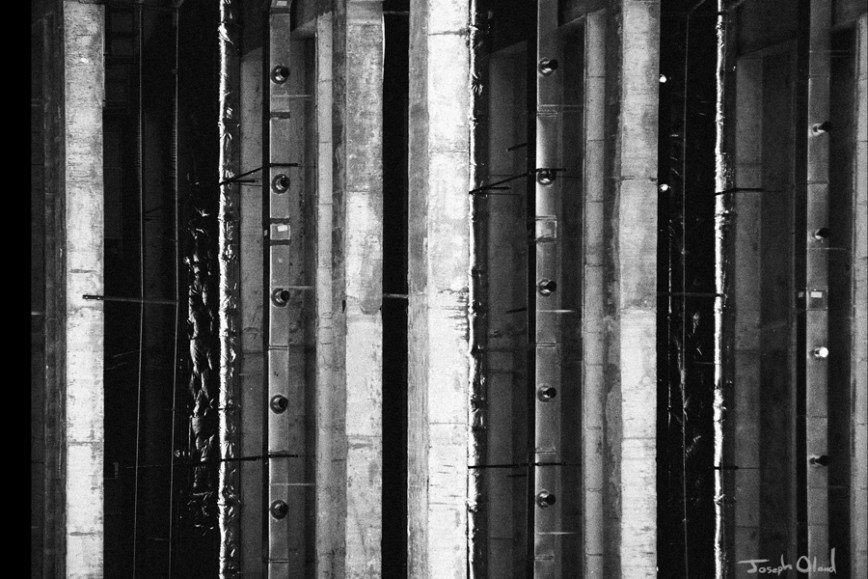
Interestingly, we humans now we live in environments wholly based on the straight edge; I-beams and milled lumber, the foundations of our homes, our streetlamps, television screens, windowpanes. There is no greater example that I can think of that represents the unbroken human endeavor to conquer nature.

Today’s photograph is how I present the tension between humankind and the natural world – steel beams, the skeletal structure of a half-complete hotel in Albuquerque. I made this image when I was in my “Aaron Siskind” period. It was my second or third year of college, and I refused to photograph anything other than sub-par replicas of his patented abstract style. For those of you unfamiliar with Siskind, he was a prolific American photographer considered to be closely involved with the Abstract Expressionist movement, whose works focused primarily on the details of nature and architecture. At his height in the 1950s, his works were often described as blurring the line between painting and photography – something I’m personally interested in as an artist.

I was working as a research assistant at The Center for Creative photography on starvation-level wages under the Federal Work-Study Program. At the time it didn’t bother me; access to so many wonderful, historically significant photographic prints and photographer archives was plenty enough for me. Hell, I considered it an honor (and still do).

Then, recently, I found a faded, crinkled pay stub in an old suitcase. Boy was I being robbed.
But that’s a story for another day.

They say that emulation is the greatest form of flattery. I hope Mr. Siskind was looking down on my  from high with his notoriously crooked smile. I learned a lot trying to copy the masters, and I believe this is how many artists begin their journey. Not from square-one, but on the shoulders of giants, borrowing their voice while we struggle to find our own.

FINE ART PRINTS AVAILABLE HERE
SIGN UP FOR THE LENSEBENDER NEWSLETTER


January 27 – The Back Alley

01-27 The Back Alley post“In any art, you don’t know in advance what you want to say – it’s revealed to you as you say it. That’s the difference between art and illustration.”

~Aaron Siskind

– – –

The thing about photography I find so wonderful is that it affords me the opportunity to look through the viewfinder and examine the world in a way that we rarely do in our day-to-day lives. Yes, that’s a sizable blanket statement, I know. But it’s true. It’s the only thing in my life that forces me to slow everything down – my thoughts, my heart rate, my emotions. It’s my meditation. Several years ago, while I was still in college, I used to walk around Tucson by myself, camera in hand.

Rather than the staid art of street photography – or the grainy, black and white portraits we often associate with ‘street photography’ – I found myself investigating the spaces in-between buildings and behind them. I would go to the warehouse district, down to the railroad tracks, out to the tire yards. Traveling at the speed-of-car, everything around us is a blur, save for what’s in the windshield – which is usually just traffic. When conducting noble battle with other 45 mile-per-hour aluminum projectiles, it’s a good idea to keep one’s head in the game. But we miss out on an awful lot.

After a couple of my earliest urban walkabouts, certain visual themes began to surface. Without even thinking about it while I was photographing, it was clear looking at the proof-sheets that my eyes were drawn to right angles. All of the pictures were nearly abstract, minimalistic compositions of windows, doorways, power conduits & boxes, architectural features, concrete slabs, and corrugated metal. A photographic DeStijl quickly became my new visual language

I would set aside time between university lectures and my job at the photo lab just so I could pack my camera and head out on my bicycle in search of new textures and colors. I photographed scenes like the one above for about two years. I haven’t revisited them in a while, but I occasionally think about the series. It’s meaning is still elusive to me, but it continues to feel significant. In a way that I haven’t been able to articulate, some of these images are deeply moving to me.

I think it might be time to put a show together, to reexamine this series, and see if I can crack the code.
Wish me luck.

FINE ART PRINTS AVAILABLE HERE
SIGN UP FOR THE NEWSLETTER HERE