Sarah Palin Endorses Trump In Iowa

Palin Trump post

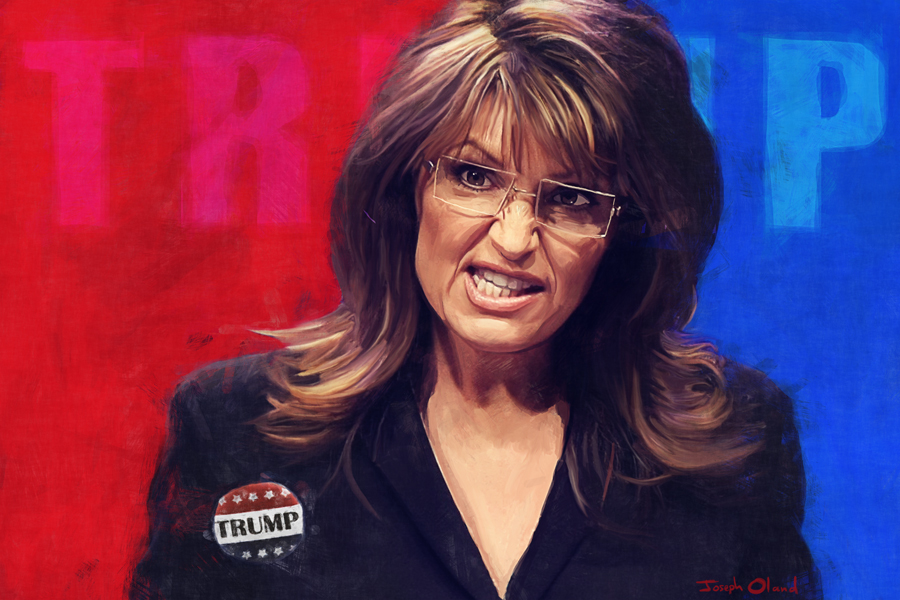
Many initial responses, especially among the political left, may hinge on shrugs. After all, it’s no secret that Sarah Palin is the darling of the Tea Party movement. In her own way, she’s just as bombastic as Donald Trump. It would follow that anybody who likes Sarah Palin probably already enjoys the aggressive rhetoric of the GOP front-runner. As pitiful as the reality is, celebrity endorsements work. And this one is a big win for the Trump campaign.

Tuesday afternoon, Sarah Palin, former governor of Alaska and 2008 vice presidential nominee, officially endorsed Donald Trump for the office of president of the United States. This is the first major endorsement for any candidate on either side. With narrow poll numbers between the Trump and Cruz camps , this type of endorsement may prove to have a significant impact in Iowa. Despite being a consistent and trustworthy punch-line, Palin remains well-loved and influential among Tea Party voters. This move, just thirteen days before the caucuses, may be the ammunition Trump needs to emerge victorious.

Like Trump, Palin is a successful reality television personality who is unusually gifted at deflecting negative attention and recovering quickly from scandal. A generation ago, Trump’s rhetoric would not be tolerated. Among the conservative Christian crowd, his multiple marriages alone would be enough to raise eyebrows. In today’s political climate, denying refugees entrance and promising to use nuclear arms against Islamic State are positions welcomed with applause.

This begs the question: what does it say about the GOP when authoritarian, arrogant, and often ill-informed reality television stars are knocking on the doors of the White House? Palin’s endorsement shouldn’t mean anything, but that isn’t the reality. It’s a new book deal, more media exposure for Trump, and probably renewed discussions for yet another television show. It’s all theater, we know it, and we gobble it up like hungry pigs anyway.

Just as any Hollywood celebrity endorsing a candidate shouldn’t mean anything, the American voter is more inclined to support a candidate because Johnny Depp says so, without ever so much as reading an article, watching a debate, or crunching a number. This needs to change, and it can’t happen quick enough.

PRINTS AVAILABLE HERE
SIGN UP FOR THE NEWSLETTER HERE


So What’s With The Iran Nuclear Thing?

Iran Nuke post

Primer: We all have that friend who appears to thrive on delivering bad news. There’s a good chance we might be that person. People love giving bad news. Negative information empowers the messenger. Giving bad news makes us feel important. The only reason why is because people listen. The information impacts people and exploits the recipient’s sense of decency to not respond ambivalently. This is what the news media has become. It tells us on a daily basis that violent crime is up, that terrorist threat levels are rising, that common household items will kill us. Bad news always grabs more attention.

A parade of talk radio personalities and editorialists know this. Once we’ve gotten used to seeing more and more negativity around us, we actually begin to actively seek it out. The more awful it is, the more we want it. This is why a myriad of misinformation has surrounded the arms deal with Iran. The truth is that world is not a vortex of despair, and the nuclear agreement with Iran has been, at least up to this point, successful.

– – –

Saturday afternoon the Associated Press reported that Ban Ki-moon, the United Nations secretary-general, is welcoming the implementation of the nuclear agreement reached with Iran in 2015. Iran has met all of the commitments outlined in the deal. According to his statement, Saturday’s achievement shows that “dialogue and patient diplomacy are the best ways to address worries about weapons proliferation.”

The optimistic view would be that Iran will continue to respect it’s commitments and that this agreement will remain unmolested. The hope is that cooperative dialogue will continue between Iran, the United States, and the five other world powers who negotiated the fifteen-year agreement. There is enhanced possibility for security and stability in a region that has been unstable, unpredictable, and antagonistic towards the west for decades.

Saturday afternoon, President Barak Obama signed an order to lift economic sanctions on Iran. This was done only after the International Atomic Energy Agency (IAEA) certified that Iran had met its obligations to curb its nuclear program. While this deal concretely deprives Iran of pathways to develop a nuclear arsenal, critics have been loud and steadfast in insisting that this agreement will have the opposite effect.

The administration’s case has been to open dialogue and delay Iran’s nuclear ambitions. In this, the administration has been successful. After decades of contention and lack of communication between governments, the United States is engaged in active, productive dialogue with the Republic of Iran. As President Obama expressed in his address Saturday, “A strong, confident America should advance our national security by engaging directly with the government of Iran.”

VIEW THE PRESIDENTIAL ADDRESS HERE

There are material benefits, as well. Two thirds of Iran’s centrifuges have been removed. More than 98% of Iran’s nuclear stockpile has been shipped outside of it’s borders; it now holds less material needed to manufacture a single nuclear bomb. After decades of expansion, Iran’s material progress towards developing a nuclear arsenal hasn’t just been stopped, it has been reversed.

The most legitimate criticism cites the time-frame of the nuclear agreement; constraints on Tehran’s nuclear program will terminate after fifteen years. With the lifting of sanctions, it is expected that Iran’s economy will expand dramatically. Over $100 Billion dollars in assets that have been frozen overseas will be released back to Iran as a result of President Obama’s executive order. New oil, trade, and financial opportunities will empower Iran significantly over the next fifteen years, and there are fears that Iran will be in a better position to quickly and efficiently develop a nuclear arsenal once the deal expires. By that time, it is also possible that Iran’s economy would be strong enough to withstand reimposed sanctions and that it’s nuclear installations would be better  protected; it is expected that Iran will increase its air defense systems with the help of Russia.

The clock is ticking. But the time-frame is concrete, comprehensible, and provides opportunities for world governments to develop strategies should diplomacy fail. Before the nuclear agreement, the global community had “it’s only a matter of time.” The anxiety generated by the unpredictable nature of Iran’s nuclear program buttressed the resolve of war hawks, and served to reinforce the idea that armed conflict would be the only solution. Nobody knows what Iran will look like in fifteen years, who it’s leaders may be, and what our relationship to their government will be like. In the interim, the United States will be in a better position to negotiate deals with Iran for the future, even after the nuclear deal expires, and maintain peaceful relations.

Misinformation has circulated that Iran will be allowed to select it’s own inspectors, allowing ample opportunity for corruption. These reports surfaced in August of 2015 and were refuted within hours by the IAEA. This did not stop radio hosts and media pundits from repeating this misinformation. This did not prevent a contingent of our political leadership from repeating this misinformation.

There are claims that the agreement protects Iran from punishment for future violations. The truth is that no aspect of the agreement prevents the United States from re-implementing sanctions should inspectors discover that Iran has violated the agreement.

A consensus of polls reflects that an overwhelming majority of American citizens support this deal, despite the near fifty-fifty divide we see on capital hill. When messages are tirelessly repeated on the airwaves, it does not make them any more factual. The call to arms from Netanyahu, Huckabee, Cruz, Kristol, et al, does not represent the attitude of the majority of Americans. These politicians, it would be important to note, were on the wrong side of history leading up to the conflict with Iraq, and there is no reason to believe that their aggressive posturing towards Iran is any more legitimate.

It is surprising that individuals often don’t take the advice they routinely give their children: use your words. Every opportunity should be made to exhaust dialogue and diplomacy with foreign governments before we commit our armed forces to lethal combat. No conflict has ever been as easy as our leadership has tried to pursued us it will be. The costs are always higher. The collateral damage is always greater. The lives lost are always much, much more.

Politicians – Willful Ignorance And Dangerous Oversimplification

Ben Carson post

“The regulation of anonymous and pseudonymous communications promises to be one of the most important and contentious Internet-related issues of the next decade.”

~ A. Michael Froomkin

– – –

Yes, it’s primary season. We all know it and it’s difficult to escape the constant pandering, posturing, and promoting. Each candidate is trying to provide their best sales pitch to the greatest number of people. At this point in the race, we are in an information loop; with so many candidates on the GOP stage, we’re hearing the same messages on repeat. If you’ve watched one debate, that’s enough to understand what the candidates stand for.

Statements from these debates are dissected, scrutinized by newsrooms,  and they’re stripped of context and converted into soundbites by radio personalities. During the GOP debate on Wednesday, each candidate spent a significant amount of time on outrage, on how President Obama has failed, and on what programs and executive orders they intend to eviscerate should they win the seat. What’s troubling about this is that very little time was committed to explaining precisely what they would do instead. It’s disconcerting, listening to ambitious political leaders pounding the podium and insisting on burning the building to the ground without explaining what they would build in its place. When fewer personalities cling desperately to the stage, perhaps we’ll be presented with a clearer picture.

One of Mr. Ben Carson’s statements stood out to me. It was emblematic of how truly uncombed the GOP’s philosophy has become. To call the GOP disconnected is a kindness; if their oversimplified statements are more calculated than they appear, there’s only one conclusion we can take from the debate: the GOP does not respect the intellect of its constituents.

– – –

Midway through the GOP debate, Ben Carson connected two dots that any reasonable person should find outlandish:

“When you go to the Internet, you start reading an article and you go to the comment section. You cannot go five comments down before people are calling each other all manner of names. Where did that spirit come from in America? It does not come from our Judaeo-Christian roots, I can tell you that.”

The auditorium, predictably, erupted with applause. If we are to paraphrase his statement, though, it would appear to condemn America for falling into an attitude of meanness and contention, and the problem comes from prevailing secular attitudes that threaten to divorce America from is great religious traditions. I didn’t hear much discussion about this particular statement following the debate, but it clearly resounds with the Republican party and with GOP supporters. The implications are important.

First and foremost, Carson unwittingly evoked the parable of the invisible man, although he missed the point entirely. He also insisted that religion, specifically Christianity, is the panacea to help resurrect civility in the industrialized world. Like many in his cohort, Carson attempted to evoke a vision of a more civilized and cooperative American past, a 1950s pastiche of “simpler times.” The problem with that is that there has never in our history been a time of social perfection, and the ethnic strife and Cold War anxieties of mid-century America are the reality that “Leave It To Beaver” denies.

What Carson failed to realize is that anonymity is a problematic concept, and the lack of accountability that it promotes will almost always result in mischief. Bank robbers wear masks for a reason. White collar criminals are good at erasing their tracks. YouTube comment sections are rife with hateful rhetoric because nobody is held accountable for the words that stream anonymously from their fingertips. No amount of religion is going to change that.

What our leaders should be doing is promoting an atmosphere of accountability, not religious piety. They should not only preach from the pulpit of truth and transparency, but they should follow it up with sound legislation that reinforces that transparency. That is infinitely more American than insisting Christianity is the answer, than denying refugees because of their race or creed, than stripping regulation from the financial sector, of which every America citizen has a stake.

Watching politicians making broad statements about the decline of culture is offensive. Insisting on a monolithic one-shot solution – be it religion, a giant wall, or a fleet of gunships – is an unrealistic and dangerous lie. We need thinking leaders who do not pander to the lowest common denominator, but instead inspire greater conversation and comprehension of our status as a nation-state. Don’t tell me about how President Obama has failed. Tell me what you are going to do that is so much better. And while you’re at it, you had better tell me why.

Photography – When Two Iceburgs Collide

Iceberg Post

“In a world of pretentious and complacent amateur snapping, we are drowning those moments of truth in an ocean of the banal.”

– – –

The echo-chamber of social media. It’s quite a thing.

I recently read an article by Jonathan Jones of The Guardian, linked here, presenting yet another analysis of our “Instagram Culture.” This particular article is in response to a dispute between two amateur photographers who – by simple virtue of being in the same place at the same time – took nearly identical photographs. Conflict only arose, of course, when one of the photographers won an award in a photography competition and managed to get her image published. When the other photographer saw this, accusations of plagiarism quickly followed.

If I believed my work had been appropriated, I would have taken issue, too.
But- yawn – that’s a bit beside the point.

In the realm of social media, accusations of this nature can lead to a landslide of criticism, denigration, and even threats. This can be accomplished without communication between aggrieved parties, without scrutiny, and without legal process of any kind. In this particular case, both photographs proved to be ever-so-slightly different, indicating two different images; we now know that both images were authored by two individuals.

The point, I believe, is that photography is an easily misunderstood practice. This is ironic considering photography’s prevalence, but I contend that it’s a practice so uniquely situated between the realms of ‘art’ and ‘science’ that we often can’t tell the difference.

Nobody could mistake a beautifully-crafted drawing of Notre Dame from a grocery list. Even if both were crafted with a No.2 graphite pencil, the aesthetic difference between the two ought to speak loudly enough. What the camera accomplishes is an unprecedented blurring of the aesthetic division between professional and amateur. Nevertheless, a distinction can still be made – in almost any circumstance – between the artful use of the camera and the pedestrian reproduction of whatever subject happens to fall in its path. This distinction is simply more nuanced.

The above-mentioned incident straddles the line. It’s always possible to “machine gun” the camera, as Robert Capa often remarked, to achieve an “eventual grand image.” I still find it necessary to bring up the ‘room of monkeys with a typewriter’ metaphor. Shakespeare may very-well emerge from such an experiment. The ubiquity of cameras, compounded by the easy-share functionality of social media, has served to buttress this idea.

The camera – and the images it produces – conform to two fundamental principles: ‘expression’ and ‘documentation’ (not necessarily one above the other). What the camera can occasionally accomplish, unlike the No.2 pencil, is an accidental merging of these principles. Such ‘accidental masterpieces’ are why the practice of photography continues to find itself under fire, stripped of legitimacy as an expressive art form. If one can ‘accidentally’ capture something beautiful and moving (as works of art actually intend to achieve), how can it genuinely be considered art?

Good question.
– – –
These ideas of ‘documentation’ and ‘expression’ will always be at odds when it comes to photo-mechanical reproduction. Take, as an example, the Mona Lisa. If a photographer makes, with his camera, a photograph of the Mona Lisa, would we ascribe great brilliance of artistic expression to this photographer?

Likely not.
And rightly so.

Many of you – statistically speaking, most of you – have never actually seen the Mona Lisa with your own eyes.

Think about that for a second.
Rather, most of you have seen photo-mechanical reproductions of the painting in books and film. In these instances, a photographer was employed. That photographer used his skill to reproduce an image made by a Renaissance artist. Despite this intervention of the camera operator, we all still recognize that the expertise of Leonardo da Vinci is of greatest import.

Does this example rob photography of its artistic efficacy? Of course not.
– – –
As a photographer, I didn’t find Mr. Jones’s article entirely insulting, but I couldn’t accept it out-of-hand. His article appears to tacitly align with the general argument that photography, by its very nature, cannot be art. He illustrates this point thusly:

“If Cézanne and Monet both stood and painted that iceberg, the results would be totally individual. Even if two amateur water-colourists painted it, their work would contrast – just as the work of every pupil in a school class would be different if they were on that cruise sketching that iceberg. Photography can easily degenerate into a pseudo-art, with millions of people all taking pictures of the same things and all thinking we are special.”

Bollacks!

If two ‘art’ or ‘professional’ photographers were hired to photograph an identical subject – be it a political figure, a beautiful flower, or somebody’s pet cat – I imagine that a similar difference would present itself. Both professional photographers, likely, would have different equipment, divergent ideas, and unique sensibilities, and would make different choices with their subject. Taken just a small step further, I imagine the comparison between the pictures of a professional against the pictures of a pedestrian photographer (with a smart phone) would yield an instantly and easily-identifiable difference.

In fact, it already has. More times than any of us could count.

Or did she actually break the internet?

Heavy pencil or light pencil, stippling or cross-hatch, muted colors or bright primes. With photography, we have just as many choices as illustrators, graphic designers, and painters. Day, night, or artificial lighting, narrow or wide depth-of-focus, color temperature, black and white. Film and digital, high-grain, high-noise, resolution, not to mention cropping, framing, and composition. As with any visual medium, the photographer has a unique language, and many choices to influence the mood, the tone, the emotional impact of his or her work.

– – –

Jones correctly asserts that “photography matters when it finds original subject matter.” This, I believe, is true in almost any case (and with any art form). What he neglects to comment on is the requisite expertise of the creator. It’s as though the subject and the creator exist independent of one another, in his analysis. But while two beautiful images can be made – by two different amateur photographers – I would remind readers that nobody is actually heralding either image, from either photographer, as a great masterpiece.  His condemnation of ‘originality’ can be applied to any visual art practice; it need not be relegated to the realm of photography.

That is his mistake. It’s a significant one.

– – –

An original painting of The Grand Canyon – or the Eiffel Tower, or The Statue of Liberty, or The Dome of the Rock – can be pleasing to the eye. The effort and skill of the artist can be seen in each individual brush stroke. But these types of image are always in danger of landing themselves in the territory of ‘kitche’ because they present nothing new or moving to the viewer. What Jones fails to recognize is that ‘original subject matter’ is more of a dividing-line between ‘art’ and ‘non-art’ than the difference between a painting and a photograph.

There’s nothing wrong with art that doesn’t challenge it’s viewer. The Grand Canyon is damned beautiful; people that paint and photograph that spectacle effectively are, in my book, no more or less brilliant than any other image-maker. They just employ their skills and passions in a certain way.

Each art form has its place. Images, made by skilled visual artists, conform to the basic idea of what we all believe art to be. There are things that people make – some profound, some religious, some common, some with skill and some with less skill, some that are themed and some that are unmistakably abstract – and they all exist under the broad aegis of ‘art.’

When articles blossom out of thin air about the happenstance and “accidental” nature of artistic photography, I cannot help but comment. There exists predictable and banal art, in every conceivable medium, and there exists great brilliance and uniqueness…in every conceivably medium. Why Jones feels compelled to direct his criticism toward photography, I’m not sure.

I don’t want to believe that it’s the actual method of picture-making that Jones is attacking, but he sure makes it seem like it. And for that reason, I feel the need to tell him that he is wrong.

– – –
Until next time.

-joe

Freedom Of Expression – Je Suis Charlie

Je Suis Charlie

“If you don’t stand up for the stuff you don’t like, when they come for the stuff that you do like you will have already lost.”
~Neil Gaiman

– – –

Extreme behaviors often inspire extreme reaction. When three masked gunmen opened fire at the Paris office of Charlie Hebdo on Wednesday, an immediate and predictable brickwork of free-speech chest-pounding unraveled, even as security forces were being dispatched and the suspects remained at large. Cartoonists took to their drafting tables and journalists mobilized, both to report the story and to express their own horror at what had occurred. Social media was flooded with proclamations of the importance of the freedom of expression.

Something I hadn’t predicted occurred shortly after the news broke, as well. Another contingent of Facebookers and bloggers surfaced, apparently mystified by the strong social response to this event. The number of victims seemed small to them and, to others, the plight of foreign journalists seemed irrelevant. Uglier sentiments about the evils of Islam and the worthlessness of French lives also made their way onto the social network and even into certain sectors of the news. There were also those decidedly callous remarks, blaming the provocateurs at Charlie Hebdo for their own fate.

Words should not be met with gunfire, nor should any reasonable individual tacitly accept such an action. The attack on Charlie Hebdo was not just an assault on those who were killed and wounded, but an assault on speech itself; content creators, artists, academics, and journalists across the globe recognized this instantly and responded. In a free society, the law provides that individuals may say and write what they please. The proper approach to materials that offend is not to read them. Critics are endowed with the right to use words of their own to speak out – not violence.

I conceive that it is much more obscene to violently attack an individual for having ideas and making lines on paper than to actually have ideas and make lines on paper.

A Danish newspaper – the very publication, in fact, that inspired riots across Europe ten years ago after publishing a cartoon depicting the prophet Muhammed – expressed today that it would not be re-publishing any inflammatory cartoons in the wake of these attacks. In a sad fit of lassitude, the newspaper itself admitted that violence is an effective tactic to quiet the media.

“It shows that violence works,” newspaper Jyllands-Posten stated about its own decision. “We have lived with the fear of a terrorist attack for nine years, and yes, that is the explanation why we do not reprint the cartoons, whether it be our own or Charlie Hebdo’s. We are also aware that we therefore bow to violence and intimidation.”

It is important to note that this statement is true only within the context of this one publication. Almost every other major newspaper in Denmark has re-published the offending material. The attack on Charlie Hebdo has seen a massive proliferation of new cartoons condemning terrorism, as well as massive re-distribution of the very cartoons from Charlie Hebdo that inspired Wednesday’s attack. In committing their crimes, Hamyd Mourad and brothers Saïd & Chérif Kouachi managed to enhance the dissemination of the very material we can only assume they had hoped to annihilate.

There is little question that freedom of speech is paramount to the preservation of the Republic. We will never see an end to the debate over free speech because the protection of it often involves the defense of seemingly indefensible material. To uphold the rights of an individual to read, to write, or to say what one disagrees with will continue to be a great challenge, and we will continue to rise to it.

Je Suis Charlie

One More Word About My Friend

COVER


Aching legs, kicking the parking lot curb in Deming, New Mexico – if not out of exhaustion & boredom, then to loose the day’s dirt from our cracked boots. Cow shit, mud, wind-burned faces and angry lungs – we carried what might well have been bags of flour on the surface of our jeans and on our feet all afternoon, leaving behind an impressive pile of dust.

We headed out to the fair grounds from our Luna County motor-lodge every day for a solid week back in September 2010, specifically to see what the rodeo was like outside of the professional circuit. And outside of the circuit, out in the badlands – out where people hold the guttering torch of an agrarian lifestyle – things proved to be contrary to any expectation we could’ve had.

Out here, ranchers exchange stories about the season’s rain, and drought is on their minds. A rash of hardship – of broken men and busted operations, sick livestock and parched crops, lost land, failure, sadness, and suicide – permeates their conversation. There’s also the non-sanctioned events of the working-rancher’s rodeo, cowboys (and girls) telling stories to one another and laughing, exchanging advice and promising prayers and support, good luck and good will. The rodeo performance itself is unflinchingly quiet, even anti-climactic to most of the rodeo crowds we know. The livestock here belong to the ranchers themselves, not a stock agency. Nobody is risking harm to self or harm to their animals – they simply can’t afford it – and that kind of risk just isn’t what we see in pro-rodeo.

At PRCA (Professional Rodeo Cowboys Association) events, many competitors certainly do herald from the ranch-lands. No question about that. But there are endorsement deals – Jack Daniels, Coors, Boot Barn, and Stetson, to name only a few. Those are professional athletes competing for professional money, and it’s a spectator sport. Risks are higher, so is the money, and sometimes people get hurt. In the photo pit and up in the crow’s nest are photographers, print journalists, and videographers, all waiting for that perfect ride. And let’s be honest: many of them are waiting for blood, too. The crowd itself is in for excitement, shaking the grandstand with stomping feet.

With working ranchers, events are skill-based with diminished risk, with little chance of personal injury or damage to livestock. It’s a meeting-ground for regional farmers & ranchers interested in land-management, stock-prices, water resources, and futures markets.

It’s a different game entirely.

Unlike pro-rodeo, women are allowed to compete in events other than barrel racing, and some of them can throw a rope with remarkable skill, rivaling the most celebrated male competitors. Ropers and muggers aren’t as daring, and there’s no Jack Daniel’s tent pouring free samples for onlookers.

These aren’t professional athletes. They’re businessmen.

This is a social gathering for ranchers, whose fates are tied together by market price and rain-water, seasonal planning and farm size. These men and women raise livestock and grow produce. They represent an increasingly rare incarnation of the American laborer. The national average of US ranchers and farmers are approaching sixty years of age, with less than two percent of the US population currently dedicated to producing food. It’s no surprise that events like this are becoming increasingly rare. In fact, when I returned to Luna County in 2011, the rodeo event was canceled due to lack of participation. With few competitors, the prize-pot was far too small to justify the expense of attending.

No gold buckles are awarded here. There are no endorsement deals. No radio station promos or truck dealerships. These men and women pay to play, with the possibility of making business contacts and winning some cash. Eliminate half of the incentive, and the rodeo grounds remain woefully empty.

– – –

Gray skyscapes and scattered clouds boiling off into the east and a peach mist of dirt in high winds, dissolving as the sun crawls down. We stomp our boots and smoke our cigarettes, leaning against the car, kicking tires and uncapping a bottle of cheap off-brand whiskey in the motel parking lot. The room is dirty but I’m not paying, so there’s no reason to complain. Moldy carpet and four channels, a shitty water-heater that takes twenty minutes just to warm up, and an infuriatingly faulty ice machine – this couldn’t be mistaken for paradise.

But hell – not half bad.

With a case of Mexican beer and a bottle of local wine from local St. Claire, the ‘take’ of the day arrives in wry comments, inside jokes, and several hundred near-useless photographs, choked-out as thoroughly as we were by the dust.

– – –

This is my best memory of Will Seberger – photojournalist, political junky, decent human being. Unafraid to curse in mixed company, he was superhuman in his ability to inject benign conversation with pointed and incendiary commentary – and usually some laughter – and all without coming off as elitist or disrespectful. He passed away unexpectedly in the wee-hours of August 17th, leaving in his wake a constellation of family, friends, fellow journalists, and a wife.

It was this trip to Deming that stands out to me, as both a photographer and a friend. Recently unemployed and living on a buddy’s couch in Tucson, this trip was a gift to me. Will called me up, lord knows why, and asked me along. I didn’t have anything better to do and I felt honored for the invite. This was an opportunity to escape my depression, to get out of the house, to be challenged as a photographer, and to spend time with my friend. I told him I was ‘in’ without skipping a beat.

I’m saddened by how few photographs I actually took of him in the twelve years I knew him. Most of the images presented here, Will was standing right beside me. At the hotel each night, reviewing our work, he didn’t pull punches when critiquing my work. I always appreciated that. It takes a good friend to look you in the eye and say “that’s shit” while loving you at the same time.

– – –
We spent a lot of time outside on the splintered concrete in front of the room, sifting through photos on Will’s laptop, a glowing screen perched on the hood of his JEEP. We smoked a lot of cigarettes outside our non-smoking room, enjoying the autumn weather. Absent a corkscrew, I remember Will cracking the head off a bottle of wine with his survival-knife. He may have ruined that knife, but we enjoyed drink, dag-nabbit.

“Drink up. It’s only ‘day one,’ and we’re only gettin’ dirtier.”

We filled the bathroom sink with ice each afternoon for beer. Twelve hours under the sun each day, rings of mud on the damp bandannas we wrapped over our mouths, local food and cheap Mexican beer were our only comfort outside of conversation. But we talked a lot. And that was nice.

We never complained. This was fun for us.

As the week wore on, the titled presented itself: Apocalypse Cow. We’d wandered into foreign land and buried ourselves in the job. After heat-stroke, booze, and a gaggle of interesting characters – a drunken beast insisting that he was black ops and handed us a copy of his self-authored bio-pic screenplay, a wild-eyed fifty-something donning kilt and ‘zombie apocalypse’ baseball cap telling stories of chemical baths, government medical experiments, anthrax, and cancer – the title seemed appropriate.

“Apocalypse Cow” became the name of the trip. We decided it’d be the name of the gallery show if we ever had one. Sadly, such a show never materialized. We did gather a lot of pictures, though, and we met a lot of great people. I’m confident some of Will’s images wound up in the portfolio, and I know there are a small handful of images that I’m proud of, too. We took notes, collected phone numbers, made plans to return. I just wish we’d found the time to get back out there.

– – –
Our political climate – of vitriol and anger, polarized constituencies and ineffectual representatives – doesn’t have much place out where Will and I ventured. In a saloon, two photographers from the Midwest found each other and struck up a friendship. Our paths were circuitous, but Will and I possessed a healthy blend of old-world values and new-world education. Neither of us were particularly seduced by partisanship. When we worked together, we’d often arrive at the media tent side-by-side. He’s bang on the door and announce: “the liberal media has arrived!”

Always a joke, and always laughter from the other side of the door.

I can’t recall Will ever scoffing at someone’s vote – even if it was against his own horse. He was a man of moral and social integrity, and always fought for what he thought was right. He understood that there are few Truths, and he burned few bridges. He was deeply principled and unforgivably opinionated, but never without a sense of humor to blunt the angst.

Time spent in the borderlands, Will appreciated that some old-world values still exist. He believed that working people matter. Beyond politics and exit polls, network & cable news, party affiliations, gender, or personal bias, he believed in our collective ability to push forward. He found common ground with each and every person he befriended, each and every person he photographed, each an every person he reported on (for the most part). He believed in the possibility of disparate players, approaching the table.

Will was my friend. And I write with a heavy heart that I can’t imagine life being as valuable without him. May he be at peace, and may he and I meet again, against all odds, in the great beyond.

It was a good ride, Will.

If I live to be twice as old and achieve half as much, I’ll be happy.

Thank you. For everything.

-joe
Back to the Rodeo

87th Fiesta de los Vaqueros

– – –

Today’s blizzard-like conditions don’t augur well for my visit to Tucson for the 88th Annual Fiesta de los Vaqueros. Bisbee was pounded with heavy wind and snow, and I expect all that’s melted on the roadways will be ice by morning. I know Tucson got hit, too and don’t expect a pleasant drive. But what the hell, right? There’s a job to do, and if there’s one thing I can take comfort in, there’ll be plenty of cheap beer and whiskey to take the sting out.

I can picture the grounds, wet with melted snow, settling into a muddy soup. I missed last weekend’s performance – something I lament, but can’t control – but after all the time I’ve spent out there, I can conjure a pretty clear picture: metal railings slathered in mud, pens filled with anxious steers, the aroma of leather and manure. There’s a certain kind of unpredictability before the rodeo; one can sense the adrenaline, anticipate the thud of hooves, the grunting of worked-up rough-stock. It’s a nervous feeling one gets, but it keeps you sharp. Things unfold quickly in the arena and I don’t want to miss a good shot.

– – –

I’ve been photographing the rodeo for years and I’m still pretty dumb-founded at my enjoyment of the sport, considering my earlier years, and the misfit toys that occupy my inner sanctum. I could intellectualize it, I suppose, and there’s definitely a rich history to the sport, but that isn’t really it. At the end of the day, folks could give me a once-over and assume – with some accuracy – that they’re looking at a blue-state sort of guy. So then, what is it about the red-state atmosphere in the rodeo arena that I find so appealing? It isn’t the pop-country rattling the aluminum grandstand, and it isn’t the whiskey; it isn’t about pretending to be anything I’m not, either, donning my hat and walking clandestinely among real cowboys. All I can figure is that my roots are in the Midwest. I took field trips to the Kansas City Royal in elementary school, just like the kids from the Tucson Unified School District spill into the stands up in Tucson. Notions of the Wild West permeate our culture, and I get to participate in this tradition by reporting on it and preserving it.

Everything’s pretty fast-paced out there, and I really dig the challenge.

– – –

There’s a lot of heartland pandering, but that’s nothing new. The idyllic “cowboy” has been used to sell trucks, whiskey, music records, and jeans for as long as I can remember. Salt-of-the-earth imagery is an effective tool to tap into our desire for so-called ‘simpler times.’ The notion of getting one’s hands dirty, being connected to the earth, and having a Calvanistic appreciation for hard work all play a role. Plenty of literature has been devoted to the topic, but this isn’t a screed I’m particularly interested in right now. Rather, I’m interested in the opposite end of the spectrum.

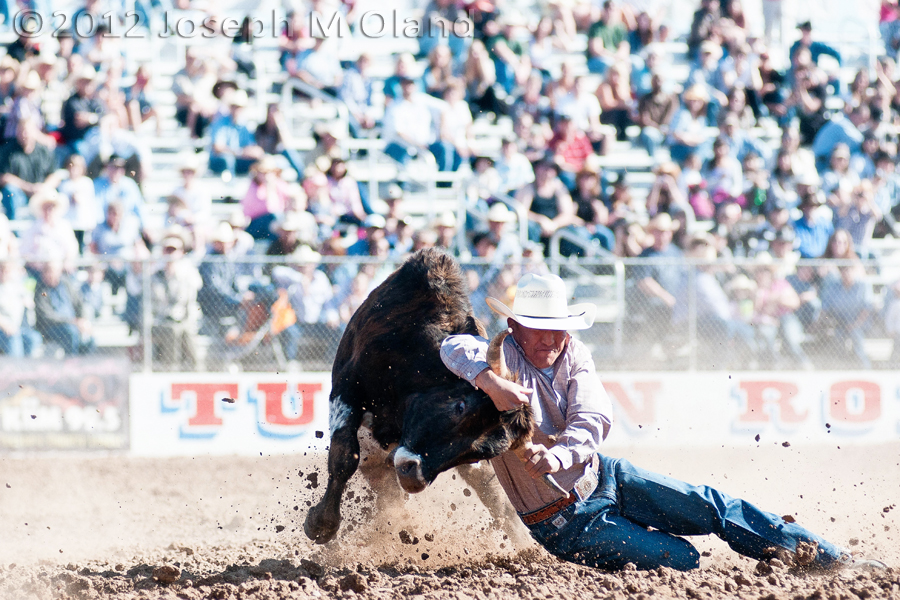
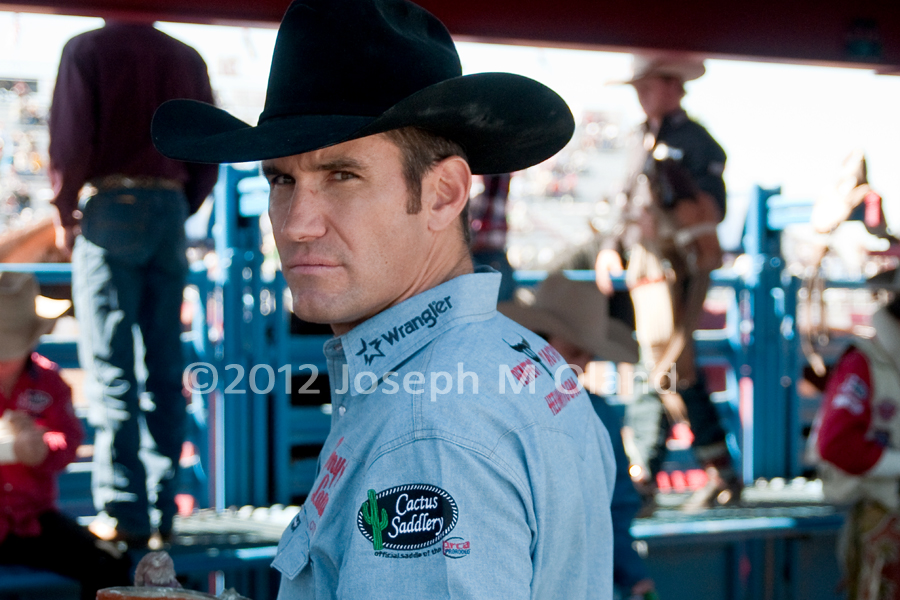
The competitors at these Pro Rodeo events are, in a manner of speaking, the genuine article. These cowboys put their bodies through hell, and have real, quantifiable skill. I’ve seen enough broken-toothed grins and scarred bodies to respect the risk these guys take, and I’m interested in that intense combination of bravery and madness that motivates a 160 pound man to mount an angry beast ten times his weight.

The cold weather’s gonna suck, there’s no doubt about it. But in my experience, the press box and photo pit empty out when the weather doesn’t cooperate. A little bit of discomfort is worth getting the shot that nobody else is around to capture. Wish me luck.

The Draw

Whitewater Sunset

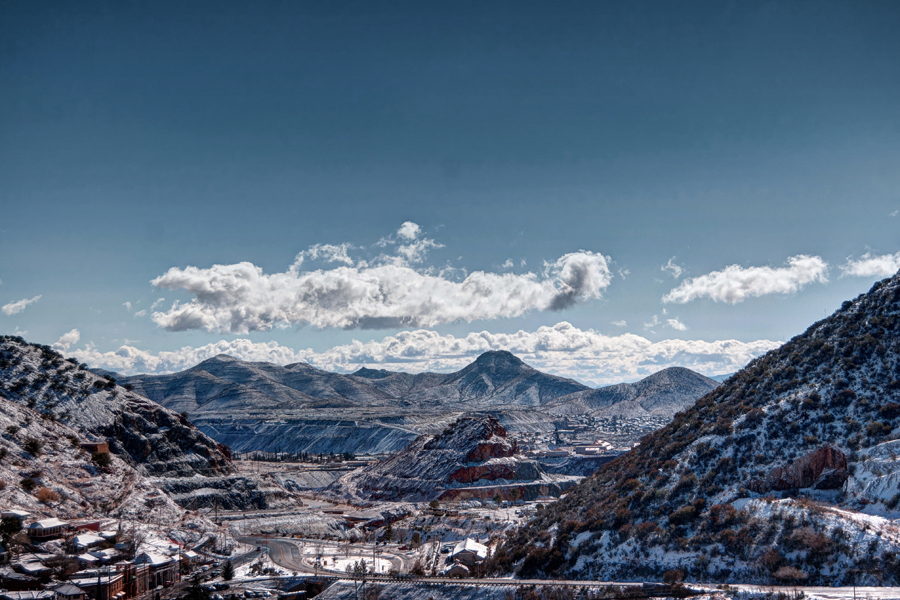
I’ve lived in the Southwest for over ten years, spending most of that time in urban areas. My goals were more aligned with pounding-out an education, whatever that means, and trying to scrape together some semblance of a living. Only after moving to Bisbee did I begin to wrap my mind around how unusual the territory is. Copper extraction in this little mining town has ceased. The hills are dotted with old miner shacks – some renovated and some decrepit – perched over tombstone canyon. Without the mining & precious metals industry – and the stock exchange that once directed commerce in this region – the town’s known more today for its sordid history of miners, gamblers, prostitutes and, of course, absurd tales of their lingering spirits. I prefer Bisbee’s ‘other’ attraction: artists, eccentrics, and junk-peddlers. At the end of the day, this is a place to drink, to sift through antique curios, and maybe grab a bite to eat at any of the decent restaurants we’ve got.

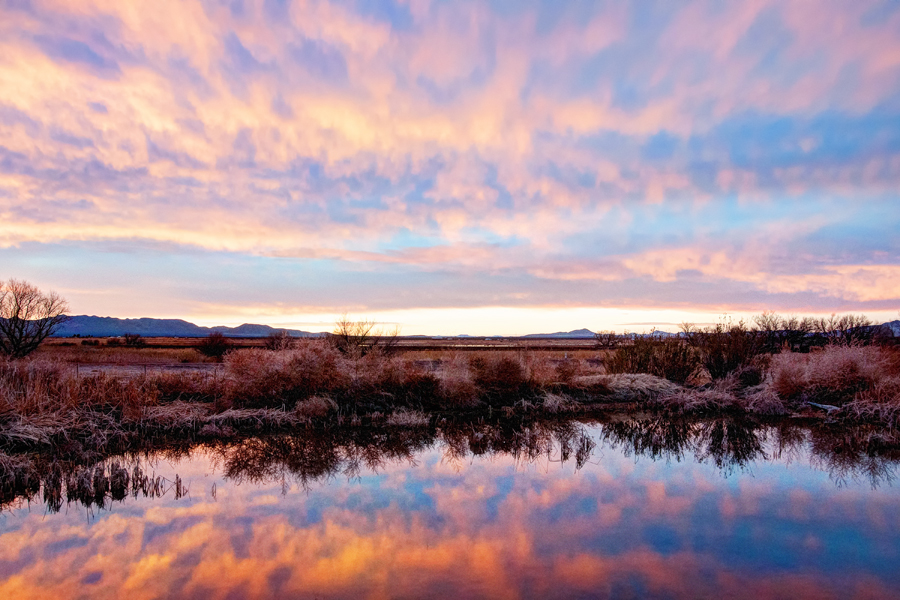
What I never would have known about, not living here, are the peculiar micro-climates. This is Arizona, we’re saddled-up along the Mexico border. This is the damned desert. But then, the San Pedro river rises and falls with the season. Fields of ocotillo and chaparral stretch out through the valley that demarcates the border – just as clearly as that hideous, rust-laden fence. Another location, a bit out of the way, is Whitewater Draw. If you can believe it, the desert of Southern Arizona boasts a wetlands, a major roost site for the Sandhill Crane.

Bird freaks, photographers, and outdoors-enthusiasts swarm this wildlife preserve during the winter season to watch the cranes descend into the wetlands; the birds spend their evening in the shallow waters evading natural predators, and then fly out in the morning to feed and socialize. It’s a sight to see, if you’re into that kind of thing. As the sun sets, flights scatter over the horizon. You can usually hear the beasts before you would ever see ’em. I didn’t have a tremendous amount of luck with my camera when I went out there a few weeks back, but you work with the hand you’re dealt. The area is tranquil and worthy of anybody’s camera.

– – –

As a result of changing habitat and hunting, it’s estimated that the Sandhill Crane population hovered, maybe, around one-thousand in the 1940’s. With conservation efforts – and an unexplained genius on behalf of the birds to select insanely secure breeding habitats – the population has increased. At this point, it would appear that the greatest threat to the crane is inter-species competition with snow geese over food resources.

The cranes are social, generally encountered in family groups. During the migration & winter seasons, non-filial cranes band together, forming “survival groups” that forage and roost together. These are the kinds of groups that one can expect to encounter at Whitewater Draw during the winter here in Southern Arizona. This year’s migratory group is estimated over twenty-thousand.

Changing Times

View of Bisbee


It’s easy to feel like one’s thoughts are unoriginal, that publishing one’s words is self-indulgent, that blogs like this are unnecessary.

I struggle with these thoughts whenever I sit down and commit thought to paper, clack on the keyboard, publish them on the inter-webs. There’s an odd compulsion, however, to share these thoughts & images, too; after all, as an image-maker and artist, this is my job. I’ve been astonished, these past few weeks, how a common thread clearly emerged; I and many of my cohort have, independent of one another, shared a number of experiences: upheaval in personal relationships, changes in profession, sleeplessness, and stress have all been common themes as we’ve moved beyond the holiday season.

It’s as though the ground has been shifting right beneath our feet.

My reluctance to sit down and write – anything – is obvious. It’s been nearly a year since I’ve sat down and contributed to this web-log. In the days to come, I’m hoping to get caught up on a lot of work. I have a lot of images sitting on various hard-drives, hiding in a stack of memory cards, and dag-nabbit it’s time I sit down and sift through ’em. I’m living alone now; the burden of keeping an ailing relationship alive has been lifted. It’s time to get back to work, so keep your eyes peeled for more photographs, illustrations, and stories.

Cheers!

Tucson Rodeo Sixth Performance Finals

Bobby Mote won the buckle for the rodeo overall, winning money in two events, bareback and team roping.

Today wrapped the 2010 Tucson Rodeo.It was a sell-out crowd with eleven thousand fans out in the stands. This years numbers are proof that the tradition of rodeo is anything but dead.

All things considered it was a hot day in southern Arizona. Empty water bottles littered the gathering area behind the bucking chutes while the cowboys dusted their hands with baby powder and stretched their legs. Folks in the grandstand fanned themselves with event programs, occasionally seeking refuge beneath the west end stands to take in the shade and shop at the four dozen vendors tents. The relentless sun didn’t seem to matter, though. Enough excitement in the arena, a few pretty ladies in the barrel races, and a tall measure of cheep cold beer always promises to keep spirits high.

Today’s final round brought the top competitors from the week into the arena for a single performance. The aggregate scores for all the timed events were close – usually within a few tenths of a second apart.

– – –

In the eight full days of rodeo this year, there were 635 competitors and $430,000.00 in prize money awarded. The overall winner at this years’ rodeo was Bobby Mote who, while not qualifying in today’s bareback ride, took home money in two separate events: team roping and bareback.

– – –

More of the rundown when I do the numbers.