January 06 – Forgotten Spaces

01-06 Forgotten Spaces post

“We look at the world and see what we have learned to believe is there. We have been conditioned to expect. As photographers, we must learn to relax our beliefs.”

~Aaron Siskind

– – –

Several years ago – I can’t quite recall how many – I stumbled across a friend’s Facebook album. It was a series of photographs, documenting every payphone along one road in Phoenix. I can’t recall which street it was. I think maybe it was Van Buren. I can’t even remember whose album it was, but I think it was this one gentleman who graduated ahead of me from art school named Aaron. Anyways, when I was looking at those photographs, I remember thinking it seemed like a silly project. But then, not to long after, it began to intrigue me a bit. In an era where so many households don’t even have landlines, in a world where flickering screens are constantly competing for our attention, I had scarcely thought about the eventual extinction of the pay phone.

When I was in high school, there was a payphone outside of the coffee shop I frequented. Frequented? Hell, I should have been paying rent. I practically lived there. The payphone outside could receive incoming calls, I remember. And those of us who spent all of our free time at The Grape Coffee House knew the number by heart. We didn’t have cell phones or tablets, and only a small handful of ‘rich kids’ even had a computer. We just had cheap cigarettes and used bookstore paperbacks. And endless conversation.

Most of the coffee shops I spent time in during college were different. Everybody had laptops and earbuds. I suppose this is the part of the narrative where I start to sound like somebody’s cantankerous grandfather, griping about how kids these days wouldn’t know good music if it bit ’em in the ass, or some such thing. It’s not so much that I’m bothered by the direction of things; it’s that I tremendously value the sense of community that I recall experiencing back in those days. Since then I, too, have watched Netflix on my laptop, at a coffee shop, for no other reason than I damn-well felt like it. But that won’t erase those good old times, when we didn’t have modern conveniences to distract us from one another.

Walking around the city, examining the loading docks behind grocery stores and the alleyways we never dare to go, something of the old world is still there. And, to my surprise, there are still payphones out there. There aren’t very many, but if you have a few coins in your pocket, you can still communicate with somebody.

And you don’t even have to think about your data plan, minutes, or cell phone bill. But you might have to remember how to use a phone book, lest you can remember a single important phone number all on your own.

Now ain’t that somethin’?

PRINTS AVAILABLE HERE


January 05 – Magical Places

01-05 Magical Places post

“One may say the eternal mystery of the world is its comprehensibility.”

~Albert Einstein

– – –

There are magical people in this world. There are magical moments. At least, that’s the best way I would be able to describe it. Experiences that are striking and unexpected, that stop everything from moving, that capture our attention, ignite our imagination, leave a mark. There are places, too, that have this effect. You can visit them whenever you want, and the feeling they provide almost always seems to be there. Places where you feel centered and calm. Unafraid.

The old mission church outside of Tucson, San Xavier del Bac, is one such place. Every time I ascend the hillside overlooking the church, it feels like everything in the world has stopped. It feels like there is no pain or frustration, no madness, no confusion. I suppose religious places have this effect on a lot of people, but San Xavier is the only one I’ve visited that really made me feel at peace. Not the Basilique Saint-Sernin de Toulouse, not Notre Dame, and certainly not the Holy Trinity Catholic church I attended when I was a child.

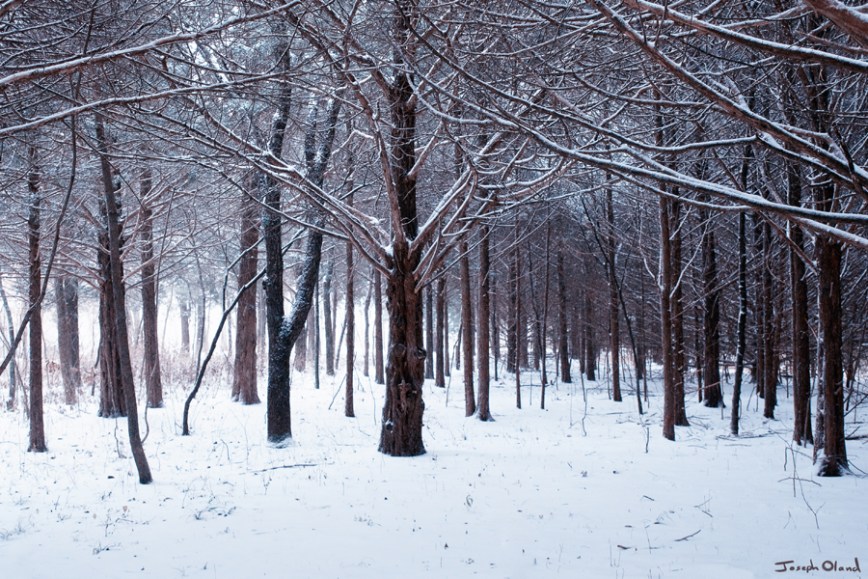
Walking through the woods, I was overcome suddenly. I took my eyes off the ground. I stopped and caught my breath, pouring out of me in thick clouds. The sound of shifting dry snow, that unusual crackling that sounds like it could almost be a campfire, except there’s no light or warmth. I looked around and it seemed as though the woods extended forever. I felt like I was in a Tolkien novel, or ‘The Lion, The Witch, and the Wardrobe.’ This plot of earth begged to possess some kind of mystical name, like The Icefields of Tregaron, or The Blue Hallows of Kill Creek. Kansas is, after all, the Land of Oz, so I suppose I should be satisfied enough by that.

I may have only been there a moment, but it drew out; it felt like I was there for a long and enjoyable time. I didn’t feel cold.

And then I kept moving forward.

PRINTS AVAILABLE HERE


January 04 – An Abstract

01-04 An Abstract post

“There is no abstract art. You must always start with something. Afterward you can remove all traces of reality.”

~Pablo Picasso

– – –

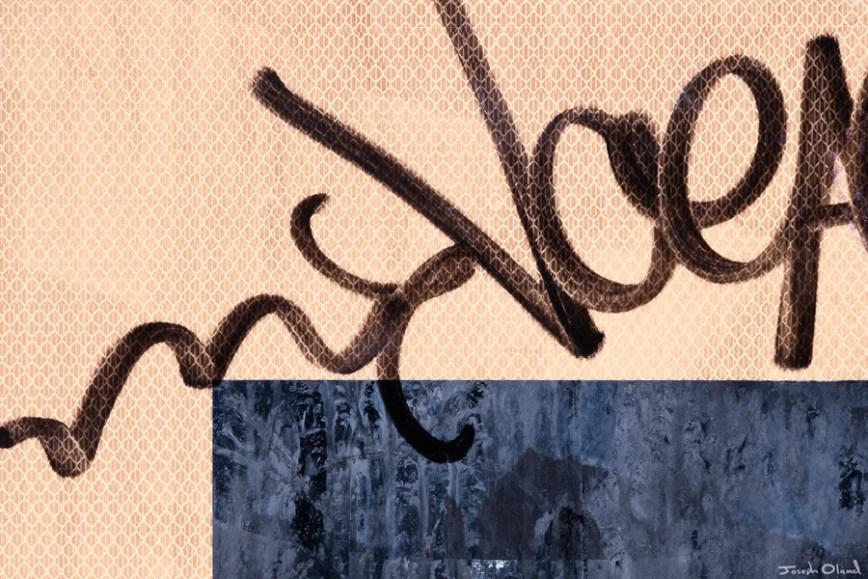
For the longest time, I’ve tried to explain to folks why I enjoy abstract photography. I’ve never been really satisfied with my explanation. I’m okay with that. The best that I can say about it is that, to one degree or another, photography wasn’t really invented with the idea of ever being used that way. The camera was invented to create accurate representations of real world objects, people, and scenes. When you make abstract work out of it, you’re kind of thumbing your nose at the tide of history, but in a playful way.

I like making pictures like this because it gives me a chance to step back from how I normally look at the world. I’ve spent more hours than I can count, just walking the streets, investigating all of the textures that you can’t appreciate when you’re filling your tank, driving to work, have other things that you’re in the middle of trying to accomplish. When I go on these ‘urban hiking’ excursions, I usually just go at an easy pace, pop my headphones in, and start looking around.

It feels like I’m a kid again, plucking up rocks and seeing that whole world of little critters hiding underneath.

PRINTS AVAILABLE HERE

January 03 – The Great Prairie

01-03 Winter Tree

The days are getting longer, but they’re still dark. These past several years, it’s been right around this time that it really starts to settle into my bones. It happens all of the sudden, and even though the holidays have come and gone, you realize that the coldest days are still ahead.

I’ve been feeling isolated. And that would be a pretty huge understatement, if I’m to tell the truth. Loneliness can be a crushing beast. In most situations, I enjoy solitude. Time to think, to read, listen to music, write, and create. But then, solitude and loneliness are different animals, aren’t they? I like to think that I do a decent job starving my sadness, filling the minutes of my day with activity. I’m sure I’ve driven my nearest and dearest a little mad at times with my unusual requirements; I need space, and I need solitude. But this winter season finds me feeling a little differently about my solitude. I find myself more anxious, and fantasizing about warm weather, about returning to Arizona where I know I belong.

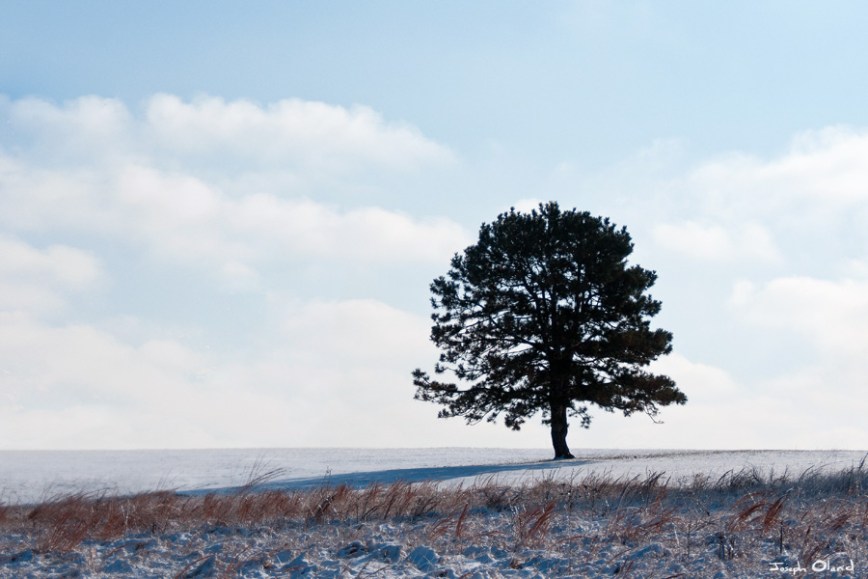
I suppose this image accurately reflects how I’m feeling, at least from my point of view. A lonely tree in the blue winter light. It looks like it’s out in the country, but this photograph was made about five miles away from my parents’ house. This little patch of land is surrounded on all sides by subdivisions and strip malls. In that way, I suppose the image reflects how I’m feeling on a whole other level, now, doesn’t it?

Nevertheless, the point of these words isn’t pity. There is beauty in everything we experience. When we’re tested, we have an opportunity to learn a great deal about ourselves. Sometimes we learn a great deal about others, too. Good things grow out of struggle, and even on a lonely winter day, I can sip my coffee, go for a walk, and find a little patch of nature in the concrete that speaks to me. And that ain’t half bad.

PRINTS AVAILABLE HERE

January 02 – Leaf

01-02 Treeleaf blog

“Nature will bear the closest inspection. She invites us to lay our eye level with her smallest leaf, and take an insect view of its plain.”

~Henry David Thoreau

– – –

After several troubled months, I found myself walking down the main street of a small town in Illinois, a short distance from the Mississippi River and the Gateway To The West. Edwardsville is a quiet place, iconic, like the “everytown” you see in movies depicting life in the 1950s, where the homes are perpetually decorated for the Forth of July. Green grass and cobblestones, it’s one of the oldest towns in the Illinois territory, and it’s just small enough that the streets aren’t overrun with strip malls; the roadways are festooned with vintage neon signs, there’s an old single-screen theater, local brewpubs, and weathered bricks wrapped around quaint coffee shops and pizzerias.

I walked in and around the town with my headphones on, piping-in a soundtrack to my walkabout. Through the residential streets and small parks, up into downtown, I felt – for the first time in months – safe and secure, shielded from the chaos that so often dominates our lives. Sure, the fantasy ended and the business of life had to keep plunging forward, but for a few hours I was able to let my thoughts wander. I watched schoolchildren playing outside, contractors mixing cement outside of an historic storefront, delivery trucks pouring into the alley behind the pizzeria to unload fresh tomatoes and cheese. Walking around the courthouse, snapping shots of bees rolling around in the pollen in the rose garden, watching birds drinking from the fountain in the plaza, I found myself smiling; it had been a long time.

Cleaning things out today, sifting through holiday sweaters and stacking greeting cards for safe keeping, I picked up a book I had been reading while I was in Illinois, visiting my sister. I thumbed through it and found this leaf; I had completely forgotten about it. While walking around, camera in hand and headphones in, I knelt down and picked it up, admiring it’s colors, noticing that the whole sidewalk was littered with bright color. I unzipped my backpack and pressed it between a couple of pages of my book, and then I got back to walking down the row. I don’t know why I did that. I don’t know what I would be saving it for.

But I found it today, and I was reminded of my walk, of that first moment of genuine peace after several months of conflict. I suppose I saved it so that I could find it again, and now I’m sharing it with you.

Prints Available Here

January 01 – Winter Woodpecker

Woodpecker wordpress

I spent the day in Eudora, Kansas – a small farmhouse with snow slowly melting back into the earth. The skies were clear today. It was sunny. I worked with a friend, tearing old aluminum siding and cedar slats off the house. Splintered wood and tattered insulation, the clanking of pry-bars and stretching wood – we made a mess, and it was enjoyable. The dripping sound of melting snow surrounded the property, accented occasionally by a lonely wing-broke rooster, unable to hop the fence of the coop to follow the hens into the leaf piles on the edge of the treeline.

As the light began to fail, I asked my friend if he could escort me down through the field, up to the western edge of the property where his tree stand is set up. I brought my camera to work today, hoping I might be able to spend dusk looking for deer. The temperature dropped quickly. Sitting silent and still, the cold grips you in a way that it really just can’t when you’re hauling lumber, swinging a hammer, running up and down a ladder.

No deer tonight, however. The low scream of State Route 10 in the distance, the red sky turned blue, darkened, and the leafless trees blended into the growing darkness. I stumbled back through the dark, through muddy grass. I followed the light of the faintly-illuminated windows of the farmhouse, and I said goodnight to the family. I was a little bummed; the lingering tracks in the snow made it seem like a sure thing that I’d see some deer. Maybe next time. I’m thinking about driving out there tomorrow night, just to give it another go.

The upside was a cluster of pretty fearless woodpeckers in the tree beside mine. I watched them, for maybe an hour – maybe an hour and a half – in the quiet, circling the tree and pecking at it, climbing to the top in a corkscrew trajectory. Once they reached the top, they’d fly back down to the bottom and ascend the tree again, combing it over meticulously. They’re funny little creatures, and quite the trick to photograph; they’re always moving. I enjoyed sitting still, watching the tireless movement of these little creatures.

Not a bad way to begin the new year, I might reckon. Happy New Year. Let’s see if sixteen really is sweet, shall we?

Prints Available Here

Fight Club And Modern Masculinity

Banner-post

For additional artwork and prints, visit my storefront: here

– – –

“Fight Club” is one of those nostalgic movies that has a special place in my heart. It wasn’t even until recently, after dusting it off and giving it a watch, that I hopped online and learned that it was heavily panned by critics and performed poorly at the box office. Even the late great Roger Ebert had some pretty sour words. Maybe it’s a ‘generation’ thing. Upon my first viewing of “Fight Club,” I knew I would never stop loving it. It is has issues – some pretty big ones, in fact. There’s a hugely problematic third act, and there does appear to be a ‘style over substance’ quality to the whole endeavor that’s pretty hard to ignore. I still think it’s pretty damn fantastic.

When “Fight Club” was released back in 1999, Roger Ebert was quick to disregard it as “macho porn.” There’s truth to this, in a sense, but I think the movie was both self-aware and intentional. Fifteen years later, considering a post-911 audience, some topics have shifted. Critics now focus on themes of sedition & terrorism, and tend to highlight the film’s wonton (and somewhat gleeful) destruction of city skyscrapers. This, I suppose, might not be as humorous to contemporary moviegoers.

The thing to keep in mind is that the film doesn’t advocate for the violence and destruction it presents. “Fight Club” is a meditation on the male animal, disenfranchisement, and the appealing but dangerous nature of herd mentality. I think it’s a careful tableaux of an imbalanced, post-modern, consumer-based society that pits “individual” and “communal” values against one another, with tragic results.

– – –

Roger Ebert opened his essay:

“Fight Club is the most frankly and cheerfully fascist big-star movie since “Death Wish,” a celebration of violence in which the heroes write themselves a license to drink, smoke, screw, and beat one another up.”

The only thing he’s correct about is the ‘fascist’ remark, but that’s kind of where I think the brilliance of the film lies. It’s anti-hero is quite literally a fascist, a charismatic sociopath who leads the members of Fight Club into a barracks and enlists them into his cult – complete with initiation rituals, hazing, forced labor, the relinquishing of individual names, and reeducation seminars. By the end of the film, these men are barely able to communicate, lest they regurgitate the nihilistic pieces of wisdom fed to them by their messiah. What I find even more fascinating is the audience who, wool over eyes, happily watch the members of Fight Club descend into destructive madness. Rather than explain precisely what was on the surface – unbridled testosterone, homo-eroticism, locker-room brawls, drinking, and sex – Roger Ebert would have done well to consider, for even an instant, what it must have been that led these men into their cult, into lives of anarchic criminality. The most fascinating thing about David Fincher’s “Fight Club” is it’s depiction of modern masculinity and the film’s ability to ask the audience a simple question: what kind of insanity can alienation & self-hatred lead to when all the dominoes are set up just right?

We all know the plot, so you’ll forgive me if I jump around a bit. It isn’t the plot that entirely interests me. The resolution plays second fiddle to the set up, and the set up is so good we can forgive the film it’s lack of focus in the final act.

The depressed, white-collar outsider of “Fight Club” is simply called “The Narrator,” and it’s effective to keep him nameless, relegating him to “everyman” status. His life presents all the hallmarks of modern American success – job stability, a well-adorned condominium, nice clothes, and a college education. The reality of his life is far different. He is lonely, wracked with insomnia and anxiety, severely discontent with his cubicle job. Not only is he dejected, but he sets the tone for every other character in the film. Foreground and background characters universally struggle with feelings of inadequacy and defeat.

Yes, indeed, “Fight Club” is macho porn, and it has gotten me off for fifteen years. But, more accurately, “Fight Club” is exquisite satire of macho porn. These aren’t the greased-up volleyball players in “Top Gun.” These are saddened and angry men who discover some sort of sick pleasure in self-destruction. It’s not a notoriously unbelievable premise. It’s not the relentless celebration of hyper-masculinity that so many critics have insisted it is. To my mind, it’s an exploration of an abstract, simplified archetype of ‘man’ and his movements in a world that has locked him in, shut him up, pumped him full of needless responsibility, rendered him fearful & subservient, and has preyed on his unrequited desire for meaning in life.

The symbolism isn’t subtle. The Narrator, quite early on, begins attending support groups – cancer, brain dementia, alcoholism, et al – as a means of putting his misery in perspective. The first group he visits is a cancer survivor group: “Remaining Men Together.” In a film about modern man’s struggle with his own masculinity, it makes sense to surround the main character with post-surgical victims of testicular cancer – men who have literally been castrated.

It becomes clear, about halfway through the film, that “Fight Club” seeks to obliterate masculine stereotypes, strangely, by employing them. The film also inverts stereotypes, allowing male protagonist to emote in ways typically reserved for female characters. For instance, The Narrator finds catharsis in these support groups; he cannot sleep without experiencing an emotional release (in this case, by being in an environment that allows him to cry). The men in “Fight Club” clobber each other in one moment, only to cry and embrace one another the next.

But in a locker-room brawl, we also remember that boys bloody-well don’t cry; an emotional man is a lesser man, probably a gay (or at least feminine) man. “Fight Club” does something interesting with this: it dismisses these negative stereotype of the emotional male. Release, be it in the form of punching somebody in the face or crying buckets of tears, proves to be empowering.

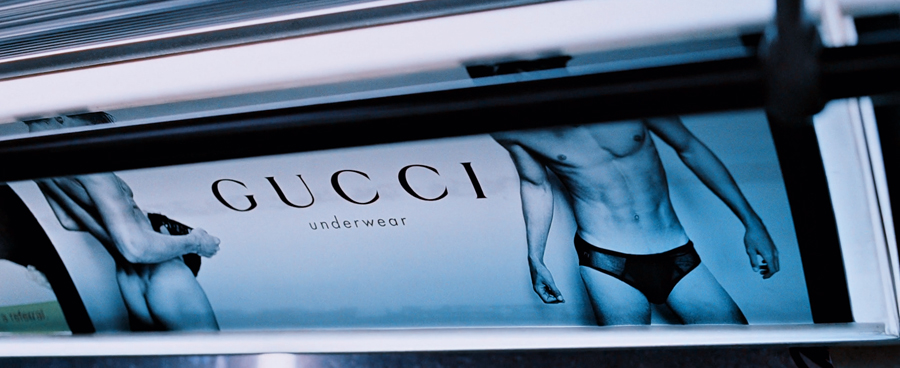
In one scene, The Narrator points to a billboard underwear ad. Taking it in – a sculpturesque man, tanned and hairless, sporting a substantial bulge and six-pack stomach – The Narrator scoffs:  “is that what a man looks like?” Anti-commercialism takes a front seat. A declaration is made about advertising and it’s negative impact on the male psyche. “I felt sorry for guys packed into gyms,” he narrates, “trying to look like how Calvin Klein or Tommy Hilfiger said they should.”

Not surprisingly, the men of “Fight Club” rally behind a renegade figure, Tyler Durden, whose condemnation of materialism and commercialism is beautifully expressed. The irony, of course, is that Tyler Durden (played by Brad Pitt) embodies the wash-board ab movie-god with clear skin and perfect teeth. We watch members of Fight Club tacitly elect a figure that, more than anything else, resembles the ideals they purport to reject. I understand, once the final reveal is made in the third act, that Tyler is a manifestation of what The Narrator views as the ideal man – good-looking, confident, and capable – but the audience doesn’t know this. The audience can’t know this in order for the story to hold any interest. It’s accidental meta-humor, our first hint that something isn’t right about Tyler’s philosophy, no matter how much we’re fooled into liking him. Remember, it’s this anarchic pseudo-messiah who convinces them to tear it all down – bathwater, baby, and all.

Along with the evolution of Tyler’s cult following, the story opines about an archetypal “primitive” man. The narrative hints not just at the reptilian brain (and the violence that comes from it), but at the notion of man as hunter-gatherer. The men fetishize Tyler, and they fantasize about a bygone era in which strength – especially strength in numbers – was essential for survival. Rejecting the conveniences of modern society, they glorify tribalism. In the dimly-lit urban backdrop of the film, we’re reminded that muscles no longer assist man the way they assisted his primitive counterpart. They’re more useful on billboards than anything else.

Underwear

So sure, Mr. Ebert took issue with the drinking, smoking, screwing, and violence. But what leads to that kind of reckless behavior – and how reckless is it, really? And why weren’t these questions asked? Discontent, in any of its forms – depression, a failing relationship or broken childhood, substance abuse, illness, et al – almost always leads to the kind of aggression, violence, and other base behaviors presented in “Fight Club.”

And beyond such base behaviors, the unhappy men in “Fight Club” are – by virtue of their discontent – susceptible to the influence of their charismatic leader. With well-constructed speeches about the evils of advertising, the fruitless pursuit of material wealth, and the helplessness of “playing along,” Tyler promises liberation – through sacrifice, obedience, and conformity. Deeply fed-up with the workaday world, these ’emasculated’ followers line up without question. The Tyler Durden character is so well-written, so wonderfully executed, that it’s easy to be taken in, even from the comfort of our living-rooms; he speaks to an oppression that we all feel.

Tyler’s more laughable pranks – urinating in soup pots and vandalizing coffee shops – give way to more severe “assignments,” which he hands out in sealed envelopes. His actions become increasingly destructive and, even though his motives seem somewhat plausible (and while many of us may be along for the ride), we ultimately know that nothing good can come from this kind of top-down leadership, and from such extreme and unquestioning obedience from his wards. Tyler manipulates his followers – using their own sadness and frustration against them – in order to achieve his goals.

“Fight Club” is a film with no heroes and only one villain (if we even want to call him that). This is precisely why things fall apart in the third act: there’s no way to effectively resolve the conflict between The Narrator and Tyler Durden. I can forgive this because the film isn’t really a ‘good versus evil’ morality play. Nobody wins in the stalemate anti-climax of the film. Nobody. Instead, we watch lost boys stumbling through life, struggling to make sense of the world – and we sympathize with them on some level. Much like in real life, nobody really wins – not even the audience. This may not have been the intended result, but it works…for the most part.

– – –

And any of you who have endured my insufferable ramblings, don’t think for a second that I’ve forgotten about Marla Singer. I’ll have more on her later.

Photography – When Two Iceburgs Collide

Iceberg Post

“In a world of pretentious and complacent amateur snapping, we are drowning those moments of truth in an ocean of the banal.”

– – –

The echo-chamber of social media. It’s quite a thing.

I recently read an article by Jonathan Jones of The Guardian, linked here, presenting yet another analysis of our “Instagram Culture.” This particular article is in response to a dispute between two amateur photographers who – by simple virtue of being in the same place at the same time – took nearly identical photographs. Conflict only arose, of course, when one of the photographers won an award in a photography competition and managed to get her image published. When the other photographer saw this, accusations of plagiarism quickly followed.

If I believed my work had been appropriated, I would have taken issue, too.
But- yawn – that’s a bit beside the point.

In the realm of social media, accusations of this nature can lead to a landslide of criticism, denigration, and even threats. This can be accomplished without communication between aggrieved parties, without scrutiny, and without legal process of any kind. In this particular case, both photographs proved to be ever-so-slightly different, indicating two different images; we now know that both images were authored by two individuals.

The point, I believe, is that photography is an easily misunderstood practice. This is ironic considering photography’s prevalence, but I contend that it’s a practice so uniquely situated between the realms of ‘art’ and ‘science’ that we often can’t tell the difference.

Nobody could mistake a beautifully-crafted drawing of Notre Dame from a grocery list. Even if both were crafted with a No.2 graphite pencil, the aesthetic difference between the two ought to speak loudly enough. What the camera accomplishes is an unprecedented blurring of the aesthetic division between professional and amateur. Nevertheless, a distinction can still be made – in almost any circumstance – between the artful use of the camera and the pedestrian reproduction of whatever subject happens to fall in its path. This distinction is simply more nuanced.

The above-mentioned incident straddles the line. It’s always possible to “machine gun” the camera, as Robert Capa often remarked, to achieve an “eventual grand image.” I still find it necessary to bring up the ‘room of monkeys with a typewriter’ metaphor. Shakespeare may very-well emerge from such an experiment. The ubiquity of cameras, compounded by the easy-share functionality of social media, has served to buttress this idea.

The camera – and the images it produces – conform to two fundamental principles: ‘expression’ and ‘documentation’ (not necessarily one above the other). What the camera can occasionally accomplish, unlike the No.2 pencil, is an accidental merging of these principles. Such ‘accidental masterpieces’ are why the practice of photography continues to find itself under fire, stripped of legitimacy as an expressive art form. If one can ‘accidentally’ capture something beautiful and moving (as works of art actually intend to achieve), how can it genuinely be considered art?

Good question.
– – –
These ideas of ‘documentation’ and ‘expression’ will always be at odds when it comes to photo-mechanical reproduction. Take, as an example, the Mona Lisa. If a photographer makes, with his camera, a photograph of the Mona Lisa, would we ascribe great brilliance of artistic expression to this photographer?

Likely not.
And rightly so.

Many of you – statistically speaking, most of you – have never actually seen the Mona Lisa with your own eyes.

Think about that for a second.
Rather, most of you have seen photo-mechanical reproductions of the painting in books and film. In these instances, a photographer was employed. That photographer used his skill to reproduce an image made by a Renaissance artist. Despite this intervention of the camera operator, we all still recognize that the expertise of Leonardo da Vinci is of greatest import.

Does this example rob photography of its artistic efficacy? Of course not.
– – –
As a photographer, I didn’t find Mr. Jones’s article entirely insulting, but I couldn’t accept it out-of-hand. His article appears to tacitly align with the general argument that photography, by its very nature, cannot be art. He illustrates this point thusly:

“If Cézanne and Monet both stood and painted that iceberg, the results would be totally individual. Even if two amateur water-colourists painted it, their work would contrast – just as the work of every pupil in a school class would be different if they were on that cruise sketching that iceberg. Photography can easily degenerate into a pseudo-art, with millions of people all taking pictures of the same things and all thinking we are special.”

Bollacks!

If two ‘art’ or ‘professional’ photographers were hired to photograph an identical subject – be it a political figure, a beautiful flower, or somebody’s pet cat – I imagine that a similar difference would present itself. Both professional photographers, likely, would have different equipment, divergent ideas, and unique sensibilities, and would make different choices with their subject. Taken just a small step further, I imagine the comparison between the pictures of a professional against the pictures of a pedestrian photographer (with a smart phone) would yield an instantly and easily-identifiable difference.

In fact, it already has. More times than any of us could count.

Or did she actually break the internet?

Heavy pencil or light pencil, stippling or cross-hatch, muted colors or bright primes. With photography, we have just as many choices as illustrators, graphic designers, and painters. Day, night, or artificial lighting, narrow or wide depth-of-focus, color temperature, black and white. Film and digital, high-grain, high-noise, resolution, not to mention cropping, framing, and composition. As with any visual medium, the photographer has a unique language, and many choices to influence the mood, the tone, the emotional impact of his or her work.

– – –

Jones correctly asserts that “photography matters when it finds original subject matter.” This, I believe, is true in almost any case (and with any art form). What he neglects to comment on is the requisite expertise of the creator. It’s as though the subject and the creator exist independent of one another, in his analysis. But while two beautiful images can be made – by two different amateur photographers – I would remind readers that nobody is actually heralding either image, from either photographer, as a great masterpiece.  His condemnation of ‘originality’ can be applied to any visual art practice; it need not be relegated to the realm of photography.

That is his mistake. It’s a significant one.

– – –

An original painting of The Grand Canyon – or the Eiffel Tower, or The Statue of Liberty, or The Dome of the Rock – can be pleasing to the eye. The effort and skill of the artist can be seen in each individual brush stroke. But these types of image are always in danger of landing themselves in the territory of ‘kitche’ because they present nothing new or moving to the viewer. What Jones fails to recognize is that ‘original subject matter’ is more of a dividing-line between ‘art’ and ‘non-art’ than the difference between a painting and a photograph.

There’s nothing wrong with art that doesn’t challenge it’s viewer. The Grand Canyon is damned beautiful; people that paint and photograph that spectacle effectively are, in my book, no more or less brilliant than any other image-maker. They just employ their skills and passions in a certain way.

Each art form has its place. Images, made by skilled visual artists, conform to the basic idea of what we all believe art to be. There are things that people make – some profound, some religious, some common, some with skill and some with less skill, some that are themed and some that are unmistakably abstract – and they all exist under the broad aegis of ‘art.’

When articles blossom out of thin air about the happenstance and “accidental” nature of artistic photography, I cannot help but comment. There exists predictable and banal art, in every conceivable medium, and there exists great brilliance and uniqueness…in every conceivably medium. Why Jones feels compelled to direct his criticism toward photography, I’m not sure.

I don’t want to believe that it’s the actual method of picture-making that Jones is attacking, but he sure makes it seem like it. And for that reason, I feel the need to tell him that he is wrong.

– – –
Until next time.

-joe

Freedom Of Expression – Je Suis Charlie

Je Suis Charlie

“If you don’t stand up for the stuff you don’t like, when they come for the stuff that you do like you will have already lost.”
~Neil Gaiman

– – –

Extreme behaviors often inspire extreme reaction. When three masked gunmen opened fire at the Paris office of Charlie Hebdo on Wednesday, an immediate and predictable brickwork of free-speech chest-pounding unraveled, even as security forces were being dispatched and the suspects remained at large. Cartoonists took to their drafting tables and journalists mobilized, both to report the story and to express their own horror at what had occurred. Social media was flooded with proclamations of the importance of the freedom of expression.

Something I hadn’t predicted occurred shortly after the news broke, as well. Another contingent of Facebookers and bloggers surfaced, apparently mystified by the strong social response to this event. The number of victims seemed small to them and, to others, the plight of foreign journalists seemed irrelevant. Uglier sentiments about the evils of Islam and the worthlessness of French lives also made their way onto the social network and even into certain sectors of the news. There were also those decidedly callous remarks, blaming the provocateurs at Charlie Hebdo for their own fate.

Words should not be met with gunfire, nor should any reasonable individual tacitly accept such an action. The attack on Charlie Hebdo was not just an assault on those who were killed and wounded, but an assault on speech itself; content creators, artists, academics, and journalists across the globe recognized this instantly and responded. In a free society, the law provides that individuals may say and write what they please. The proper approach to materials that offend is not to read them. Critics are endowed with the right to use words of their own to speak out – not violence.

I conceive that it is much more obscene to violently attack an individual for having ideas and making lines on paper than to actually have ideas and make lines on paper.

A Danish newspaper – the very publication, in fact, that inspired riots across Europe ten years ago after publishing a cartoon depicting the prophet Muhammed – expressed today that it would not be re-publishing any inflammatory cartoons in the wake of these attacks. In a sad fit of lassitude, the newspaper itself admitted that violence is an effective tactic to quiet the media.

“It shows that violence works,” newspaper Jyllands-Posten stated about its own decision. “We have lived with the fear of a terrorist attack for nine years, and yes, that is the explanation why we do not reprint the cartoons, whether it be our own or Charlie Hebdo’s. We are also aware that we therefore bow to violence and intimidation.”

It is important to note that this statement is true only within the context of this one publication. Almost every other major newspaper in Denmark has re-published the offending material. The attack on Charlie Hebdo has seen a massive proliferation of new cartoons condemning terrorism, as well as massive re-distribution of the very cartoons from Charlie Hebdo that inspired Wednesday’s attack. In committing their crimes, Hamyd Mourad and brothers Saïd & Chérif Kouachi managed to enhance the dissemination of the very material we can only assume they had hoped to annihilate.

There is little question that freedom of speech is paramount to the preservation of the Republic. We will never see an end to the debate over free speech because the protection of it often involves the defense of seemingly indefensible material. To uphold the rights of an individual to read, to write, or to say what one disagrees with will continue to be a great challenge, and we will continue to rise to it.

Je Suis Charlie

One More Word About My Friend

COVER


Aching legs, kicking the parking lot curb in Deming, New Mexico – if not out of exhaustion & boredom, then to loose the day’s dirt from our cracked boots. Cow shit, mud, wind-burned faces and angry lungs – we carried what might well have been bags of flour on the surface of our jeans and on our feet all afternoon, leaving behind an impressive pile of dust.

We headed out to the fair grounds from our Luna County motor-lodge every day for a solid week back in September 2010, specifically to see what the rodeo was like outside of the professional circuit. And outside of the circuit, out in the badlands – out where people hold the guttering torch of an agrarian lifestyle – things proved to be contrary to any expectation we could’ve had.

Out here, ranchers exchange stories about the season’s rain, and drought is on their minds. A rash of hardship – of broken men and busted operations, sick livestock and parched crops, lost land, failure, sadness, and suicide – permeates their conversation. There’s also the non-sanctioned events of the working-rancher’s rodeo, cowboys (and girls) telling stories to one another and laughing, exchanging advice and promising prayers and support, good luck and good will. The rodeo performance itself is unflinchingly quiet, even anti-climactic to most of the rodeo crowds we know. The livestock here belong to the ranchers themselves, not a stock agency. Nobody is risking harm to self or harm to their animals – they simply can’t afford it – and that kind of risk just isn’t what we see in pro-rodeo.

At PRCA (Professional Rodeo Cowboys Association) events, many competitors certainly do herald from the ranch-lands. No question about that. But there are endorsement deals – Jack Daniels, Coors, Boot Barn, and Stetson, to name only a few. Those are professional athletes competing for professional money, and it’s a spectator sport. Risks are higher, so is the money, and sometimes people get hurt. In the photo pit and up in the crow’s nest are photographers, print journalists, and videographers, all waiting for that perfect ride. And let’s be honest: many of them are waiting for blood, too. The crowd itself is in for excitement, shaking the grandstand with stomping feet.

With working ranchers, events are skill-based with diminished risk, with little chance of personal injury or damage to livestock. It’s a meeting-ground for regional farmers & ranchers interested in land-management, stock-prices, water resources, and futures markets.

It’s a different game entirely.

Unlike pro-rodeo, women are allowed to compete in events other than barrel racing, and some of them can throw a rope with remarkable skill, rivaling the most celebrated male competitors. Ropers and muggers aren’t as daring, and there’s no Jack Daniel’s tent pouring free samples for onlookers.

These aren’t professional athletes. They’re businessmen.

This is a social gathering for ranchers, whose fates are tied together by market price and rain-water, seasonal planning and farm size. These men and women raise livestock and grow produce. They represent an increasingly rare incarnation of the American laborer. The national average of US ranchers and farmers are approaching sixty years of age, with less than two percent of the US population currently dedicated to producing food. It’s no surprise that events like this are becoming increasingly rare. In fact, when I returned to Luna County in 2011, the rodeo event was canceled due to lack of participation. With few competitors, the prize-pot was far too small to justify the expense of attending.

No gold buckles are awarded here. There are no endorsement deals. No radio station promos or truck dealerships. These men and women pay to play, with the possibility of making business contacts and winning some cash. Eliminate half of the incentive, and the rodeo grounds remain woefully empty.

– – –

Gray skyscapes and scattered clouds boiling off into the east and a peach mist of dirt in high winds, dissolving as the sun crawls down. We stomp our boots and smoke our cigarettes, leaning against the car, kicking tires and uncapping a bottle of cheap off-brand whiskey in the motel parking lot. The room is dirty but I’m not paying, so there’s no reason to complain. Moldy carpet and four channels, a shitty water-heater that takes twenty minutes just to warm up, and an infuriatingly faulty ice machine – this couldn’t be mistaken for paradise.

But hell – not half bad.

With a case of Mexican beer and a bottle of local wine from local St. Claire, the ‘take’ of the day arrives in wry comments, inside jokes, and several hundred near-useless photographs, choked-out as thoroughly as we were by the dust.

– – –

This is my best memory of Will Seberger – photojournalist, political junky, decent human being. Unafraid to curse in mixed company, he was superhuman in his ability to inject benign conversation with pointed and incendiary commentary – and usually some laughter – and all without coming off as elitist or disrespectful. He passed away unexpectedly in the wee-hours of August 17th, leaving in his wake a constellation of family, friends, fellow journalists, and a wife.

It was this trip to Deming that stands out to me, as both a photographer and a friend. Recently unemployed and living on a buddy’s couch in Tucson, this trip was a gift to me. Will called me up, lord knows why, and asked me along. I didn’t have anything better to do and I felt honored for the invite. This was an opportunity to escape my depression, to get out of the house, to be challenged as a photographer, and to spend time with my friend. I told him I was ‘in’ without skipping a beat.

I’m saddened by how few photographs I actually took of him in the twelve years I knew him. Most of the images presented here, Will was standing right beside me. At the hotel each night, reviewing our work, he didn’t pull punches when critiquing my work. I always appreciated that. It takes a good friend to look you in the eye and say “that’s shit” while loving you at the same time.

– – –
We spent a lot of time outside on the splintered concrete in front of the room, sifting through photos on Will’s laptop, a glowing screen perched on the hood of his JEEP. We smoked a lot of cigarettes outside our non-smoking room, enjoying the autumn weather. Absent a corkscrew, I remember Will cracking the head off a bottle of wine with his survival-knife. He may have ruined that knife, but we enjoyed drink, dag-nabbit.

“Drink up. It’s only ‘day one,’ and we’re only gettin’ dirtier.”

We filled the bathroom sink with ice each afternoon for beer. Twelve hours under the sun each day, rings of mud on the damp bandannas we wrapped over our mouths, local food and cheap Mexican beer were our only comfort outside of conversation. But we talked a lot. And that was nice.

We never complained. This was fun for us.

As the week wore on, the titled presented itself: Apocalypse Cow. We’d wandered into foreign land and buried ourselves in the job. After heat-stroke, booze, and a gaggle of interesting characters – a drunken beast insisting that he was black ops and handed us a copy of his self-authored bio-pic screenplay, a wild-eyed fifty-something donning kilt and ‘zombie apocalypse’ baseball cap telling stories of chemical baths, government medical experiments, anthrax, and cancer – the title seemed appropriate.

“Apocalypse Cow” became the name of the trip. We decided it’d be the name of the gallery show if we ever had one. Sadly, such a show never materialized. We did gather a lot of pictures, though, and we met a lot of great people. I’m confident some of Will’s images wound up in the portfolio, and I know there are a small handful of images that I’m proud of, too. We took notes, collected phone numbers, made plans to return. I just wish we’d found the time to get back out there.

– – –
Our political climate – of vitriol and anger, polarized constituencies and ineffectual representatives – doesn’t have much place out where Will and I ventured. In a saloon, two photographers from the Midwest found each other and struck up a friendship. Our paths were circuitous, but Will and I possessed a healthy blend of old-world values and new-world education. Neither of us were particularly seduced by partisanship. When we worked together, we’d often arrive at the media tent side-by-side. He’s bang on the door and announce: “the liberal media has arrived!”

Always a joke, and always laughter from the other side of the door.

I can’t recall Will ever scoffing at someone’s vote – even if it was against his own horse. He was a man of moral and social integrity, and always fought for what he thought was right. He understood that there are few Truths, and he burned few bridges. He was deeply principled and unforgivably opinionated, but never without a sense of humor to blunt the angst.

Time spent in the borderlands, Will appreciated that some old-world values still exist. He believed that working people matter. Beyond politics and exit polls, network & cable news, party affiliations, gender, or personal bias, he believed in our collective ability to push forward. He found common ground with each and every person he befriended, each and every person he photographed, each an every person he reported on (for the most part). He believed in the possibility of disparate players, approaching the table.

Will was my friend. And I write with a heavy heart that I can’t imagine life being as valuable without him. May he be at peace, and may he and I meet again, against all odds, in the great beyond.

It was a good ride, Will.

If I live to be twice as old and achieve half as much, I’ll be happy.

Thank you. For everything.

-joe